
Standalone Pump
Compact autonomous pressure or vacuum regulator
Compact
Integrate it easier into your lab setup
Silent operation
Operate without generating any noise
Vibration-free
Eliminate all vibrations
No computer needed
Use the intuitive integrated interface
Need a microfluidic SME partner for your Horizon Europe project?
Advantages
Compact
The standalone pump offers more flexibility when integrated into your lab setup. It takes up less space on your lab bench and is easier to move around as needed. The small size makes it easy to transport to different locations, ideal for researchers working across multiple labs or even in the field.
Quiet
This feature is essential for researchers who need to work in quiet environments or who prefer a noise-free workspace. The pump is suitable for use in labs that require minimal background noise, and the silent operation makes it easier to work within its proximity without the distraction of constant noise.
Vibration-free
Our new design eliminates all vibrations, ensuring that external factors do not affect your experiments. It is essential if you need to work with delicate samples or if you require a stable and controlled environment for microscopy, for example. The pump is designed to be stable and robust, providing a reliable pressure or vacuum source. This autonomous pressure controller improves the accuracy and precision of your results, making it easier to achieve reproducible and reliable data.
Intuitive integrated interface
With or without a computer, you can have total pressure and flow control and automate your microfluidic experiments. Reduce the overall cost of your setup and run your experiments quickly.
Easy to use
With simple controls and a precise pressure and flow rate display, just set up the pump and work on your experiment without a computer. We’re ensuring the pump is accessible regardless of your technical background.
This is the perfect solution if you need an autonomous pressure or vacuum controller for your microfluidic applications. This compact, quiet, vibration-free standalone pump is ideal for standard and simple experiments.
Applications of the standalone pump
This compact and standalone pump can be used for several applications, such as:
- Benchtop tests: It is possible to have a simple setup to showcase your experiments in your lab or industry
- Lab-on-a-chip development: for applications such as point-of-care diagnostics, environmental or food analysis, drug development, forensics, and the analysis of biomolecules.
- Cell perfusion: This instrument is designed for biology and suited for cell culture
- Mechanotransduction studies (cell confinement, tissue engineering, etc..)
- Microfluidic chip and biosensors testing
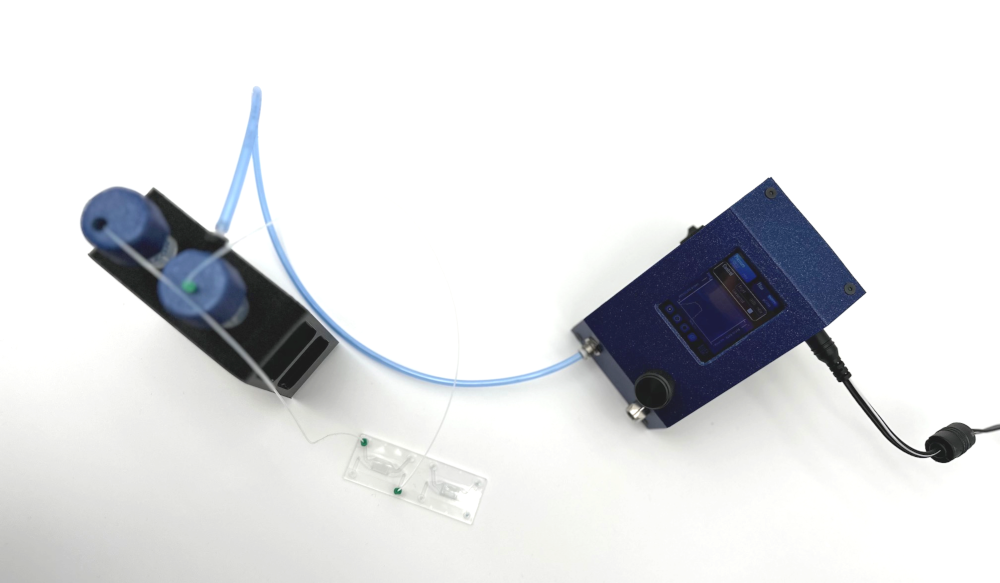
Standalone pump technical specifications
| Pressure control | |
|---|---|
| Pressure range | -400 to 600 mbar |
| Pressure stability | 0.2 mbar |
| Air flow rate | 0.1 L/min at atmospheric pressure Possibility to work with higher air flow rates by reducing the pressure range |
| Flow control | |
| Microfluidic flow sensor | Monitoring and feedback loop flow control available |
| Flow rates | From 0.1 µL/min to 5 mL/min |
Customize your pack
Our instruments can be added to different setups depending on your specific needs. In this light, our microfluidic specialists will advise you on the best instruments and accessories depending on your needs and will accompany you during the system’s setup.
Products & Associated Accessories
FAQ - Standalone Pump
What will be the use of the standalone pump?
The standalone pump is a very compact, autonomous pressure and vacuum regulator that is designed to be used in microfluidic systems. This is a completely self-contained device; it can be programmed and operated directly on its internal interface, unlike the conventional laboratory pumps that need to be connected to a computer. It is intended to provide:
- Precise pressure and flow regulation having a small footprint.
- Silent and vibration-free labor, suitable in sensitive scientific applications.
- A simple and user-friendly interface despite the amount of technical expertise of the operator.
It is advertised as the ideal choice of scientists who need to have a reliable, portable, and convenient pressure source to conduct the usual and straightforward microfluidic research.
Does the standalone pump require a computer?
With or without a computer, you can have total pressure and flow control and automate your microfluidic experiments. Reduce the overall cost of your setup and run your experiments quickly.
What are the major operation and physical strengths of this pump?
The standalone pump has four primary advantages that include:
- Small size: Due to its small size, it consumes less space on a bench and is easily transportable to other workplaces or laboratories, which is beneficial to scientists who have multiple working environments.
- Noise-free operation: This feature makes the pump suitable in places where it is required or desired to operate quietly since it does not produce any audible noise during operation.
- Vibration-free design: This is of paramount importance to use cases where sensitive samples are used or where the imaging process relies on microscopy.
- Ease of use: The user interface is simple and clear, and one will not have to spend considerable time learning due to the ease of use with simple controls.
What type of laboratory uses can the standalone pump be used in?
The pump is applicable in many microfluidic applications, including:
- Benchtop tests and demonstrations: Simple setups to illustrate experiments in learning or business applications,
- Lab-on-a-chip development: Supporting applications such as drug development, forensics, biomolecule analysis, environmental and food analysis, and point-of-care diagnostics.
- Cell perfusion: The pump is suitable to the cell perfusion process due to its biologically oriented design.
- Other areas of inquiry include, but are not restricted to, mechanotransduction in tissue engineering, cell confinement and related biophysical research.
- Test of microfluidic chips and biosensors: provision of uniform and repeatable pressure stimuli to characterize sensors and validate chips.
Why is operation in vibration free important in microfluidic research?
Instabilities in fluid flows may be due to conventional pumping equipment vibrations, which is particularly problematic in relation to:
- It is known that in microscopy systems, mechanical interruptions deteriorate the quality of an image and render the ability to accurately follow cellular processes impossible.
- Fine control, in which minor variations of pressure cause variations in the data; fragile biological samples, in which the flow variations can affect the functionality of cells, or destroy fragile structures.
The standalone pump can be used to ensure that the experimental result is indicative of real biological or chemical processes and not an instrument artifact through the removal of vibrations entirely.
Does this pump work with researchers with little knowledge of microfluidics?
Yes. Whether it is expertise in technology or not, the pump is especially designed to be user-friendly. Significant factors that facilitate adoption ease are:
- A single interface with a limited number of controls,
- An easy-to-read pressure/flow rate display not needing program interpretation,
- The computer based control software does not have to be installed or configured to perform the standard operation.
Due to this fact, the tool suits well with interdisciplinary teams, novice members in the lab, or any other scenario where the speed and ease of use are paramount.
Can the standalone pump be used as both a vacuum and a pressure device?
Yes. The pump is used as a vacuum and pressure controller with a vacuum of 400 mbar (vacuum) to a positive pressure of +600 mbar (positive pressure). Due to its two-fold capability, we can use it with:
- Forcing fluid with positive pressure through microfluidic chips
- Uses involving alternating or simultaneous pressure/vacuum
- Uses involving aspiration of fluids or creation of vacuum-driven flow environments under vacuum.
- Applications need alternating or simultaneous pressure/vacuum cycles.
Can you add accessories to the pump or combine it with other instruments?
Yes. The standalone pump has the potential of being used in larger systems depending on the requirements of the experiment and can be used with standard commercial microfluidic chips in a variety of brands & provides the additional equipment and accessories like:
- Microscopy and microfluidic flow sensors (to monitor and provide feedback control) Perfusion pump systems,
- Automated sampling instruments, flow splitters, several modules to inject medication, and so on.
The microfluidic experts of the center could assist in installation and give guidelines about the optimal setup to be used in specific research orders.
What does the standalone pump have when compared to the more advanced pressure controllers in the range?
The standalone pump is developed to be usable, transportable, and independent in the normal experimental conditions. More advanced instruments such as the OB1 MK4 pressure controller or the entire automated cell culture platform can be of benefit to researchers having more complex requirements, including multi-channel control, long-period automated cell culture, or very precise parallelized research. In a straightforward workflow, benchtop tests, or a setup where your small, computer-free setup is needed, the Standalone Pump is the best place to begin.