
Patented technology
Microfluidic Flow Rate Sensor
Low flow rate microfluidic flow sensor with automatic clogging detection
Low flow rates
Accurate to below 1 µl/min
Detect clogging inside the sensor
Be alerted of issues
No drift
Trustworthy readings throughout
Need a microfluidic SME partner for your Horizon Europe project?
Microfluidic flow rate sensor highlights
Low flow rates
As the microfluidics field evolves, it stretches the capabilities of current instruments. The demand for low flow rates is an example. Current flow sensors cannot read below 1 µl/min accurately. Galileo was designed to bridge this technological gap, giving you accurate reading below 1µl/min.
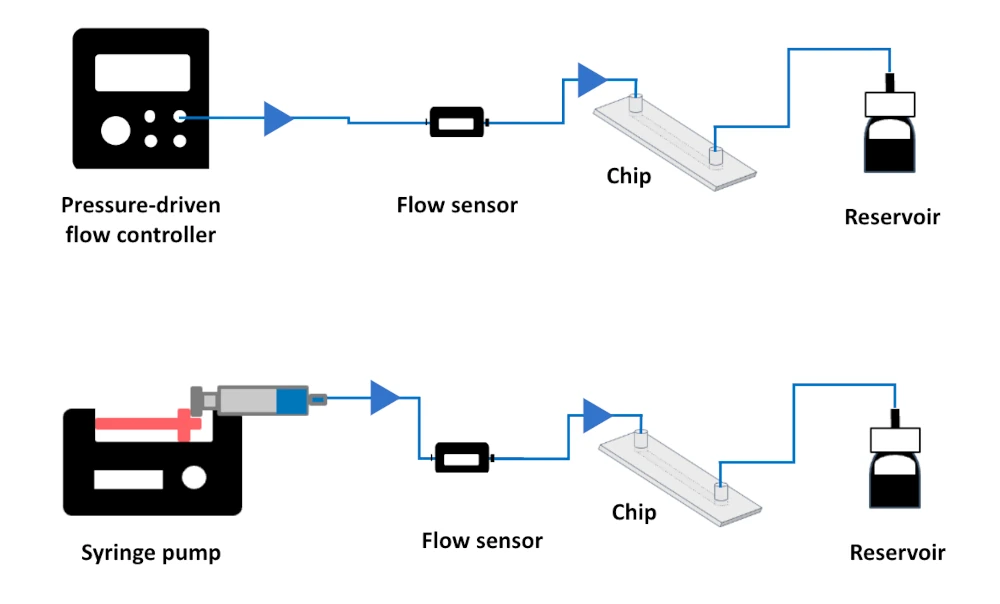
It was also designed to work with all types of pumps, such as pressure-driven flow controllers and syringe pumps, as can be seen in the schematics below.
Clogging detection
Microfluidics systems are complex because they depend on several parts put together: pumps, tubings, connectors, chips, sensors, valves, you name it. And when something goes wrong, a lot of time is lost trying to troubleshoot the whole system. To make life easier, our microfluidic flow sensor, Galileo, can alert you if the problem is coming from its internal fluidic path.
Drift detection
Through empirical observation, our team realised that flow sensors drift during long experiments due, for instance, to modification of the inner flow path of the sensor, i.e. biofouling by the accumulation of particles on the walls of the sensor.
So we developed a flow sensor that can detect if modifications are occurring within its channel walls. When drift occurs, it gives out a visual alert, so you can have 100% confident in your readings and take measures to correct any drift by easily replacing the cartridge.
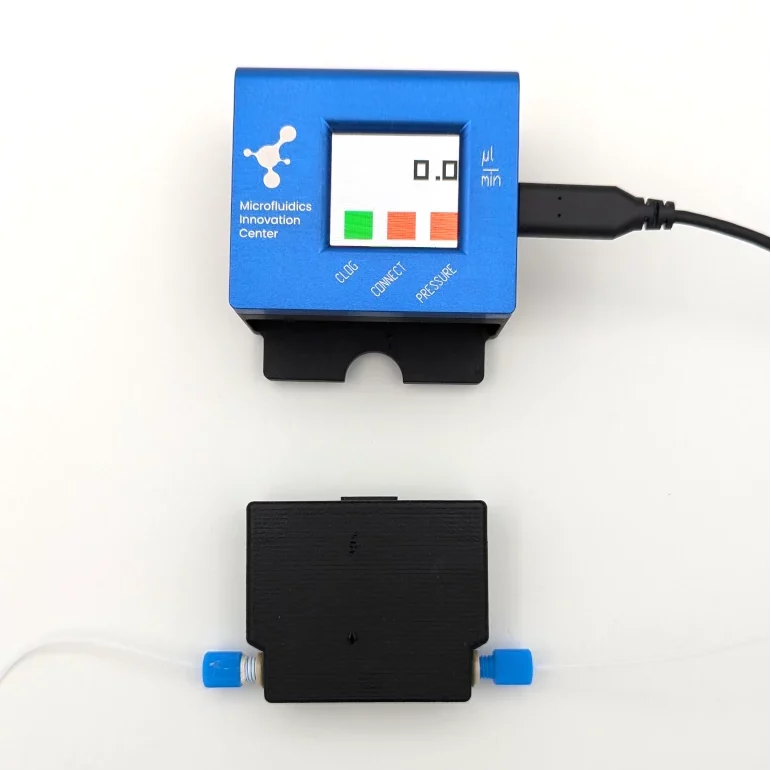
The Microfluidics Innovation Center developed Galileo, a highly-performant microfluidic flow sensor with proven high accuracy, precision, and reliability.
The technology provides a robust and versatile solution for microfluidic applications thanks to its many features:
- <5% flow rate accuracy for any given range
- Configurable sensing ranges from 0.5 to 10,000 µL/min
- Fully replaceable cartridge format for range configuration and flow path replacement
- Automatic detection of internal clogging and measurement drift (e.g., biofouling)
- Bi-directional flow rate measurement (positive & negative)
- Galileo user interface and LCD screen for direct flow rate monitoring
The Galileo Operation video offers clear step-by-step instructions on easily connecting the Galileo flow sensor and navigating the software interface. The video also includes a live demonstration of the sensor in action and a detailed explanation of the indicator lights.
Technical specifications
The technical specification sheet can be downloaded using the button below.
User guide
Please refer to the user guide for detailed instructions using the button below.
The Galileo Operation video gives some visual instructions on connecting the Galileo flow sensor and navigating the software interface.
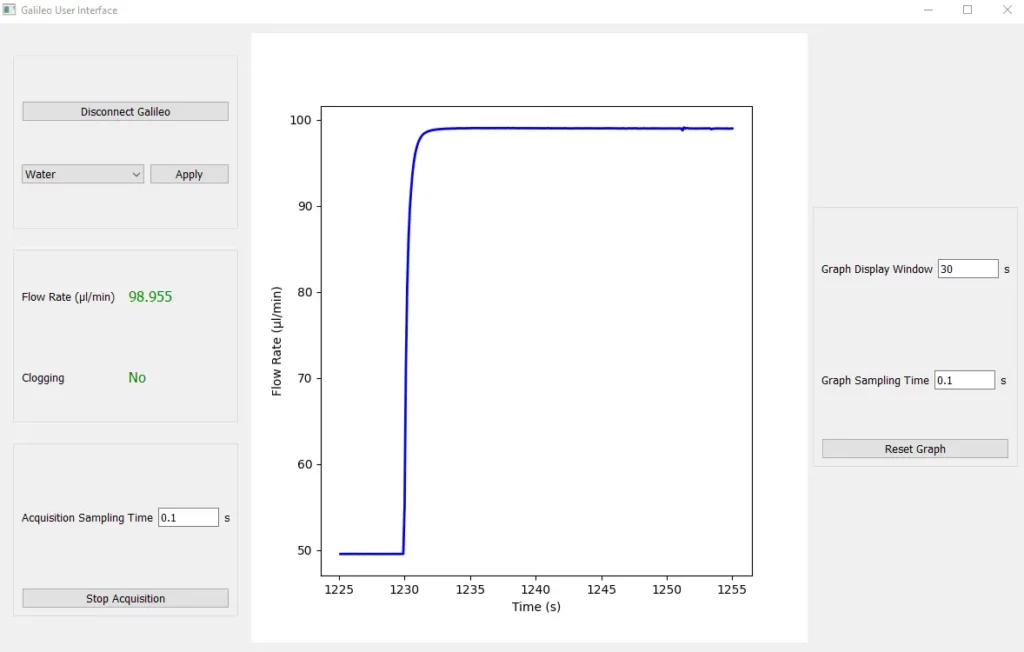
Download the Galileo user interface
- Detection of the Galileo flow sensor
- Reading and plotting flow rate in real time
- Display of clogging detection flag
- Record flow rate and clogging detection with an acquisition rate of up to 100 Hz
Frequently asked questions
Can the cartridges be reused?
Yes, depending on your application. The flow sensor cartridges can be reused if there’s no alert of clogging, or if you face no problems of cross-contamination in your experiments.
With which types of pumps can the sensor be used?
Our microfluidic flow sensor can be used with all types of pumps, as it has an independent software that doesn’t depend on the flow generating system.
Can I have customized features?
We would love to hear what you have in mind. Drop us a line at innovation[at]microfluidic.fr or just click on the “get a quote” green button on top.
Download the MIC Horizon Europe 2026/2027 Calls Calendar:


Funding and Support
The development of this microfluidic flow sensor has received funding from the European Union’s Horizon research and innovation program under HORIZON-EIC-2022-TRANSITION-01, grant agreement no. 101113098 (GALILEO).
Products & Associated Accessories
FAQ - Microfluidic Flow Rate Sensor
What exactly is a microfluidic flow rate sensor, and what makes it different from a standard flow meter?
A microfluidic flow rate sensor measures small volumes of fluid passing through channels, typically at nanoliter to microliter per minute. Standard flow meters are installed on pipes and measure volumes at an industrial scale. Below several milliliters per minute, they become totally inaccurate. A microfluidic sensor is tailor-designed for that ultra-low regime, where pressure sensitivity, dead volume, and response time become important in a way that conventional instruments cannot.
What flow rate range does this sensor cover?
This type of sensor generally has a working range of about 0 to 7 µL/min (occasionally, up to 80 µL/min, depending on the channel setup). The region of usability is the area where the linearity and repeatability are assured. It is always advisable to read the datasheet for the actual model you are using, as operating too high or too low can introduce uncertainty into the measurement.
How does the clogging detection feature work?
The sensor measures the pressure drop across the measurement channel in real time. Flow resistance increases as a blockage begins to form. This causes a measurable change in the relationship between pressure and flow that the onboard electronics consider an anomaly. It is not just a system that measures: it actively differentiates between a real change in flow and an obstruction. This can be applied in any application where the fluid contains particles, cells, or biological debris.
Why does automatic clogging detection matter in practice?
A clog that is not immediately apparent, even for a few minutes, can destroy a whole dataset in laboratory automation or a long-running experiment, or costly reagents can be wasted. At the throughput that modern microfluidic platforms achieve, manual inspection is not a viable option. Automatic detection allows the system to stall, issue an alert, or reroute the fluid before the issue is compounded. It puts the load on the instrument, not on the operator.
What fluids is this sensor compatible with?
The majority of the sensors in this category can work with aqueous buffers, cell culture media, ethanol solutions and light organic solvents. The wetted materials, usually glass or PEEK or fluoropolymer-coated surfaces, are critical to compatibility with aggressive acids or bases or viscous oils. It is advisable to check the compatibility of chemicals before adding a new fluid. The channel walls can be coated with proteins and surfactants and calibration can change with time.
How does fluid viscosity affect measurement accuracy?
The viscosity directly influences the pressure-flow relationship within the channel. The majority of microfluidic flow sensors are specific to water at a certain temperature. The raw reading will be offset if your fluid has a different viscosity. Certain instruments accept a viscosity correction factor as input; others require the user to enter a correction coefficient. In biological fluids such as blood or synovial fluid, this is not an option.
What is the response time of the sensor?
The sensor class has response times that are normally within a few hundred milliseconds to a few seconds with a full-scale step change. Most microfluidic workflows, such as gradient generation, droplet production, and perfusion assays, are adequately covered by this. Applications with time requirements of less than 100 ms, such as fast valve switching characterization, might require a different instrument architecture.
How is the sensor connected to a microfluidic system?
Connection is typically done using standard microfluidic fittings: Luer slip, Luer lock, or press-fit tubing adapters based on the outer diameter of the tubing used in the connection. The electrical interface is typically a USB or a dedicated analog output that can be read by a DAQ system or by the manufacturer’s software. The relevant specification when working with precious samples is the dead volume at the connectors.
What is dead volume, and why should I care about it?
Dead volume refers to the volume of fluid confined by the sensor but not directly involved in the flow being measured. This volume in microfluidic experiments combines with the sample, slows the passage through the fluids, and traps air bubbles. In cell experiments or concentration gradients, temporal resolution is degraded by high dead volume. Microfluidic sensors maintain dead volumes in the low-microliter range, often smaller than those created by a traditional flow meter.
Can this sensor be integrated into an automated or closed-loop system?
Yes. The output may be sent to a controller that adjusts the pump speed or valve state as the measured flow changes. It is a typical setup in organ-on-chip perfusion platforms, droplet generators, and automated liquid-handling platforms. To prevent damage to the rest of the system, the clogging alert can be directly connected to a safety interlock to shut down the system.
How often does the sensor need to be recalibrated?
Calibration drift can typically be low with thermal or pressure-dependent sensors when used with compatible fluids. A reasonable baseline is a functional check against a reference condition after every few months. When the fluid composition changes significantly, the sensor has been in contact with a chemically incompatible fluid, or the sensor is giving readings inconsistent with expectations, recalibration is justified before the data is relied upon.
What are the most common user errors with this type of sensor?
In practice, four patterns recur. To start with, adding air bubbles, which cause large transient spikes and can offset the baseline. Second, the application of fluids that are not within the viscosity or chemical compatibility range without corrections. Third, excessive torque on the fittings may cause deformation of the internal channel geometry. Fourth, the warm-up time is neglected: as with most precision instruments, microfluidic flow sensors have a short stabilization period before measurements are taken and stored in a dataset.