
Cell Culture Tubes for Perfusion
Adapted for sterility and easiness of use
Easy to handle
No need to screw and twist, just plug and play
Autoclavable
No more risk of contamination
Keep everything sterile
Replace handling tubing for plugging sterile needles
Need a microfluidic SME partner for your Horizon Europe project?
When design meets scientific instrumentation: cell culture tubes redesign
“The devil is in the detail” was reportedly said by Nietzsche once. Indeed, we believe that attention to detail can make life much easier. That’s why we decided to apply design concepts to our scientific instruments and accessories.
We redesigned our cell culture tubes so their lids require less effort. Instead of requiring two different fittings to secure the tubing for the media line, we replaced them with a single miniluer adapter. Hence, you must put the tubing tip inside the adapter and plug it into the lid. For the pressurized-gas line, there is no need to screw the fittings. You must connect the tube to the adapter and drill it into the lid.
Keeping everything sterile was also a significant motivation for our redesign. Now, you don’t need to pass the tubing through the lid until the bottom of the reservoir, which can be a vector of contamination; you need to plug a sterile needle into the lid.
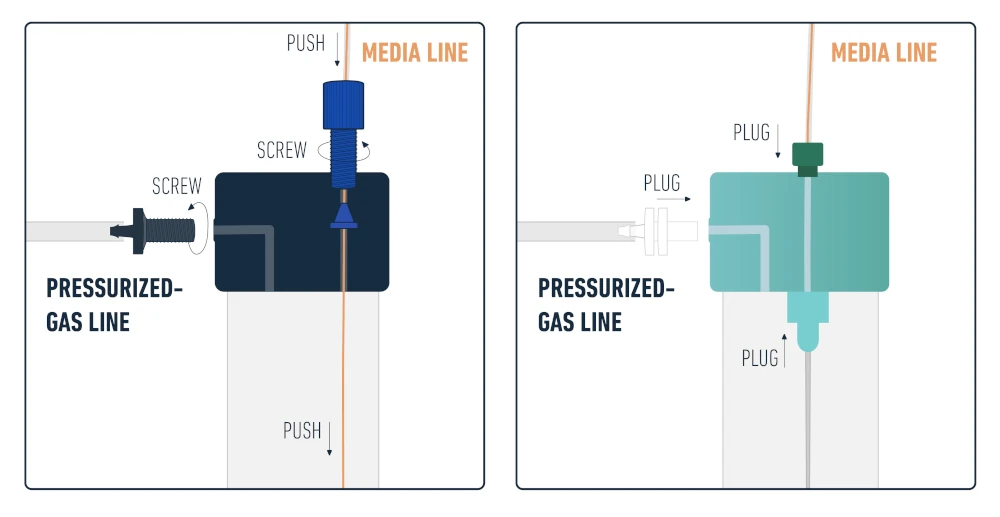
By making your assembly process easier, we save time and mental space so you can focus on your experiments.
Customize your pack
Our instruments can be added to different setups depending on your specific needs. In this light, our microfluidic specialists will advise you on the best instruments and accessories depending on your needs and will accompany you during the system’s setup.
Frequently asked questions
Can the cell culture tubes be placed inside the CO2 incubator?
Yes, the cell culture tubes were designed to be compatible with the CO2 incubator.
Are the cell culture tubes for other volumes than 15 ml?
For the moment, only 15ml cell culture tubes are available. However, reservoirs for other volumes are being developed. Don’t hesitate to contact us to learn more about it!
Can I combine the cell culture tubes with other instruments?
Yes! Our team can help you design the setup that makes more sense for your application. Contact us using the “talk to our experts” green button above.
Download the MIC Horizon Europe 2026/2027 Calls Calendar:


Funding and Support
The ALTERNATIVE project helped develop this beta instrument. This project is funded by European Union’s H2020-LC-GD-2020-3, grant agreements No. 101037090.
Products & Associated Accessories
FAQ - Cell Culture Tubes for Perfusion
What sets the Perfusion Cell Culture Tubes apart?
These are special media reservoir tubes designed for use with microfluidic perfusion systems. Instead of having to use homemade adapters and fittings to convert regular cell culture tubes for use with a perfusion system, the designers at MIC have completely redesigned the tube lid and the interface. The special features include a sterile needle interface that doesn’t require the tubing to be threaded through the lid, a single mini luer connection for the media tubing, and a no-screw connection for the pressurized gas tubing. These are all unique compared to other media reservoir tubes.
How is the tube lid fixed to the media line?
The tube lid is fixed to the media line by the single mini luer adapter. This adapter clamps the tubing in place. Previously, two adapters had to be used. After the tubing tip is inserted into the adapter, the adapter is plugged into the tube lid in one piece. This removes the problem of the tube not being aligned with the tube lid and the tube leaking. This is a common problem with other cell culture tubes and reservoirs.
How is the pressurised gas line connected?
The pressurized gas line doesn’t require the use of screws. The tube is drilled straight into the tube lid after it has been connected to the adapter. The gas pressurization side of the tube could also be connected as easily as the media side.
Can the tubes be used inside a CO2 incubator?
The cell culture tubes could definitely be used inside a CO2 incubator. This is important for cell culture experiments.
How does the design improve the sterility of the experiment?
In the previous design of the reservoir, there were a lot of points of contamination at the interface with the lid since the media tubing had to go all the way to the bottom of the tube and then through the lid. The new lid design improves on this since it uses a sterile needle that is simply inserted into the lid port. This means that the points of contamination will not be compromised since the needle is sterile until it is inserted and the tube is closed during the experiment.
Can the tubes be autoclaved?
Yes. This is highlighted as one of the benefits of the system. This means that the tubes will not need to be replaced frequently, thus reducing costs and making the system more eco-friendly. The sterile needle interface also improves the situation since there is reduced contamination at the tube input site during the experiment.
What is the tube volume format that is currently supported?
Currently, the system only supports 15 mL cell culture tubes. That the reservoir is currently in development for other tube sizes. This means that if your experiment requires a different tube volume, it is recommended that you contact the company for more information on availability or expected release dates.
What is the tubing connector format of the system?
The system uses the Miniluer connector for the lid interface. This is a very small connector commonly used in microfluidics. This means that the system will be able to support a wide range of combinations of tubing and chips that are currently in the market and support the Miniluer standard.
Can these tubes be combined with other MIC instruments?
Yes. These cell culture tubes can be used with other devices to form a wider range of perfusion configurations. This is especially true if you’re integrating these tubes with other devices, such as an organ-on-a-chip system, a cell culture pump, or a unidirectional cellular perfusion system. Please contact our experts to know how to configure a system that is appropriate for a particular application.