
Inline Viscometer for whole blood viscosity
Whole blood viscosity, measured across the shear range.
Shear resolved
Reports whole blood viscosity across 1 to 1000 s⁻¹
A fraction of the usual sample
0.1 mL per measurement & retrieve your sample
Automatic drift/clogging detection
Flags clogging or instability in real time
Need a microfluidic SME partner for your Horizon Europe project?
Inline viscometer for whole blood viscosity
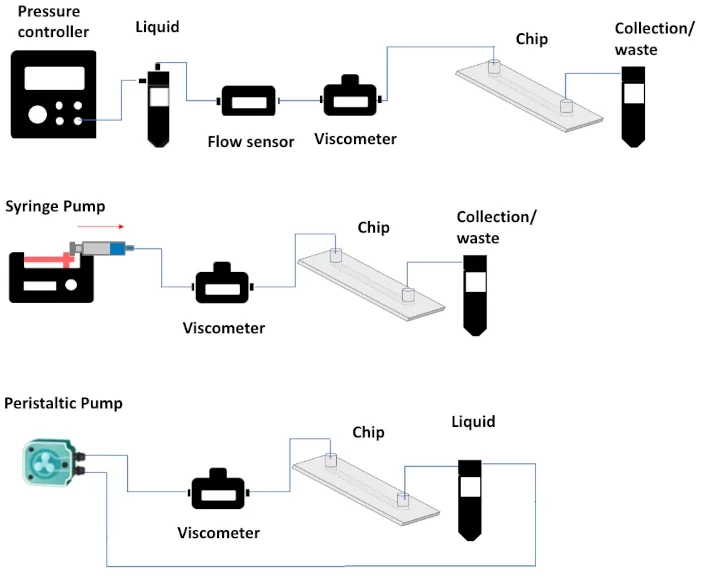
The inline viscometer measures the viscosity of blood and plasma directly in your flow line, from a 0.1 mL sample. It connects between your reservoir or syringe and your chip, works with any pump in your microfluidic setup and an optional microfluidic flow sensor, and shows readings in real time. It is a classical rheometer tailored for blood, built on the same platform as our inline viscometer. The sample isn’t consumed, so you can recover it after the run.
Blood is non-Newtonian. Its viscosity falls as shear rises, so a single value doesn’t describe it. At low shear, red cells aggregate into rouleaux and viscosity climbs. At high shear they deform and align, and viscosity drops [1].
The shear rate is set by the flow. High flow gives the systolic value near 300 s⁻¹, low flow the diastolic value at 1 to 5 s⁻¹. Stepping through flows covers roughly 1 to 1000 s⁻¹ [2]. The low-shear end is where red cell aggregation shows, and where rotational instruments run short on torque.
Whole blood viscosity changes with temperature, so physiological samples are measured at 37°C. Elevated low-shear viscosity has been linked to vascular risk, including cerebral small vessel disease [3].
What's included
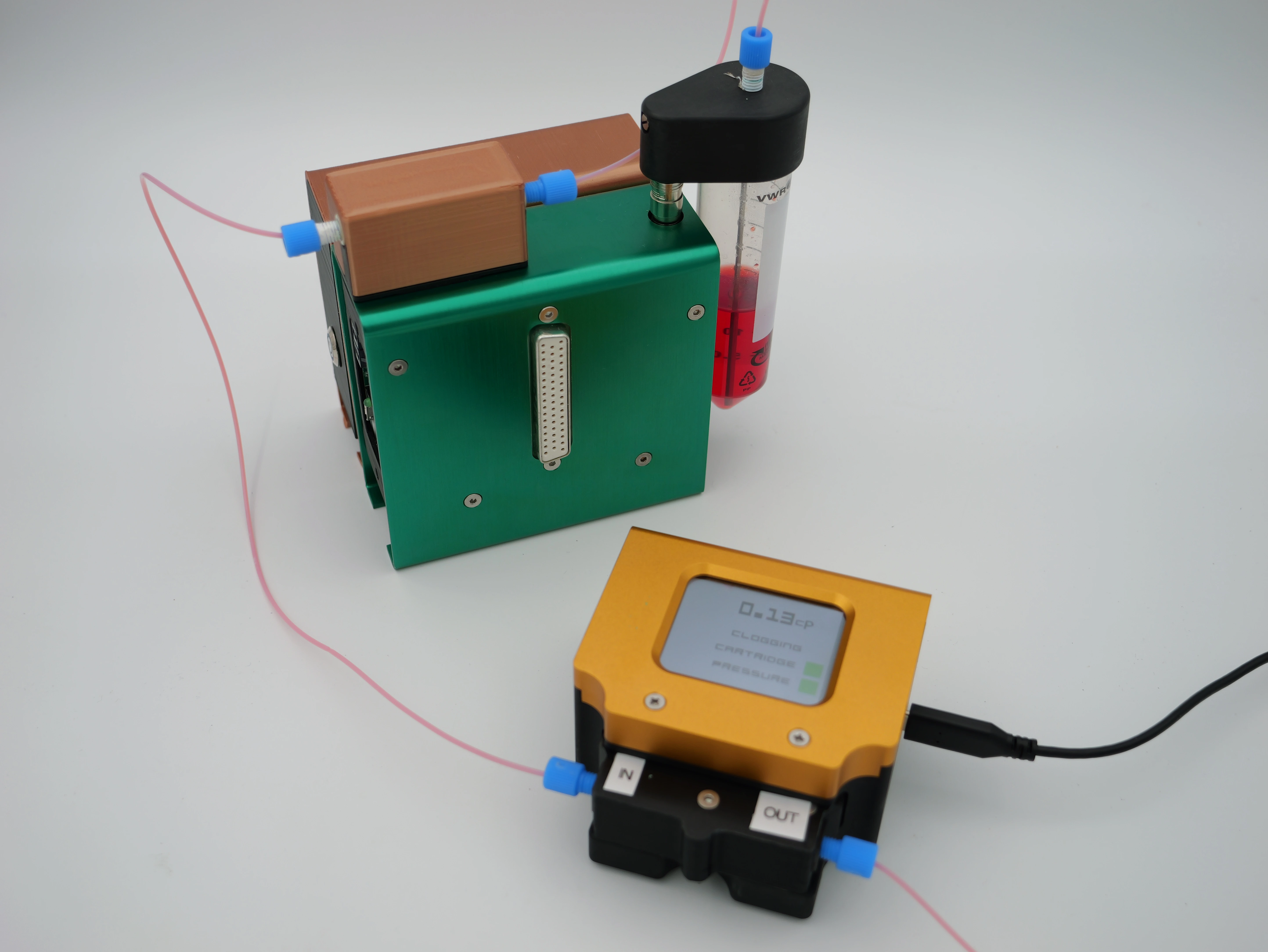
Inline viscometer
Single-use disposable cartridges
Reservoirs, tubing and fittings
Dedicated software interface, with real-time display and data logging
User guide and technical spec sheet
Optional inline flow sensor
The inline viscometer drops into your existing setup, whether you run a pressure-driven flow controller, a syringe pump or a peristaltic pump. You connect its inlet to the outlet of your reservoir or syringe, and its outlet to your chip. Readings appear in real time on the on-device screen and log to the software. The wetted path is a single-use, disposable cartridge, so you run a fresh one per sample and recover your sample after the run. On top of that, we can provide the whole setup, everything you need to install and run your application right away.
Whole blood viscometer applications
Applications of the blood and plasma viscometer include:
- Hemorheology and blood rheology research
- Plasma viscosity for hyperviscosity syndrome [4] and inflammation [5]
- Red cell aggregation and deformability studies
- Development of blood-contacting hardware (ECMO, bypass, dialysis)
- Viscosity control for biological fluids
Inline viscometer technical specifications
The inline viscometer ships pre-calibrated, with the following specifications:
| Parameter | Value |
|---|---|
| Measurement | Shear-resolved viscosity (systolic and diastolic), set by flow rate |
| Viscosity range | 0.2 to 100,000 cP |
| Shear rate range | About 1 to 1000 s⁻¹ (high shear ~300 s⁻¹, low shear 1 to 5 s⁻¹) |
| Low-shear reach | Reliable readings down to 1 s⁻¹ |
| Viscosity resolution | 0.01 cP |
| Accuracy | Better than 5% of reading |
| Repeatability | Better than 2% |
| Minimum sample volume | 0.1 mL |
| Operating temperature | 10 to 70°C, incubator-friendly |
| Maximum operating pressure | 4 bar |
| Monitoring rate | Continuous logging at up to 100 Hz |
| Compatible pumps | Pressure-driven, syringe, or peristaltic |
| Sample | Recoverable after the run |
| Readout | Real-time on-device screen, with software logging and CSV export |
| Connection | USB to a standalone software interface |
| Fittings | Standard microfluidic fittings (1/4-28 or Luer) |
| Chips | Works with commercial or home-made chips |
| Wetted path | Single-use, disposable cartridge in PEEK and silicone |
| Cleaning | Sanitization protocol, or discard after use |
| Tubing and connectors | Available sterile |
| Footprint | Compact benchtop unit |
Download the MIC Horizon Europe 2026/2027 Calls Calendar:
References
[1] Blood Rheology: Key Parameters, Impact on Blood Flow, Role in Sickle Cell Disease and Effects of Exercise. Frontiers in Physiology, 2019. doi:10.3389/fphys.2019.01329.
[2] Micro-Viscometer for Measuring Shear-Varying Blood Viscosity over a Wide-Ranging Shear Rate. Sensors, 2017, 17(6):1442. (PMC5492087)
[3] Elevated blood viscosity is associated with cerebral small vessel disease in patients with acute ischemic stroke. BMC Neurology, 2017, 17:21. doi:10.1186/s12883-017-0808-3.
[4] Hyperviscosity Syndrome. StatPearls, NCBI Bookshelf, NBK518963.
[5] Optoelectronic microfluidic device for point-of-care blood plasma viscosity measurement. Lab on a Chip, 2024, 24, 3305 to 3314. doi:10.1039/D4LC00211C.






Funding and Support
This project has received funding from the European Union’s Horizon research and innovation program under HORIZON-EIC-2024-PATHFINDEROPEN-01, grant agreement no. 101185661(ERMES), HORIZON-EIC-2022-TRANSITION-01, grant agreement no. 101113098 (GALILEO). It has also received funding from the European Union’s Horizon research and innovation program under the Marie Skłodowska-Curie grant agreements no. 101119956 (DarChemDN).
About the author

Julia Sepulveda Diaz, PhD
Chief Executive Officer, Microfluidics Innovation Center
Julia holds a PhD in glycobiology and neurobiology from Université Paris-Est Créteil. Before moving into microfluidics, she spent several years as a postdoctoral researcher at the Paris Brain Institute, on Parkinson’s disease, neuroinflammation, and the role of heparan sulfate in protein aggregation. Today she leads the Microfluidics Innovation Center as CEO, steering its researchers and engineers and its collaborative research and innovation projects.
LinkedIn | ORCID | ResearchGate | MIC profile
Products & Associated Accessories
FAQ - Inline viscometer for whole blood viscosity
What is the inline viscometer for blood and plasma?
It measures the viscosity of blood or plasma flowing through it, in real time, from a 0.1 mL sample. For whole blood it gives both a systolic (high-shear) and a diastolic (low-shear) value, since blood is non-Newtonian and one value doesn’t describe it. It is a classical rheometer tailored for blood, in a compact inline format.
What problem does it solve?
Whole blood is non-Newtonian, so a single viscosity value misleads. Conventional rotational rheometers need a large sample, run offline, and struggle at the low shear rates that matter for blood. This viscometer sits in your flow line, works from 0.1 mL, and reports viscosity from high shear to low shear.
What viscosity and shear range does it cover, and how accurate is it?
It covers a viscosity range of 0.2 to 100,000 cP and a shear rate range of about 1 to 1000 s⁻¹, with an accuracy better than 5% of reading and a resolution of 0.01 cP. It reads down to a low shear rate of 1 s⁻¹, needs a minimum sample of 0.1 mL, and runs at a controlled 37°C within a 10 to 70°C range.
How does it fit into a microfluidic setup?
It drops into an existing setup, connecting between your reservoir or syringe and your chip. It works with pressure-driven, syringe or peristaltic pumps, and with commercial or home-made chips. Readings appear in real time and log to the software, with continuous logging at up to 100 Hz.
Can it measure plasma, serum and whole blood?
Yes. It measures whole blood, plasma and serum, and other biological liquids. Plasma and serum are Newtonian, so a single reading describes them, usually around 1.1 to 1.3 cP at 37°C for plasma. Whole blood is non-Newtonian and is measured across shear rates.
Is it sterilisable, and how does it handle clotting and sample recovery?
The wetted path is a single-use, disposable cartridge, so you run a fresh cartridge per sample to avoid carryover, then clean it with the sanitization protocol or discard it. It isn’t autoclavable. You can recover your sample after the run, and for whole blood you run an anticoagulation protocol such as EDTA.
Can the viscometer be customised for my application?
Yes. It’s built to drop into an existing setup, with different chips, pumps and sample-handling needs. If you have specific shear rates, temperatures or sterility requirements, get in touch and let us know your needs.
How do I get a quote or order one?
Use the Get a quote button on this page, or contact MIC directly. Tell us your fluid, your target shear and temperature range, and how you plan to run it, and we’ll scope the right configuration and lead time for you.
Can MIC be our microfluidic SME partner for a Horizon Europe or EIC project?
Yes. The Microfluidics Innovation Center takes part in Horizon Europe and EIC projects as the microfluidic SME partner. We handle the microfluidic engineering, work on valorization, and help optimize the proposal with you. Reach out early while the consortium is forming.