
Microfluidic Chemotaxis Assay Pack
Chemotaxis assay using a gradient microfluidic chip
Easy microfluidic chemotaxis
Unbox, set up and start your experiments right away
Efficient chemotaxis study
Chemical gradient control, reduced reagent consumption, quantification
Long-term gradient stability
Laminar flows in straight microchannels limit any mixing
Need a microfluidic SME partner for your Horizon Europe project?
Principle figure adapted from Jeon et al. (2002)
Microfluidic chemotaxis assay
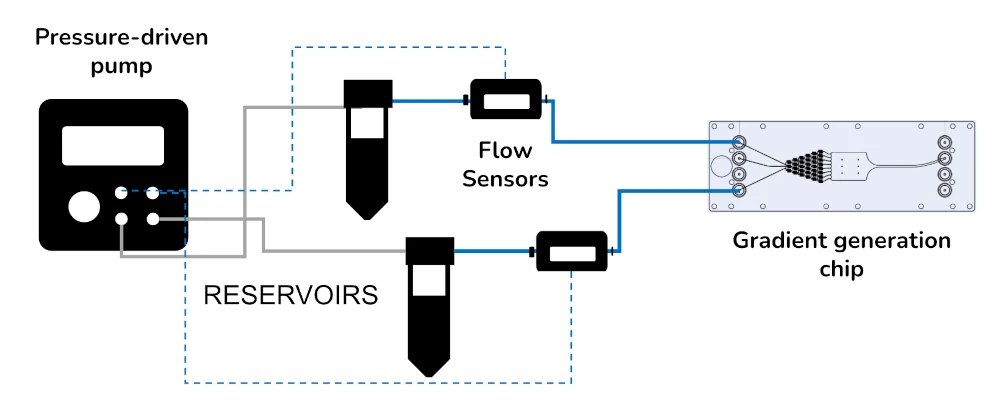
A standard microfluidic chemotaxis pack contains two pumping channels to push the two chemical solutions needed to create the chemical gradient required to observe the chemotaxis of the studied entity.
This gradient is created in a large channel thanks to a network of junctions and serpentines. The pyramidal layout of the chip allows the two fluids to split and mix. The stability and the ratio between the two liquids directly depend on the flow rates of each fluid in the microfluidic channel.
Microfluidic chemotaxis assay enables reasonable gradient control and particle quantification with a good throughput.
Microfluidic chemotaxis assay setup
An all-in-one pack guarantees a good compatibility between the different instruments, allows you to start your experiment right away, is piloted by a single software and can be used for other different applications. These are a few arguments why a pack is the easiest way to setup a microfluidic experiment.
Setup
Flow sensor (Galileo, MIC)
Software (Galileo user interface)
Flow controller
2 x 15 mL falcon reservoirs
Microfluidic chip from microfluidic ChipShop
All necessary accessories: tubing, connectors, filters, etc…
Why use microfluidic for chemotaxis?
Based on a high-accuracy flow controller and gradient chips, this solution reduces reagent consumption and allows quantification. Our experts will help you set up and use the microfluidic platform step-by-step, thus allowing scientists with no prior microfluidic experience to perform chemotaxis assays.
Firstly, using microfluidics is a way to decrease the amount of potentially valuable samples needed for a reaction, reducing the costs of experiments. Microfluidic chips could also help better mimic the in vivo chemical gradient conditions, thus helping recreate more precise cell chemotaxis in vitro.
Microfluidics make static gradients more stable on long-term scales thanks to laminar flow.
Other microfluidic chips can be easily added before or after the gradient generation chip for chemotaxis assay to create a more integrated platform to perform more complex experiments.
Furthermore, the low sample volume required for experimenting with microfluidics brings more specific advantages, like measuring mouse neutrophil chemotaxis without sacrificing the animal.
References
1. Ratajczak, M.Z., Suszynska, M. and Kucia, M. (2016), Does it make sense to target one tumor cell chemotactic factor or its receptor when several chemotactic axes are involved in metastasis of the same cancer? Clin Trans Med, 5: e28.
Microfluidic chemotaxis assay principle
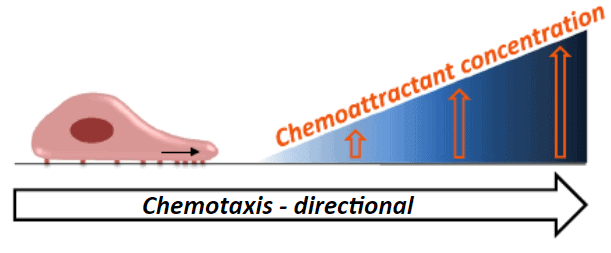
It has been showed that microfluidic technology can be particularly useful for the formation of a chemical gradient that allows a good study of chemotaxis [1-2]. The gradient microfluidic chip is able to create a steady state with a stable concentration of chemicals on each point of the channel. This is thanks to the low-Reynolds flows at the microfluidic scale where the diffusion and therefore, the mixing, is limited in straight channels.
The fluids adopt a laminar flow in these kinds of channels. Consequently, we have to first use serpentine channels to make a premixing that allows the formation of the gradient [3].
Microfluidic devices are more effective for chemotaxis assays than more conventional transwell assays for several reasons like reduced reagent consumption, particle tracking and its unmatchable control of the chemical environment [4-7].
Microfluidic device gradient assay allows the study of many cells and microorganisms for multiple potential applications like body function study or developing new treatments [8-9] .
References
Tanvir Ahmed, Thomas S. Shimizu, Roman Stocker, Microfluidics for bacterial chemotaxis, Integrative Biology, Volume 2, Issue 11-12, November 2010, Pages 604–629
Li Jeon, N., Baskaran, H., Dertinger, S. et al. Neutrophil chemotaxis in linear and complex gradients of interleukin-8 formed in a microfabricated device. Nat Biotechnol 20, 826–830 (2002).
Wu J, Hillier C, Komenda P, Lobato de Faria R, Levin D, Zhang M, et al. (2015) A Microfluidic Platform for Evaluating Neutrophil Chemotaxis Induced by Sputum from COPD Patients. PLoS ONE 10(5)
Wu, J., Kumar-Kanojia, A., Hombach-Klonisch, S., Klonisch, T., & Lin, F. (2018). A radial microfluidic platform for higher throughput chemotaxis studies with individual gradient control. Lab on a Chip.
R. Keller, Cell migration during gastrulation, Curr. Opin. Cell Biol., 2005, 17, 533–541.
H. Yamaguchi, J. Wyckoff and J. Condeelis, Cell migration in tumors, Curr. Opin. Cell Biol., 2005, 17, 559–564.
Wu J, Wu X, Lin F, Recent developments in microfluidics-based chemotaxis studies, Lab Chip, 2013,13, 2484-2499
Karbalaei, A.; Cho, H.J. Microfluidic Devices Developed for and Inspired by Thermotaxis and Chemotaxis. Micromachines 2018, 9, 149.
Sackmann, E. K., Berthier, E., Young, E. W., Shelef, M. A., Wernimont, S. A., Huttenlocher, A., & Beebe, D. J. (2012). Microfluidic kit-on-a-lid: a versatile platform for neutrophil chemotaxis assays. Blood, 120(14), e45–e53.
Customize your pack
The gradient chip provided by Microfluidics ChipShop is available in Cyclic Olefin Copolymer (Topas COC) or polystyrene (PS) materials; the material can also be hydrophilized to improve cell seeding. It is easier to seed the cells via the outlet of the gradient chip so they won’t get stuck in the serpentine parts of the channel.
Bubbles can be a problem when mixing; if this issue is critical for your experiment, we can provide you with a bubble remover that can tackle it.
You can contact our experts for any questions about this chemotaxis assay Pack and how it can match your specifications.
Download the MIC Horizon Europe 2026/2027 Calls Calendar:
Products & Associated Accessories
FAQ - Microfluidic Chemotaxis Assay
What is a microfluidic chemotaxis assay?
A microfluidic chemotaxis assay is an experimental procedure that involves microfluidic chips to describe the movement of cells or microorganisms toward a chemical gradient. The chip forms a constant and controlled concentration gradient within a microchannel, which allows researchers to investigate and measure chemotactic behavior in an environment that is highly comparable to the in vivo environment.
What comes with the Microfluidic Chemotaxis Assay Pack?
The pack is a complete solution which includes:
- Microfluidics microchip (Microfluidics Chipshop).
- A flow controller of high accuracy.
- A flow sensor (Galileo, MIC)
- 2 x 15 mL falcon reservoirs
- Accessories (tubing, connectors, filters) All required.
- Galileo user interface software.
But what actually happens in the chip with regard to the gradient generation?
Two chemical solutions are split and premixed by the chip through a pyramidal network of junctions and serpentine channels. Since microfluidic flows have a small Reynolds number, only a diffusion-driven mixing takes place in straight channels, and the flow regime is laminar. This results in a steady, constant, gradient concentration throughout the primary field of observation.
What is so good about microfluidics compared to traditional transwell assays to study chemotaxis?
The microfluidic chemotaxis assays are superior to transwell methods in a number of aspects:
- Gradient stability: Laminar flow has gradients which are long lasting and repeatable.
- Reagent efficiency: Reduced by a significant amount, both consumption of potentially limited or expensive samples.
- Environmental control: Accurate realtime control of the chemical environment.
- Quantification: Allows the tracking of particles and counting of cells with increased throughput.
What are the cell types or organisms that can be studied using this pack?
The pack will be evaluated to investigate chemotaxis of a large variety of biological systems, such as HUVECs (human umbilical vein endothelial cells), neutrophils, bacteria, cancer cells, and other microorganisms. Of special importance is the fact that it allows the measurement of mouse neutrophil chemotaxis without the sacrifice of animals due to the small volume needed in samples.
Is any prior knowledge of microfluidics required to operate this pack?
No. The package is clearly targeted to scientists who have no experience in microfluidics. MIC professionals will give instructions on how to install and use the platform. The single controlled software and all-in-one design reduce the technical barrier to entry to the lowest extent possible and enables one to experiment the minute they are out of the box.
What is the material used to make the microfluidic chips and is it customizable?
The gradient chip comes in the following two materials:
- Cyclic Olefin Copolymer (COC/Topas).
- Polystyrene (PS)
Both materials can be hydrophilized so as to enhance cell seeding. Introduction of the cells is preferable through the chip outlet to avoid entrapment of the cells in the serpentine premixing channels. The experiments that are sensitive to air bubble interference also have a bubble remover accessory.
What is the stability of the chemical gradient in the long-run?
The gradient is very stable in long-term periods. It is that stability which is a direct result of the laminar flow regime in microchannels: at low Reynolds numbers, the natural constraint of the diffusive mixing in straight channels is that the concentration gradient is necessarily unsteady; that is, the distribution of a concentration within a microchannel will be uniform and predictable across the length of the experiment – an enormous benefit over a diffusion only system or a transwell system.
Is the pack compatible with other microfluidic modules?
Yes. The gradient chip may also be used together with other microfluidic chips located either upstream or downstream to create a more integrated experimental platform. This is a more modular technique that allows higher complexity in workflows, e.g., in pre-processing a sample before gradient exposure or in area of interest cells after migration to be captured and analyzed further.
Where can this chemotaxis assay pack be most used?
The pack is used in a wide variety of research applications including:
- Immunology: The neutrophil recruitment and immune responses.
- Cancer biology: Understanding the cell migration and metastasis in cancer cells.
- Vascular biology: Examination of the HUVEC migration in endothelial chemotaxis environments.
- Microbiology: Defining the behavior of bacterial chemotaxis.
- Drug development: Identification of screening compounds which regulate cell migration pathways.