Giant Unilamellar Vesicle (GUV) Production Pack
Monodisperse and unilamellar GUVs
Bottom-up approach for bigger than 1 µm biomimetic structures
Great monodispersity and reproducibility
Better control than electroformation or other GUV synthesising methods
Automated high-throughput production
Produce GUV with custom sequences
Need a microfluidic SME partner for your Horizon Europe project?
Cell-sized GUV picture adapted from Ho et al. (2016), double emulsion production with oleic acid by Teh, Shia-Yen, et al. (2011)
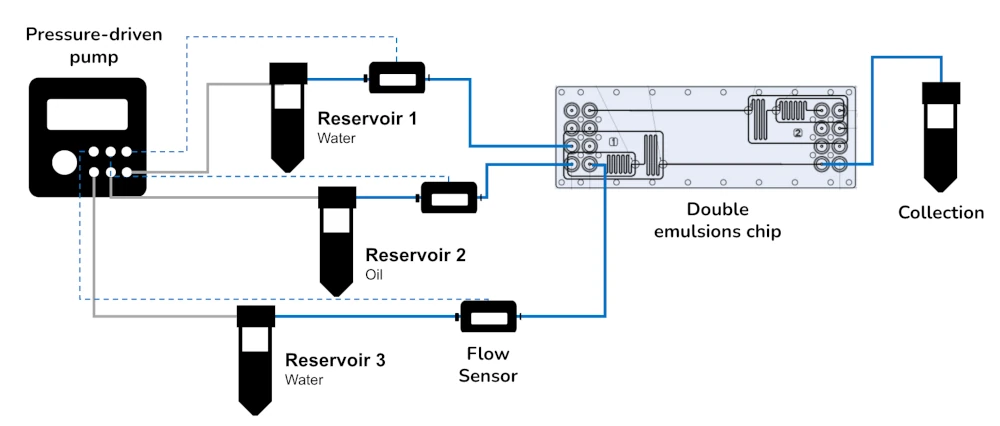
Giant unilamellar vesicles production pack setup
Microfluidics allows better reproducibility, monodispersity, vesicle size control, encapsulation efficiency, and membrane homogeneity, making it the most efficient method to create GUVs compared to bulk techniques.
This Pack comprises an flow controller that controls three channels through flow sensors. One channel has the inner aqueous solution, the other the oil/lipid-based solution, and the third the outer aqueous solution and the solutions meet at the junctions of the double emulsions chip, which can be homemade or commercial, such as the microfluidic ChipShop fluidic 1480.
This pack can be customized to fit any double emulsion application; contact us for personalized advice and expertise.
The GUVs production pack contains:
Flow sensor (Galileo, MIC)
Software (Galileo user interface)
Flow controller
Fittings, tubings & luers
Reservoirs
User guides for instruments
Can contain the fluidic 1480 microfluidic chip from microfluidic chipshop if needed
Compatibility of the pack
Applications
GUVs produced by this pack can be used for:
Membrane-protein interaction assays
Drug delivery studies
Artificial cell-like systems
Encapsulation assays
Membrane deformation studies
and much more!
Analysis
Depending on your application, your results can be gathered by:
Bright-field microscopy
Fluorescent microscopy (if stained accordingly)
Secretion assays
and much more!
Customize your pack
Our Packs can be modified depending on your specific needs. For example, this pack can include a sequential injection function to change the composition of the membrane easily during giant unilamellar vesicle production. Our microfluidic specialists will help you choose the best instruments and accessories depending on your needs and will accompany you during the setup of the microfluidic platform.
Download the MIC Horizon Europe 2026/2027 Calls Calendar:

Funding and Support
The ACDC and Protomet projects results helped develop this giant unilamellar vesicle production pack, with funding from
the European Union’s Horizon 2020 research and innovation program under grant agreement No. 824060 (ACDC)
and the European Union’s Horizon 2020 MSCA-ITN under grant agreement No. 813873 (ProtoMet).
Products & Associated Accessories
FAQ - Giant Unilamellar Vesicle (GUV) Production
What is a Giant Unilamellar Vesicle (GUV)?
A GUV is a biomimetic lipid bilayer assembly, which exceeds 1 µm in diameter, and is meant to replicate a biological cell membrane architecture. Due to their unilamellar (single-bilayer) composition and cell-like size, GUVs can be used to investigate membrane biophysics, cellular processes, and the origin of life as well as to engineer synthetic building blocks that can be used in diagnostics and drug delivery applications.
Why should microfluidics be used to make GUVs when there are traditional ways of making them, such as electroformation?
The production of microfluidic GUVs has a number of important benefits over bulk processes like electroformation:
- Increased monodispersity: Vesicles are generated with highly regulated, uniformly sized particles.
- Increased reproducibility: The automated flow control removes variability based on the operator.
- Greater encapsulation efficiency: Accurate fluid control enhances the process of cargo molecule loading.
- Better membrane heterogeneity: There is a higher homogeneity in the bilayer composition in the produced vesicles.
- Custom sequencing: GUVs with programmable membrane compositions can be built in custom sequences.
How does the GUV Production Pack work?
The pack has a flow controller to manage three separate fluid channels, each monitored by a flow sensor.
The three channels carry:
- The inner aqueous solution (that is to be trapped in the vesicle)
- The oil/lipid-based solution forming the membrane.
- The outer aqueous solution (the surrounding environment).
The three streams converge at the crossroads of a dual emulsion chip whereby the controlled formation of droplets create the precursor double emulsions that further form GUVs on their own.
What does the GUV Production Pack contain?
A standard pack contains:
- Multichannel flow controller (3 channels)
- Flow sensors (Galileo, MIC)
- Galileo user interface software.
- Fittings, tubing, and luers
- Fluid reservoirs
- User instructions for all instruments.
- Alternatively, the Fluidic 1480 double emulsion chip of Microfluidics Chipshop.
What chip do you recommend to use in the production of GUV and will I be able to use my own?
The pack can be used with commercially available Fluidic 1480 chip of Microfluidics ChipShop that is optimized to generate double emulsions. Nevertheless, custom chips may also be incorporated, which will provide scientists with the option of customizing geometries to fit their application or size of vesicle needs.
What applications do GUVs generated using this pack have?
GUVs of this pack can be used in a wide variety of contexts of research or application, such as:
- Assays of membraneprotein interaction: the behaviour of proteins in membrane integration or interaction.
- Pharmaceutical transport research: encapsulation and release control of therapeutic molecules.
- Synthetic Artificial celllike systems: building synthetic cells for bottomup synthetic biology
- Evaluation of encapsulation efficiency: loading of biological or chemical cargoes.
- Membrane deformation investigations: exploring physical stimulus bilayer mechanical properties.
Which analytical strategies can be used with GUVs generated using this pack?
Depending on the application of particular research, GUVs may be described as:
- Morphology and size distribution by Brightfield microscopy.
- Fluorescence microscopy in the presence of fluorescently labelled components in the membranes or cargos.
- Assays of molecular secretion across the bilayer.
- Other downstream methods may be incorporated based on the experiment design.
Is it possible to modify the composition of membranes of GUVs during production?
Yes. A sequential injection module can be added to the pack to allow dynamic adjustment of the lipid or oil phase composition when running a production run. This enables scientists to obtain batches of GUVs that have particular membrane compositions in a single experiment, without having to halt the workflow or to break down the apparatus.
Is it possible to adapt the pack for other double-emulsion applications?
Absolutely. Although the system is optimized to produce GUV, the overall platform of the double emulsion has a high degree of versatility. MIC specialists are able to scale pack to other emulsion-based processes such as synthesis of polymer capsules, drug-loaded microdroplets, or artificial organelles by changing chip geometry, fluid combinations, and flow parameters to fit the desired structure.