Blood-vessel-on-chip-pack
Reproduce physiological flow conditions for vasculature assays
Undirectional flow
Mimic what actually happens inside blood vessels
Reproduce physiological shear stress
Control the flow rate and profile with accuracy
Use the device of your preference
Circular tubules, monolayers, barrier models can be connected
Need a microfluidic SME partner for your Horizon Europe project?
Image credit: Choroidal vessels in the human eye with red blood cells. Peter Maloca. Attribution 4.0 International (CC BY 4.0).
Blood-vessel-on-chip setup
Our blood-vessel-on-chip pack is designed to replicate the relevant flow rates found inside blood vessels with the flexibility of using the chip of your preference so you can better reproduce the tissue microenvironment of your interest. A pressure-driven flow controller, combined with a flow sensor, can provide a range of flow rates (from 0.5µl to 5ml/min) and flow profiles (linear, pulsatile, stepwise, etc.) to mimic the pathophysiological conditions found in the vasculature.
The recirculation bridge is a set of arranged valves that allows the recycling of the media, enabling its enrichment with metabolites, the preservation of conditioned media containing bioactive molecules, and the economy of large volumes of media in long-term experiments.
The level sensors, integrated into the smart culture tube rack, automate the experiment setup and changes between reservoirs. Also, in case of leakage, they stop the flow before the reservoirs become empty and air can reach the cells.
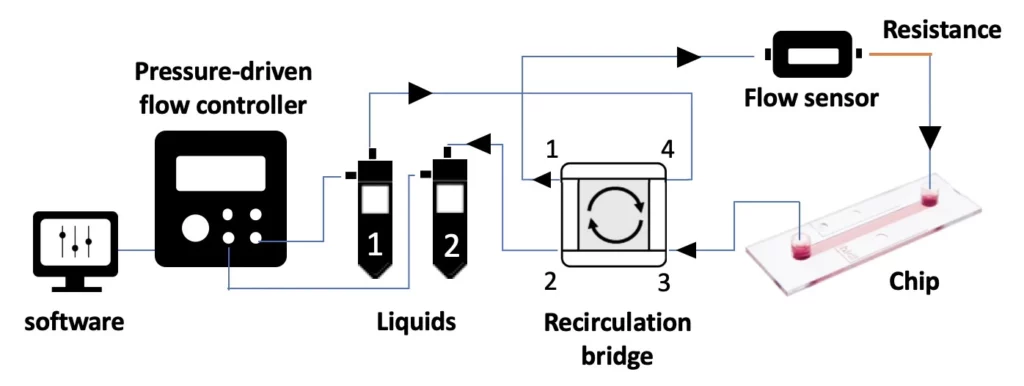
The blood-vessel-on-chip pack includes:
Flow sensor (Galileo, MIC)
Recirculation bridge
Smart culture tube rack
Software (Galileo user interface)
Flow controller
Reservoirs for precursor solutions
Several falcon reservoirs
Tubings and fittings
Microfluidic chip of your choice
User guide
Compatibility of blood-vessel-on-chip pack
Our blood-vessel-on-chip Pack was designed to be compatible with commercially available or homemade chips (specific adaptors might be required), the most common microscopy, and supernatant assays. If you work with a particular chip or assay not listed below, please get in touch with us!
Chips
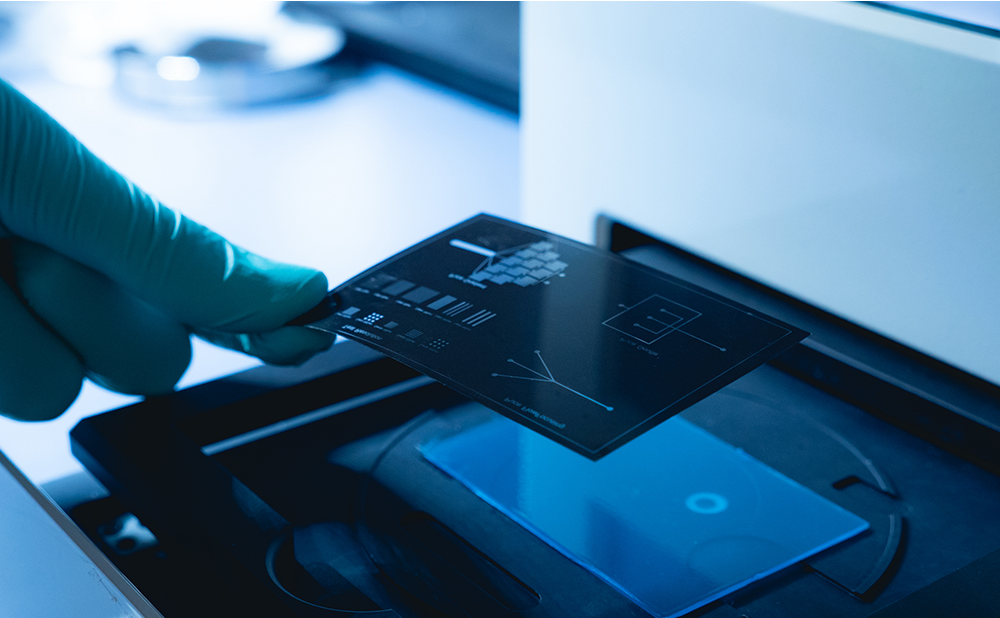
PMMA device station
From mold development to high-resolution PMMA chip fabrication
✓ Fast process
✓ Multiple applications
✓ Simple and innovative setup
PMMA
Synvivo
Ibidi
Microfluidic ChipShop
And many more!
Applications
Assays
TEER
Immunostaining of endothelial cell markers
Albumin reabsorption
3D reconstructions
Perfusion assay, using fluorescent dyes
Pharmacokinetics assays
Immunohistochemical and histopathological characterization
Toxicity assays
And many more!
- Effects of shear stress and flow profile on endothelial cells
- Migration and evasion/invasion of circulating tumor cells
- Barrier structure and permeability
- Vascularisation
- Angiogenesis
If you want to know more about organ-on-a-chip technology, have a look at this review!
Customize your pack
We offer compatible instruments for standard commercialized chips from various brands. We can customize your pack to suit your specific needs with guidance from our specialists, who will suggest the best instruments and accessories. We’ll also help you set up the perfusion platform.
Frequently asked questions
Can I order a pack?
Since Packs are products that are still being developed, we have a few eligibility criteria to maximize their success rate. A discussion with our experts is needed to determine your specific needs to offer you a personalized response.
Can the modules be sterilized/autoclaved?
The components of the setup can be sterilized. Our user guide provides detailed information on how to do it.
Can a pack be customized based on my specific application?
Yes! Our experts will establish which instruments are best suited for your application, such as the type of flow sensor or the number of flow controller channels you need to perform your experiment. Contact us using the “talk to our experts” green button above.
Can I buy individual instruments?
Our instruments are in beta testing phase and can be tested as a pack or individually, so get in contact with our team to know how our beta testing program works.
Download the MIC Horizon Europe 2026/2027 Calls Calendar:



Funding and Support
The ALTERNATIVE and LIFESAVER projects helped develop this instrument pack.
These projects are funded by the European Union’s H2020-LC-GD-2020-3, grant agreements No. 101037090 (ALTERNATIVE) and 101036702 (LIFESAVER).
Products & Associated Accessories
FAQ - Blood Vessel On Chip Pack
In simple words, what is the Blood Vessel-on-Chip Pack?
It is a perfusion system designed to simulate in vivo conditions of real vessel flow in vitro that is, controlled and measurable flow and shear stress across endothelial models, without pushing you into a proprietary single chip format. It is quite straightforward, maintain your biology model loose, but cause the fluidics to act as vasculature.
What is the type of flow that it can produce (how close to physiological conditions is it)?
The pack is built around the principles of pressure-driven control and flow sensing, such that you can set flow rates ranging between the very low microfluidic level of perfusion and relatively high level of vascular-like regimes. The mentioned is 0.5 µL/min – 5 mL/min, and programmable profiles can be linear ramps, pulsatile flow, and stepwise patterns. This is important in real-life situations since endothelial phenotype may quickly move when shear stress is approximately right as opposed to right.
Is it limited to a particular chip blood vessel, or can I use my own?
It is purposely non-chip specific. It is stated that the pack is compatible with commercially available chips and homemade devices (adaptors may be required depending on geometry/connectors). It is compatible with standard formats like PDMS homemade equipment, and popular commercial vendors (synvivo, ibidi, and Microfluidic Chipshop among others), and other platforms.
What are the biological models it supports- endothelial monolayers only?
Not only. The pack is stated to be applicable in circular tubules, monolayers and barrier models provided that they can be attached to a controlled loop of perfusion. When your installation is more niche (Multi-organ coupling, weird connectors, odd dead volumes), that is just where homemade adaptors and a brief engineering consultation tend to save weeks of experimentation.
So, what’s in the pack?
The out modules are known as core modules:
- A flow sensor (Galileo, MIC)
- A flow controller, which is a pressure-driven flow controller.
- A recirculation bridge (structure that allows the media to be recycled)
- Level sensors fitted on a smart culture tube rack.
- Software interface (Galileo user interface).
- Reservoirs (with several Falcon reservoirs), tubing and fittings.
- A microfluidic chip – of your choice (i.e. one that is chosen to fit your application).
- A user guide.
What is recirculation? what is fresh media and discarding?
There is recirculation in the instances where not only wasting media cost is involved. Recycling may:
- Minimize overall media use in the case of long experiments
- Conserve conditioned media and bioactive factors
- Permit enrichment of the metabolites which can be more similar to what occurs in vivo. Naturally not all assays desire accumulation–but instead it is preferable to have it as a non-fixity instead of a constraint.
What does the setup do to minimize the possibility of running an experiment dry (or forcing air into the chip)?
The level sensors (combined with the smart culture tube rack) will serve to automate the process of switching the reservoirs and avoid disastrous occurrences: when leaked or depleted too fast, the system can be terminated before the reservoirs are emptied and air get into the cells. It is among those features which are boring, and which you find yourself interested in when you fail to have a culture of 10 days one time.
What assays and readouts can it be used in?
The page clearly indicates that it is compatible with standard microscopy procedures and supernatant assays, and provides examples of typical vascular / barrier measurements:
- TEER measurements
- Endothelial cell immunostaining.
- Fluorescent dyes perfusion assays.
- 3D reconstructions
- Albumin reabsorption
- Pharmacokinetics-style assays
- Characterization, immunohistochemical / histopathological.
What are the most directly relevant scientific questions that this pack addresses?
There are some themes that are obviously underlined:
- Endothelial cell shear stress and effects of flow profiles.
- Under flow Migration and invasion/evasion of circulating tumor cells (CTCs).
- Under defined perfusion, there is a change in barrier integrity and permeability.
- Angiogenesis and vascularisation processes.
Is it possible to sterilize or autoclave the components?
The parts of the arrangement can be sterilized and the user manual is said to have detailed operations. Autoclaving is a protocol specific to each module (some modules can be subject to autoclaving, some are better served by chemical sterilization or filtration-compatible protocols), and as such is often not a protocol followed as a single instruction, but on a module-by-module basis.
Is the pack customizable to my specific application (channels, sensors, special chips)?
Yes, customization is also included in the offer. The examples provided are highly practical: you have to select the type of flow sensor and its size, determine the number of controller channels you require, and modify the pack to suit your chip manufacturer or your own home-made device. It is also here that a skilled microfluidics engineering collaborator will come in handy: you can skip some minor failure modes, such as compliance-induced oscillations, dead-volume dilution of your secreted factors, or placement of flow sensors that silently bias your readouts.
Is it ready to order or is it still in use?
The packs are mentioned as underdeveloped, with the eligibility criterion to be set aimed at maximizing the success rate, and a meeting with MIC experts is necessary to discuss needs and suggest a customized setup. Equally, separate instruments have been denoted as being in a beta-testing stage, in which case you can probably test them as an item, or a pack, but they are governed by a beta program and must not be purchased as an item of a completely standardized webshop.