
Microbiology Incubator
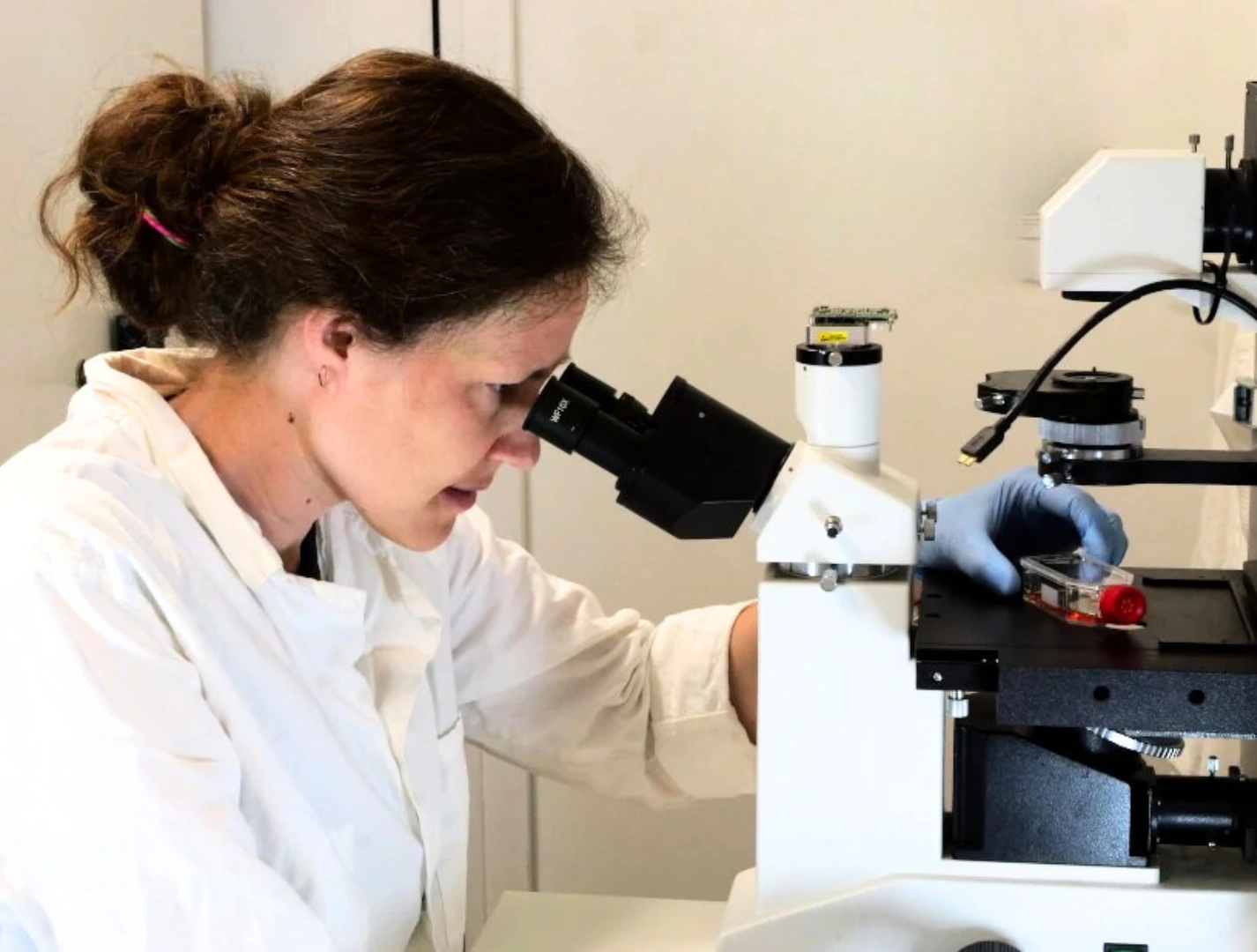
Follow your bacteria’s growth and responses in real time under the microscope
Follow your bacteria in real time
Small and mobile incubator chamber for the microscope stage
Accurate temperature control
Keep your bacteria at 37.5°C ± 0.5°C outside the incubator
Up to 2 simultaneous cultures
Test different conditions in the same system
Need a microfluidic SME partner for your Horizon Europe project?
Image credit: Proteus, SEM. David Gregory & Debbie Marshall.
How to culture bacteria under the microscope?
The current advances in analytical assays allow greater detail and information out of experiments. For example, it is possible in microbiology to follow single-cell gene expression through time [1] or follow the growth rate and gene expression of several generations of bacteria [2] in microfluidic devices.
However, to do so also requires better ways of gathering data. For example, single-cell monitoring can be significantly improved if the bacterial culture is maintained on top of the microscope stage. But that, in turn, requires minimal culturing conditions outside the incubator.
The microbiology incubator was designed to address precisely this need. As shown below, it keeps an ideal temperature under the microscope for better imaging data gathering for either static or dynamic flow conditions.
References
1. Young, J., Locke, J., Altinok, A. et al. Measuring single-cell gene expression dynamics in bacteria using fluorescence time-lapse microscopy. Nat Protoc 7, 80–88 (2012). https://doi.org/10.1038/nprot.2011.432
2. Long, Z., Nugent, E., Javer, A., Cicuta, P., Sclavi, B., Lagomarsino, M. C., and Dorfman, K. D. Microfluidic chemostat for measuring single cell dynamics in bacteria. Lab Chip, 2013,13, 947-954
Microbiology incubator setup
A pressure-driven flow controller and a microfluidic flow sensor (eg. Galileo) can control the flow in experiments with bacteria in dynamic conditions.
This setup can also be combined with other packs, such as media perfusion and recirculation, sequential injection, bubble trapping, cell-cell interaction monitoring, or precision sampling for more complex applications.

The Microbiology incubator pack contains:
Flow sensor (Galileo, MIC)
Software (Galileo user interface)
Flow controller
Microbiology incubator (in development)
Several Eppendorfor falcon reservoirs
Tubings and luers
Microfluidic chips if needed
User guide
For more information on the chamber, check our stage top incubator page!
The performance of the microbiology incubator
Bacillus subtilis is a gram-positive soil bacteria related to many critical applications in the food industry and environmental sciences. Given its wide range of utility and that it is not a pathogen to humans, it is a widespread model organism for bacterial adaptability, development, and biofilm formation.
It is found in diverse environments, from soil to human gut microbiome, with radical differences in temperature. In addition, they produce endospores that can withstand extreme temperatures. Therefore, depending on the behavior to be studied, high temperatures, constant fluctuations, or stable 37oC can be of interest as culturing conditions.
Here, the goal was to assess the performance of the microbiology incubator in comparison with a traditional incubator at 37oC and cultures grown at room temperature.
The microbiology incubator was initially designed to house dynamic cultures, such as cultures grown in chips subjected to media flow. However, it can easily accommodate static cultures and different culturing devices, such as the Eppendorf demonstrated below.
Methods
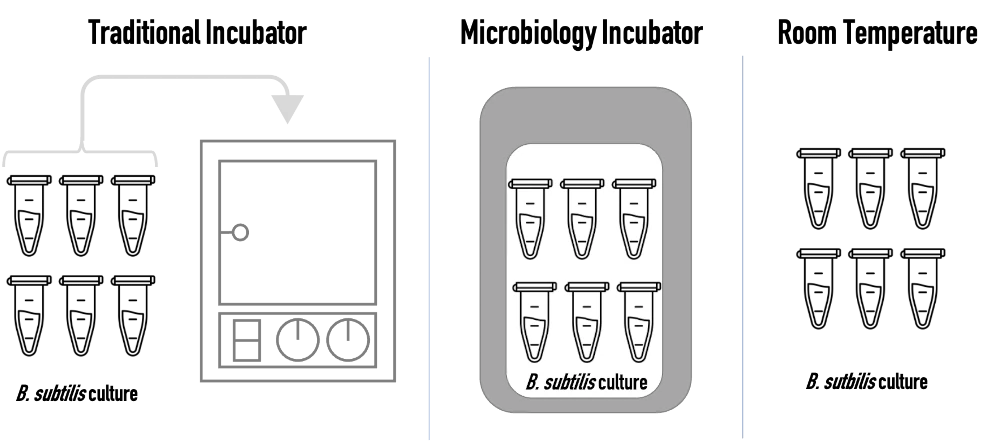
Freshly inoculated Lysogeny Broth (LB) medium was distributed in 18 Eppendorfs that were divided in three groups and placed in a standard incubator at 37 °C, in the microscope stage incubator at 37 °C and left outside at room temperature.
Results
Preliminary results of bacterial growth in the microbiology incubator show equivalent curves when compared to a standard incubator.
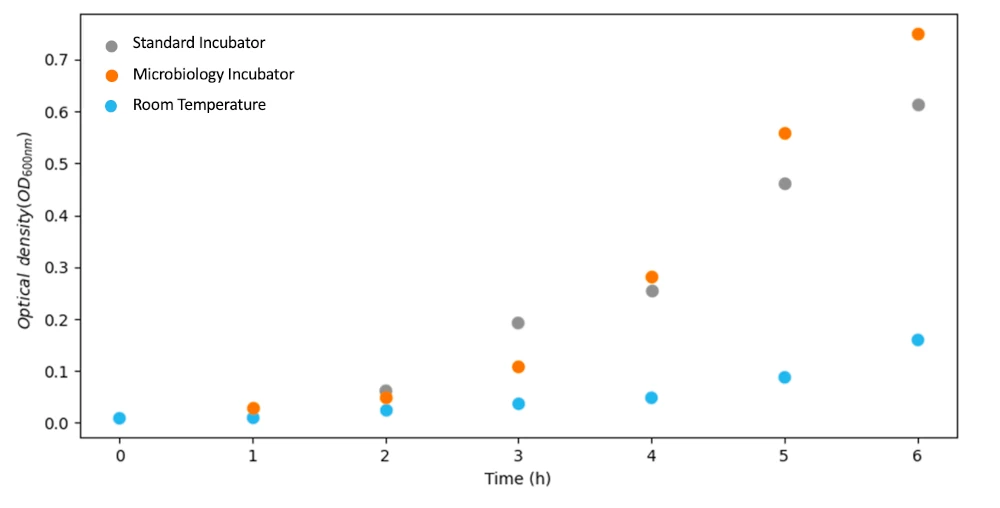
Each group’s turbidity of one Eppendorf was measured every hour for 6 hours with a spectrophotometer at 600 nm wavelength (OD600). OD600 measurements are routinely used to measure microbial proliferation in liquid cultures. Bacillus subtili’s ideal culture temperature is 37 °C.
Therefore, faster growth is expected in inoculates stabilized at such temperatures. Both incubator and microbiology incubator showed similar OD readings at each timestep, with both groups entering the exponential growth phase as opposed to the room temperature group.
Customize your microbiology incubator pack
In the past years, several commercialized and laboratory-made microfluidic chips have been developed and tested to perform dynamic cell and bacteria culture efficiently. We can include one of them with different surface modifications inside the pack. A chip can also have several separate channels.
Our products and packs are fully customizable to fit your needs. Our microfluidic specialists and researchers will help you choose the best instruments and accessories and accompany you during the setup of the microfluidic platform until you can obtain your first experimental results.
Contact our experts for any questions about this microbiology incubator and how it can match your specifications!
Frequently asked questions
Is the microbiology incubator gas-tight?
No, the chamber allows gas exchange with the atmosphere.
Can the chamber be sterilized?
Yes, we have developed a simple protocol for sterilization and cleaning that is provided along with the user guide.
In the case of dynamic culture, do the reservoirs need to be kept warm?
No, the reservoirs can be kept at room temperature. The microbiology incubator was designed to warm the liquids to the right temperature before reaching the bacteria.
Can I order a pack?
Packs like this one are available under certain conditions. Since Packs are still under development, we have a few eligibility criteria to maximize their success rate. Discussions with our experts are needed to determine your specific needs and offer you a personalized response. Contact us using the “talk to our experts” green button above.
Download the MIC Horizon Europe 2026/2027 Calls Calendar:




Funding and Support
The ActiveMatter, ACDC, and Protomet projects helped develop this instrument pack, with funding from the European Union’s Horizon 2020 MSCA-ITN under grant agreement No 812780 (Active Matter),the European Union’s Horizon 2020 research and innovation program under grant agreement No 824060 (ACDC project), and the European Union’s Horizon 2020 MSCA-ITN under grant agreement No 813873 (ProtoMet).
Products & Associated Accessories
FAQ - Microbiology Incubator
What is the Microbiology Incubator Pack, and what is the solution?
Microbiology Incubator Pack is a small, broad-based stage-top incubator that keeps bacterial cultures at the appropriate temperature directly on a microscope stage. In conventional incubators, the researcher must transfer samples to obtain images, break experiments, and limit real-time data acquisition. This pack removes this restriction by maintaining constant conditions in the microscope, allowing continuous, live observation of bacterial behavior without disturbing the culture.
What was the incubator’s temperature, and how consistent was it?
The incubator will maintain a temperature of 37.5 °C with a ±0.5 °C tolerance, which matches the growth temperature of the commonly used model organisms (Bacillus subtilis and Escherichia coli). Such stability is essential for obtaining repeatable measurements and for observing temperature-sensitive biological processes, e.g., gene expression or sporulation.
Is the incubation chamber gaseous?
None – it is not gas-tight and exchanges gases with the atmosphere. This implies that it is adapted for aerobic bacterial cultures that require atmospheric oxygen. Students who need a high degree of controlled gas conditions, like anaerobic conditions or high CO2, would have to take further adjustments or different configurations into account.
Is it possible to sterilize between experiments in the chamber?
Yes. An easy-to-follow sterilization and cleaning procedure is provided in the user guide. This makes it convenient to reuse over time across any bacterial strain or experimental conditions without creating cross-contamination, which is crucial in any microbiology workflow.
Should the fluid reservoirs also be heated?
No. This is because the reservoirs are allowed to be at room temperature. The incubator will raise the new liquid to the desired temperature before it gets to the bacteria. This makes the entire system easier because only the stage-top requires active heat control, not the entire fluid line between the reservoir and chip.
What is the performance of the pack when compared to a standard laboratory incubator?
The validation of performance was done through the use of Bacillus subtilis cultures that were grown in a standard incubator and also in the microbiology incubator and at room temperature. OD600 measurements were made every hour within six hours and both the standard incubator and the microbiology incubator gave similar growth curves, with both systems entering the exponential growth phase and the room-temperature group lagging behind. This confirms that this system supports growth of bacteria at a similar rate to benchtop incubators.
Does the pack support dynamic flow conditions and static cultures?
Yes. Although originally intended to support dynamic cultures, including bacterial culturing in microfluidic chips under continuous media flow, the incubator can accommodate both static and dynamic cultures and standard vessels such as Eppendorf tubes. A pressure-driven flow controller and microfluidic flow sensor can be used together to control and monitor fluid delivery in dynamic experiments, enabling researchers to study bacteria under conditions more relevant to their natural habitats.
Which other experimental setups may be used together with this pack?
The microbiology incubator is meant to be a part of a larger microfluidic tool ecosystem. One can add media perfusion and recirculation, sequential injection systems, bubble trapping, cell-cell interaction monitoring systems, or even more complex experimental designs using more complex tools.
Which microfluidic chip can be used with the pack?
The pack can be supplied with a variety of commercially produced microfluidic chips for dynamically culturing cells and bacteria, and surface engineering within the chip may be performed when required. Multi-channel chips can also be chosen, depending on the application of interest, i.e., whether the investigator requires observation of individual channels with bacteria, parallel cultures in many different conditions, or more complicated geometries to investigate biofilm formation or chemotaxis.
What is the ordering of this pack and can it be ordered immediately?
Under some conditions, the packs are available. As they are still in their development phase, the eligibility requirements can be used to maximize the success rate, and it is necessary to consult our team for specific needs and provide a specialized response. Interested researchers are invited to contact our experts directly via the contact options on our website.