Biomechanics and modeling in mechanobiology pack
Surround your cells with a more realistic microenvironment
Control the chip of your preference
Apply different mechanical stresses with one setup
Follow your cells in real-time
Keep your cells at the right temperature under the microscope
Mechanobiological cell response
Allows advanced molecular and morphological analysis of cells
Need a microfluidic SME partner for your Horizon Europe project?
Image Credit: SEM of blood corpuscles in clot. David Gregory & Debbie Marshall. Licence: Attribution 4.0 International (CC BY 4.0)
Biomechanics and modeling in mechanobiology (BMM) setup
The pack consists of a flow controller and a flow sensor to control the media supply to your cells and the desired mechanical stimulus. The level sensors are a fail-safe mechanism to prevent reservoir empties and your cells from being undesirably exposed to air.
The chip is placed inside our stage-top incubator, so the cells are kept at the ideal temperature on top of the microscope stage during the experiment. The mechanical stimulus’s effects can be followed in real-time. The supernatant can be collected for further molecular analysis.
Different chips can be employed with this setup. In the example below, the Microfluidic ChipShop chip 480 has been used to exert stretching stimulus on cells cultured on the membrane. It is important to note that off-the-shelf chips do not possess a flexible membrane and the membrane may require customization to be suitable for trial assays.
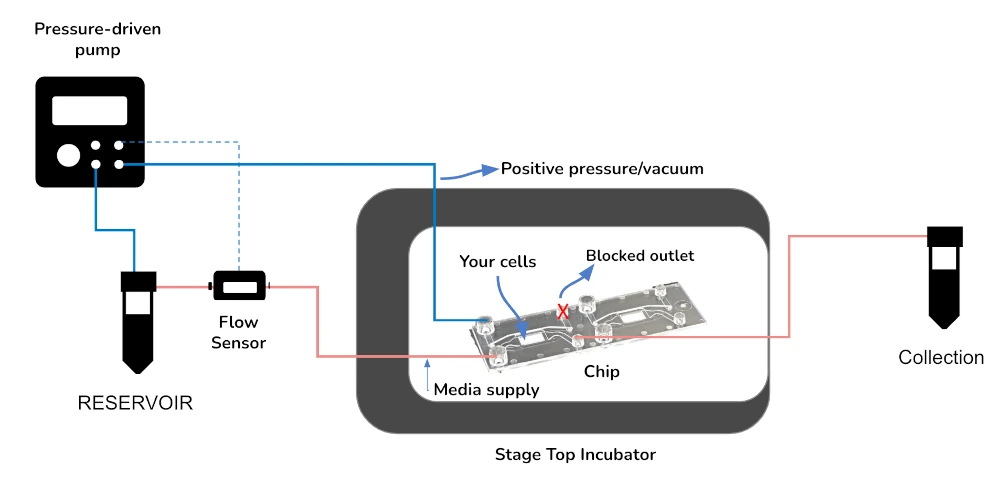
The BMM pack includes:
Flow sensor (Galileo, MIC)
Stage top incubator (in development)
Level sensors
Software (Galileo user interface)
Flow controller
Several Falcon or Eppendorf reservoirs
Tubings and luers
Microfluidic chips of choice (including home-made chips)
User guide
* The off-the-shelf membrane is intended for molecular transport assays and does not possess a flexible membrane. Customer-specific membranes can be used upon request to Microfluidic ChipShop.
Check our automated cell culture platform for more details on an integrated approach!
Types of mechanical stimuli
Several commercially available chips can perform mechanical stimulus analysis with our biomechanics and modeling in mechanobiology setup. The setup can also be used with home-made chips. A quick exchange with our team can clarify the need for specific adapters.
For shear stress assays, Ibidi’s straight channel µ-Slide I Luer is a great option that can be easily used with our setup. The shear stress applied on top of the cells can be estimated by entering the dimensions of the chip into the Shear Stress calculator.
As shown above, the Microfluidic ChipShop chip 480 can be adapted to perform stretching assays. The chip comes with a porous cross-flow membrane intended to serve molecular transport across the chambers, but the supplier can customize it upon request.
Netri’s DuaLink Delta Ultra chips are a good option for confinement assays. These devices were designed especially for co-cultures and enhanced growth kinetics studies.
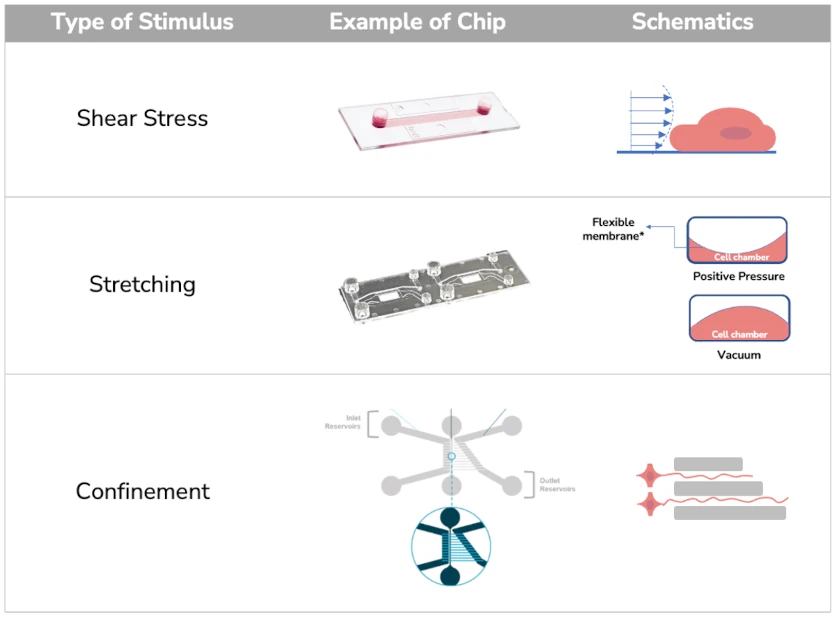
* The off-the-shelf membrane is intended for molecular transport assays. Customer-specific membranes can be used upon request to Microfluidic ChipShop.
Customize your pack
Our Packs, such as the Biomechanics and Modeling in Mechanobiology Pack, can be modified according to your specific needs. In this light, our microfluidic specialists will advise you on the best instruments and accessories and accompany you during the setup of the microfluidic platform.
Frequently asked questions
Is the stage top incubator gas-tight?
No, the chamber allows gas exchange with the atmosphere.
Can the chamber be sterilized?
Yes, we have developed a simple protocol for sterilization and cleaning that is provided along with the user guide.
Can I buy individual instruments?
Our instruments are in beta testing phase and can be tested as a pack or individually, so get in contact with our team to know how our beta testing program works.



Products & Associated Accessories
FAQ - Biomechanics and Modeling in Mechanobiology
Does it have a single chip supplier?
No, this is one of the main notions of the pack. It is programmed to operate with the majority of commercial chips, and can also be modified to home-made chips. Practically, it often is the connectors/adaptors which determine all, not the chip itself but whether or not the internal geometry of the chip corresponds to the mechanical signal you wish to assume quantitatively.
What is really in the pack?
It relies on a flow controller + flow sensor (to impose and check what the cells actually feel), and level sensors as a backup in order to ensure that your reservoirs do not empty quietly (and expose the cells to air in the middle of the experiment). The chip is placed in a stage-top incubator allowing experiments to be conducted on-microscope and in temperature. It also has a software interface (Galileo UI) which is controlled and monitored.
The rest is the real lab life kit: reservoirs (Falcon/Eppendorf), tubing/luers, user guide and the chip(s) of your choice.
Can I follow cell response in real time or is it more of a set and forget flow rig?
Follow-up is explicitly part of a real-time workflow. The system is constructed in such a way that you can observe the live mechanobiological response on the microscope (morphology, migration, dynamics, etc). And most importantly, you may gather supernatant later to complementary molecular readouts, so that you do not have to make the decision to use imaging or downstream biology.
I saw membranes mentioned. Do I need a flexible membrane for stretching assays?
For stretching assays, yes, then there must be an element that is mechanically compliant at some stage. Another pitfall is that in some commercial chips, off-the-shelf membranes are usually fabricated to perform transport/permeability measurements, and not for elastic deformation. A custom membrane (or a modified version of the chip) can then be required in such instances, when your experimental statement is that you are seeing the phenomenon of stretching, not that of flow across a porous interface.
Can you provide examples of the chips that are used by people of each type of stimulus?
Common combinations are relatively pragmatic:
- Shear stress: shear-based mechanotransduction is characterized by easy-to-plumb straight-channel slides.
- Stretching: Chips which may be programmed with a strain-compatible membrane architecture.
- Confinement assays: instruments that are based on either co-culture or constrained geometries (frequently when growth kinetics or migration under constraint is the final goal).
When you already have chips in-house, you can often get out there much more quickly it is faster to begin with what you can do and see what adapters or alterations are required than to go to chip selection and design.
Does the stage-top incubator have gas-tightness?
No. The room permits the exchange of gases with the atmosphere. That is an attribute (facilitation, ease), an attribute (restraint, strict control of gas composition). When stringent gaseous control is of utmost importance (e.g. specified O2/CO2 profiles), it is a good flag to note early since it affects the experimental design.
Is the sterilization between runs of the chamber possible?
Yes. The user manual is accompanied by a cleaning and sterilization procedure. In actual processes, it is not just that it can be sterilized. but also the extent of reproducibility and low labor of that routine–at least when more than one person is on the microscope platform.
Are the instruments commercially available today, or is this experimental?
There are instruments that are under beta testing. That is to say they might be tested as a package or stand-alone, though their availability and configuration may be subject to the prevailing beta program circumstances. Practically, that may be a plus when you have to have something custom made, not a pre-defined item in stock.
Does the MIC package my specific question in mechanobiology?
Yes, customization is also in the deal. The pack may be adjusted according to needs and MIC may recommend instruments/accessories and assist in the setup. This is likely to be important when your project occupies the interface between biology and engineering (e.g., hybridizing a standard chip with non-standard readouts, non-standard viscosities, delicate primary cells, or non-standard perfusion patterns).
Why should an EU research consortium be interested in an SME like MIC to do mechanobiology work?
In the rare case of mechanobiology in microfluidics, it is simply a matter of purchasing a device. It is integration work: fluidic design, experimental tradeoffs, microfabrication decisions, and the hurtful details that tell whether the information can be used or not. In the case of Horizon Europe-style projects, introducing a dedicated microfluidic SME can frequently decrease technical risk as well as decrease the time to a functioning prototype – particularly where the consortium requires both a plausible engineering as well as an actual-world delivery (not just a simulation or a mock-up). MIC applies to working in European consortia, prototype development and assisting partners to transform a scientific goal into something that can endure actual laboratory conditions.