Inline Viscometer for Ink Viscosity and Formulation
Ink viscosity measured across shear rates, from a recoverable 0.1 mL sample.
Shear-resolved ink viscosity
Capture full behaviour: from low (1 s⁻¹) to high (10⁵ s⁻¹) shear rates
Keep your precious sample
Measurements from 0.1 mL, with the sample recoverable
Catch drift during the run
Real-time readout with automated drift and clogging detection
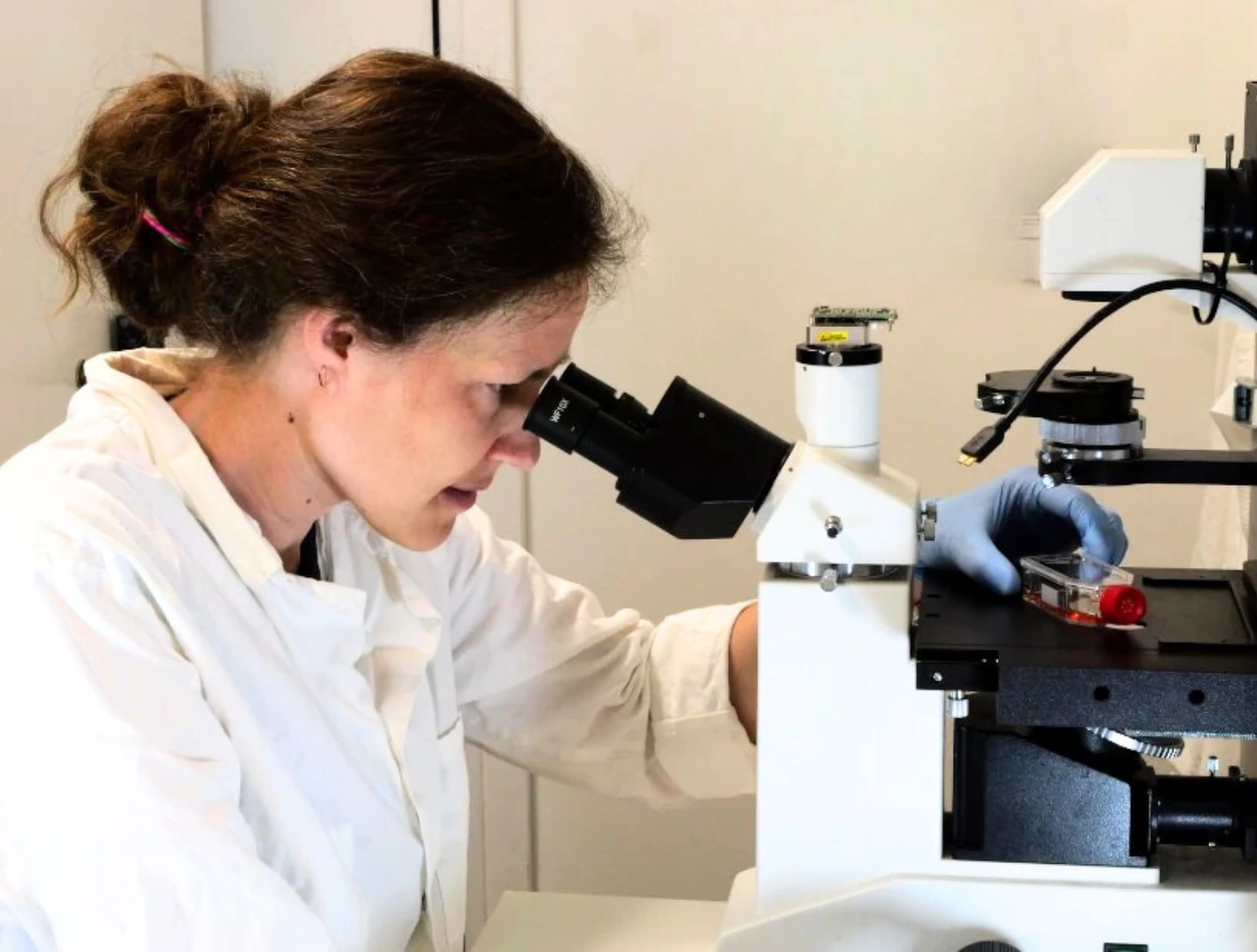
Need a microfluidic SME partner for your Horizon Europe project?
Inline ink viscosity measurement
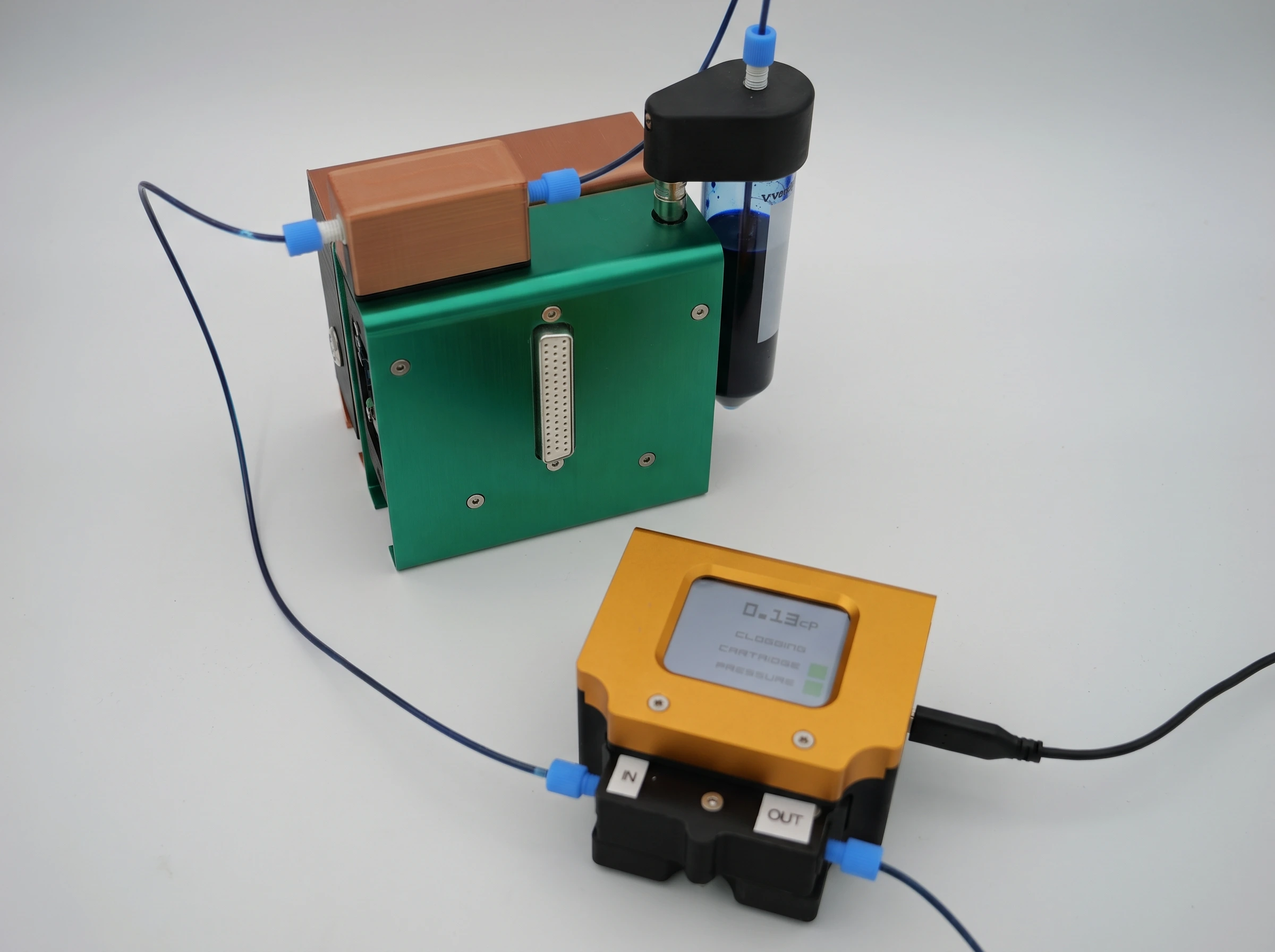
The inline viscometer measures ink viscosity in a flowing sample, at a controlled temperature. It provides flow curves for formulation work and real-time readings for small-batch quality control.
This application pack combines our inline viscometer with all-PEEK cartridges, sample-handling components and logging software. An optional microfluidic flow sensor can be added to the same setup.
Ink flow curves from low shear to handling conditions
Many pigmented and functional inks are shear-thinning. Their viscosity changes with shear rate, so one reading cannot describe the whole flow curve. Low-shear behaviour informs investigations of settling, sag and leveling, while higher-shear measurements help characterise pumping and handling.
Research on particle-loaded catalyst inks shows why both shear rate and recovery time matter for settling and coating behaviour [1]. Readings down to 1 s⁻¹ support formulation comparisons. Storage stability and thixotropic recovery also require appropriate time-dependent tests.
Small samples at a controlled temperature
Screening experimental UV-curable inkjet inks can mean comparing many monomer and reactive-diluent ratios in small batches. Published formulation screening has used just 0.5 mL per candidate [2]. The viscometer measures from 0.1 mL, with the sample recoverable after the run.
The instrument covers 0.2 to 100,000 cP, with a controlled setpoint within 10 to 70°C. Compare formulations at the same temperature, or repeat measurements at different setpoints to study viscosity versus temperature.
How the measurement works
Flow rate sets the shear rate inside the measurement channel. Stepping through flow rates gives viscosity as a function of shear rate. Holding a measurement condition provides a viscosity trace over time.
The standard shear range is about 1 to 1000 s⁻¹. A high-shear configuration extendable up to 10⁵ s⁻¹ is available on request. Inkjet studies show that inks with similar low-shear viscosity can differ substantially at jetting shear rates [3].
Readings appear on the instrument screen and are logged through the software, with CSV export. Automated drift and clogging detection flags conditions that may affect measurement reliability.
What's included
Inline viscometer
Single-use disposable all-PEEK cartridges
Reservoirs, tubing and fittings
Dedicated software with real-time display and data logging
User guide and technical spec sheet
Optional inline flow sensor
Connect the instrument between your reservoir or syringe and the downstream chip or collection vessel. It works with pressure-driven, syringe or peristaltic pumps.
Use a fresh cartridge for each sample to limit carryover. For inline monitoring, MIC scopes the connection around your line pressure, flow conditions and ink.
Ink viscosity applications
Formulation and small-batch quality control
- Mapping shear-thinning flow curves for pigmented screen, flexo and gravure inks.
- Comparing low-shear viscosity when investigating pigment settling, sag, leveling and storage stability.
- Characterising small batches of silver or copper nanoparticle conductive inks while recovering the sample.
- Measuring UV-curable formulations, printable bio-resins and multi-composition liquids for material jetting.
- Tracking viscosity at fixed shear and temperature to identify changes within or between batches.
Printable resin droplets in VOXWRITE
In the VOXWRITE project, MIC develops a microfluidic sequential injection device that produces resin droplets with varying compositions for multi-material 4D printing. The work brings MIC into direct contact with polymerisable liquids and the flow conditions needed to generate droplets.
For formulators developing such liquids, a shear-resolved viscometer provides viscosity data to guide flow and droplet trials. The practical case illustrates MIC’s work on printable-material delivery; it does not establish that this viscometer was used in VOXWRITE.
The inline viscometer was developed within GALILEO, coordinated by MIC under the EIC Transition programme. The same instrument platform also serves the whole-blood viscosity application pack.
Inline viscometer technical specifications
| Parameter | Value |
|---|---|
| Measurement | Shear-resolved viscosity (high-shear and low-shear), set by flow rate |
| Viscosity range | 0.2 to 100,000 cP |
| Shear rate range | About 1 to 1000 s⁻¹, extendable to 10⁵ s⁻¹ on request |
| Low-shear reach | Reliable readings down to 1 s⁻¹ |
| Viscosity resolution | 0.01 cP |
| Accuracy | Better than 5% of reading |
| Repeatability | Better than 2% |
| Minimum sample volume | 0.1 mL |
| Operating temperature | 10 to 70°C, controlled setpoint |
| Maximum operating pressure | 4 bar |
| Monitoring rate | Continuous logging at up to 100 Hz |
| Compatible pumps | Pressure-driven, syringe, or peristaltic |
| Sample | Recoverable after the run |
| Readout | Real-time on-device screen, software logging and CSV export |
| Connection | USB to a standalone software interface |
| Fittings | Standard microfluidic fittings (1/4-28 or Luer) |
| Chips | Works with commercial or home-made chips |
| Wetted path | Single-use, disposable cartridge, all-PEEK version for solvent-based inks |
| Cleaning | Sanitization protocol, or discard after use |
| Footprint | Compact benchtop unit (10 cm × 10 cm × 6 cm) |
Download the MIC Horizon Europe 2026/2027 Calls Calendar:
References
- [1] Liu P, Yang D, Li B, Zhang C, Ming P. Influence of Degassing Treatment on the Ink Properties and Performance of Proton Exchange Membrane Fuel Cells. Membranes. 2022;12(5):541. https://doi.org/10.3390/membranes12050541
- [2] Zhou Z, Ruiz Cantu L, Chen X, Alexander MR, Roberts CJ, Hague R, Tuck C, Irvine D, Wildman R. High-throughput characterization of fluid properties to predict droplet ejection for three-dimensional inkjet printing formulations. Additive Manufacturing. 2019;29:100792. https://doi.org/10.1016/j.addma.2019.100792
- [3] Wang X, Carr WW, Bucknall DG, Morris JF. High-shear-rate capillary viscometer for inkjet inks. Review of Scientific Instruments. 2010;81(6):065106. https://doi.org/10.1063/1.3449478





Funding and Support
This project has received funding from the European Union’s Horizon research and innovation program under HORIZON-EIC-2024-PATHFINDEROPEN-01, grant agreement no. 101185661(ERMES), HORIZON-EIC-2022-TRANSITION-01, grant agreement no. 101113098 (GALILEO). It has also received funding from the European Union’s Horizon research and innovation program under the Marie Skłodowska-Curie grant agreements no. 101119956 (DarChemDN).
About the author

Mukesh Kumar Sivakumar
Doctoral researcher in microfluidics, Microfluidics Innovation Center
Mukesh Kumar Sivakumar develops advanced microfluidic systems at the Microfluidics Innovation Center, as a doctoral candidate in the DarChemDN European doctoral network. He holds a BS-MS dual degree in physics from IISER Tirupati, India, and three years of hands-on research experience in microfluidics, biophysics, and diagnostics, in both academic and industrial settings.
Products & Associated Accessories
FAQ: Inline viscometer for ink viscosity
What is the inline viscometer, and what does it measure for inks?
It measures the shear viscosity of ink flowing through a microfluidic cartridge. You can map viscosity against shear rate or monitor viscosity over time at a controlled temperature. Values are expressed in cP, numerically equivalent to mPa·s. Use those measurements alongside coating or droplet trials when assessing printability.
Can it measure shear-thinning inks, and what viscosity and shear ranges does it cover?
Yes. Changing the flow rate sets different measurement shear rates, giving low-shear and high-shear readings across about 1 to 1000 s⁻¹. The viscosity range is 0.2 to 100,000 cP.
This captures changes in viscosity across the measured flow curve. For a thixotropic ink, keep sample preparation, shear history and dwell times consistent, because viscosity also changes with time [1]. A reading at 1 s⁻¹ is a low-shear measurement, not a direct measurement of behaviour at rest.
Does it reach inkjet jetting shear?
Yes, with a high-shear configuration extendable to 10⁵ s⁻¹ on request. It is best suited to thin, low-viscosity inks. Pressure requirements and viscous heating limit the achievable rate for more viscous formulations, so MIC scopes the reach for each ink.
Jetting can reach roughly 10⁵ to 10⁶ s⁻¹, depending on the nozzle and drive conditions [3]. The requested configuration therefore reaches into this regime without covering its full upper end.
If your ink is Newtonian from the standard measurement range through jetting conditions, its shear viscosity is the same at the same temperature. A standard measurement then supplies that value. A flat curve between 1 and 1000 s⁻¹ alone does not prove that the ink stays Newtonian at jetting shear [3].
How much ink does a measurement need, and do I get it back?
The minimum sample volume is 0.1 mL, and the sample is recoverable after the run. This is useful for scarce conductive or functional formulations. When planning the total ink volume, also account for filling your tubing and any other components in the setup.
Can it measure at my application temperature?
Yes. The instrument provides a controlled setpoint within 10 to 70°C. Measure each formulation at your selected temperature, or repeat the flow curve at different setpoints to compare temperature dependence. Allow the sample to reach the measurement temperature before comparing results.
Is it compatible with solvent-based inks?
This pack uses the all-PEEK wetted-path version with a single-use disposable cartridge. Share the complete solvent blend, operating temperature and contact time with MIC so the cartridge, reservoirs, tubing and fittings can be matched to the application.
Use fresh cartridges to limit cross-contamination. For volatile inks, limit solvent loss from reservoirs during measurement.
Can it run inline in my printing or coating line, and does it flag drift or clogging?
Yes. MIC can integrate the instrument into a suitable flow line, within its 4 bar maximum operating pressure. It provides a real-time screen readout, automated drift and clogging detection, and continuous logging at up to 100 Hz.
Compare viscosity at consistent shear and temperature when looking for batch drift. The logging rate is distinct from the time needed to acquire a complete flow curve. For longer runs, include checks for solvent evaporation, carryover and pump-tubing wear in your operating procedure.
Can it be customised for my ink, chips and pumps?
Yes. The instrument works with pressure-driven, syringe or peristaltic pumps, standard microfluidic fittings, and commercial or home-made chips.
For a quote, send MIC your solvent system, expected viscosity, particle size and loading, target shear rates, temperature and setup diagram. Include any UV-curing sensitivity or sample-recovery requirements. MIC can then scope the cartridge and integration around your formulation.
Can MIC be our microfluidic SME partner for a Horizon Europe or EIC project?
Yes. MIC contributes microfluidic engineering, instrumentation and integration, and helps develop the proposal and valorization plan. Its relevant experience includes resin-droplet delivery in VOXWRITE and coordination of the GALILEO EIC Transition project.
For a printable-materials or printed-electronics proposal, contact MIC while the consortium is forming. Share the liquid-handling and measurement tasks you need, so the team can define a suitable microfluidic contribution.