Inline Viscometer for Nanoparticle Synthesis
Real-time feed viscosity for reproducible nanoparticle synthesis.
Wide viscosity range
0.2 to 100,000 cP, from thin aqueous buffers to thick lipid and polymer solvent phases.
Small, recoverable sample
0.1 mL per measurement, and you collect the sample back. No wasted lipids or API.
Catches feed drift in real time
Automatic clog and drift detection, before a changing feed quietly costs you a batch.
Need a microfluidic SME partner for your Horizon Europe project?
Inline viscometer for nanoparticle synthesis
When you make nanoparticles by microfluidic mixing or nanoprecipitation, the viscosity of your feed streams shapes how the phases mix, and mixing shapes the size of the particles and how tightly that size is distributed [1]. A lipid mix in ethanol, a polymer in acetone or acetonitrile, a plain aqueous buffer: each carries its own viscosity. That viscosity moves when concentration, temperature, or a solvent batch changes, and the shift is quiet. Your size and PDI drift before you know why.
The inline viscometer sits in the flow line and reads viscosity in real time, so you can hold the feed steady from one run to the next. It measures viscosity, and only viscosity. It does not measure particle size, PDI, or encapsulation efficiency, so it works next to a DLS sizer rather than replacing it. What it does add for that sizer is the true medium viscosity needed to turn particle diffusion into a hydrodynamic size, instead of assuming water when the dispersant is a buffer, a residual-solvent mix, or a sucrose cryoprotectant.
Viscosity is one of the parameters worth keeping constant, not the single knob that sets size. For some formulations the link between solvent viscosity and final size is strong; for others it is weaker [2]. Either way, watching it tells you when the process has shifted.
It also watches itself. Automatic clog and drift detection flags a blocked line or a feed that has started to change, so a silent problem does not run for an hour before you notice.
In the NAP4DIVE project [3], MIC builds the microfluidic system that supplies the cells and injects the nanoparticle formulations under test, lipid, polymer, and metal-core, onto a high-throughput blood-brain-barrier-on-chip model. Delivering those formulations reproducibly is exactly the setting where feed and formulation viscosity matter, and where an inline viscometer earns its place for feed control and batch QC. The instrument itself was developed in the GALILEO project [4], alongside a wide-range flow sensor and a flow calibrator.
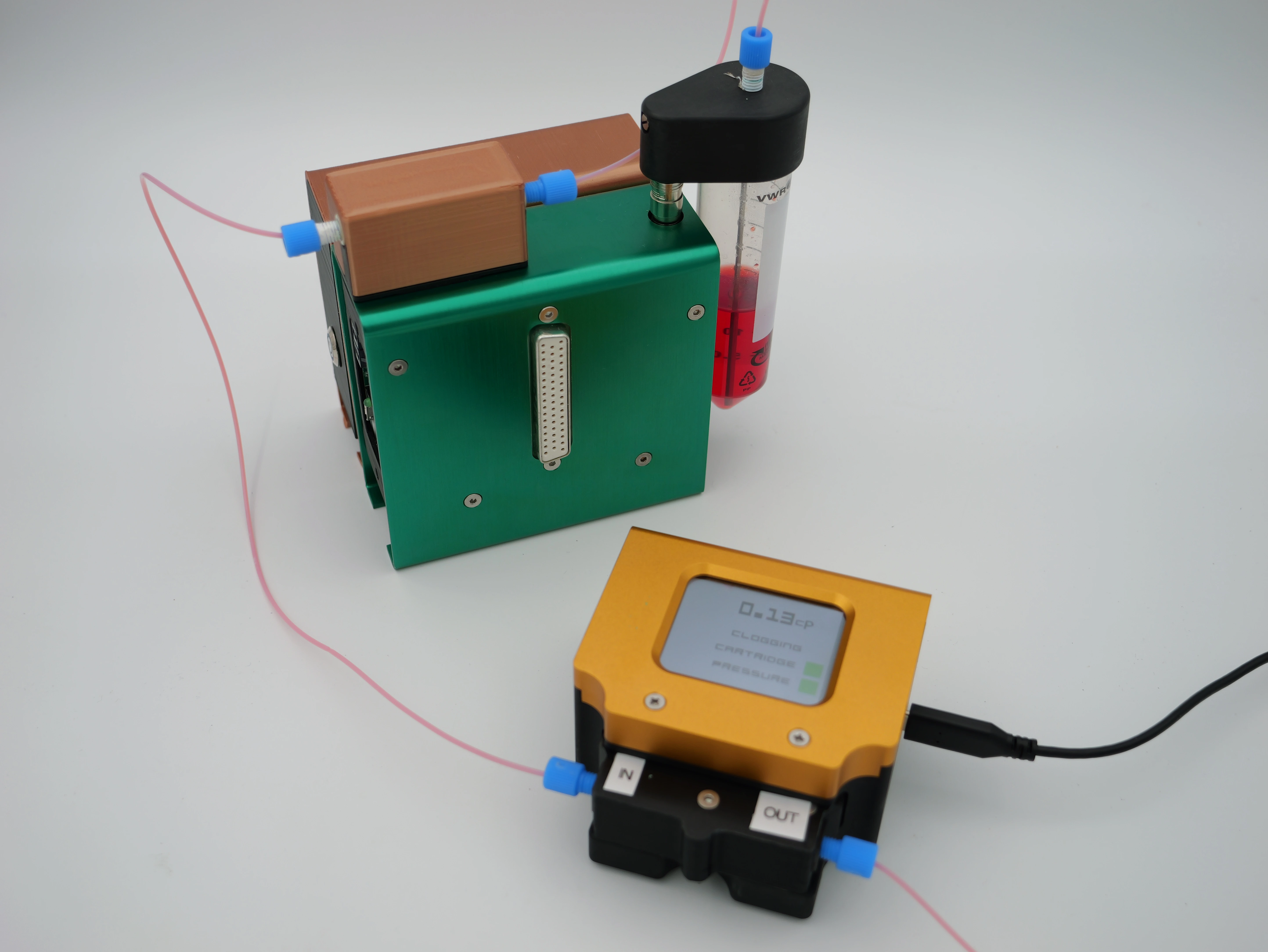
Setup
Pressure-driven flow controller, syringe pump, or peristaltic pump
Flow sensor (Galileo, optional)
Inline viscometer
Reservoirs
Tubing and fittings
User guide
Software
The inline viscometer drops into your existing setup, whether you drive flow with a pressure controller, a syringe pump, or a peristaltic pump. You connect its inlet to the outlet of your reservoir or syringe and its outlet to your mixing chip. Dedicated software logs the data, and you can read viscosity in real time on the on-device screen.
Reservoirs, tubing, and connectors are commercially available, reusable or disposable, sterile or not. The system works with any chip, commercial or home-made, including staggered-herringbone and flow-focusing mixers.
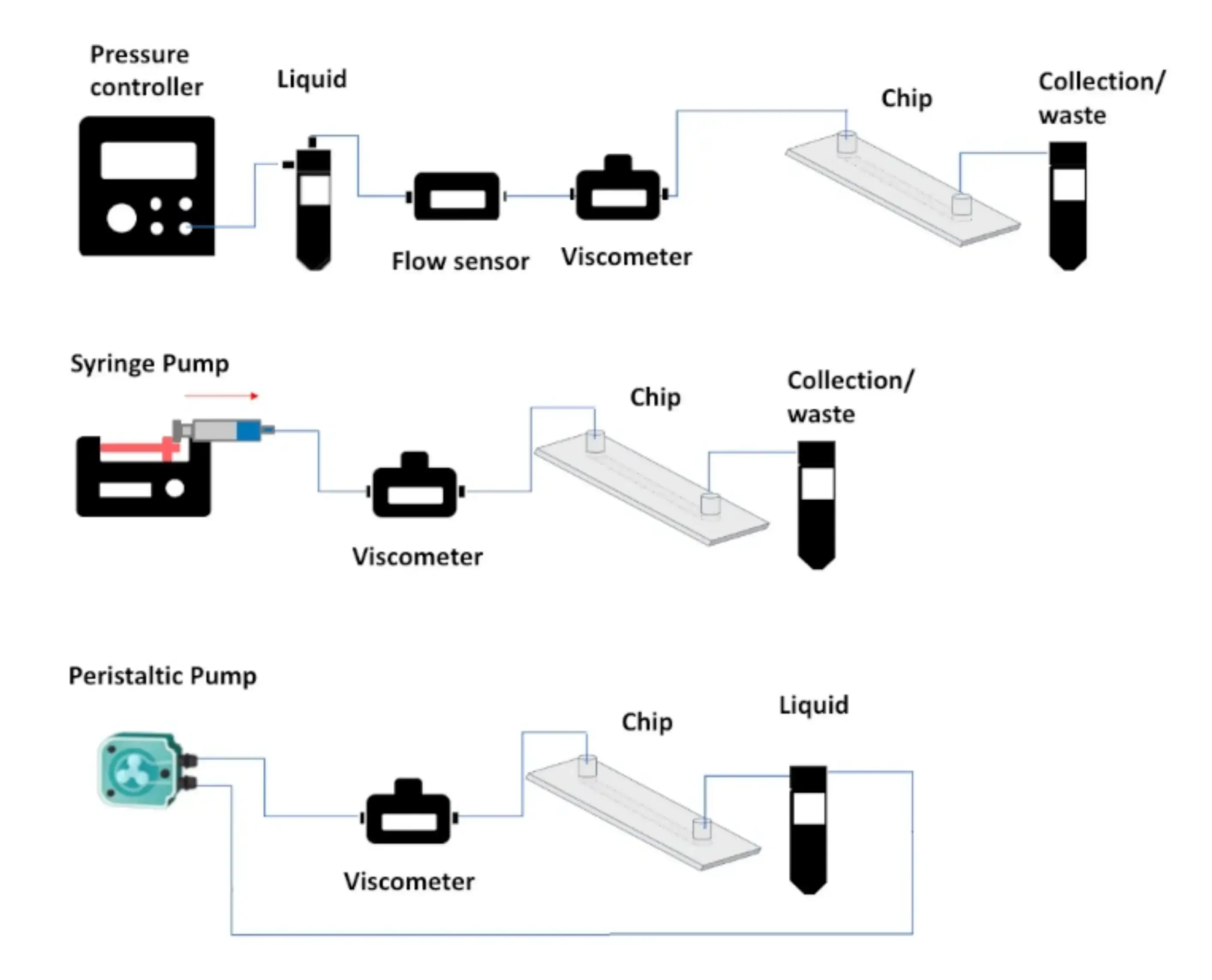
Inline viscometer applications in nanoparticle synthesis
Where an inline viscometer helps:
- Watching the organic or solvent phase viscosity as it feeds the mixer, so mixing conditions and particle size stay put from run to run.
- Batch-to-batch QC of feed streams and finished formulations, with drift flagged between runs before it costs a batch.
- Supplying the true dispersant viscosity a DLS sizer needs, when the medium is a buffer, a residual-solvent mix, or a cryoprotectant rather than plain water.
- Catching aggregation or gelation early. As particles aggregate or a polymer solution starts to set, viscosity climbs, and that rise is an early warning.
- A quick standalone check on a small aliquot of a precious formulation, with the sample recovered afterward.
These are common cases, not an exhaustive list. Tell us your formulation and we will confirm the fit.
Inline viscometer technical specifications
The inline viscometer ships with pre-calibrated liquids and the following specifications:
| Components | Technical Specifications |
|---|---|
| Viscosity range | 0.2 to 100,000 cP |
| Viscosity resolution | 0.01 cP |
| Accuracy | Better than 5% of reading |
| Repeatability | Better than 2% |
| Response time | 100 ms to a few seconds |
| Minimum sample volume | 0.1 mL |
| Operating flow rate | 0.5 to 10,000 µL/min |
| Clog and drift detection | Automatic |
| Wetted materials (standard) | PEEK and silicone |
| Wetted materials (solvent-resistant) | All-PEEK, THF-compatible |
| Temperature range | 10 to 70 °C, incubator-friendly |
| Sterilization | Not autoclavable, protocol available |
| Software acquisition rate | Up to 100 Hz |
| Cartridge | Fully replaceable |
Download the MIC Horizon Europe 2026/2027 Calls Calendar:
References
[1] A review on microfluidic-assisted nanoparticle synthesis, and their applications using multiscale simulation methods. Discover Nano, 2023. https://doi.org/10.1186/s11671-023-03792-x
[2] Bovone G, Cousin L, Steiner F, Tibbitt MW. Solvent Controls Nanoparticle Size during Nanoprecipitation by Limiting Block Copolymer Assembly. Macromolecules, 2022, 55(18), 8040-8048. https://doi.org/10.1021/acs.macromol.2c00907
[3] NAP4DIVE, Nanoparticle delivery across the blood-brain barrier. HORIZON-HLTH-2024-TOOL-05, grant agreement 101155875. CORDIS
[4] GALILEO, Innovative wide-range flow sensor to unlock microfluidic cell analyses. HORIZON-EIC-2022-TRANSITION-01, grant agreement 101113098. CORDIS






Funding and Support
This project has received funding from the European Union’s Horizon research and innovation program under HORIZON-EIC-2024-PATHFINDEROPEN-01, grant agreement no. 101185661(ERMES), HORIZON-EIC-2022-TRANSITION-01, grant agreement no. 101113098 (GALILEO). It has also received funding from the European Union’s Horizon research and innovation program under the Marie Skłodowska-Curie grant agreements no. 101119956 (DarChemDN).
About the author

Mukesh Kumar Sivakumar
Doctoral researcher in microfluidics, Microfluidics Innovation Center
Mukesh Kumar Sivakumar develops advanced microfluidic systems at the Microfluidics Innovation Center, as a doctoral candidate in the DarChemDN European doctoral network. He holds a BS-MS dual degree in physics from IISER Tirupati, India, and three years of hands-on research experience in microfluidics, biophysics, and diagnostics, in both academic and industrial settings.
ORCID | Google Scholar | ResearchGate | LinkedIn | DarChemDN
Products & Associated Accessories
FAQ: Inline Viscometer for Nanoparticle Synthesis
What does the inline viscometer measure in a nanoparticle synthesis setup, and what does it not measure?
It measures viscosity, in real time, inside your flow line. It does not measure particle size, polydispersity (PDI), or encapsulation efficiency. It is a rheometer built for flow setups, not a particle characterizer. It complements a DLS sizer rather than replacing it, and it can supply the medium viscosity a DLS measurement needs.
Why does viscosity matter when I make nanoparticles by microfluidic mixing or nanoprecipitation?
The viscosity of your feed phases affects how they mix, and mixing affects the size and distribution of the particles you get. If the feed viscosity drifts, from a concentration change, a temperature move, or a new solvent batch, the mixing shifts with it and so do your particles. Keeping viscosity steady is one of the parameters that keeps a process reproducible. It is not the only thing that sets size, but it is one worth watching.
Can it handle the organic solvents used in nanoparticle synthesis (ethanol, acetonitrile, acetone, DMF, THF)?
With the standard PEEK-and-silicone flow path, ethanol and acetonitrile are fine and DMF is likely fine. Acetone is borderline for prolonged contact. The silicone is the limiting material, so contact time and temperature matter. For THF and other aggressive organic solvents, an all-PEEK version of the instrument is available and compatible. Tell us your solvent and exposure and we will confirm the right configuration.
How small a sample does it need, and do I lose my formulation?
It needs about 0.1 mL, and the sample is recoverable, in both inline and standalone modes. That matters when the material is a scarce lipid, an mRNA payload, a functionalized polymer, or an API.
What viscosity range does it cover?
0.2 to 100,000 cP, which spans thin aqueous buffers through thick lipid and polymer solvent phases.
Can it give my DLS particle sizer the correct medium viscosity?
Yes. DLS converts particle diffusion into a hydrodynamic size using the viscosity of the dispersant, through the Stokes-Einstein relation. When your medium is not plain water, a buffer, a residual-solvent mix, or a cryoprotectant, measuring its real viscosity gives the sizer the right input instead of a guessed value.
Does it fit my existing setup, and can I use it as a standalone viscometer?
Yes to both. You connect its inlet to the outlet of your reservoir or syringe and its outlet to your mixing chip, and it works with pressure controllers, syringe pumps, and peristaltic pumps, and with any chip, commercial or home-made. Used standalone, it just needs a source of flow, and you can collect your sample back afterward.
Can it run inside an incubator or at a controlled temperature?
The hardware operates from 10 to 70 °C and is incubator-friendly.
Can MIC join our Horizon Europe proposal as a microfluidic SME partner?
Yes. MIC takes part in Horizon Europe and other European projects as a microfluidic SME, handling the microfluidic engineering, contributing to valorization, and helping shape the proposal. Use the Horizon Europe button above or contact us.