
Microfluidic vesicle production for crop resilience: EVOLVE
Author
Celeste Chidiac
Publication Date
Keywords
extracellular vesicles
microfluidic encapsulation
wheat breeding
plant-microbe communication
biofertilisation
nitrogen-use efficiency
flow control
Your microfluidic SME partner for Horizon Europe
We take care of microfluidic engineering, work on valorization and optimize the proposal with you
Extracellular vesicles for crop improvement: introduction
How could root signals inform both breeding and biofertilisation?
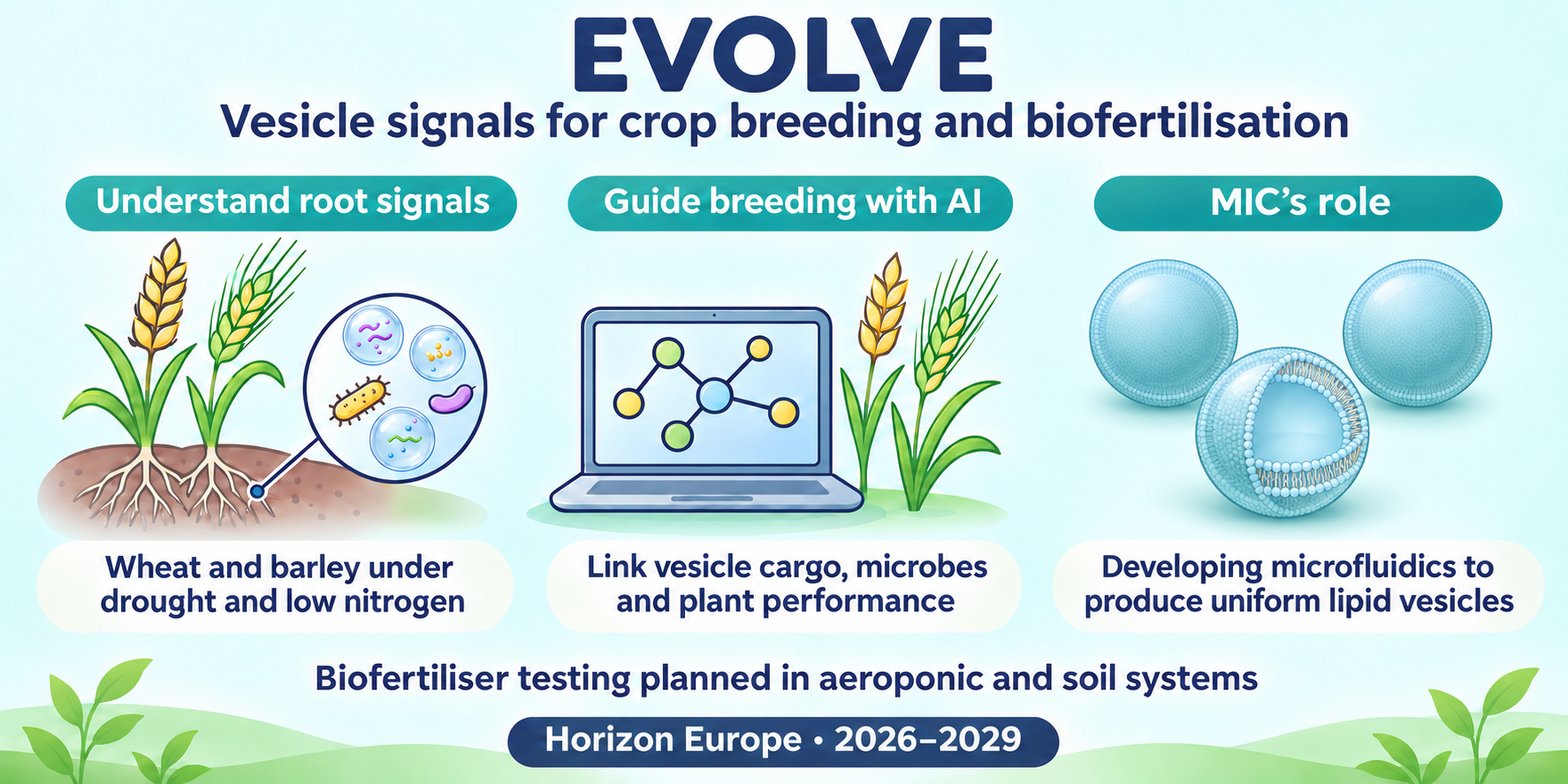
The molecules carried by root vesicles could serve two purposes: help identify useful plant traits and provide signals for bio-based fertilisers. EVOLVE is investigating whether this cargo, including small RNAs and metabolites, changes the microbes around plant roots in ways that improve crop performance under stress.
Within EVOLVE, Microfluidics Innovation Center (MIC) is developing a microfluidic encapsulation system to produce lipid vesicles with uniform sizes. This work supports the project’s biofertilisation research.
Investigating plant-microbe communication: the EVOLVE project
EVOLVE is a three-year Horizon Europe EIC Pathfinder project coordinated by Aarhus University in Denmark. Eight partners from seven countries are investigating plant–microbe communication under drought, nitrogen limitation and the combination of both stresses. Wheat is the target crop, with barley used as a reference.
The consortium plans to characterise vesicle cargo and combine molecular, microbial and plant-performance data using artificial intelligence (AI). The resulting molecular markers are intended to guide faster crop breeding. In parallel, the project plans to develop synthetic and algae-derived vesicles as programmable bio-based fertilisers.
The planned proof of concept will be assessed in aeroponic and soil systems under individual and combined stresses. EVOLVE targets an improvement of at least 10-15% in nitrogen-use and water-use efficiency. The project also aims to maintain yield and grain quality while reducing nitrogen losses.
Microfluidic encapsulation of lipid vesicles: our role
MIC is leading the work package on new bio-based inputs and is developing the associated microfluidic encapsulation system. The system is intended to form lipid vesicles of uniform size using precision flow control and flow sensors.
This engineering work supports vesicle preparation for the project’s biofertiliser studies. The consortium’s plant and soil experiments will assess how the resulting bio-inputs affect microbial functions and crop performance.


Funding and Support
This project has received funding from the European Union’s Horizon Europe programme through EIC Pathfinder Challenges under grant agreement No. 101307269.
Funding topic: HORIZON-EIC-2025-PATHFINDERCHALLENGES-01-01
Start date: 1 October 2026
End date: 30 September 2029
About the author

Céleste Chidiac, PhD
Scientific writer and digital marketing specialist
Céleste Chidiac holds a doctorate in neuroscience and molecular biology from the University of Strasbourg. Since joining the Microfluidics Innovation Center in 2023, she has combined scientific writing with website management. Her reviews draw on published research to explain microfluidic technologies, compare experimental approaches and discuss their applications and limitations. She helps researchers understand how these methods work and assess their relevance to their own research.