
Protein-RNA condensates for catalysis: PhaseCat
Author
Celeste Chidiac
Publication Date
Keywords
protein-RNA interactions
phase separation
catalysis
biomolecular condensates
microfluidic screening
Raman spectroscopy
doctoral training
Your microfluidic SME partner for Horizon Europe
We take care of microfluidic engineering, work on valorization and optimize the proposal with you
Protein-RNA condensates and catalysis: introduction
Could droplets without membranes have helped early protein synthesis?
Protein and RNA can gather into condensates: droplets that concentrate molecules without a surrounding membrane. These environments offer a possible setting for reactions involved in early protein synthesis. PhaseCat aims to investigate how protein and RNA catalysis could have evolved together inside such droplets, and whether their chemistry could also support industrial applications.
Microfluidics Innovation Center (MIC) is a beneficiary of this doctoral network and plans to host a doctoral candidate. The project will connect experimental studies of condensates with microfluidic screening, Raman spectroscopy and computational modelling.
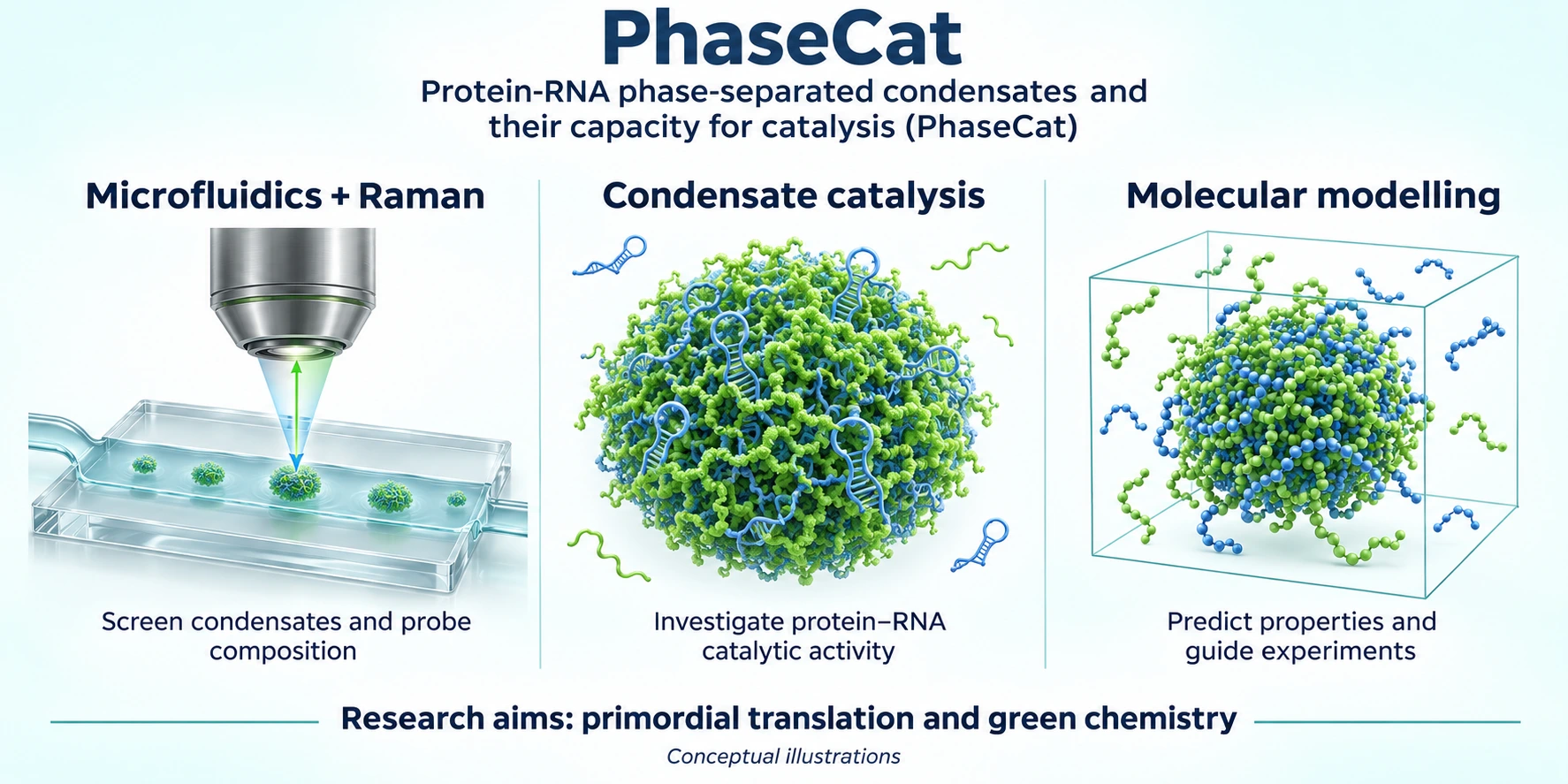
Investigating catalytic droplets: the PhaseCat project
PhaseCat is a four-year Horizon Europe Marie Skłodowska-Curie Actions (MSCA) Doctoral Network, coordinated by Vrije Universiteit Brussel in Belgium. Scheduled to begin in January 2027, the network plans to train nine doctoral researchers across universities and companies.
The research starts from the close relationship between proteins and RNA, or ribonucleic acid. Both are central to present-day protein production, and their interactions may help explain how early catalytic systems emerged. PhaseCat will examine whether phase-separated condensates could have provided environments for these reactions.
The consortium plans to combine high-throughput microfluidic screening with Raman spectroscopy to investigate condensates. Alongside these experiments, researchers will study catalysis by proteins and RNA, including its potential use in green chemistry. Computational methods will help predict condensate properties and guide experimental choices.
By linking molecular interactions to catalytic activity, the project aims to improve understanding of early protein synthesis and explore reactions relevant to industry. Its doctoral programme brings fundamental questions about the origins of life together with applied chemistry.
Doctoral research on condensates: MIC's role
MIC plans to host one doctoral candidate within PhaseCat. As a beneficiary, MIC will contribute to the network’s research and training programme on protein–RNA condensates and their capacity for catalysis. The doctoral research will take place within a consortium combining experimental and computational approaches.

Funding and Support
This project has received funding from the European Union’s Horizon Europe programme through the Marie Skłodowska-Curie Actions Doctoral Networks under HORIZON-MSCA-2025-DN-01-01 (grant agreement no. 101312146).
Start date: 1 January 2027
End date: 31 December 2030
About the author

Céleste Chidiac, PhD
Scientific writer and digital marketing specialist
Céleste Chidiac holds a doctorate in neuroscience and molecular biology from the University of Strasbourg. Since joining the Microfluidics Innovation Center in 2023, she has combined scientific writing with website management. Her reviews draw on published research to explain microfluidic technologies, compare experimental approaches and discuss their applications and limitations. She helps researchers understand how these methods work and assess their relevance to their own research.
Check our Projects
FAQ – PhaseCat condensate research
Questions about condensate properties, experimental interpretation and the limits of predictive models.
Are condensates the same as lipid vesicles?
No. Protein-RNA condensates lack a surrounding lipid membrane; vesicles enclose their contents within a lipid bilayer.
Does a round droplet prove liquid-like behaviour?
No. Shape alone is insufficient; molecular exchange, fusion dynamics and reversibility help characterise a condensate’s material properties.
Which conditions influence condensate formation?
Protein and RNA concentrations, their ratio, salt, pH and temperature can shift phase behaviour. Effects depend on the molecular system.
Does enrichment guarantee faster catalysis?
No. Concentration can favour reactions, but the local chemical environment and molecular interactions can also inhibit catalytic activity.
How is catalysis distinguished from molecular accumulation?
Measure product formation over time using appropriate controls. An increased signal inside a droplet can reflect enrichment rather than chemical conversion.
What does Raman spectroscopy reveal?
Raman spectra probe molecular vibrations and help assess condensate composition. Overlapping signals and background contributions require careful interpretation.
Why screen condensates with microfluidics?
Microfluidics enables controlled mixing and screening across many conditions using small sample volumes. Flow and surface interactions still need consideration.
Can simulations replace experiments?
No. Simulations predict behaviour under defined assumptions. Experimental measurements are needed to test whether those predictions describe the chosen protein-RNA system.
Can these experiments establish how life began?
No. Laboratory condensates test possible mechanisms for early molecular organisation and catalysis; they cannot establish a unique historical pathway.
What makes condensate catalysis relevant to green chemistry?
Potential benefits require evidence of reaction selectivity, efficiency and stability, alongside assessment of resource use and waste.