
Microfluidic Single Cell Aligner Pack
An ultra low-shear way to sort your cells combining MIC and qfluidics technologies
A plug-and-play single cell aligner
Ready to be connected to your fluidic system
Ultra low shear stress
Based on a patented liquid tube technology: the integrity of the living cells is preserved
Biocompatible
To ensure the well-being of your biological fluids
Need a microfluidic SME partner for your Horizon Europe project?
QFLUIDICS single cell aligner
This cell aligner technology is integrated into a customizable, user-friendly, and automatized microfluidic platform composed of instruments that allow easy injection of different fluids into the cell aligner from Qfluidics. The aligned cells are then injected to a transparent microfluidic chip where you can implement your equipment for cell observation or sorting.
As cell populations show a great heterogeneity (size morphologies, etc.), which directly influences the interpretation of diagnostic and therapeutic results of diseases [1], it is crucial to be able to manipulate and align them for proper sorting with the key difficulty being the fragility of those living cells which are very sensitive to mechanical stress (shear stress).
Over the past decades, researchers have developed non trivial strategies to manipulate single cells ranging from dielectrophoresis [2] to optical tweezers [3] and acoustic waves [4].
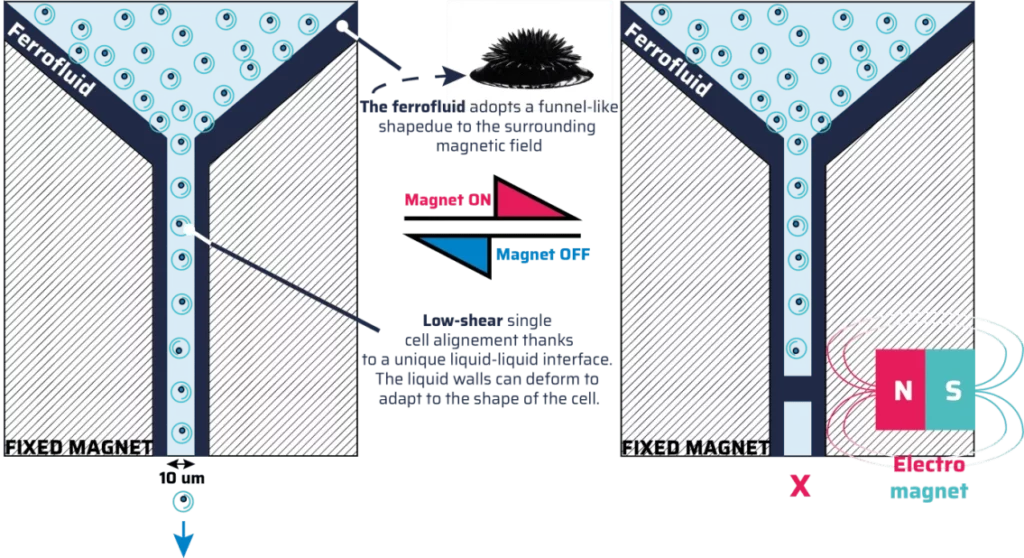
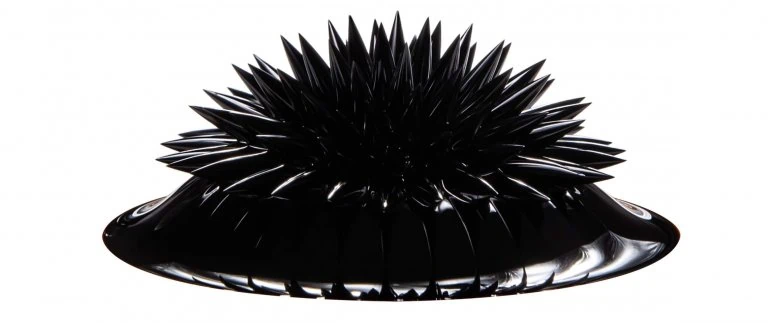
Recently, experts at Qfluidics have designed a simple way to magnetically confine a magnetic liquid (ferrofluid) into a funnel like shape to “levitate” a second immiscible liquid [5]. This unique liquid-liquid interface grants an ultra low-shear as the cells are aligned without any friction (and thus without any damage see figure 1).
An electro-magnetically actuated “liquid valve” (also made of ferrofluid is built in to be able to control the flow of cells in a contactless way, thus preserving the well-being of the cells.
References
1. Luo, T., Fan, L., Zhu, R. & Sun, D. Microfluidic Single-Cell Manipulation and Analysis: Methods and Applications. Micromachines (Basel) 10, (2019)
2. Taff, B.M.; Voldman, J. A scalable addressable positive-dielectrophoretic cell-sorting array. Anal. Chem. 2005, 77, 7976–7983
3. Ashkin, A., Dziedzic, J. M. & Yamane, T. Optical trapping and manipulation of single cells using infrared laser beams. Nature 330, 769–771 (1987)
4. Collins, D. J. et al. Two-dimensional single-cell patterning with one cell per well driven by surface acoustic waves. Nat Commun 6, 8686 (2015)
5. Dev, A. A., Dunne, P., Hermans, T. M. & Doudin, B. Fluid drag reduction by magnetic confinement. arXiv:2006.14973 (2020).
Single cell aligner pack setup
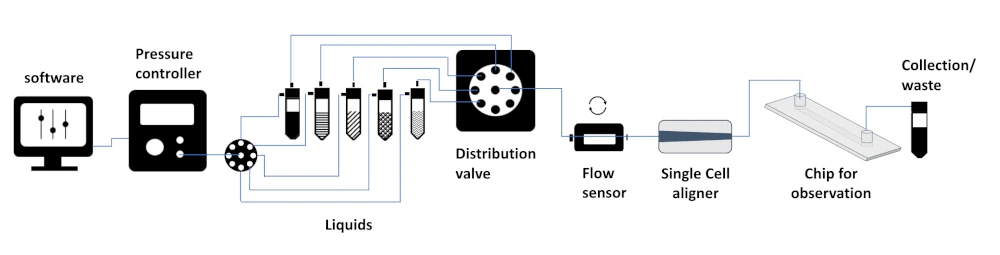
The fluids (medium containing cells, washing solution…) are pressurized in reservoirs by a flow controller and selected by a rotary valve so they can be sequentially injected to the cell aligner with automated sequences. A microfluidic flow sensor is also included to measure and regulate the flow rate thanks to a feedback loop to the flow controller.
This all-in-one pack assembles compatible state-of-the-art instruments that can be used to start your experiment out of the box. They are piloted by a single software and can be used for other different applications. Thus, this pack is the best and easiest way to setup a microfluidic experiment for cell alignment.
Setup
Flow sensor (Galileo, MIC)
Software (Galileo user interface)
Sequential injection device
The Qfluidics cell aligner liquid tube
Flow controller
A pressure splitter manifold
Falcon or Eppendorf reservoirs
Advantages of microfluidics for single cell alignement
he basic principle of microfluidics is to use tiny volumes of sample which can be a critical improvement for valuable cell solutions.
Moreover, Qfluidics’s cell aligner is simpler than more conventional methods as it relies only on its funnel architecture to align cell and the valving system allows to tune the volume of cells transported to the cell sorter.
Also, the liquid-liquid interface guarantees an extreme low-shear without requiring sheath flow and eliminates potential biohazardous aerosols.
To summarize, microfluidics solutions allow more flexible, precise, automated and efficient cell sorting.
Customize your pack
- Non-miscibility with the solvent used in your experiment/production (leachable < 100 ppb)
- Complete biocompatibility for biofluids (cells, blood, etc.)
Contact our scientists and engineers for any questions about this single-cell aligner pack and how it can match your specifications.
Frequently asked questions
How can we help your experiment
This pack is in beta testing phase. So, although the instruments are not fully industrialized, we can provide extensive support as part of our beta testing program. Get in touch to see if you are eligible.
Can a pack be customized?
Yes! Our experts will establish which instruments are best suited for your application, such as the type of flow sensor or the number of flow controller channels you need to perform your experiment. Contact us using the “talk to our experts” green button above.
Can I buy individual instruments?
Our instruments are in beta testing phase and can be tested as a pack or individually, so get in contact with our team to know how our beta testing program works.
Products & Associated Accessories
FAQ - Microfluidic Single Cell Aligner
What is single cell aligner pack, and what does it do?
The single-cell aligner pack is a microfluidic device that integrates MIC’s high-precision flow-control instrumentation with Qfluidics’ patented liquid-tube technology to align single cells for sorting and observation experiments. It is particularly configured to work with weak living cells – very sensitive to mechanical forces – by providing cell alignment without physical contact or friction associated with solid walls, thus maintaining cell integrity during loading.
What is so important about shear stress during single-cell manipulation?
The cell populations are heterogeneous in both terms of size and morphology, and the manipulation of individual cells is necessary to provide the correct diagnostic and therapeutic use. But living cells are delicate by nature: too much shear stress – the force of fluids acting on cell surfaces – may tear or lyse cells invalidating the results of downstream sorting and analysis. Under normal cell handling techniques, harmful amounts of mechanical stress are introduced, and that is exactly what this pack is meant to overcome.
What is so important about shear stress during single-cell manipulation?
The cell populations are heterogeneous in both terms of size and morphology, and the manipulation of individual cells is necessary to provide the correct diagnostic and therapeutic use. But living cells are delicate by nature: too much shear stress – the force of fluids acting on cell surfaces – may tear or lyse cells invalidating the results of downstream sorting and analysis. Under normal cell handling techniques, harmful amounts of mechanical stress are introduced, and that is exactly what this pack is meant to overcome.
What is Qfluidics liquid tube technology and what is the operation principle?
The liquid tube technology of Qfluidics involves the employment of a magnetic liquid (ferrofluid) that when placed in a fixed magnetic field takes the shape of a funnel. It involves a second immiscible liquid (in which the cells are suspended) contained in a magnetic funnel to form an interface between liquids that serves as an ultra-soft channel wall. Since the cell-contacting boundary is a liquid rather than a solid surface, cells experience nearly no friction, as they are funnelled and oriented. The system has shear stress that is significantly lower than in standard, solid microchannels, due to this liquid-wall architecture.
What happens to the operation of the contactless valve in the cell aligner?
The device is designed to control cell flow without any mechanical contact by creating an electromagnetically actuated valve, which is designed in the same way as a ferrofluid. The electromagnet is turned on and accordingly the ferrofluid is reshaped to open or close the fluidic pathway. The valve is a liquid, and cannot clog, being a highly important quality among solid microvalves, which tend to become clogged when dealing with cell suspensions or viscous biological fluid. This guarantees smooth, stable running during the experiment.
Which would be the comparison with other single cell manipulation techniques?
Some historically used methods of manipulating individual cells have included dielectrophoresis (deflection of cells through the electric field), optical tweezers (trapping cells with lasers), and acoustic waves (patterning cells with sound). These techniques are efficient, but in most instances are technically complicated, equipment based, and even disruptive to cell biology. Qfluidics liquid tube method has similar accuracy but has a less complex architecture – it only uses the geometry of the ferrofluid funnel and does not rely on sheath flow or external fields of energy that act directly on the cells.
So what would become of the cells in the alignment?
After alignment of the liquid tube, the single-file cell stream is injected into a transparent microfluidic chip with the researcher having the option of putting whatever equipment he or she wants to observe the cells or sort them. The optical chip is clear to allow imaging, fluorescence observance, or any other analysis results. Such modularity implies that the pack can be used as an upstream alignment step which feeds into a vast array of downstream detection or sorting platforms that already exist in the laboratory of the researcher.
What are the main benefits of this microfluidic method of cell alignment and sorting?
There are four benefits, namely, first, the shear stress is so low that it maintains the viability and integrity of fragile cell types. Second, the system is sheath flow free, which makes implementing the fluidic setup easier and consumes less reagents. Third, the liquid valve removes the risk of clogging that is experienced by solid valve systems. Fourth, no aerosol generation due to completely sealed liquid-liquid interface eliminates the possible risk of biohazard, which is especially in point when working with infectious or dangerous biological samples.
Is it possible to tailor the ferrofluid to particular biological use?
Yes. It is possible to prepare the ferrofluid as needed for a specific experiment or production process. The parameters that can be customised are: the non-miscibility with the solvent that the experiment will be done with (a leachable content of less than 100 ppb) and complete biocompatibility on biological fluids like cell suspensions or blood. In the same way, even the cell aligner can be obtained in different sizes and even MIC specialists may recommend which configuration would be most appropriate to the target cell type and in the experimental environment.
What is the pack’s accessibility, and does it have support during setup?
The pack is still in beta testing. Although instruments have not yet become fully industrialised, MIC has an extensive beta testing programme that offers hands-on assistance to the researchers who are eligible, so that the first steps of instrument setup, up to the first experimental results, are accompanied. Separate access can also be made to individual instruments. Researchers can get in touch with our team to discuss possible customisation options and eligibility.