
Tips & Tricks for a successful HORIZON-CL5-2027-07-D3-17 proposal
Opening
04 August 2027
Deadline
Keywords
Cluster 5 Energy
EUPI-PV Partnership
energy balance
high voltage DC PV systems
industrial electrification
ancillary services
electricity markets
lump sum
Your microfluidic SME partner for Horizon Europe
We take care of microfluidic engineering, work on valorization and optimize the proposal with you
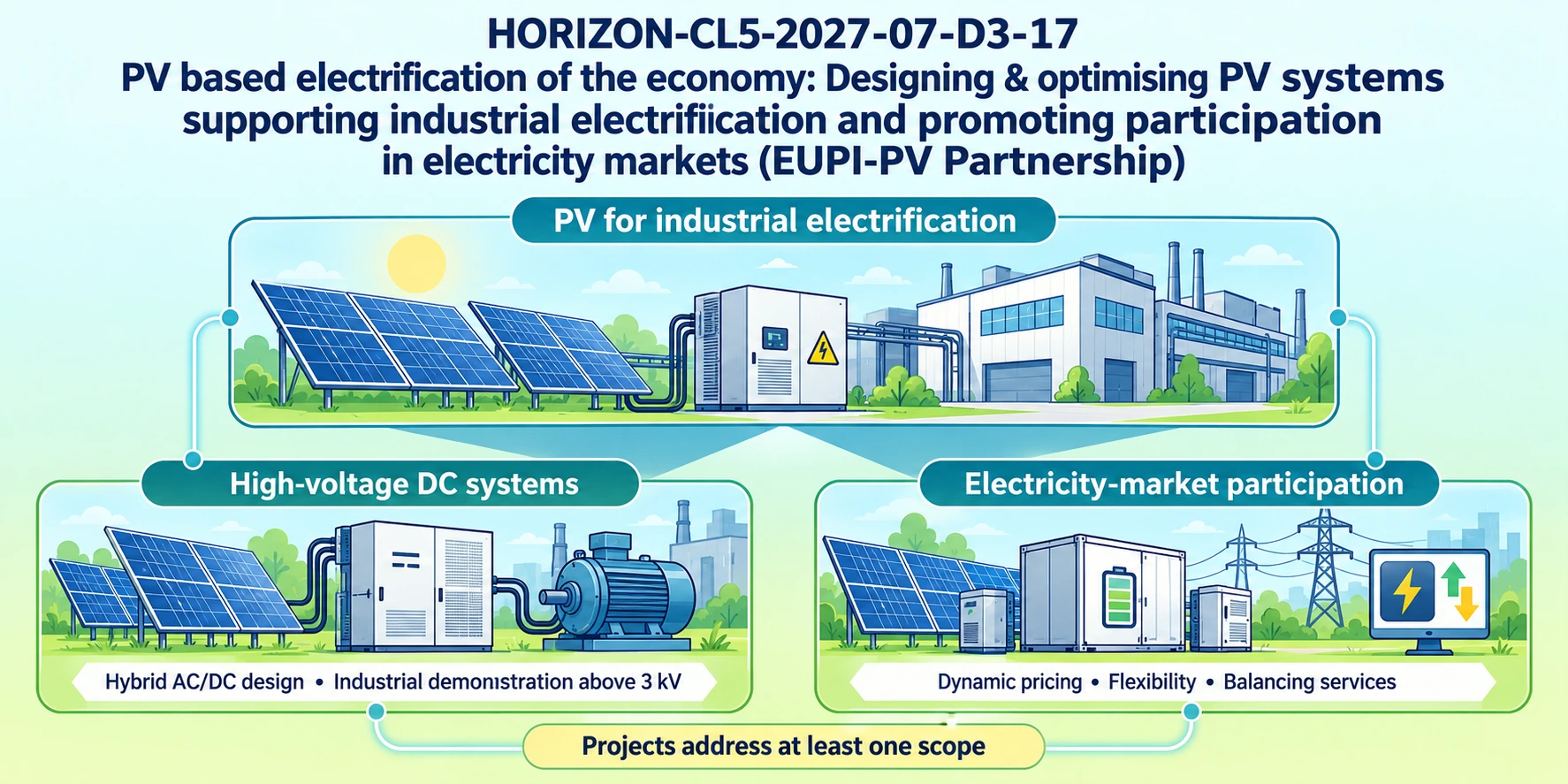
HORIZON-CL5-2027-07-D3-17: PV based electrification of the economy: Designing & optimising PV systems supporting industrial electrification and promoting participation in electricity markets (EUPI-PV Partnership)
How can a PV demonstration distinguish useful electricity delivery from headline efficiency?
A photovoltaic (PV) demonstration needs a measured energy balance that follows electricity from generation to the industrial load, including conversion losses, storage losses and auxiliary consumption. Comparing systems under the same operating conditions helps establish whether an architectural change improves useful electricity delivery. For HORIZON-CL5-2027-07-D3-17, this measurement perspective connects efficient industrial electrification with the separate challenge of delivering dependable flexibility to electricity markets.
If liquid cooling is relevant to the chosen architecture, Microfluidics Innovation Center (MIC) could contribute as a consortium partner by developing controlled-flow test setups and assessing fluidic measurement quality. Its inline flow sensor measures liquid flow and detects internal clogging and measurement drift. This provides a basis for investigating the fluidic part of a cooling loop; performance in a high-voltage PV installation would require application-specific validation with power-electronics and industrial partners.
Download the MIC Horizon Europe 2026/2027 Calls Calendar:
Discover more!
Administrative facts: what do we know about the HORIZON-CL5-2027-07-D3-17 call?
Which call is it, and when is the opening and the deadline?
- Call name: ENERGY
- Call identifier: HORIZON-CL5-2027-07
- Destination: Sustainable, secure and competitive energy supply (Global leadership in renewable energy)
- Topic: HORIZON-CL5-2027-07-D3-17, EUPI-PV Partnership
- Scheduled opening: 04 August 2027
- Scheduled deadline: 01 December 2027, 17:00 Brussels local time
- Type of action: Innovation Action
These dates follow the Commission work programme. Consult the live topic submission page for timetable changes before applying.
What about the budget and estimated size of the project?
- Overall call budget: EUR 179.00 million
- Topic budget: EUR 18.00 million
- Number of projects expected: 3
- Budget per project: around EUR 6.00 million
What are the key eligibility and evaluation conditions?
- Consortium eligibility: under General Annex B, the minimum is three independent beneficiary organisations in three different countries: one in an EU Member State and the other two in EU Member States or Associated Countries. Affiliated entities do not count towards this minimum.
- China-related restrictions: organisations established in China are excluded from Innovation Actions, subject to any expressly granted exception under General Annex B. For this topic, participation is also excluded for organisations located in otherwise eligible countries when control rests, directly or indirectly, with China or a China-established legal entity. The topic-specific conditions apply alongside all other General Annex B eligibility requirements.
- Award criteria per General Annex D. Standard Innovation Action thresholds apply: 3/5 per criterion, 10/15 overall.
- TRL 6 to 8 by project end. Activities may start at any TRL.
- Eligible costs take the form of a lump sum.
- If satellite-derived Earth observation, positioning, navigation or related timing data and services are used, beneficiaries must use Copernicus and/or Galileo/EGNOS, as applicable. Other data and services may be used in addition.
- The granting authority may object to a transfer of ownership or exclusive licensing of results, up to 4 years after the action ends.
- No JRC participation foreseen.
- No clustering obligation, beyond reporting results to EUPI-PV for its KPI monitoring.
Scientific range: what does the Commission expect from the HORIZON-CL5-2027-07-D3-17 grant?
What outcomes are expected?
By the end of the grant something has to be running. Under Scope 1 that means high voltage DC PV systems with measured efficiency gains and a lower LCOE for industrial users. Under Scope 2, PV assets actually earning from ancillary services, with the business model and financing scheme shown to work. Design studies with a demo bolted on at the end are not what the Commission is after.
What is within scope?
Proposals cover at least one of the two scopes. Both is allowed, though at six million we would argue it usually spreads the work too thin.
- Scope 1: higher voltage system architectures and the efficiency benefit they bring
- Scope 1: a blueprint for an AC/DC hybrid solution managing end user loads at high efficiency
- Scope 1: demonstration of a hybrid system above 3 kV operating in DC grids on industrial installations, plus the effect of higher voltage on the modules themselves
- Scope 2: integrated management of PV generators for dynamic and nodal pricing
- Scope 2: pooling PV with other production or consumption assets for balancing mechanisms, including viability, business models and financing
- Scope 2: reliability and system availability through digitalisation
What are the specifically proposed research directions?
- Strategic end users are named: industrial sites, servers, EV charging stations. Pick one and build the demo around it.
- Storage integrated into hybrid PV systems, offering flexibility rather than sitting idle
- Module behaviour under high voltage stress, which is the part most consortia underestimate
- Procurement driven risk mitigation, a phrase the work programme leaves quite open. Our reading: they want the contractual and financial risk handled, not only the technical one.
Scientific strategy: how can you enhance your chances of being funded through HORIZON-CL5-2027-07-D3-17?
What scientific choices matter most?
- Secure the host site before writing. A signed industrial site, data centre or charging hub beats any letter of intent. Evaluators check this first.
- Quantify the LCOE reduction. Give a baseline and a target number.
- Treat the lump sum seriously. Your work package breakdown becomes the payment schedule, so vague deliverables will cost you later.
- Show the market side, even in Scope 1. Grid codes and ancillary service rules differ by country, and reviewers notice when a consortium ignores that.
- Do not oversell digitalisation. We see a lot of proposals where the AI layer has no measurable role.
- Explain what happens to the demo after month 48.
Consortium & proposal-writing plan: what works best with this type of call?
- Somewhere between eight and twelve partners, maybe one or two more if you need several demo countries.
- You need a power electronics manufacturer, an industrial or commercial end user, a system integrator, a research organisation for the modelling, plus someone who understands electricity market rules. A TSO or DSO as associated partner helps.
- Bringing in an innovative SME usually strengthens the exploitation story, especially for the DC conversion hardware or the digital layer.
- If your coordinator has never handled a lump sum grant, put an experienced partner on management.
- Write the impact section against the EUPI-PV KPIs. Above all, keep the business case concrete.
How would microfluidics contribute to this topic?
Heat is the quiet constraint here. Push a PV system to 3 kV DC and the losses concentrate in the converters, not in the panels. Conventional air cooling runs out of margin at that point. Microfluidic cold plates move heat out of dense power electronics using very little pumping energy, and that changes what you can package into an industrial cabinet.
- Say your DC/DC stage derates every summer afternoon. A microchannel cold plate lets you keep it at full output, and you can measure the gain directly.
- Servers are named in the call as an end user. Direct liquid cooling of the racks is already where that market is heading, so a PV to DC to server demo has a natural thermal component. We looked at the same question for AI data centre cooling and for edge data centres and IT rooms.
- High power EV chargers, same problem. Cables and connectors, liquid cooled.
- On the storage side, flow battery performance depends heavily on how electrolyte moves through the stack. Flow field design is a microfluidics question, and you get the same answer twice when the channels are right.
None of this replaces the electrical engineering. But it removes a ceiling. If your consortium wants to claim efficiency at high voltage, thermal management is where part of that claim gets proven, and it is worth a work package rather than a footnote.
The MIC already brings its expertise in microfluidics to Horizon Europe:
H2020-NMBP-TR-IND-2020

Microfluidic platform to study the interaction of cancer cells with lymphatic tissue
H2020-LC-GD-2020-3

Toxicology assessment of pharmaceutical products on a placenta-on-chip model

About the author

Céleste Chidiac, PhD
Scientific writer and digital marketing specialist
Céleste Chidiac holds a doctorate in neuroscience and molecular biology from the University of Strasbourg. Since joining the Microfluidics Innovation Center in 2023, she has combined scientific writing with website management. For MIC’s Horizon Europe topic pages, she draws on her research background to explain scientific challenges and clarify funding priorities. Her writing helps prospective applicants understand each topic’s scope, expected outcomes and research directions.
FAQ - HORIZON-CL5-2027-07-D3-17
These questions examine system-level measurement, delivery of flexibility services and the evidence needed to assess a possible microfluidic contribution.
How should AC and DC architectures be compared?
Compare alternating-current (AC) and direct-current (DC) systems using the same load profile and solar resource, with a clearly defined metering boundary. Account for conversion stages, cable losses, storage cycling and auxiliary demand. Report energy delivered over representative periods alongside peak efficiency, distinguishing measurements from modelled annual savings and stating how downtime and curtailment are treated.
Does a higher DC voltage automatically require microfluidic cooling?
No. At fixed transmitted power, higher voltage reduces current, which can reduce resistive cable losses. Cooling requirements depend on converter losses, power density, packaging and ambient conditions. Assess the thermal load before selecting a cooling technology. The topic scope requires investigation of higher-voltage architectures and their effect on modules; it does not prescribe microfluidic cooling.
Can PV provide upward balancing without a battery?
Yes, while sunlight is available, a PV plant can operate below its available power and retain headroom for an upward response. That reserve varies with irradiance and must be estimated reliably. The 2024 NREL report on PV reserve estimation explains this approach. Storage can extend the operating possibilities, but curtailed PV cannot provide sustained active power without an available energy source.
What makes a PV reserve forecast useful to a grid operator?
It must estimate the power available when the dispatch instruction takes effect, including uncertainty and communication delays. Test the forecast against measured delivery during changing cloud conditions, rather than reporting only average prediction error. The NREL reserve-estimation study distinguishes available power from curtailed output and examines the consequences of overestimating or underestimating reserve.
Why can lower electricity production costs still leave a PV project unprofitable?
The levelised cost of electricity averages production costs over energy output; it does not describe the prices received when that electricity is sold. Evaluate the timing of revenues, curtailment, reserve payments and the opportunity cost of holding headroom. For a proposed business model, stress-test these factors together with operating costs and service-delivery obligations. The work programme explicitly connects PV profitability with market participation.
How should a cooling demonstrator establish a net energy benefit?
Compare cooling options at the same heat load, inlet temperature and permitted device temperature. Measure electrical consumption across the complete cooling system, including pumps and heat rejection. Combine those measurements with any reduction in converter losses or thermal derating. A cooler component alone does not establish an improvement in the installation’s energy balance.
Why do two-phase microchannels need dynamic measurements?
Boiling introduces moving vapour structures that can cause flow reversal and pressure fluctuations. Pontes and colleagues combined pressure measurements, high-speed imaging and infrared thermography in HFE-7100 microchannel experiments to relate flow regimes to heat transfer. [1] Their study supports measuring transient behaviour and local temperatures, with attention to image calibration and optical resolution.
Can a laboratory microchannel result be applied directly to a standard PV plant?
No. Pontes and colleagues studied an electrically heated microchannel as part of research directed at concentrated photovoltaic cooling. [1] That experiment does not demonstrate energy savings in a conventional PV field or a high-voltage converter. Transfer requires matching the application’s heat flux, coolant, materials, electrical isolation, operating environment and maintenance constraints.
What could MIC’s inline flow sensor establish in a cooling experiment?
MIC’s inline flow sensor can measure liquid flow and flag internal clogging or measurement drift. It could support a suitable laboratory liquid loop after checking coolant compatibility, temperature, pressure and measurement range. Its internal diagnostics do not establish blockage detection throughout a cold plate. Adaptation to cooling would require validation; the device remains a research prototype, not a qualified industrial cooling instrument.
How could MIC and a power-electronics partner divide a validation task?
MIC could develop the fluidic test setup, compare channel designs and contribute flow measurements, drawing on its custom flow-cell fabrication and project-specific prototyping. A power-electronics partner would define heat loads and electrical interfaces, with specialist support for safety validation. Proposed joint outputs could include a test protocol and operating-envelope dataset before industrial integration. Tasks and acceptance criteria would be agreed within the consortium.
References
[1] Pontes, P., Marseglia, G., Perez, M., de Giorgi, M. G., Moreira, A. L. N. and Moita, A. S. Experimental description of heat transfer processes at two-phase flow in microchannels towards the development of a heat sink for PV panels. Frontiers in Thermal Engineering. 2024;4:1345452. doi:10.3389/fther.2024.1345452