
Tips & Tricks for a successful HORIZON-CL5-2027-05-D4-06 proposal
Opening
05 May 2027
Deadline
Keywords
IT rooms
Energy Efficiency Directive
BMS integration
waste Heat recovery
Edge data centers
energy use
energy optimization
Thermal management
buildings
Your microfluidic SME partner for Horizon Europe
We take care of microfluidic engineering, work on valorization and optimize the proposal with you
HORIZON-CL5-2027-05-D4-06: Thermal energy optimization and waste heat recovery of high energy demand IT rooms in buildings or small edge data centers
Why can two IT rooms releasing the same amount of heat have different heat-reuse potential?
Heat-reuse potential depends on the temperature at which heat is collected and the requirements of the receiving heating system. Mixing warm server exhaust with cooler room air can reduce that temperature. Ding and colleagues combined measurements in an academic data centre with simulations showing how hot-air containment could preserve higher-temperature heat for recovery. The proposed room modification was simulated, rather than demonstrated in operation. [1] HORIZON-CL5-2027-05-D4-06 addresses this connection between thermal management and useful heat delivery through integrated systems for existing IT rooms in buildings and small edge data centres.
Microfluidics Innovation Center (MIC) contributed, with Cherry Biotech, to the design of a preliminary microprocessor phase-change cooling platform within the completed Horizon 2020 ThermaSMART project. This experience provides a basis for a technical partner contribution to microchannel heat-capture systems, alongside specialists responsible for building integration and heat reuse.
Download the MIC Horizon Europe 2026/2027 Calls Calendar:
Discover more!
Administrative facts: what do we know about the HORIZON-CL5-2027-05-D4-06 call?
Which call is it, and when is the opening and the deadline?
- Call name: BATTERIES and ENERGY
- Call identifier: HORIZON-CL5-2027-05
- Destination: D4 – Efficient, sustainable and inclusive energy use
- Topic: HORIZON-CL5-2027-05-D4-06
- Opening date: 05 May 2027
- Deadline: 15 Sep 2027
- Type of action: Innovation Action (IA)
What about the budget and estimated size of the project?
- Total indicative topic budget: EUR 15.75 million
- Number of projects expected: 3
- Budget per project: around EUR 5.25 million
- Eligible costs take the form of a lump sum contribution.
What are the key eligibility and evaluation conditions?
- Standard eligibility conditions apply per General Annex B
- If satellite-based earth observation, positioning, navigation, or timing data is used: mandatory use of Copernicus and/or Galileo/EGNOS
- TRL target: activities expected to achieve TRL 6-7 by the end of the project; may start at any TRL
- Granting authority may object to the transfer of ownership or exclusive licensing of results up to 4 years post-action
- No clustering or JRC involvement requirements are explicitly stated for this topic.
Scientific range: what does the Commission expect from the HORIZON-CL5-2027-05-D4-06 grant?
What outcomes are expected?
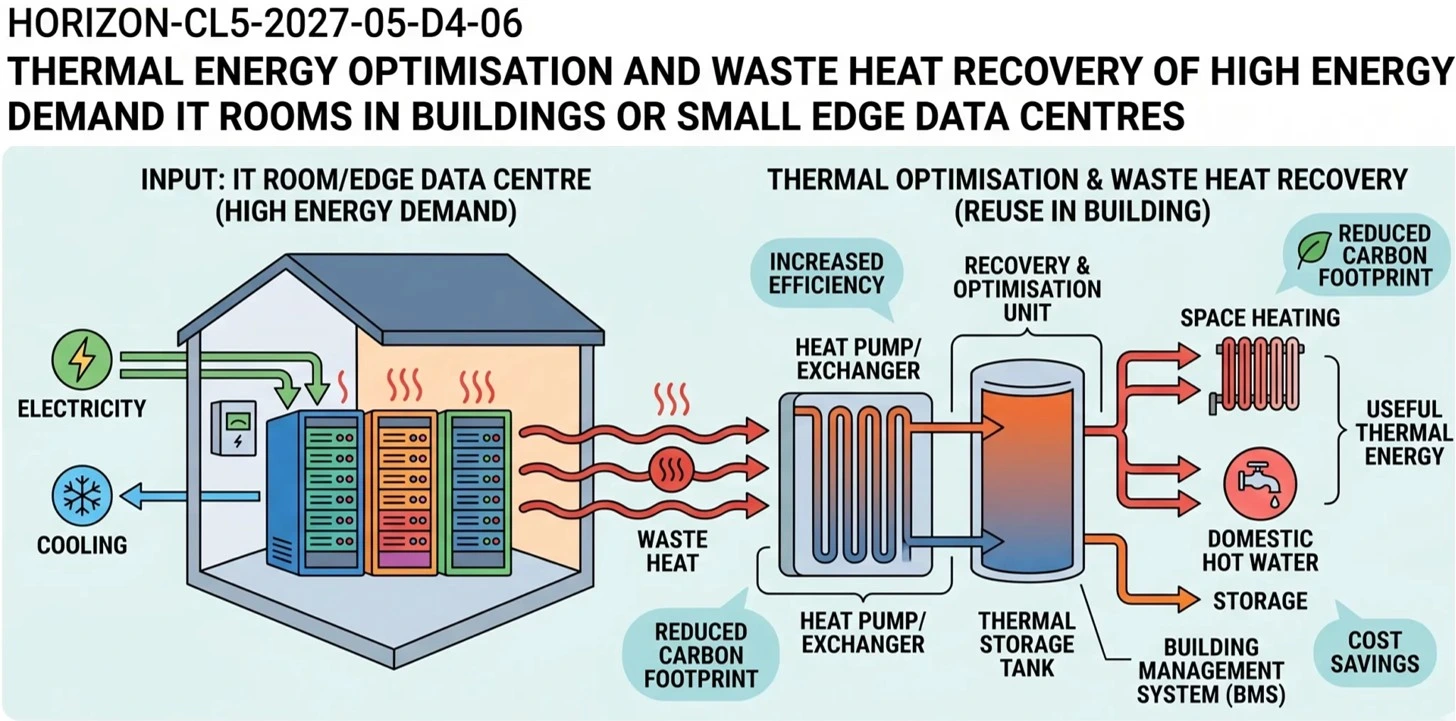
There are two key expected outcomes. Firstly, demonstrations of fully integrated thermal management and heat recovery systems within a mix of existing (building-based) and new-build (edge, 100-500 kW) IT rooms operating under various climate conditions across Europe. Secondly, complete business cases demonstrating the added value of the heat recovery system, either through space heating or feeding local heating networks. Open access to data and knowledge for IT operators and building owners will be another crucial output for any proposal.
What is within scope?
This call focuses on the under-regulated small-scale IT sector and specifically targets IT rooms and edge data centers ranging from 100 to 500kW of power:
- Existing and small edge IT data centers based within buildings and which need thermal management systems
- Heat recovery and utilization system development, possibly integrated with heat storage or a complementary heating device (e.g. Heat pump)
- Integration of the proposed system with existing BACS and BMS systems
- Account for the thermal behaviour of the building and its envelope using suitable methods, such as simulation or digital twins.
- Inclusion of smart building-level self-assessment and self-optimization functionality
- Utilization of the recovered heat for space heating/cooling within the building, domestic hot water or district heating/cooling networks
- Demonstrators should be located in both cold and warm climate EU Member States or Associated Countries to address climate-specific challenges in thermal management and waste heat recovery.
The exclusion is the large data centers which will be subject to new Energy Efficiency Directive rules.
What are the specifically proposed research directions?
The Work Programme also identifies some explicit and desirable research avenues:
- Cost-effective integrated thermal management systems – focus is not just on the heat recovery, but also the whole system which would include building envelope and control aspects
- Business cases for excess heat recovery, with realistic plans for economic benefits of heat recovery along with suitable financial analysis, taking into account different climate and building specificities.
- Integration with BMS systems, with the scope of development of an additional service above a standard BMS through utilizing its data and function of the thermal system
- Climate-specific benchmarking to show performance differences across various climates, and identification of specific needs for both cold and warm climates
It would also seem beneficial to focus on the implementation of open data, which the commission places a high priority on.
Scientific strategy: how can you enhance your chances of being funded through HORIZON-CL5-2027-05-D4-06?
What scientific choices matter most?
- The proposal should clearly feature real site-based demonstrations, not just simulation. Working proof of concept in a building environment is critical.
- Demonstrators should be located in both cold and warm climate EU Member States or Associated Countries to address climate-specific challenges in thermal management and waste heat recovery.
- A heat reuse value chain must be evident. Who will use the heat? What additional value would they get? What other energy sources would be replaced? Abstract efficiency will be less valuable than a concrete solution.
- BMS integration planning should start from the outset, with the demonstration that a correct understanding of the topic has been achieved. The self-optimization requirement needs careful attention.
- A scalable and reproducible business case should be put forth in the proposal, which will serve as proof of concept to scale out across various IT rooms/buildings.
- Select appropriate methods to assess how the building and its thermal envelope affect the proposed thermal management and heat recovery system. Simulation and digital twins are examples of suitable approaches; a digital twin is not specifically required.
- Also investigate links with the call HORIZON-CL4-2027-04-DATA-09, which covers energy efficiency and sustainability of AI processing, as overlap may lead to greater research impact.
Consortium & proposal-writing plan: what works best with this type of call?
The following recommendations concern the expertise and practical arrangements needed to deliver the project.
- Consortium size: Select partners according to the demonstration, integration, validation and business-case tasks. The topic does not prescribe a consortium of 8–12 partners.
- Demonstration access: Secure access to sites covering cold and warm climates in EU Member States or Associated Countries. Define responsibilities for installation, operation and monitoring; the topic does not require exactly two building-owner partners.
- Thermal assessment: Bring together expertise in building energy performance, thermal management and appropriate modelling methods. These capabilities may be provided by different types of organisations; a research institute or technical university is not a specifically required partner category.
- Building-system integration: Cover building automation, control and building management system integration, including monitoring and self-optimisation. Select organisations with the relevant capabilities; the topic does not specifically require an SME.
- IT infrastructure: Include expertise in IT equipment, cooling requirements and operational constraints so the proposed solution fits the demonstration sites.
- Heat reuse: Involve a district heating or cooling operator where the selected heat-reuse route depends on that network.
- Expected outcomes in the proposal should directly reflect those stipulated in the work program and avoid broad and vague language.
- Since a lump sum grant is expected, realistic budget calculation and realistic time allocation for tasks are necessary.
Where could microchannel cooling support building-level heat recovery?
Microchannel phase-change cooling captures heat close to the processor: coolant evaporates as it absorbs heat, and the vapour releases heat when it condenses. Connecting the condenser to a useful heat demand makes heat recovery part of the system design. The receiving circuit, operating temperatures and auxiliary electricity consumption determine whether this arrangement provides a practical benefit.
MIC’s work in ThermaSMART involved the joint design of a preliminary cooling platform with Cherry Biotech. For a demonstrator using microchannel cooling, MIC could contribute fluidic design, prototype integration and controlled-flow testing of the heat-capture module. Proposed deliverables could include an instrumented fluidic prototype, a test protocol and operating data linking flow and pressure conditions to thermal measurements.
Validation should connect these component tests to the complete installation. Cooling specialists and IT operators would need to define equipment limits and reliability requirements; building-energy specialists would assess heat delivery, control integration and overall energy performance. The useful result would be evidence that the selected cooling module supports the demonstrator’s heat-reuse objective.
The MIC already brings its expertise in microfluidics to Horizon Europe:
H2020-NMBP-TR-IND-2020

Microfluidic platform to study the interaction of cancer cells with lymphatic tissue
H2020-LC-GD-2020-3

Toxicology assessment of pharmaceutical products on a placenta-on-chip model

About the author

Julia Sepulveda Diaz, PhD
Chief Executive Officer, Microfluidics Innovation Center
Julia holds a PhD in glycobiology and neurobiology from Université Paris-Est Créteil. Before moving into microfluidics, she spent several years as a postdoctoral researcher at the Paris Brain Institute, on Parkinson’s disease, neuroinflammation, and the role of heparan sulfate in protein aggregation. Today she leads the Microfluidics Innovation Center as CEO, steering its researchers and engineers and its collaborative research and innovation projects.
FAQ – HORIZON-CL5-2027-05-D4-06
These questions address heat measurement, operational reliability and the assessment of practical heat reuse.
Does a low power usage effectiveness demonstrate successful heat reuse?
No. Power usage effectiveness (PUE) compares total data-centre energy consumption with IT-equipment consumption. It does not measure useful heat delivered to another user. Assess cooling overhead and heat reuse separately. [1]
Does a higher coolant outlet temperature necessarily mean more heat has been recovered?
No. A temperature reading alone cannot establish heat transfer. For a single-phase liquid loop, assessment also needs mass flow, the inlet-to-outlet temperature difference and the coolant’s heat capacity. Distinguish heat captured from heat actually delivered to the receiving system.
Is a heat pump always necessary?
No. The need depends on the temperatures available from the cooling system and required by the heat user. The topic scope allows heat upgrading and storage as optional elements of the recovery solution.
Can thermal storage solve every mismatch between heat supply and demand?
No. Storage should be sized against the duration and magnitude of the mismatch, its temperature requirements and thermal losses. A buffer designed for short interruptions should not be credited with resolving a seasonal lack of heat demand.
How should cooling operate when nobody needs the recovered heat?
Define a fallback heat-rejection mode that maintains acceptable IT operating conditions. Test the transition between heat reuse, storage and heat rejection, including a full store or an unavailable receiving circuit. Treat these tests as part of the demonstrator’s operating strategy.
Can a flow reading reveal a complete cold-plate temperature map?
No. Flow, pressure and temperature describe different aspects of operation. Lee and colleagues demonstrated combined local sensing inside a liquid-cooled cold plate; their measurements were specific to sensor positions and calibration conditions. They did not establish a complete rack-level temperature map. [2]
Does prolonged sensor operation prove that measurements remain accurate?
No. Lee and colleagues’ separate 120-hour circulation test showed continued sensor operation alongside changes in sensitivity. A validation plan should therefore include calibration checks and measurement uncertainty, rather than treating uninterrupted data acquisition as proof of unchanged accuracy. [2]
How can a thermal model be tested beyond the conditions used to calibrate it?
Compare its predictions with measurements from operating periods excluded from calibration. Include different IT loads, weather conditions and heat-demand patterns. Define acceptable prediction errors before testing, and identify conditions in which the model is unsuitable for control decisions.
What information makes demonstration data useful for replication?
Publish understandable system boundaries, equipment configurations, units, sampling intervals and operating conditions alongside performance data. Explain sensor calibration, missing-data treatment and calculation methods. Separate measured results from modelled scenarios so another operator can assess applicability to their installation.
What should a heat-reuse business case test when the future heat user is uncertain?
Test alternative heat-demand levels, connection costs, energy prices and periods without heat uptake. Identify who owns, operates and maintains each interface. These sensitivity cases help distinguish a technically workable recovery system from an economically dependable arrangement.
References
[1] Ding, W.; Ebrahimi, B.; Kim, B.-D.; Devenport, C. L.; Childress, A. E. Analysis of Anthropogenic Waste Heat Emission from an Academic Data Center. Energies. 2024;17(8):1835. doi:10.3390/en17081835
[2] Lee, C.-Y.; Lee, K.-C.; Luo, Y.-S.; Lin, W.-T.; Hung, C.-T. In Situ Characterization of Local Thermal–Hydraulic Characteristics in a Liquid-Cooling Cold Plate for AI Servers Using an Embedded Flexible MEMS Microsensor. Micromachines. 2026;17(11):1312. doi:10.3390/mi17111312