Soil remediation and land management: EDAPHOS
Author
Marco De Battista
Publication Date
May 10, 2025
Keywords
Soil remediation
land management
Advanced mapping
risk assessment
Lab-on-a-chip
toxicity tests
ecological risks
Your microfluidic SME partner for Horizon Europe
We take care of microfluidic engineering, work on valorization and optimize the proposal with you
Soil remediation and land management: introduction

Healthy soils are an essential element for human sustainability, as they play a critical role in food production, water filtration, carbon storage, and overall ecosystem health.
Historically, human societies thrived the most in fertile areas where crops could grow and water was abundant.
Humanity still depends on healthy ecosystems to create a sustainable future for its population.
However, under the mounting pressure of the energetic demands of an ever-increasing population, more and more land becomes constantly endangered under the threat of pollution.
Estimates claim that contaminated sites in Europe (EU) amount to up to 3 million, with an average of more than three sites/km2.
In light of this data, it is paramount to take immediate action to invest in developing and actuating effective soil remediation methods to preserve both terrestrial and aquatic ecosystems.
The European Union (EU) recognizes this problem as one of the most critical challenges for the future of society. It is currently taking action to incentivize the development of soil remediation methods for contaminated areas, pushing for a green transition in a just and inclusive way.
EU policies aim to achieve an environment where artificial contaminants do not cause significant impacts or risks to human health and surrounding ecosystems.
Advanced mapping, risk assessment and nature-based soil remediation: project description
The project EDAPHOS (the Greek name for soil) aims to establish revolutionary, cutting-edge soil remediation for contaminated lands. Specifically, the aim is to develop a novel framework for land rehabilitation and ecological restoration of degraded areas featuring nature-based solutions (NBS) technologies.
Coordinated by Communauté d’universités et établissements Universités Bourgogne-Franche-Comte in a consortium of 13 public and private organizations, EDAPHOS will improve the monitoring of contaminated soils and the understanding of precise pollution sources at seven selected EU regions.
It will implement advanced remote sensing tools and geographic information systems. Based on the TRIAD concept (integration of chemical, ecological, and ecotoxicological lines of evidence), novel assessment methods and metrics for pollution levels and their risks will be developed and applied.
EDAPHOS will involve performing lab and field studies to validate the technological readiness and the cost-effectiveness of NBS as an effective soil remediation methodology. In addition, artificial intelligence techniques will be implemented throughout the project to improve forecasting and analysis.
Advanced mapping, risk assessment and nature-based soil remediation: our role

Microfluidics technology represents an emerging tool for environmental quality assessment.
We will use our experience in microfluidic development and optimization in collaboration with other consortium partners’ knowledge of ecotoxicological methods.
We will develop a new tool (lab-on-a-chip) to transfer classical toxicity tests to microfluidic technology.
It will allow for validating NBS methods as an effective tool for soil remediation in the medium and long-term perspective.
A key objective is developing a lab-on-a-chip platform for testing ecotoxicity properties. It will involve creating new bioassays, standardizing the methodology for the evaluation of ecological risks, and evaluating the methods for the restoration of contaminated soils, alongside an increase in automation and parallelization of the procedure.
The microfluidic platform will allow the testing of samples in a fully controlled environment regulating key parameters such as the flow rate, temperature, pH, O2, and CO2, as recorded in the test fields.
This project has received funding from the European Union under HORIZON-MISS-2022-SOIL-01, grant agreement number 101112768 (EDAPHOS).
More information on the Horizon Europe Mission Soil program can be found on the website of Ministère de l’Enseignement Supérieur et de la Recherche (MESR).
Start date: September 1, 2023
End date: August 31, 2027
EU contribution: € 6,992,053.75



Check our Projects
FAQ – Soil remediation and land management: EDAPHOS
Which problem EDAPHOS is trying to solve?
Europe is currently facing the problem of extensive soil contamination- it is estimated that there are 3 million sites and that, on average, above three sites per square kilometer are contaminated. The goal of EDAPHOS is not to conduct another partial cleanup, but to develop a robust, science-based model to restore degraded land permanently.
What is different about the project compared to previous remediation projects?
Rather than understanding soil as a black box, EDAPHOS balances between small and big data; between advanced remote sensing and GIS with the TRIAD concept, which integrates chemical, ecological, and ecotoxicological levels of evidence, identifying the origin of pollution, measuring risk, and subsequently testing solutions, which act with nature, not against it (nature-based solutions). This leads to a traceable pipeline; mapping, risk assessment, and field-validated remediation.
What is the coordinator of EDAPHOS, and what is the size of the consortium?
The Université Bourgogne-Franche-Comté coordinates the project and gathers 13 partners, including public and private ones. They are spread out across the seven regions of the EU so that methods can be transported across climates, land uses, and regulatory environments.
Soil remediation: What is the role of microfluidics?
Microfluidics enables miniaturization, parallelization, and lab-on-a-chip testing of classical ecotoxicological assays. Controlled flow rate, temperature, pH, oxygen, and CO2 precisely equal to those of the field plots have made the platform replicate realistic exposure conditions at high throughput -and with less reagent, fewer samples, and tighter statistics.
What will MIC be building or delivering?
MIC is developing a lab-on-a-chip system that enables the transfer of conventional toxicity assays into microfluidic systems, with further automation, parallelization, and standardized readout for ecological risk assessment. This involves adding bioassays, deepening method harmonization, and an engineering stack to enable the device to be a manufacturable piece rather than a single special-purpose design.
What organisms or models are utilized on-chip?
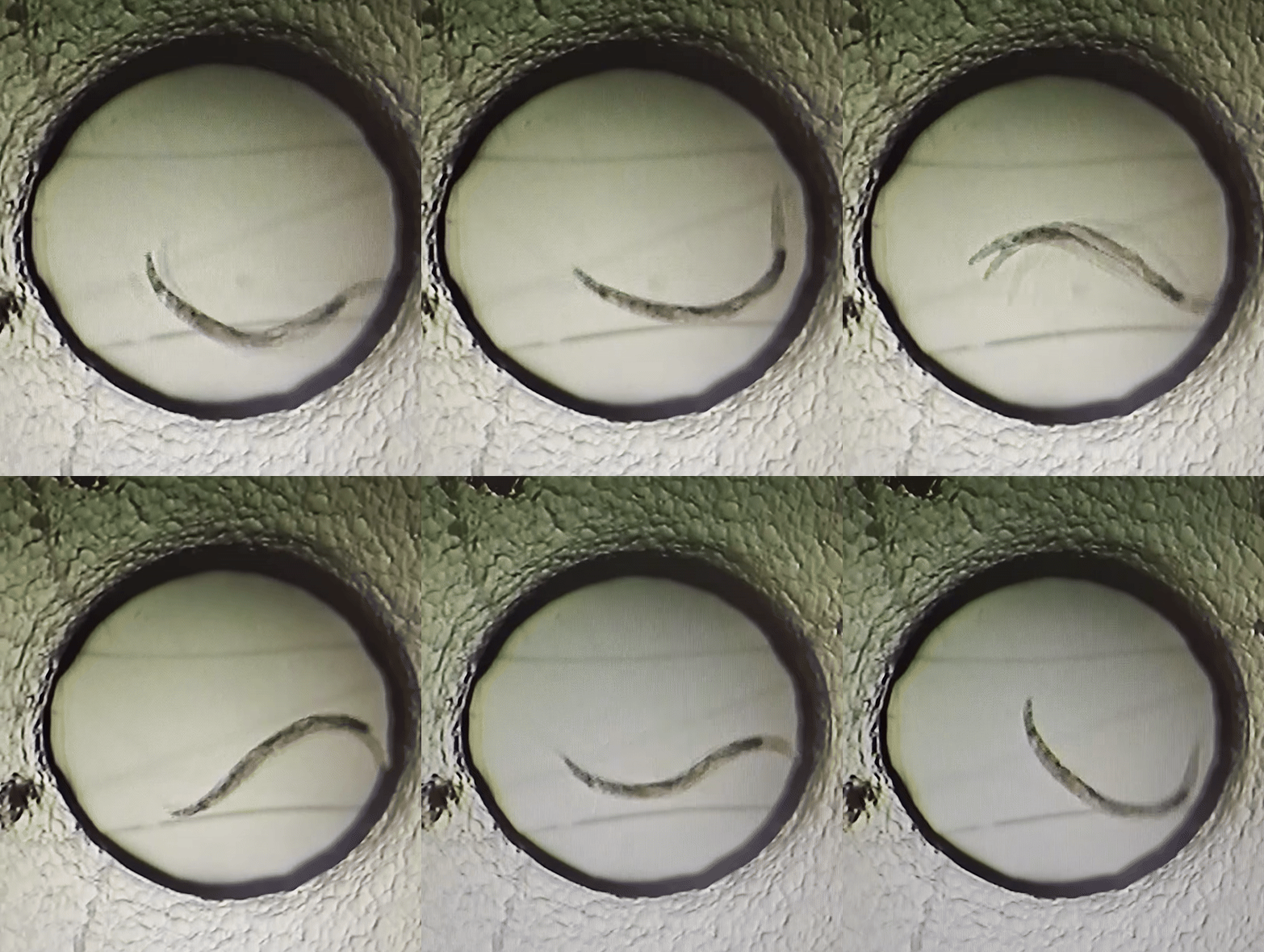
One of the nematodes, Caenorhabditis elegans, is directly monitored in microfluidic chips in the project, among others. This allows accurate dosing, real-time imaging, and time-resolved monitoring of reactions to sophisticated soil extracts or specific contaminants.
What is the role of AI and data systems?
Techniques for predicting and identifying patterns are employed in remote-sensing layers, TRIAD, and chip-based bioassays using artificial intelligence. Imagine that it has been completed as a cycle, connecting satellite- or drone-based signals with the ground-truth biological impacts, and vice versa, back to decision support for land managers.
I am a researcher. How can MIC help?
Three convergent products: (i) region-scale maps with discriminatory ability in terms of source, extent, and risk; (ii) a validated, standardized microfluidic ecotoxicology toolkit with standard use; and (iii) evidence that field-supported, nature-based solutions offer cost-effective delivery of remediation on a medium-to-long-term basis.
Why is it necessary to involve a specialised SME such as MIC in a Horizon consortium?
As a matter of fact, SMEs base their feasibility and exploitation. MIC provides microfluidic engineering, automation, technology transfer, and practical experience in writing and optimizing European proposals. Using the results of our internal benchmarking between official success counts and our own data, consortia with integrated MIC during the early stages are more or less likely to succeed with proposals, and we actively support transitioning devices from TRL 3-4 prototypes to field-ready tools.
What is the EDAPHOS correspondence to the EU policy and the agenda of the Mission Soil?
The program is directly related to the Mission Soil goal of mitigating the risks of contamination and protecting the ecosystem services. The EDAPHOS helps build the evidence base on which regulators and land managers should rely to achieve just, inclusive remediation by integrating mapping and TRIAD-based risk metrics, along with uniform, scalable assays.
What will be considered as proof that attacking phenotypic variation is effective?
If you are submitting a proposal for a Mission Soil or another Horizon Europe, MIC can scope a microfluidic assay approach, jointly design field-to-chip sampling, and provide prototypes tailored to your concerns about contaminants. We help align KPIs, data standards, and exploitation paths so your study can progress to a proof-of-concept stage rather than freeze there.