
Establishing metrology standards in microfluidic devices: MFMET II
Opening
Deadline
Keywords
Metrology
Standardization
Flow measurement
Measurement protocols
Validation methods
Reliability
Reproducibility
ISO standards
Transfer standards
Your microfluidic SME partner for Horizon Europe
We take care of microfluidic engineering, work on valorization and optimize the proposal with you
Turning microfluidics into a standardized, trustworthy technology
Microfluidics has progressed quickly thanks to advances in microfabrication and nanotechnology. But while devices are increasingly available, reliable qualification and characterization methods remain lacking at the system level.
EURAMET 24NRM03 MFMET II is a European project focused on establishing metrology standards in microfluidic devices, including complex systems used in Organ-on-Chip (OoC), diagnostics, microreactors, and other miniaturized lab platforms.
MFMET II addresses this gap by developing protocols, guidelines, and metrology tools that help the field move from “each product has its own validation method” to shared, standardized, comparable testing.
The project focuses on turning key measurement needs into practical protocols and guidance that can be used consistently across labs, manufacturers, and application domains. A key part of that ambition is feeding directly into the work of standardization bodies like ISO/TC 48/WG 3, helping translate metrological rigor into practical industry guidance.
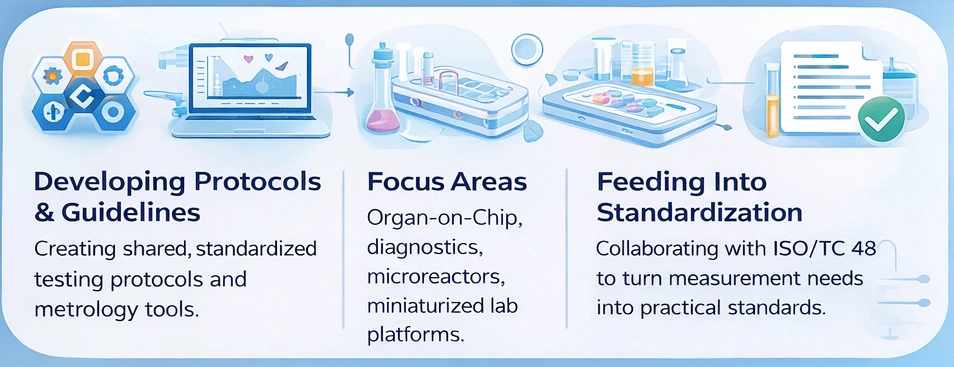
MFMET II project in a nutshell
MFMET II aims to strengthen the metrological foundations needed for reliable standardization in microfluidics and organ-on-chip technologies.
A central objective is to define standardized measurement procedures for core microfluidic quantities that drive performance and comparability, including particle-laden flows (droplets, bubbles, particles, cells), shear stress, pressure drop, flow resistivity, and device volumes (dead and total volume). This helps move the field away from “device-specific” validation toward methods that are repeatable and comparable across platforms.
In parallel, the project will develop protocols for integrating sensors, actuators, and fluidic components using scalable and sustainable manufacturing approaches, while addressing sterilization, contamination prevention, and material-medium interactions, such as absorption/adsorption, coatings, and wettability changes, which are especially critical for organ-on-chip systems.
Finally, MFMET II will establish guidelines for quality control and reliability (including test approaches, failure modes, and safety aspects). The project will also develop an integrated microfluidic setup with multiple sensors and actuators intended to act as a metrological transfer standard. The project’s outcomes will be disseminated through publications, protocols, white papers, and recommendations aimed at regulators, standardization bodies, and the global microfluidic community.
How does MIC contribute to MFMET II?
MIC’s role in MFMET II is to bring hands-on microfluidics and flow-control expertise to the project, ensuring that emerging metrology protocols translate into practical, system-level qualification methods that work in real devices and real workflows. MIC helps stress-test and refines procedures around stable low-flow operation, pressure-flow characterization, and repeatable flow verification. Crucially, this includes accounting for the failure modes that quietly undermine reproducibility in practice: clogging, drift, and subtle changes in the fluidic path that can be easy to miss but hard to explain away.
A good illustration is MIC’s microfluidic flow sensor, designed for wide-range, high-accuracy liquid flow measurement in microfluidic setups and explicitly aimed at making flow control and verification more trustworthy across experiments and platforms.





Funding and Support
The project has received funding from the European Partnership on Metrology, co-financed from the European Union’s Horizon Europe Research and Innovation Programme and by the Participating States.
Start date: June 2025
End date: June 2028