
Microfluidic Benchtop Pump
Precise and silent pressure control without the need of an external pressure and power source
Pressure and vacuum control
-400 mbar to 600 mbar
Work outside the lab
Only plug one cable to your computer, then play
Completely silent
Work in a quiet environment
Compact
Small size to leave you space for your experiment
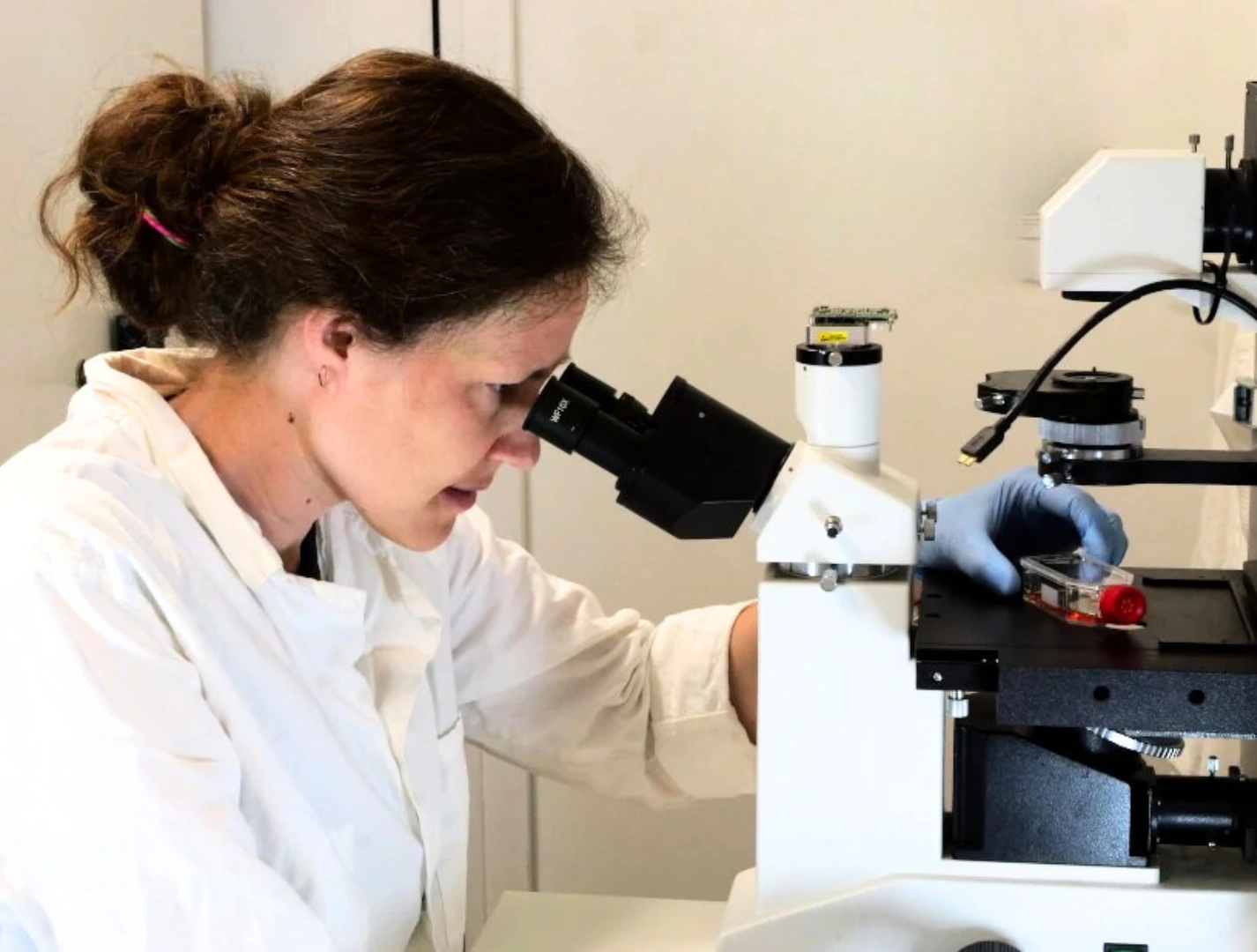
Need a microfluidic SME partner for your Horizon Europe project?
Microfluidic benchtop pump
Work in the field
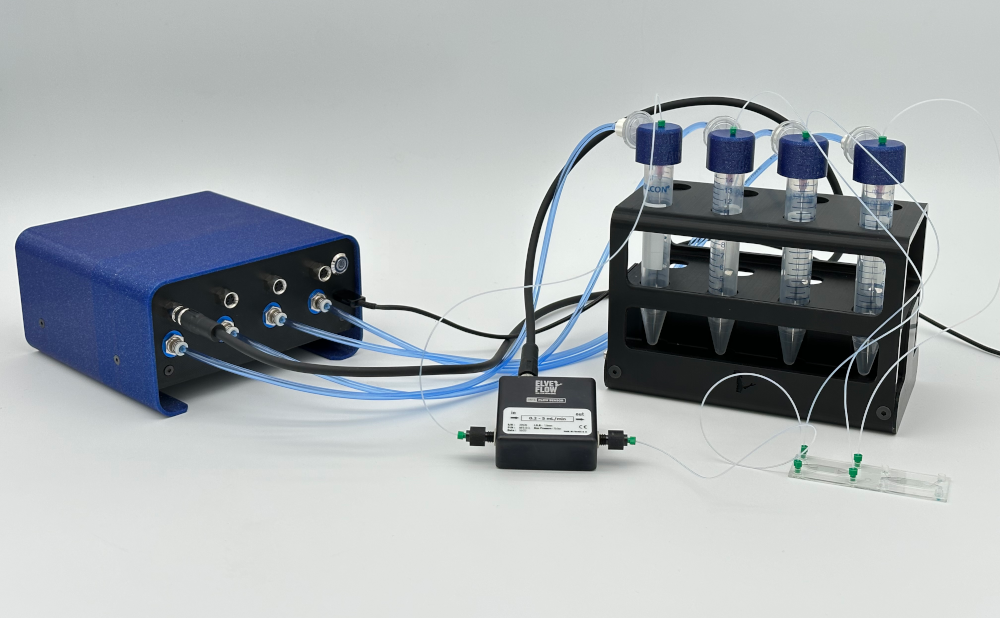
Just plug-&-play: This microfluidic benchtop pump is pressure-autonomous with its integrated pressure source and advanced feedback loop control algorithm. Work wherever you want; no need for a power supply; plug it into your computer and do your experiments.
Quiet and vibration-free
Our pressure controller stands out for its quiet and vibration-free operation, making it ideal for use in any lab environment. This feature ensures that unwanted vibrations do not disrupt your experiments, leading to more accurate and reliable results. Plus, the lack of vibrations reduces the wear and tear on your lab equipment.
Compact size
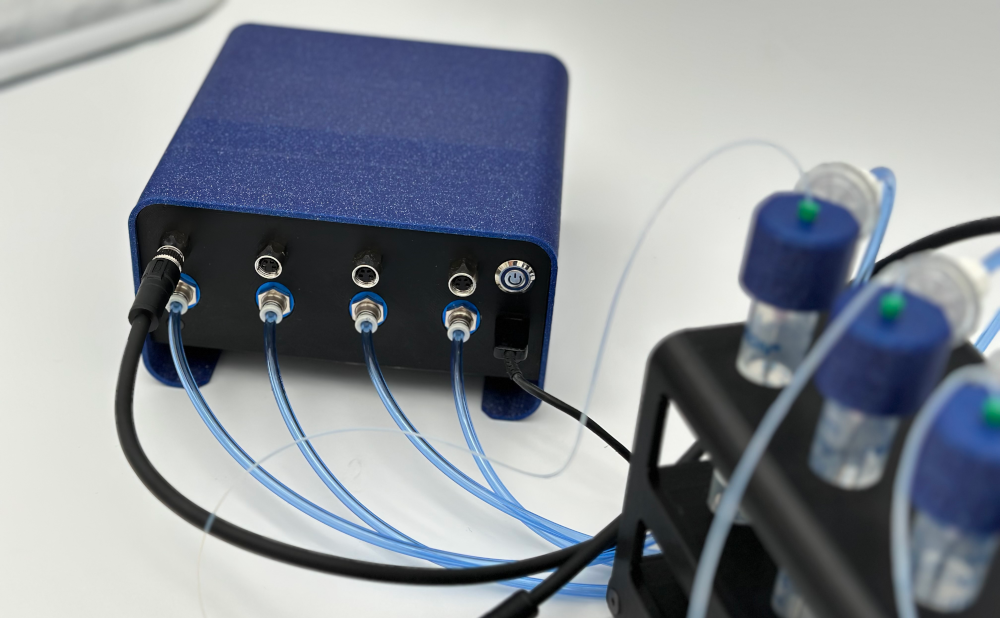
Our pressure controller is designed to be as small as possible to maximize space in your lab. Its compact size allows easy integration into any microfluidic system without sacrificing performance.
Multi-channel capabilities
This pressure controller can control up to four pressure and vacuum channels. It is customizable to fit any lab setup, and its modularity allows for future upgrades to be easily integrated.
Precise flow control
This pressure controller offers precise flow rate control when paired with a flow sensor. The system continuously calculates the pressure and maintains the desired flow rate, allowing for accurate and repeatable results.
Microfluidic benchtop pump applications
Thanks to its outstanding capabilities, this benchtop pump has various applications in biotechnology research, analytical chemistry, biomedicine, and environment.
A self-powered microfluidic pressure pump
- Point-of-care diagnostics: This benchtop pump does not require external pressure or power sources. It finds applications in point-of-care diagnostics, where rapid and portable diagnostic tests are needed. This solution enables precise control of fluid flow in microscale channels for sample preparation, analyte detection, and result readout, making it suitable for use in resource-limited settings or areas with limited access to electricity.
- Environmental monitoring: This portable solution can autonomously drive fluid through microchannels to transport samples or reagents for analysis, making it ideal for remote or field-based applications: analyzing water quality, air pollution, or soil contamination.
Noiseless and vibration-free microfluidic pump
- Microscale cell and tissue culture: This microfluidic pressure pump does not produce noise or vibrations and can provide controlled fluid flow for maintaining cell cultures, microscale organ-on-a-chip systems, or tissue engineering constructs without causing any disturbance to the delicate biological samples.
- Microscale optics and photonics: This autonomous microfluidic pump could be employed to control fluid flow for optical tuning, switching, or modulation, where noise or vibrations could impact the performance of the optical components. This concerns various optics and photonics applications, such as microscale optical waveguides, microscale lenses, or microscale spectrometers.
- Microscale chemical and biochemical analysis: Microfluidic systems are commonly used for chemical and biochemical analysis, such as chromatography, electrophoresis, or immunoassays. This microfluidic pressure controller provides precise fluidic control for these analytical processes, ensuring accurate results without interference from noise-induced artifacts or vibrations.
Microfluidic benchtop pump specifications
| Components | |
|---|---|
| Pressure range | -400 to 600 mbar |
| Air flow rate | 0.1 L/min at atmospheric pressure Possibility to work with higher air flow rates by reducing the pressure range |
| Flow control | |
| Microfluidic Flow sensor | Monitoring and feedback loop flow control available |
| Flow rates | From 0.1 µL/min to 5 mL/min |
| Liquid compatibility | Non contact pump Any aqueous, oil, or biological sample solution |
| Electrical connection | |
| USB connection | USB C |
| Sensor connection | One M8-4 pins connector available per channel |
The microfluidic autonomous pump is compatible with 4mm tubing (outside diameter).
Customize your pack
Our instruments can be added to different setups depending on your specific needs. In this light, our microfluidic specialists will advise you on the best instruments and accessories depending on your needs and will accompany you during the system’s setup.


Funding and Support
The ALTERNATIVE project developments helped develop this instrument. This project is funded by the European Union’s H2020-LC-GD-2020-3, grant agreement No. 101037090.
Products & Associated Accessories
FAQ - Microfluidic Benchtop Pump
What sets the Microfluidic Benchtop Pump apart?
The Microfluidic Benchtop Pump is essentially a small pressure-driven flow controller that does not require a separate power source or an external pressure source. Instead, it has a smart feedback loop and its own pressure generation capability, allowing it to connect to a computer via a USB-C connection.
Does the pump require a compressed gas line or an external power source?
The answer is no. The Microfluidic Benchtop Pump does not require an external power source because it uses the power supplied by the computer’s USB port. It does not require a compressed gas line because it does not require an external pressure source.
Can the pump perform pressure and vacuum tasks? What is the pressure range?
The answer is yes. The pressure range of the pump is from +600 mbar for positive pressure and goes as low as -400 mbar for vacuum.
How does the pump control the flow?
The pump has the capability for precise flow control by connecting the pump with a flow sensor. Once the flow sensor is connected, the pump constantly monitors the flow and adjusts the pressure output to achieve the desired flow. This way, the pump compensates for changes in fluidic resistance due to temperature changes and partial blockage of the channel. The flow rates are controlled between 0.1 µL/min and 5 mL/min.
How many channels does the pump control at one time?
The pump can control up to four pressure and vacuum channels at one time. Each channel can be connected to a flow sensor using a single M8-4 pin sensor connector. This allows for a reduction in footprint and system complexity in that a researcher may be able to have multiple inlets on a single chip or conduct multiple experiments from a single instrument.
Why is vibration-free operation important in microfluidics?
Vibration is important in microfluidics because it may affect tiny lenses and optical waveguiders in a system. It may also affect flow measurements and cell adhesion in a system. In this case, the oscillations and periodic pressure pulses from a peristaltic pump may affect both the system’s sensors and cells.
What types of liquids does the pump work well with?
This pump is a non-contact pressure pump and will never come into contact with a liquid at any point in a system. It works by placing pressure on the headspace above a liquid in a reservoir. This allows it to be used with any type of liquid that a researcher may need to use in a system.
What type of tubing does the pump work well with?
This pump works well with a 4 mm OD tubing format. This is a commonly used format in a microfluidics system and a typical format for a system that will be used in a researcher’s laboratory.
What are the major applications for this pump?
Unlike most laboratory pumps, this pump excels in a variety of applications due to its standalone and quiet operating characteristics:
- Point-of-care diagnostics in which independence from infrastructure and portability are important.
- Environmental field monitoring for studies of soil contamination or water quality in remote areas.
- On-chip cell and tissue culture in which vibrations can be problematic for the samples.
- Mechanical noise that can interfere with optical performance in microscale optical and photonic devices.
- Microscale chemical and biological analysis for applications such as chromatography, electrophoresis, and immunoassay.