Tips & Tricks for a successful HORIZON-CL6-2027-02-FARM2FORK-01 proposal
Opening
20 April 2027
Deadline
Keywords
Digital agriculture
Green Transition
Water scarcity
Nutrient management
AI decision support
Precision farming
Multi-actor approach
Your microfluidic SME partner for Horizon Europe
We take care of microfluidic engineering, work on valorization and optimize the proposal with you
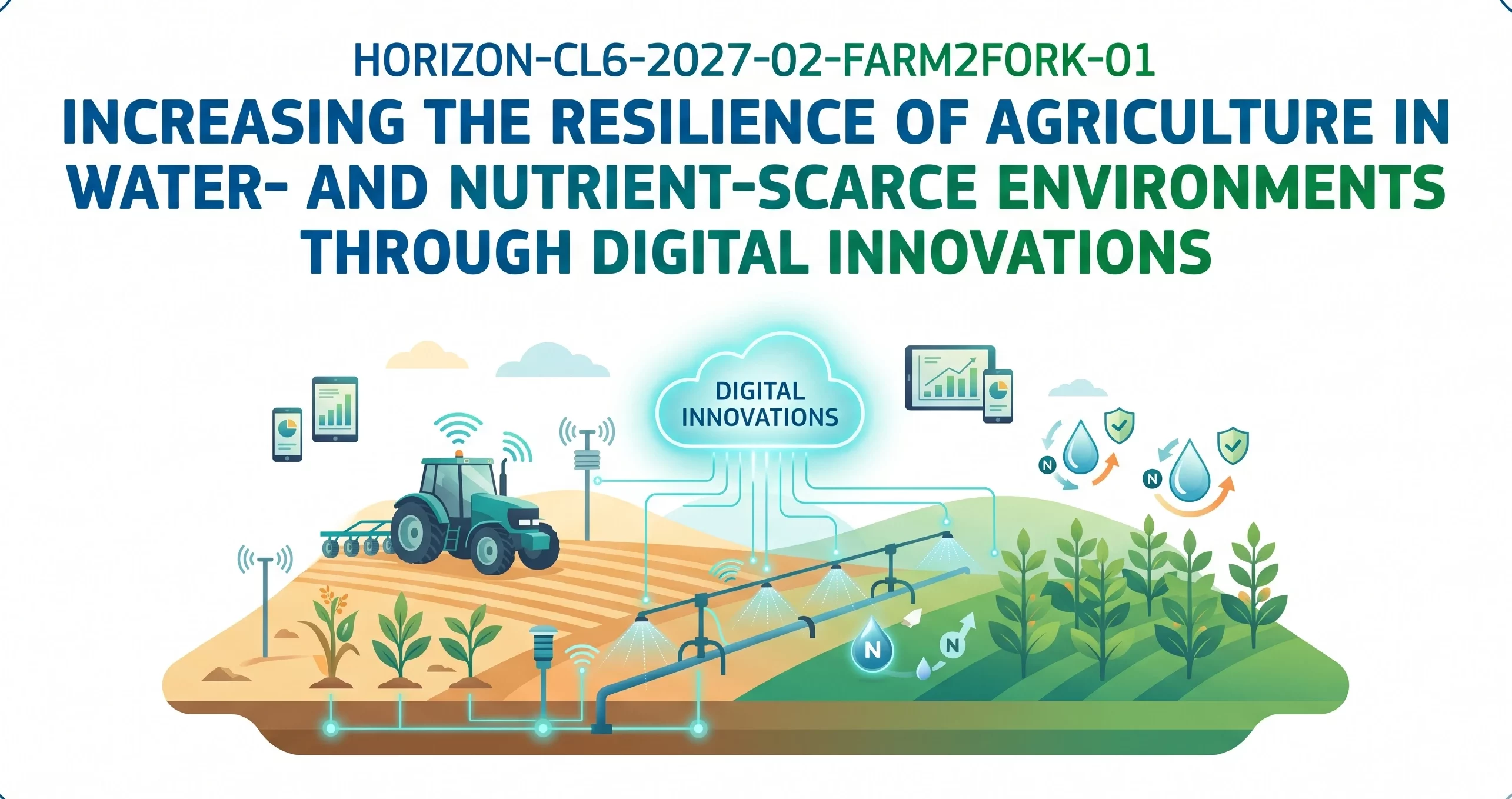
HORIZON-CL6-2027-02-FARM2FORK-01: Increasing the resilience of agriculture in water and nutrient-scarce environments through digital innovations
Two of the most tangible dangers to European agriculture, currently, are water stress and nutrient depletion, and the Commission is interested in technology bridging the gap between what farmers are familiar with and what they can actually do at the ground level. This issue is demanding a study that can relate soil science, digital sensing and AI into something that the farmers can actually implement. The focus on the practical application is not an incidental matter. It is the point of it all.
Download the MIC Horizon Europe 2026/2027 Calls Calendar:
Discover more!
Administrative facts: what do we know about the HORIZON-CL6-2027-02-FARM2FORK-01 call?
Which call is it, and when is the opening and the deadline?
- Call name: Call 02, single stage (2027)
- Call identifier: HORIZON-CL6-2027-02
- Destination: Fair, healthy and environment-friendly food systems from primary production to consumption
- Topic: HORIZON-CL6-2027-02-FARM2FORK-01
- Opening date: 20 April 2027
- Deadline: 23 September 2027 (17:00 Brussels time)
- Type of action: Research and Innovation Actions (RIA)
What about the budget and estimated size of the project?
- Total indicative budget: EUR 12.00 million
- Expected number of projects: 2
- Budget per project: around EUR 6.00 million
What are the key eligibility and evaluation conditions?
- Multi-actor approach: mandatory eligibility criterion
- TRL target: 4-5 by end of project
- Lump sum grant (Decision of 7 July 2021)
- Standard thresholds apply per General Annexes A, B, C, D
Scientific range: what does the Commission expect from the HORIZON-CL6-2027-02-FARM2FORK-01 grant?
What outcomes are expected?
By the end of the project, the farmers are expected to have access to affordable digital tools and advisory systems, enabling them to address water and nutrient shortages. Water, soil, and air pollution should be reduced, and reliance on mineral fertilizers must be reduced by a significant margin. Another way the Commission anticipates the projects to contribute to Green Transition policy is not to merely generate knowledge that is stored in a journal.
What is within scope?
- Research on soil-plant-water-air-nutrient interaction, which includes nitrogen and phosphorus dynamics in the climate change conditions.
- Soil conditions, water quality and nutrient availability sensor systems and monitoring devices to be used affordably and easy to combine with farm management information systems (FMIS) or decision support systems (DSS).
- DSS on water and nutrient use management based on AI and optimized to various pedoclimatic zones and farm environmental conditions.
- Generation and publication of quality AI training data, using standardised protocols, clear metadata and clear legal status.
- Barrier to adoption analysis, such as the issue of trust, accessibility by users with disabilities, poor rural connectivity and knowledge gaps.
The Commission is not after purely theoretical modelling with no way of finding its way to farm-level deployment.
What are the specifically proposed research directions?
- Mapping of complex plant-soil-water-nutrient interactions in a representative sample of European pedoclimatic regions, as a basis to the monitoring and AI work.
- Building monitoring systems that are operational in actual farm scenarios, such as low-connectivity rural settings (that one is underestimated in proposals)
- As part of the research, AI-based DSS to evaluate the implications of land management decisions on water consumption, nutrient cycles, and biodiversity are to be developed and tested.
- Organizing and publicly publishing AI training datasets that can be based on in other projects.
- Determining what really stops farmers in the use of these tools, other than the cost and suggest methods to seal these gaps.
Scientific strategy: how can you enhance your chances of being funded through HORIZON-CL6-2027-02-FARM2FORK-01?
What scientific choices matter most?
- Represent a variety of pedoclimatic areas. An individual country, individual climatic proposal will not pass the test with the assessors. There must be at least three or four real agro-environmental settings.
- Construct the monitoring system with the farmers, and not for them. The multi-actor approach is obligatory. If your system presupposes reliable connectivity and high digital literacy, the strategy will be interpreted as a laboratory experiment. Design for the realistic constraints.
- Go beyond nitrogen. The interactions of phosphorus with soil and water are also within scope and suggestions involving the two in serious considerations have a tendency to come out as more stringent.
- The training data of the AI requires a publication strategy. Open access, metadata, standards, legality: evaluators will make sure that you have actually considered this.
- Research adoption barriers as a research activity. Never a work package title. An actual research question having a methodology and outputs.
Consortium and proposal-writing plan: what works best with this type of call?
- The number of eight to twelve partners is appropriate, perhaps a little more when the pedoclimatic coverage is necessitated.
- Agronomists, soil scientists and digital/AI experts are required. That’s a given. The lack of behavioural science or social science component is what is lacking in the work of the proposals to tackle the barrier of adoption. The text in the call is that they are expected to contribute to the Social Sciences and Humanities (SSH).
- The advisory services and farmers should not be put on the list as end-users who validate in month 30. Multi-actor implies co-designing in the beginning.
- Have an innovative SME that deals with precision agriculture equipment or sensor technology. They should also be a developer in the monitoring system and not a dissemination partner, so to speak. Evaluators notice.
- On writing: position the problem as a deployment failure and not a knowledge gap. The Commission is already aware that there is science on nutrient cycling. They would like to know why farmers are not using it and what these changes are in your project.
How would microfluidics contribute to this topic?
The traditional soil and water surveillance equipment are usually cumbersome, costly and time consuming. Labs send samples away and spend days. That is no help to a farmer deciding whether to irrigate this morning. Microfluidic sensors have the ability to transform that equation and your consortium should take it into consideration.
- Assume that you would like to monitor nitrate leaching in real time on a particular field zone on a complete season. That can be done continuously on a microfluidic chip with a scaled cost miniaturised electrochemical sensor. Calibration on different analyte, same device and you also have phosphate. That is the type of multi-parameter, field-deployable monitoring which the Commission is referring to.
- Lab-on-chip systems to analyze soil nutrients can be incorporated into FMIS as edge-computing nodes, providing AI-DSS with real-time information as opposed to periodical laboratory reports. The quality of decision made is not a minor one.
- Microfluidic water quality sensors are already available, which detect nitrate and phosphorus at detection limits that are able to detect run-offs in agricultural systems. At that level, TRL 4-5, the level that this call requests, your proposal can be constructed upon.
- Accessibility is relevant in this case as well. Microfluidic systems can be made to operate with low skills, low reagents and batteries. That is important in rural areas with low connections with each other, which the work program specifically identifies.
- And here is the AI training data aspect. Field-distributed sensor data collected consistently and at high frequency with the same microfluidic array provides you with the volume and quality of data that AI models actually require. The traditional soil laboratories are not as easy to obtain that.
Microfluidic sensing is not an add-on to a consortium developing a digitally enabled tool for agricultural resilience. This is what renders the monitoring layer really field-ready. The Microfluidics Innovation Center has experience with the development of miniaturised systems of environmental analysis, which would suit well into the sensor development and field validation efforts this topic needs.
The MIC already brings its expertise in microfluidics to Horizon Europe:
H2020-NMBP-TR-IND-2020

Microfluidic platform to study the interaction of cancer cells with lymphatic tissue
H2020-LC-GD-2020-3

Toxicology assessment of pharmaceutical products on a placenta-on-chip model

About the author
Julia Sepulveda Diaz, PhD
Chief Executive Officer, Microfluidics Innovation Center
Julia holds a PhD in glycobiology and neurobiology from Université Paris-Est Créteil. Before moving into microfluidics, she spent several years as a postdoctoral researcher at the Paris Brain Institute, on Parkinson’s disease, neuroinflammation, and the role of heparan sulfate in protein aggregation. Today she leads the Microfluidics Innovation Center as CEO, steering its researchers and engineers and its collaborative research and innovation projects.
FAQ – HORIZON-CL6-2027-02-FARM2FORK-01
What is the main objective of HORIZON-CL6-2027-02-FARM2FORK-01?
The topic calls for Research and Innovation Actions (RIA) to make digital tools and advisory systems available and affordable to farmers to address water and nutrient scarcity. The Commission does not want “ivory tower” models. It is looking for tools that can be used on the farm to inform the Green transition policy.
Who is eligible to apply?
Any legal entity in an eligible Horizon Europe country. The key limiting factor is the requirement to work in a multi-actor approach: farmers, advisors, and end-users should co-design, not test. The usual rules apply per General Annexes A, B, C, and D.
What TRL is expected by the end of the project?
By the end of the project, activities should be at TRL 4-5. This means validation in relevant environments, not just laboratory settings. Field demonstrations with real farmers in real pedoclimatic conditions are expected. Check the Funding and Tenders Portal for more information.
Is the multi-actor approach really mandatory?
Yes. It’s a mandatory eligibility criterion. Projects that do not implement the multi-actor approach are considered ineligible. Farmers, agricultural advisors and other stakeholders must be involved in the project, including in the design and validation of the digital tools and DSS.
How many projects will be funded, and what is the budget per project?
The work program anticipates that 2 projects will be funded from this topic, each for around EUR 6.00 million. The indicative budget is EUR 12.00 million. The competition is likely to be high with the number of grants.
What role should AI play in the proposal?
This topic is all about AI Proposals will need to build and test AI-based decision support tools (DSS) for water and nutrient use, tailored to various pedoclimatic regions. Not only tools, but also quality AI training data (with standardized protocols, metadata, and legal framework) to be publicly released.
What does ‘lump sum grant’ mean in practice?
Under the lump-sum modality (Decision of 7 July 2021), the grant is fixed. Outputs are reported, not costs. This is an easier way to report, but requires a very detailed workplan design up front, as the budget available to work packages is fixed at the time of signing.
How should the consortium address farmer adoption barriers?
The work plan explicitly calls for considering adoption barriers, including trust, digital skills, connectivity in rural areas, and accessibility for people with disabilities. This must be considered as a research task (with methods and deliverables) rather than an extension service. The call wants the social sciences to be engaged.
Can microfluidic technology be integrated into the monitoring work?
Yes, and it can be a strong differentiator. Microfluidic platforms with miniaturized electrochemical sensors enable the real-time monitoring of nitrate, phosphate and other parameters for agricultural use at a cost. They feed FMIS and provide the data at the frequency required for AI-DSS modeling. The Microfluidics Innovation Center has experience in this field.
What is the deadline, and how early should we start preparing?
The call closes on 23 September 2027 at 17:00 (Brussels time), and opens on 20 April 2027. These are complex proposals and need plenty of advance planning. Early engagement with field partners and farmer organizations: the multi-actor approach demands co-design evidence from the start, not an “on paper” sign-off.