
Hydrogen cities: turning valley experience into urban decarbonisation roadmaps
Opening
9 February 2027
Deadline
Keywords
Renewable hydrogen
Hydrogen Valleys
City twinning
Coordination and support
Industrial decarbonisation
Hydrogen roadmaps
Measurement quality
Your microfluidic SME partner for Horizon Europe
We take care of microfluidic engineering, work on valorization and optimize the proposal with you
HORIZON-MISS-2027-04-CIT-02: Hydrogen cities
How can cities turn renewable hydrogen into credible decarbonisation pathways?
Cities need to match renewable hydrogen supply to uses that are difficult to electrify, while checking the environmental consequences of the whole supply chain. Terlouw and colleagues’ global scenario analysis highlights location-dependent electricity, water and material trade-offs. These are modelled pathways, not measured city outcomes. [1]
Within Horizon Europe research projects, the Microfluidics Innovation Center (MIC) designs and develops microfluidic prototypes tailored to each project’s scientific and technical needs. For example, its inline flow sensor measures liquid flow and detects internal clogging and measurement drift. It was developed through the Horizon Europe EIC Transition project GALILEO.
For Hydrogen cities, MIC could help assess where existing microfluidic methods can support liquid sampling, analytical workflows and measurement quality during feasibility studies and knowledge exchange.
Download the MIC Horizon Europe 2026/2027 Calls Calendar:
Discover more!
Call facts and the coordination framework
The HORIZON-MISS-2027-04-CIT-02 – Hydrogen cities topic supports the implementation of the Climate-Neutral and Smart Cities Mission.
- Action and funding. A Coordination and Support Action (CSA), single-stage and forthcoming, funded through a lump sum. The general CSA funding rate is 100%.
- Work-programme schedule. Opening: 9 February 2027. Deadline: 7 October 2027, 17:00 Brussels time.
- Indicative budget. €5 million for the topic, with an expected EU contribution of around €5 million per project. One project is indicatively expected; different requested amounts remain possible.
- Eligibility and proposal length. The General Annexes allow one or more eligible legal entities. Beneficiaries normally need establishment in an EU Member State or Associated Country. The default limit for a lump-sum CSA proposal is 28 pages, subject to the submission template.
- Partnership requirements. The administrative minimum does not replace the cross-city partnerships needed to deliver the scope. The grant will be linked to HORIZON-MISS-2021-CIT-02-03.
- Cities Mission Platform. Include collaboration activities and resources in the work plan. Formalise this relationship through a Memorandum of Understanding as soon as possible after project start.
The Missions work programme sets out the topic conditions.
What the Hydrogen cities project must achieve
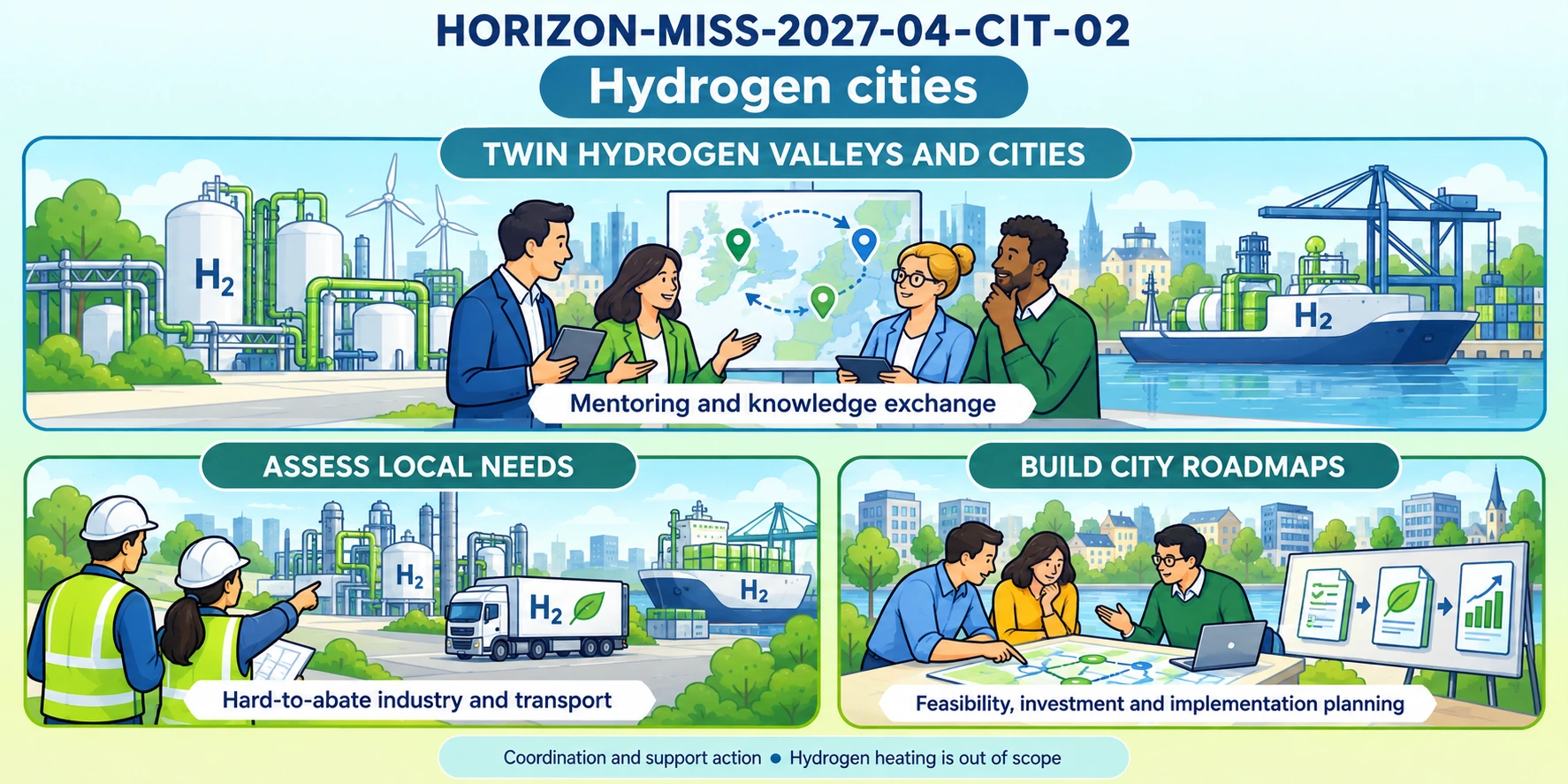
The action connects Hydrogen Valleys with cities seeking to decarbonise local and peri-urban activities. Its central mechanism is mentor–mentee twinning: experienced initiatives help other cities develop their pathways.
- Select and support city pairings. Use a defined selection procedure, organise tailored collaborative activities for each pair and enable learning across cities.
- Produce city-specific roadmaps. Deliver a detailed renewable-hydrogen roadmap for every twinned city, supported where relevant by feasibility studies, business cases, implementation planning, environmental and socio-economic assessment, and training.
- Focus on relevant applications. Address industry, heavy-duty and long-distance transport, aviation and maritime activities. Hydrogen for heating is outside the topic scope.
- Connect planning to outcomes. Explain how the roadmaps can support subsequent investment and deployment, local air-quality improvements, economic activity and employment. Distinguish planned infrastructure from operating installations.
- Build geographical reach. At least one twinned city is expected to belong to the 112 Cities Mission cities. Geographical balance is encouraged; pairings may also involve enlargement countries.
- Coordinate with European initiatives. Strengthen links with the Clean Hydrogen Partnership, use the Hydrogen Valley and Cities Mission platforms, and allocate resources to clustering work.
The topic does not specify a universal number of twinning pairs or a final technology readiness level.
Design roadmaps around decisions and usable evidence
Build each roadmap around a decision that a city or operator can make. Identify the industrial process or transport service, the responsible organisation and the existing energy supply before choosing infrastructure.
- Compare feasible options. Explain why hydrogen is being considered and assess alternatives, including direct electrification where applicable.
- Establish the baseline. Bring together demand profiles, electricity and hydrogen sourcing, delivery arrangements, land availability and water constraints. Record the origin and date of each assumption and identify major uncertainties.
- Test the assumptions that matter. Use low, central and high cases for variables that could change an investment decision. These are proposed planning methods, not additional eligibility rules.
- Keep evidence in context. Laboratory performance, supplier estimates and operating-site records answer different questions. State the functional unit and life-cycle stages used in environmental comparisons.
- Use application-specific analysis. The supply-chain analysis by Goita and colleagues illustrates why results differ between steel and heavy-duty transport. [2] Its US-specific scenarios cannot be adopted as European city forecasts.
- Assign decisions and responsibilities. Resolve the supply option, assess permitting and infrastructure interfaces, establish a financing route and define implementation conditions. Pairing reviews should explain which assumptions were retained, changed or rejected.
Each roadmap should provide a defensible basis for subsequent investment, with remaining evidence needs clearly identified.
Build partnerships that can transfer experience into action
Organise the partnership around city needs and the experience mentors can share. Make responsibilities for data access, interpretation and roadmap acceptance visible in the work packages.
- Local authorities. Connect the roadmap to climate planning and public decisions, and identify who will own and maintain it after the action.
- Hydrogen Valley operators. Contribute practical knowledge of supply chains, operational constraints and implementation that mentee cities can assess against their circumstances.
- Industrial users, ports and transport operators. Provide demand profiles, operating requirements and credible adoption pathways.
- Specialist partners. Bring together energy-system analysis, environmental assessment, financing, permitting and stakeholder engagement. Choose consortium size from these responsibilities; the topic imposes no SME quota or preferred partner count.
- Transparent pairing. Select pairings using relevant experience, city readiness, mutual learning and geographical diversity. Distinguish consortium beneficiaries from cities or stakeholders selected later for twinning.
- Knowledge transfer. Resource shared templates, peer learning, training and the Cities Mission Platform relationship from the beginning. Leave participating organisations with a usable method or decision aid.
- Data access and continuity. Agree how commercially sensitive operating information can be used and how the final roadmap will feed into investment planning.
How microfluidics and MIC can contribute to HORIZON-MISS-2027-04-CIT-02
MIC’s proposed role is to help city teams assess whether microfluidic methods can meet a specific liquid-analysis need within their hydrogen roadmap. In this coordination and support action, the contribution would centre on technical assessment, measurement requirements and knowledge transfer.
- Identify a relevant use case. Start from an operator’s problem, such as liquid sampling or water-analysis workflows considered in a feasibility study. Define the information required and the decision it would inform before proposing a microfluidic approach.
- Assess what microfluidics could add. Microfluidics enables controlled handling of small fluid volumes and the miniaturisation or automation of analytical workflows. MIC could compare existing approaches for sample handling, controlled flow and integration with an analytical method, alongside their maintenance and operator-training needs.
- Define measurement requirements. Translate the use case into flow ranges, sample compatibility, calibration checks, repeatability and acceptable uncertainty. The inline flow sensor provides relevant experience in flow measurement and troubleshooting; MIC’s work in MFMET II supports practical flow-control and qualification methods.
- Make lessons transferable. Help a mentor–mentee pair compare its workflows and data requirements. Deliver a method-comparison note, measurement-requirements brief or training guide that the city team can use in its feasibility assessment.
- Connect expertise to the roadmap. The operator defines the decision and provides existing process information. MIC assesses the microfluidic workflow; hydrogen and analytical specialists address application-specific requirements and interpret the wider implications.
Project-specific development: MIC develops tailored prototypes within suitable Horizon Europe research projects. For Hydrogen cities, the proposed work uses existing expertise to assess options and transfer knowledge. Any new prototype development would need a separate research framework.
The MIC already brings its expertise in microfluidics to Horizon Europe:
H2020-NMBP-TR-IND-2020

Microfluidic platform to study the interaction of cancer cells with lymphatic tissue
H2020-LC-GD-2020-3
Toxicology assessment of pharmaceutical products on a placenta-on-chip model

About the author
Céleste Chidiac, PhD
Scientific writer and digital marketing specialist
Céleste Chidiac holds a doctorate in neuroscience and molecular biology from the University of Strasbourg. Since joining the Microfluidics Innovation Center in 2023, she has combined scientific writing with website management. For MIC’s Horizon Europe topic pages, she draws on her research background to explain scientific challenges and clarify funding priorities. Her writing helps prospective applicants understand each topic’s scope, expected outcomes and research directions.
FAQ - Measurement choices for HORIZON-MISS-2027-04-CIT-02
These questions examine the evidence behind hydrogen roadmaps, the transfer of knowledge between cities, and the limits of microfluidic measurement expertise.
Does renewable hydrogen have zero life-cycle emissions?
No. Renewable electricity reduces a major source of emissions, but equipment manufacture, resource use and supply-chain losses still matter. Terlouw and colleagues’ global modelling found that impacts vary with production location and renewable-resource conditions. [1] A city should therefore use a supply-specific assessment rather than treat the word “renewable” as a complete environmental result.
Why does the time horizon matter when assessing hydrogen leakage?
Hydrogen emissions cause indirect atmospheric warming, and their relative influence depends on the time horizon used. Ocko and Hamburg’s scenario analysis shows why short-term and long-term climate comparisons can give different impressions of benefits. [3] Leakage assumptions and the chosen climate metric should therefore be reported together; a modelled leakage scenario is not a measured loss rate at a proposed city site.
Can a hydrogen result for steel be reused for heavy-duty transport?
No. The displaced process, energy conversion and supply chain differ. Goita and colleagues found that production pathways affected the climate case differently for steel and heavy-duty transport in their US-specific life-cycle assessment. [2] Their results support application-specific comparison, not transferring a sector’s savings to every other hydrogen use. European roadmaps need locally relevant input data.
How should water availability influence a hydrogen supply option?
Water assessment should consider local scarcity and competing uses alongside the volume required. Terlouw and colleagues identified a geographical tension between attractive renewable-hydrogen production potential and water availability. [1] This does not determine the outcome for an individual city, but it supports screening the water context of both local production and imported supply.
What should cities compare when mentors use different measurement methods?
Before comparing reported values, check that the methods use comparable:
- Measured quantities and sampling boundaries;
- Calibration procedures and measurement uncertainty;
- Operating conditions.
MFMET II works on comparable characterisation and qualification of microfluidic systems, including flow, pressure and volume. Its methods offer a useful example of disciplined measurement practice; applying that practice to hydrogen requires the relevant gas and application expertise.
Can the inline flow sensor be used as a hydrogen leakage detector?
The inline flow sensor measures liquid flow in microfluidic systems; it is not a hydrogen gas detector. Its replaceable cartridges and internal clogging or drift alerts help users monitor the reliability of liquid-flow measurements. Hydrogen leak monitoring requires a gas-specific sensing method suited to the concentration range and operating environment. MIC’s flow expertise is relevant to associated liquid-handling or sampling workflows.
How can MIC’s work in MFMET II improve measurement practice?
MIC brings practical flow-control and device-qualification expertise to MFMET II. This experience can help teams ask useful questions about calibration, repeatability and changes in a fluidic circuit. Where a city roadmap uses microfluidic measurements, MIC can help turn those questions into method-selection criteria and clear instructions for users.
Can a laboratory flow result validate a city-scale hydrogen pathway?
A laboratory flow result answers a defined measurement question; a city-scale pathway also depends on supply, operation and environmental performance. MIC’s GALILEO work focused on flow measurement for microfluidic cell-analysis workflows. In Hydrogen cities, MIC can help assess relevant liquid-flow data and its limitations, while energy-system and hydrogen specialists connect that evidence to the wider feasibility assessment.
What distinguishes a transferable lesson from a copied hydrogen roadmap?
A transferable lesson explains the conditions under which an approach worked. For a mentor–mentee pair, a useful exercise is to separate reusable procedures from local assumptions about demand, supply, land and stakeholder decisions. The topic’s tailored twinning activities and city-specific roadmaps create space for this adaptation. The proposed exercise is a planning recommendation, not an extra call requirement.
What would make a MIC contribution useful to a city team?
A useful contribution resolves a specific measurement problem and gives the city team a method it can use. MIC can translate microfluidic needs into technical specifications and support knowledge transfer between partners. For this action, that could mean a method-selection note, a calibration guide or training based on an operator’s existing workflow, with the output agreed around a concrete decision in the roadmap.
References
[1] Terlouw, T., Rosa, L., Bauer, C. and McKenna, R. Future hydrogen economies imply environmental trade-offs and a supply-demand mismatch. Nature Communications. 2024;15:7043. https://doi.org/10.1038/s41467-024-51251-7
[2] Goita, E. G., Beagle, E. A., Nasta, A. N., Wissmiller, D. L., Ravikumar, A. and Webber, M. E. Effect of hydrogen leakage on the life cycle climate impacts of hydrogen supply chains. Communications Earth & Environment. 2025;6:160. https://doi.org/10.1038/s43247-025-02141-3
[3] Ocko, I. B. and Hamburg, S. P. Climate consequences of hydrogen emissions. Atmospheric Chemistry and Physics. 2022;22:9349–9368. https://doi.org/10.5194/acp-22-9349-2022