Tips & Tricks for a successful HORIZON-NEB-2026-01-PARTICIPATION-03 proposal
Opening
05 May 2026
Deadline
Keywords
NEB
neighbourhoods
lump sum
green transition
health & well-being
social inclusion
local democracy
urban design
RIA
social sciences & humanities
Your microfluidic SME partner for Horizon Europe
We take care of microfluidic engineering, work on valorization and optimize the proposal with you
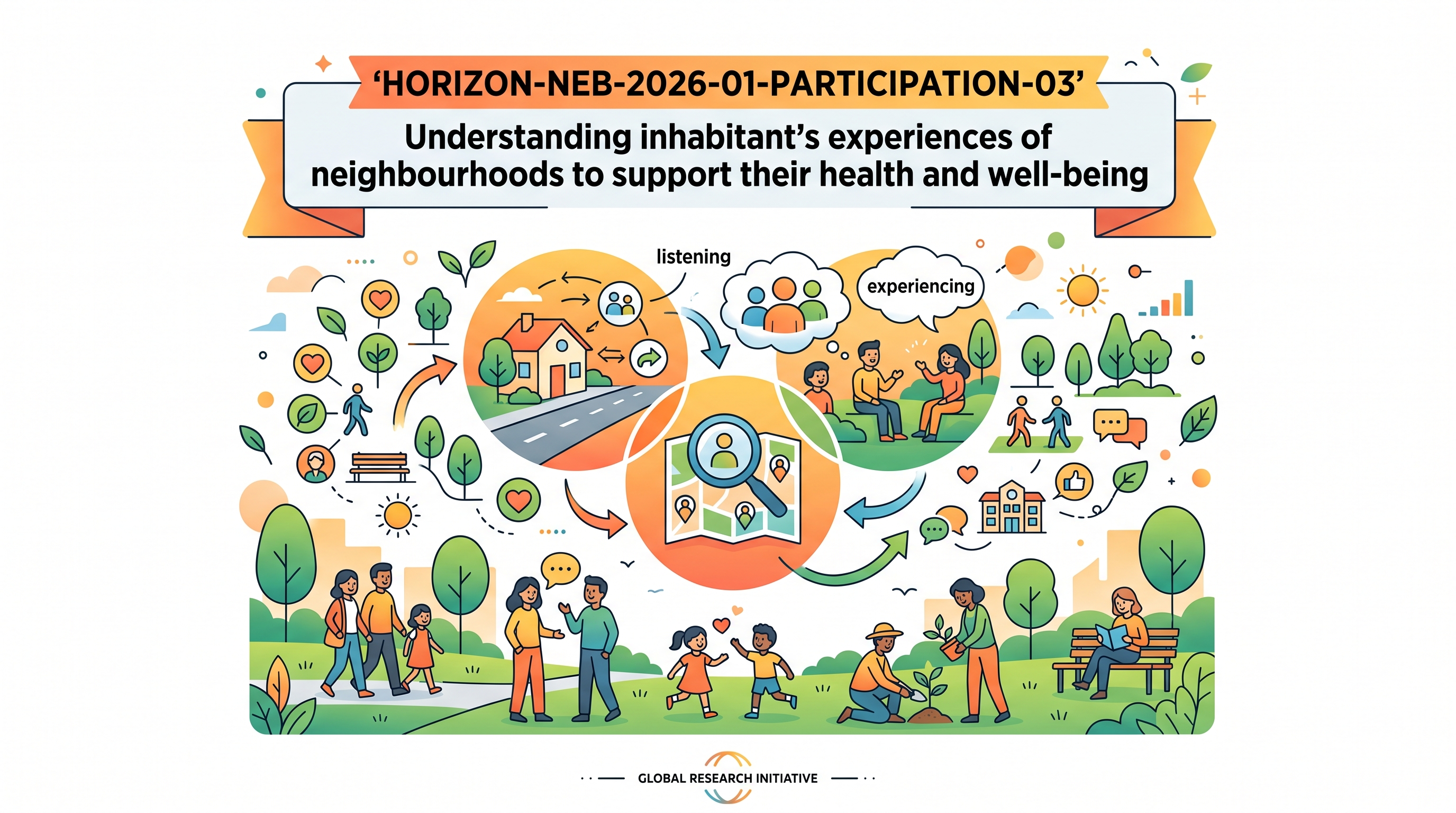
HORIZON-NEB-2026-01-PARTICIPATION-03: Understanding inhabitant's experiences of neighbourhoods to support their health and well-being
The Commission wants hard evidence on something studied so far in fragments: how people actually feel their neighbourhood, and what that does to their health. Not opinion surveys alone. Findings have to travel across very different places, then land with local authorities and cultural actors. Beauty and inclusion are part of the frame, not decoration.
Download the MIC Horizon Europe 2026/2027 Calls Calendar:
Discover more!
Administrative facts: what do we know about the HORIZON-NEB-2026-01-PARTICIPATION-03 call?
Which call is it, and when is the opening and the deadline?
- Call name: Beautiful, inclusive and sustainable neighbourhoods for communities
- Call identifier: HORIZON-NEB-2026-01
- Destination: Connecting the green transformation, social inclusion and local democracy
- Topic: HORIZON-NEB-2026-01-PARTICIPATION-03
- Opening date: 05 May 2026
- Deadline: 01 December 2026, 17:00 Brussels time
- Type of action: Research and Innovation Action, lump sum funding
What about the budget and estimated size of the project?
- Topic budget: EUR 15.00 million
- Number of projects expected: 3
- EU contribution per project: around EUR 5.00 million
What are the key eligibility and evaluation conditions?
- General Annex B eligibility: at least three independent legal entities from three different Member States or Associated Countries.
- Award criteria and thresholds: General Annex D.
- Contribution of social sciences and humanities is mandatory.
- At least 0.8% of the budget goes to the NEB hub for results and impact.
- Findings validated in three neighbourhoods (urban, peri-urban, rural) in three different Member States or Associated Countries.
- No JRC participation foreseen, no mandatory clustering clause.
Scientific range: what does the Commission expect from the HORIZON-NEB-2026-01-PARTICIPATION-03 grant?
What outcomes are expected?
The Commission is after evidence that holds up under scrutiny: how inhabitants experience their neighbourhood, and how that moves their physical and mental health. And it wants the evidence used. Policy, planning and procurement for the green transition should lean on your results. A publication series is not the point.
What is within scope?
- Sensory and emotional experience of the neighbourhood, and its effects on health and well-being
- Neuro-architectural aspects of space, atmosphere and ambiance in urban design, perceived beauty
- Digital methods to map how inhabitants experience the built environment
- Recommendations for local authorities and for the artistic, cultural and heritage sector
- The NEB self-assessment method as a shared data reference
Research on experience and its health effects. Not a renovation demonstrator.
What are the specifically proposed research directions?
- Involve people in vulnerable or marginalised situations: children, older adults, people with functional variations and their carers, migrants and refugees
- Assess how experiences vary across sociodemographic groups and neighbourhood types: geography, quality of the built environment, perceived beauty, social mixing, reputation, access to nature and culture
- Provide consistent, comparable data across sites and populations
- Turn the evidence into guidance on belonging, on health, and on the green transition
Scientific strategy: how can you enhance your chances of being funded through HORIZON-NEB-2026-01-PARTICIPATION-03?
What scientific choices matter most?
- Design the comparison first. Three neighbourhoods is the floor, not the target. Pick sites differing on one or two variables you can isolate, or the analysis becomes a pile of case studies.
- Put objective measures next to self-reported ones. Evaluators get nervous when everything rests on interviews.
- Commit to the NEB self-assessment method early. The call names it.
- Say how you will handle sensitive data from vulnerable participants (this trips consortia up more than you would expect).
- Build the recommendation work package from month one.
- The wording on digitalisation is loose. Room to frame it your way.
Consortium & proposal-writing plan: what works best with this type of call?
- Somewhere between ten and fourteen partners, a couple more if site coverage demands it.
- SSH is not decoration here. Environmental psychology, medical sociology, urban anthropology, public health. Lead work packages, not support roles. Plus architects and urban planners.
- Cities and local authorities as full beneficiaries wherever you can. Letters of support are weaker, and reviewers know it.
- An innovative SME on the sensing and measurement side usually strengthens the impact section.
- Lump sum funding means your work package structure is your budget. Fix it before writing.
How would microfluidics contribute to this topic?
Self-reported well-being is hard to compare across countries and languages. Questionnaires drift. Lab biomarker analysis is precise but slow, and you cannot run it in a courtyard in three countries at once. Microfluidics shrinks that lab onto a chip you carry to the site. One protocol, everywhere.
- Stress biology, measured where people live. You want to know whether a noisy street really raises stress or whether residents just report it that way. A saliva cortisol assay, run on site, gives the biological half of the answer.
- Air and water quality screening at neighbourhood scale.
- One site has a reputation problem. Residents believe the soil is contaminated, the authority says otherwise, nobody has measured it. Portable heavy-metal screening settles that in days. Then you study what the belief itself does to well-being.
- Inflammation markers from a finger prick. No cold chain.
Microfluidics will not tell you why someone loves their street. It gives your consortium a hard data layer underneath the soft one, and it makes your comparability claim credible. Which is what this call asks for.
The MIC already brings its expertise in microfluidics to Horizon Europe:
H2020-NMBP-TR-IND-2020

Microfluidic platform to study the interaction of cancer cells with lymphatic tissue
H2020-LC-GD-2020-3

Toxicology assessment of pharmaceutical products on a placenta-on-chip model

About the author
Céleste Chidiac, PhD
Scientific writer and digital marketing specialist
Céleste Chidiac holds a doctorate in neuroscience and molecular biology from the University of Strasbourg. Since joining the Microfluidics Innovation Center in 2023, she has combined scientific writing with website management. For MIC’s Horizon Europe topic pages, she draws on her research background to explain scientific challenges and clarify funding priorities. Her writing helps prospective applicants understand each topic’s scope, expected outcomes and research directions.
FAQ - HORIZON-NEB-2026-01-PARTICIPATION-03
What is the HORIZON-NEB-2026-01-PARTICIPATION-03 topic about?
It funds research on how inhabitants actually experience their neighbourhood, and on what that experience does to their physical and mental health. The findings then have to feed policy, planning and procurement for the green transition of neighbourhoods.
When does the call open and when is the deadline?
The call HORIZON-NEB-2026-01 opens on 05 May 2026. The deadline is 01 December 2026 at 17:00 Brussels time. Note that the Commission reserves the right to shift opening and deadline dates.
How much funding is available, and how many projects will be funded?
The topic budget is EUR 15.00 million. Three projects are expected, each with an EU contribution of around EUR 5.00 million.
What type of action is it, and how is the grant paid?
It is a Research and Innovation Action. Eligible costs take the form of a lump sum, so your work package structure defines your budget from the start.
Check the Funding and Tenders Portal for more information.
How many neighbourhoods do we need to cover?
At least three, spread across urban, peri-urban and rural settings, and located in at least three different Member States or Associated Countries. Three is the minimum, not a comfortable target.
Is social sciences and humanities expertise really mandatory?
Yes. The topic explicitly requires the effective contribution of SSH disciplines and the involvement of SSH experts and institutions. Treat it as a design constraint, not a box to tick.
What is the NEB self-assessment method, and why does the call mention it?
It is a European Commission tool for assessing projects against New European Bauhaus principles. The topic asks for consistent and comparable data across sites, and names this method as one of the references to use.
What partners should be in the consortium?
SSH researchers in lead roles, architects and urban planners, cities or local authorities as full beneficiaries, at least one cultural or heritage organisation, and an innovative SME on the measurement side. Ten to fourteen partners is a sensible range.
What is clearly outside the scope of this topic?
This is not a building renovation or construction demonstrator. The research object is experience and its health effects. Proposals that turn into a retrofit pilot are likely to miss the point of the topic.
How can microfluidics strengthen a proposal on this topic?
It adds an objective data layer under the self-reported one. Portable chips let you run the same stress biomarker, water and soil screening protocol across every site, which is exactly what the call means by comparable data.