
Tips & Tricks for a successful HORIZON-MISS-2027-04-CIT-CCRI-04 proposal
Opening
09 February 2027
Deadline
Keywords
circular logistics
reusable packaging
reverse logistics
urban freight
modular loading units
Climate-Neutral
smart Cities Mission
circular logistics
e-commerce
Your microfluidic SME partner for Horizon Europe
We take care of microfluidic engineering, work on valorization and optimize the proposal with you
HORIZON-MISS-2027-04-CIT-CCRI-04: Advancing circular logistics solutions in cities
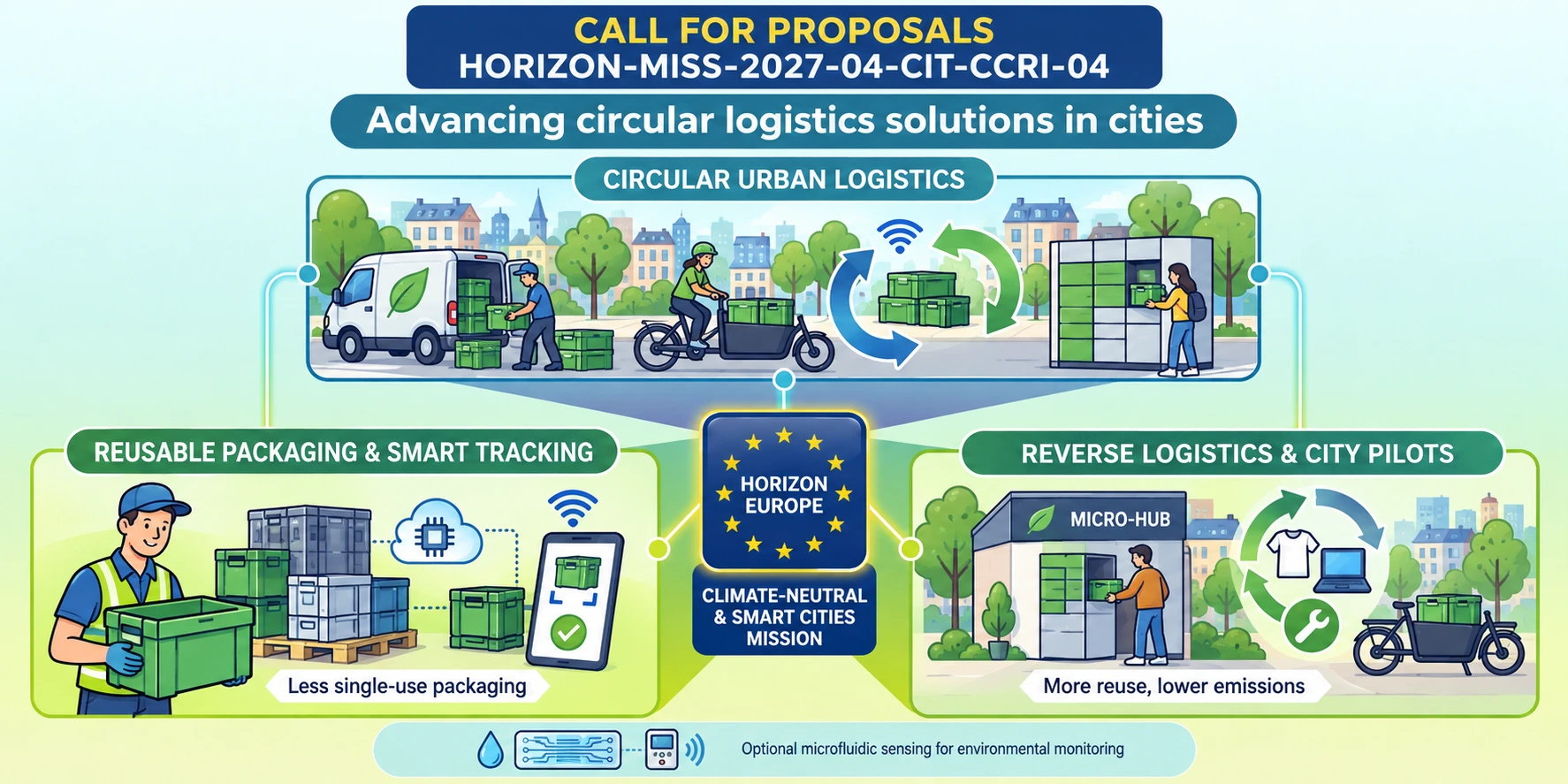
It is a topic for funding Innovation Actions under the Climate-Neutral and Smart Cities Mission (call HORIZON-MISS-2027-04). E-commerce keeps growing, and so does the packaging waste and truck traffic that follow it. The Commission wants circular answers to urban logistics. Think reusable modular packaging, smarter reverse logistics, and pilots that run on real streets. Less single-use, less wasted movement, more materials kept in the loop.
Download the MIC Horizon Europe 2026/2027 Calls Calendar:
Discover more!
Administrative facts: what do we know about the HORIZON-MISS-2027-04-CIT-CCRI-04 call?
Which call is it, and when is the opening and the deadline?
- Name of the call: Supporting the implementation of the Climate-Neutral and Smart Cities Mission
- Call identifier: HORIZON-MISS-2027-04
- Destination: 100 Climate-Neutral and Smart Cities by 2030
- Topic: HORIZON-MISS-2027-04-CIT-CCRI-04, Advancing circular logistics solutions in cities
- Opening date: 09 February 2027
- Deadline: 07 October 2027, 17.00 Brussels local time
- Type of action: Innovation Actions
What about the budget and estimated size of the project?
- Overall budget for the topic: EUR 22.50 million
- Number of projects: 3
- Budget per project: around EUR 7.50 million
What are the key eligibility and evaluation conditions?
- At least three cities as beneficiaries, each from a different Member State or Associated Country, represented by a local authority or an entity with its explicit consent
- At least one of those cities must be among the 112 Mission cities
- TRL 7-8 expected by the end of the project
- Funding is a lump sum, linked to action HORIZON-MISS-2021-CIT-02-03
- Clustering with the Cities Mission Platform through CIVITAS and the CCRI is mandatory, formalised by an MoU or collaboration agreement
- Eligibility is subject to restrictions for the protection of European communication networks
Scientific range: what does the Commission expect from the HORIZON-MISS-2027-04-CIT-CCRI-04 grant?
What outcomes are expected?
The Commission wants tested circular logistics working in real cities, not a study of what might work. Reusable packaging and modular loading units should be adopted by logistics operators, with reverse logistics feeding measurable reuse and recycling rates. Publication series are not what they are after here.
What is within scope?
- Modular, reusable and recyclable packaging and loading units that cut single-use packaging in urban freight
- Digital tools for tracking and optimising loading units, using IoT, edge computing, AI and data spaces
- Parcel lockers and micro-hubs for returning and collecting items for repair, reuse, remanufacture or recycling
- Real-world pilots in at least two urban environments, each covering two or more types of goods
- Reverse logistics systems and innovative return-and-reuse schemes
- Impact assessment across environment, society and economics, plus co-created policy recommendations
This is an Innovation Action. Early-stage lab concepts sit outside it. The Commission wants things close to deployment.
What are the specifically proposed research directions?
- Align packaging design with the revised EU Packaging and Packaging Waste Regulation (PPWR), and show its effect on delivery models
- Build data-driven collaboration platforms while respecting technological sovereignty and energy efficiency
- Co-design solutions with retailers, operators and citizens
- Pilot across at least two different goods types per site, for instance textiles and consumer electronics
- Quantify emissions and material savings from reverse logistics, alongside new business models and incentives
The Work Programme is explicit, so there is little guesswork. If anything, reverse logistics carries more weight than packaging alone.
Scientific strategy: how can you enhance your chances of being funded through HORIZON-MISS-2027-04-CIT-CCRI-04?
What scientific choices matter most?
- Lead with the pilots. Two cities is the floor, not the ceiling, and reviewers on an IA want deployment.
- Make the PPWR your backbone. Every packaging choice should trace back to the regulation.
- Bring at least one Mission city in early. This is an eligibility gate, and late recruitment shows.
- Prove reuse with numbers, not intentions.
- Design the digital layer for interoperability. Data spaces and IoT only help if operators can plug in, and technological sovereignty is written into the text, so treat it as a real constraint.
- Cover reverse logistics properly. We see this underdone a lot, and here it is half the point.
Consortium & proposal-writing plan: what works best with this type of call?
- Aim for somewhere between eight and twelve partners, maybe a couple more if you need broader city coverage.
- Cities are non-negotiable. Three at least, three countries, one of them a Mission city.
- Mix local authorities, logistics operators, retailers, and an academic partner or two for the impact work.
- If you can, add an innovative SME that already builds reusable packaging or tracking tech. It sharpens the deployment story, and evaluators notice.
- Write the clustering plan properly. CIVITAS and CCRI collaboration is mandatory, so budget real time and money for it.
- Keep impact concrete. Tonnes of packaging avoided, kilometres saved, that kind of thing.
How would microfluidics contribute to this topic?
Let’s be straight. This call is about trucks, packaging and reverse flows, not lab chips. Conventional impact reporting often leans on modelled estimates that reviewers can poke holes in. Microfluidics won’t sit at the centre of your proposal, but it can help you measure a few of the things you claim to save.
- Emissions and air quality. You will claim reduced pollutant emissions around your pilots. Small microfluidic sensors give you field readings instead of desk figures, so your numbers hold up.
- Water at micro-hubs. If your hubs wash reusable packaging, microfluidic water-quality sensors can flag contaminants on the spot.
- Say a reviewer doubts your reuse cycle is really cleaner. Put a compact sensor on the wash line at one hub, log water quality across a hundred cycles, and you have measured evidence instead of a claim.
Point is, microfluidics here is a supporting instrument, not the headline. It backs the measurement side of your impact story, and that is where circular-economy proposals often get picked apart. If it fits your setup, a light sensing component can defend your environmental claims. If it doesn’t, don’t force it. For how microfluidics maps across the Mission calls, see the Missions relevance overview.
The MIC already brings its expertise in microfluidics to Horizon Europe:
H2020-NMBP-TR-IND-2020

Microfluidic platform to study the interaction of cancer cells with lymphatic tissue
H2020-LC-GD-2020-3

Toxicology assessment of pharmaceutical products on a placenta-on-chip model

FAQ - HORIZON-MISS-2027-04-CIT-CCRI-04
So what is this call really about?
It funds circular logistics for cities. The Commission wants reusable packaging, modular loading units and reverse logistics tested in real urban pilots, under the Climate-Neutral and Smart Cities Mission.
Who can apply and how much money is on the table?
The topic budget is EUR 22.50 million for 3 projects, around EUR 7.50 million each. You need at least three cities as beneficiaries, each from a different Member State or Associated Country, and at least one among the 112 Mission cities.
What type of action is it, and what TRL is expected?
It is an Innovation Action. Activities should reach TRL 7-8 by the end of the project. Funding is a lump sum linked to action HORIZON-MISS-2021-CIT-02-03.
When does the call open and close?
The call HORIZON-MISS-2027-04 opens on 09 February 2027. The deadline is 07 October 2027 at 17.00 Brussels local time.
Which outcomes do evaluators really want?
Adoption of reusable packaging and loading units by operators, better reverse logistics with measurable reuse and recycling, lower material use and emissions, and stronger cooperation among cities, retailers and citizens.
What is in scope and what is out?
In scope are reusable packaging, digital tracking with IoT and AI, micro-hubs, reverse logistics and real pilots. Out of scope are early lab-stage concepts with no deployment path. This is an IA, so demonstration matters.
Do we really need the CIVITAS and CCRI clustering?
Yes. Collaboration with the Cities Mission Platform through CIVITAS and the CCRI is mandatory. Formalise it with an MoU or collaboration agreement, and budget time and resources for it.
How big should the consortium be?
Somewhere between eight and twelve partners usually works, a couple more if city coverage requires it. Mix local authorities, logistics operators, retailers, academics, and ideally an innovative SME.
What usually sinks these proposals?
Thin pilots, reverse logistics treated as an afterthought, packaging claims not tied to the PPWR, and impact figures with no measurement behind them. Late recruitment of the Mission city is another red flag.
Where does microfluidics actually fit?
At the edges, not the centre. Microfluidic sensors can back your environmental claims with field data on emissions or wash-water quality. Useful support for impact, not the core of the project.