
Tips & Tricks for a successful HORIZON-CL6-2027-02-FARM2FORK-07 proposal
Opening
20 April 2027
Deadline
Keywords
Cluster 6
microbiome solutions
food systems
Innovation Action
commercialization
multi-actor
scalable production
Your microfluidic SME partner for Horizon Europe
We take care of microfluidic engineering, work on valorization and optimize the proposal with you
HORIZON-CL6-2027-02-FARM2FORK-07: Towards commercialization of food systems microbiome solutions
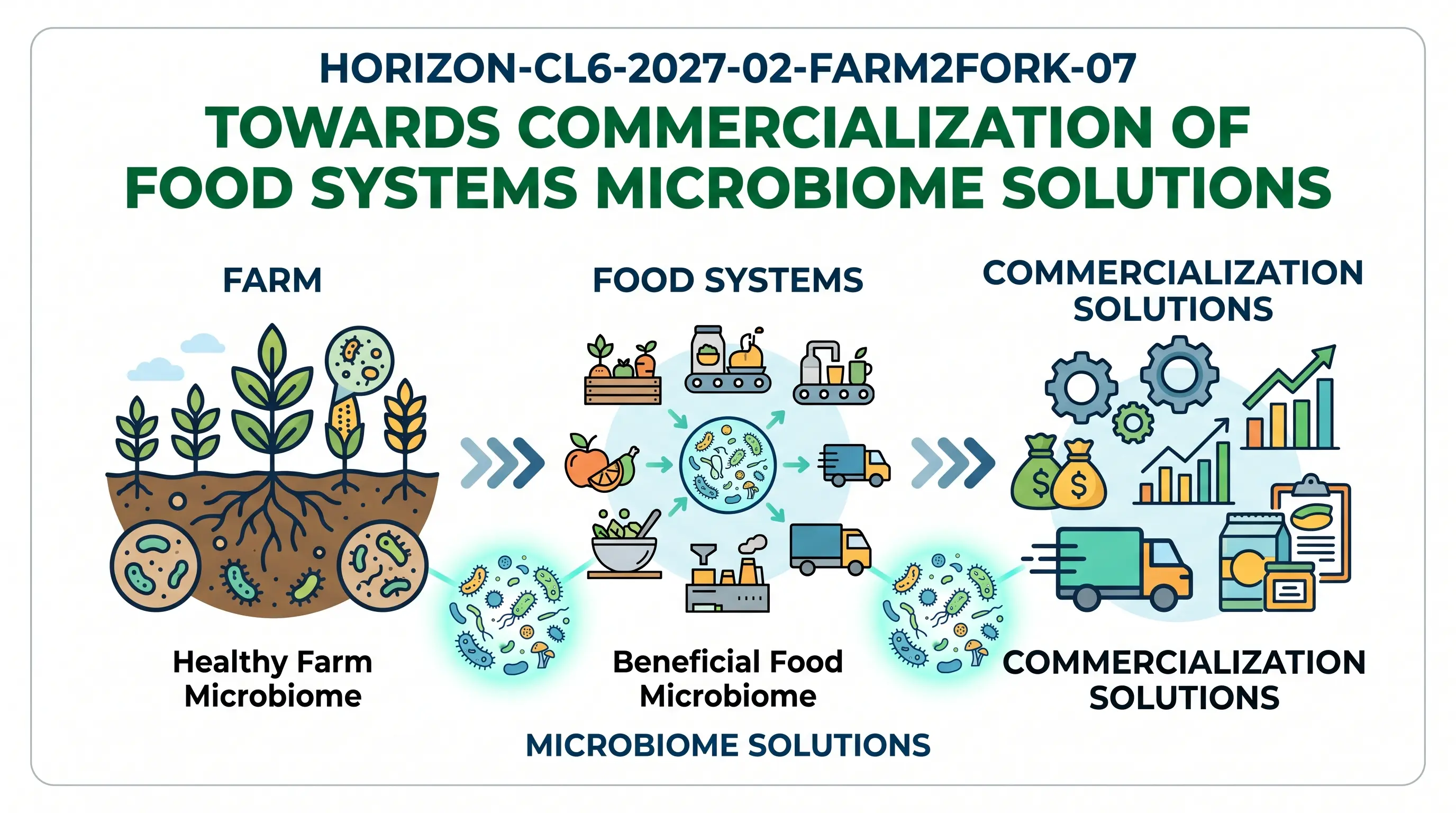
Microbiome research for food systems has been building momentum for years. The science is there, more or less. What the Commission is now after is something different: getting those solutions out of the lab and into the market. This topic is not about generating new fundamental knowledge. It is about closing the commercialization gap, building business models, and demonstrating that microbiome-based products can scale reliably and reach the EU market.
Download the MIC Horizon Europe 2026/2027 Calls Calendar:
Discover more!
Administrative facts: what do we know about the HORIZON-CL6-2027-02-FARM2FORK-07 call?
Which call is it, and when is the opening and the deadline?
- Call name: Call 02 – single stage (2027)
- Call identifier: HORIZON-CL6-2027-02
- Destination: Fair, healthy and environmentally friendly food systems from primary production to consumption
- Topic: HORIZON-CL6-2027-02-FARM2FORK-07
- Opening date: 20 April 2027
- Deadline: 23 September 2027 (17:00:00 Brussels local time)
- Type of action: Innovation Actions (IA)
What about the budget and estimated size of the project?
- Overall indicative budget for this topic: EUR 15.50 million
- Number of projects expected to be funded: 2
- Expected EU contribution per project: EUR 7.00 to 8.00 million
What are the key eligibility and evaluation conditions?
- Multi-actor approach: mandatory eligibility condition
- TRL progression: proposals must start from TRL 5 and achieve TRL 7-8 by the end of the project
- Eligible costs are paid as a lump-sum contribution.
- Technology transfer restriction: the granting authority may object to ownership transfers or exclusive licensing of results up to 4 years after the end of the action
- General admissibility, eligibility, and evaluation criteria apply as described in General Annexes A, B, C, D, E, F, and G.
Scientific range: what does the Commission expect from the HORIZON-CL6-2027-02-FARM2FORK-07 grant?
What outcomes are expected?
The Commission wants projects that have identified and addressed the real barriers to scaling microbiome solutions in food systems and have improved in situ testing of those solutions to support EU market access. Think commercialization roadmaps, not research reports. By the end, there should be validated products or technologies closer to market, with business models that companies and SMEs can actually use.
What is within scope?
The call covers microbiome solutions broadly, meaning any technology or product that leverages microbial communities and their interactions with their host or environment in food systems. Conventional, organic, and circular food systems are all in scope. Applications range from boosting crop yields to improving food safety, supporting biodiversity, or reducing fertilizer and pesticide needs.
- Microbiome solutions targeting resilient, competitive, climate-friendly food systems
- Technologies and standards enabling reliable large-scale production of microbiome products
- Methodologies for cost-effective deployment of microbial solutions
- Business models and commercialization pathways for companies, SMEs, and start-ups
- In-situ validation and market-readiness testing
- Both organic and conventional food system applications
What the Commission is not after here: fundamental research or purely academic outputs. The wording is clear on that.
What are the specifically proposed research directions?
The work program names three mandatory activities, and they point in a fairly specific direction.
- EU market access facilitation: the core task is getting innovative microbiome solutions (products or technologies working with microbial communities) past the commercial barriers that have kept them on the lab side of the fence
- Scalable production technology: the Commission explicitly flags the lack of consistent, cost-effective large-scale production as a bottleneck. Proposals need a credible technical answer to that
- Business model development: this one is less common in Horizon calls and worth noticing. The Commission wants structured business models, not just technology demonstrators, to help SMEs and start-ups monetize microbiome solutions in the EU market
Scientific strategy: how can you enhance your chances of being funded through HORIZON-CL6-2027-02-FARM2FORK-07?
What scientific choices matter most?
- Anchor the proposal in deployment challenges, not discovery: Evaluators will look for a clear problem statement about why microbiome solutions haven’t reached the market yet. Scalability, regulatory bottlenecks, inconsistent efficacy in field conditions: name them explicitly and describe how your project addresses each.
- Make TRL 5 the honest starting point: The call requires starting at TRL 5. Don’t try to claim your solutions are already higher. In practice, reviewers notice when the description reads like TRL 3 work dressed up.
- Build the business model as a genuine deliverable, not an appendix: We’ve seen proposals where commercialization appears as a one-page section at the end. For this call, that won’t work. The business model should be developed in collaboration with industry partners and SMEs from month one.
- Pair laboratory validation with real-world in-situ testing: The call specifically asks for in-situ testing to support market access. Field trials, farm-level pilots, or food system validation at realistic scale will be rated favorably.
- Address regulatory pathways explicitly: One of the core barriers named in the work programme is the regulatory gap. Proposals that include a regulatory affairs component or collaboration with a partner who knows EU approval processes will stand out.
- Show that your consortium has already engaged end-users before submission.
Consortium & proposal-writing plan: what works best with this type of call?
- The multi-actor approach is a hard eligibility condition here. This is not just language: your consortium must visibly include researchers, businesses, public authorities or policymakers, and ideally consumers or user associations. Missing one of those categories is a risk.
- Somewhere between 8 and 12 partners is probably the right size. Maybe a couple more if you need strong coverage across multiple food system sectors (agroforestry, processed foods, aquaculture). Bigger than that and coordination costs start eating into scientific quality.
- Include at least one or two innovative SMEs with a direct stake in commercializing microbiome solutions. This is where the business model deliverable becomes credible. An SME that can test and validate the market pathway in real time is far more convincing than an academic partner describing the market landscape from a distance.
- Industry partners matter here, not just as end-users but as co-developers. Food processors, agri-biotech companies, and distributors who can pilot the solutions at scale will strengthen the market-readiness narrative considerably.
- If you include a regulatory affairs consultancy or a partner with experience in EU novel product approvals, say so prominently in the proposal.
- On writing: frame the executive summary around the commercial gap, not the science. Evaluators for Innovation Actions respond to impact framing first. The science should support that narrative, not lead it.
- Build a clear exploitation plan from the start. This call is asking for market-ready outputs. A vague reference to “further uptake after the project ends” won’t score well.
How would microfluidics contribute to this topic?
One of the central problems in microbiome commercialization is that laboratory results don’t always hold up when you move to larger, more variable environments. The gap between controlled conditions and real food system complexity catches a lot of promising solutions out. Microfluidics offers a way to test that transition before it becomes expensive.
- Say you want to know whether a microbial inoculant that works beautifully in a controlled lab setting will still perform when soil conditions vary or when a food matrix changes its pH profile. A gut-on-chip or soil microenvironment chip lets you run those stress tests quickly and cheaply, with consistent results, before committing to a full field trial.
- Screening and selection of microbial strains at scale: conventional cultivation methods for selecting high-performing microbial strains are slow. Microfluidic droplet platforms can screen thousands of variants per day, identifying strains that perform well under realistic food system conditions. This directly addresses the scalability bottleneck the call names explicitly.
- Organ-on-chip and gut microbiome models allow you to test how a microbiome solution behaves in a human or animal digestive context without running full animal studies. For food safety and efficacy claims, that’s a meaningful step toward regulatory acceptance. (This one catches people off guard when they first think about microfluidics in a food call.)
- Fermentation and bioprocess optimization at the micro-scale: Before committing to a production process at industrial scale, your consortium can use microfluidic bioreactors to optimize culture conditions, media composition, and yield parameters. This reduces the cost and time of process development, making the scale-up pathway more credible.
- For in-situ testing specifically, portable microfluidic detection tools can monitor microbial communities in field or food processing environments in real time. Your consortium’s capacity to demonstrate that monitoring without expensive lab equipment strengthens the market-readiness narrative.
MIC’s experience with microfluidic platforms for biological testing, strain characterization, and organ-on-chip systems makes it a natural fit for the validation and scale-up workpackages of a HORIZON-CL6-2027-02-FARM2FORK-07 proposal. If your consortium needs a partner who can bridge the bench-to-pilot gap, that’s exactly where microfluidics earns its place in this call.
The MIC already brings its expertise in microfluidics to Horizon Europe:
H2020-NMBP-TR-IND-2020

Microfluidic platform to study the interaction of cancer cells with lymphatic tissue
H2020-LC-GD-2020-3

Toxicology assessment of pharmaceutical products on a placenta-on-chip model

FAQ – HORIZON-CL6-2027-02-FARM2FORK-07
What is the Commission after with this topic?
They are looking for something new from the Commission: commercializing those solutions. This is not about gaining new basic knowledge. It is about helping the commercialization gap, creating business models and demonstrating that microbiome products can be manufactured at scale and be brought to the EU market.
What are the basic call coordinates?
- Call name: Call 02 – single stage (2027)
- Call identifier: HORIZON-CL6-2027-02
- Topic: HORIZON-CL6-2027-02-FARM2FORK-07
- Opening date: 20 April 2027
- Deadline: 23 September 2027 (17:00:00 Brussels local time)
- Type of action: Innovation Actions (IA)
What is the budget and how many projects will be funded?
- Total indicative budget for the topic: EUR 15.50 million
- Number of projects to be funded: 2
- EU contribution per project: EUR 7.00 to 8.00 million
What are the key eligibility and evaluation conditions?
- Multi-actor: mandatory eligibility condition
- TRL advancement: projects should start at TRL 5 and end at TRL 7-8
- Reimbursement by lump sum.
- Technology transfer restriction: the funding body may impose a veto on the assignment or exclusive licensing of results, until 4 years after the action
Check the Funding and Tenders Portal for more information.
What outcomes does the Commission expect?
The Commission is looking for projects that have removed the real barriers to scaling microbiome solutions in the food system and improved in-situ testing of those solutions to ease their adoption in the EU market. The thinking is in terms of commercialization plans rather than scientific reports. And at the end, they should have tested products or technologies close to the market, and business models that companies and SMEs can use.
What microbiome solutions are within scope?
Microbiome solutions in the call are technologies or products that employ microbial communities and their interactions with the environment or hosts in food systems. They all consist of conventional, organic and circular food systems. They have been applied to increase yield, improve food safety and biodiversity, or reduce fertilizer and pesticide consumption.
What is not within scope?
What the Commission is not looking for: fundamental research or publishing per se. There is no room for doubt on that.
What are the three obligatory activities for FARM2FORK-07?
The work program lists three mandatory activities, which have a quite narrow focus.
- Market access to the EU: the primary task is to remove trade barriers that have prevented innovative microbiome technologies from being brought from the lab bench to the market.
- Large-scale production technology: The Commission, in particular, mentions the absence of cost-effective large-scale production. This must be addressed technically in the proposal.
- Business model development: This is uncommon in Horizon calls and should be addressed. The Commission is more interested in structured business models than demonstrators to support SMEs and start-ups in commercializing the microbiome in the EU.
What kind of consortium fits this call?
In this case, there is a multi-actor condition. It is not just words; your consortium will have to be perceived as including researchers, businesses, public authorities or policymakers, and, hopefully, even consumers or user groups. The danger is not to have one of these. Perhaps 8-12 partners in the group is the right number.
Why does microfluidics matter for this topic?
The biggest problem for the commercialization of the microbiome is that lab experiments will not necessarily work in larger, more complex settings. The gap between the lab and the complexity of the food system catches many. Microfluidics enables testing before it gets too expensive.