
Tips & Tricks for a successful HORIZON-CL6-2027-01-BIODIV-07 proposal
Opening
20 April 2027
Deadline
Keywords
One Health
emerging stressors
Wild Species Health
Biodiversity & Ecosystems
Human Health Impacts
Exposome strategy
ecosystem monitoring
IPBES
Your microfluidic SME partner for Horizon Europe
We take care of microfluidic engineering, work on valorization and optimize the proposal with you
HORIZON-CL6-2027-01-BIODIV-07: Health of ecosystems and wild species, predictions and impacts on human health, in the face of existing and emerging stressors, from a One Health approach
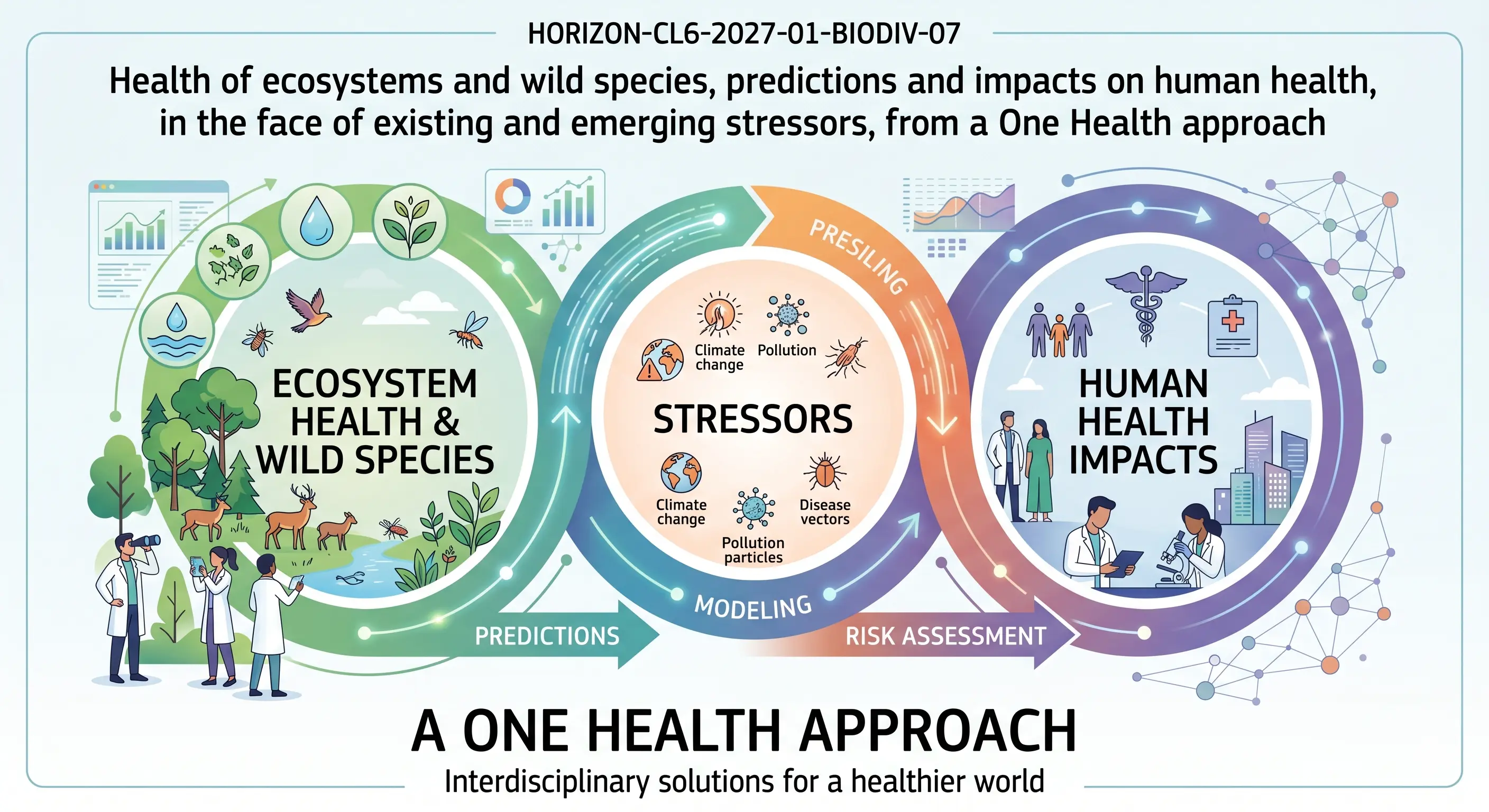
The question that the Commission is posing, which is simple but gigantic, is as follows: when ecosystems and wild species fall ill, what will become of us? The One Health system views nature, animals, and human beings as one interdependent system. This call finances research that renders that connection measurable, predictive and policy-relevant. You will desire a truly transdisciplinary consortium of natural scientists, social scientists, and public health researchers collaborating from the very beginning.
Download the MIC Horizon Europe 2026/2027 Calls Calendar:
Discover more!
Administrative facts: what do we know about the HORIZON-CL6-2027-01-BIODIV-07 call?
Which call is it, and when is the opening and the deadline?
- Call name: Call 01 – single stage (2027)
- Call identifier: HORIZON-CL6-2027-01
- Destination: Biodiversity and ecosystem services
- Topic: HORIZON-CL6-2027-01-BIODIV-07
- Opening date: 20 April 2027
- Deadline: 22 September 2027 at 17:00 Brussels local time
- Type of action: Research and Innovation Action (RIA)
What about the budget and estimated size of the project?
- Total indicative budget for the topic: EUR 14.00 million
- Number of projects expected: 2
- Expected EU contribution per project: around EUR 7.00 million
- Eligible costs are paid as a lump-sum contribution.
What are the key eligibility and evaluation conditions?
- Standard admissibility conditions apply.
- Standard eligibility conditions apply; no specific additional eligibility exceptions are noted for this topic.
- No multi-actor approach requirement (unlike some sibling biodiversity topics in this call)
- SSH disciplines must contribute effectively to the research
- Proposals must foresee resources for cooperation with the EC Knowledge Center for Biodiversity (KCBD) and with Biodiversa+ and the Animal Health and Welfare Partnership.
- No JRC participation provision noted for this topic
- Clustering may apply; check the Funding and Tenders Portal at the time of submission.
Scientific range: what does the Commission expect from the HORIZON-CL6-2027-01-BIODIV-07 grant?
What outcomes are expected?
By the end of the project, you ought to have developed some predictive knowledge of the influence of current and emerging stressors on the health of ecosystems and wild species, and to have established clear connections to human health outcomes. There should be science-based indicators that enable public authorities to quantify progress towards One Health governance. The Commission does not want a literature review to replace yet another literature review.
What is within scope?
- Freshwater, terrestrial and marine ecosystems, and no geographical restriction.
- Health indicators: Wild species physiology, genetic diversity, population distribution, and ecology.
- Other causes of biodiversity loss, both direct and indirect, include climate change, pollution, changes in land use, and others.
- The exposome strategy, which combines both ecosystem and wildlife health information.
- Interrelations between the health of wildlife, domestic animals and plants and human health.
- Cost-benefit analysis of nature restoration based on human health outcomes.
- Intersectional analysis, with an impact on vulnerable populations (low-income communities, elderly people, persons with disabilities, and others).
- Contributions in the field of social science and humanities, especially in the area of governance and its impact on society.
There is a likelihood that the Commission is not considering proposals that remain entirely within a single ecosystem or stressor. The breadth is indicated by call signals. It desires a view of how the entire system does not work, and not a fragment.
What are the specifically proposed research directions?
- Characterize the current health of ecosystems and wild species with the highest likelihood of interacting with human health across all ecosystem types.
- Prepare short, mid, and long-term projections of ecosystem and wildlife well-being, based on revised IPBES projections.
- Have common benchmarking protocols to compare across research communities, such as definitions of common risk and benefit indicators.
- Measure human health costs of ecosystem degradation, including cost-benefit analysis of conservation and restoration.
- Prepare policy recommendations for a One Health governance system that can be implemented by the authorities.
Scientific strategy: how can you enhance your chances of being funded through HORIZON-CL6-2027-01-BIODIV-07?
What scientific choices matter most?
- Develop the forecasting model prematurely. The evaluators desire to observe that the project will result in future-state models of ecosystem health, rather than narrate the current state of the situation. The modeling element must be plausible at the beginning.
- Select your wild species and ecosystem selectively. It is an open call, a freedom and a trap at the same time. In our case, the proposal, which has an established scope and justifies why those ecosystems are of the most interest to human health patterns, will have a higher score than the one that remains ambiguous.
- Incorporate SSH, not as a second thought. This is stipulated in the work program. Having a social scientist or governance expert on the list of token WP leaders will not work with reviewers. Show genuine co-design.
- Conform to IPBES nexus assessment situations. This is brought out specifically. Cite it, develop it, do not reference it.
- The exposome framing is significant. The reviewers who are already knowledgeable about this issue will determine whether your proposal actually incorporates data on ecosystem exposures into the health analysis of individuals, or merely mentions the term.
- Prepare the cost-benefit analysis. It’s not optional. Add realistic assumptions of the costs of inaction to your ecosystem.
Consortium and proposal-writing plan: what works best with this type of call?
- Goal: between ten and fourteen partners, perhaps a little more, should there be a need to in various ecosystems because of a clinical or governance portfolio.
- You will need ecology and biodiversity science teams, a public health/ epidemiology institute, social scientists, and one partner with experience in policy interface. The absence of any of these will manifest itself.
- Incorporate a creative SME with potential in environmental testing, biosensing, or data integration. This call is a reward to technical novelty, and an SME can base their decision on that.
- When you introduce partners in Africa, Latin America, or Asia, make it clear that you are incorporating important ecosystems and stressor backgrounds, not merely diversity itself.
- The theory of change of the proposal ought to shift from ecosystem monitoring and evidence of human health to policy indicators. Write it that way.
- Maintain consistency in the work plan across the three health arenas (ecosystem, animal, human) – here, most consortia run into parallel silos, which reviewers punish.
How would microfluidics contribute to this topic?
The tools used to monitor the environment are often too slow and too rough to accurately track what is being followed. You desire to monitor changes in wild species biology and ecosystem biochemistry in a timely manner (early), with fine spatial resolution, and with standard procedures across sites. That is where microfluidics can transform what is practically achievable in an actual field.
- Your team is monitoring variations in the condition of freshwater species within river networks. Laboratory sampling is weeks and results in a huge loss of samples. A handheld microfluidic chip capable of on-site biochemical profiling of a water sample or a small tissue sample provides near-time data from dozens of locations simultaneously. Same ecosystem, different compound, same time of the year. That is a transformation of the monitoring design.
- Microfluidic multiplex detection systems can screen multiple pathogens, pollutants, and stress biomarkers in stress, polluted, and pathogen samples. This cross-domain profiling is precisely what is required of an exposome integration component in a One Health proposal. You do not have three labs operating on three signals.
- Organ-on-chip models would assist your consortium to test the actual effects of a given environmental stressor (pollutant, pathogen carried by wildlife) on human or animal tissue. Not only epidemiologically correlated, but a literal cause-and-effect reading in a controlled system. The policy recommendations are credible given this mechanistic evidence.
- Microfluidic tools would be useful in your consortium in the benchmark protocol work as well. When specifying shared indicators across multiple research locations in different countries, the measurement platform must be small, inexpensive, and reliable. See how MIC approaches environmental detection with PMMA devices. In the vast majority of conventional methods, microfluidics would be a better fit.
Microfluidics does not specify this call, but it addresses some of its most difficult practical challenges: real-time field measurements, cross-domain biosensing, and the production of the mechanistic data that transforms ecological measurements into evidence of public health. That contribution is difficult to overlook in a consortium that is developing recommendations on One Health policy-grade.
The MIC already brings its expertise in microfluidics to Horizon Europe:
H2020-NMBP-TR-IND-2020

Microfluidic platform to study the interaction of cancer cells with lymphatic tissue
H2020-LC-GD-2020-3

Toxicology assessment of pharmaceutical products on a placenta-on-chip model

FAQ – HORIZON-CL6-2027-01-BIODIV-07
What is this HORIZON-CL6-2027-01-BIODIV-07 call actually about?
This call has a very simple, yet enormous question: what happens when ecosystems and wildlife get sick? The Commission invests in research that makes the link between ecosystem, wildlife and human health measurable, predictive, and relevant to policy, via a One Health approach.
Who should apply and how much money is on the table?
The indicative budget is EUR 14.00 million and around EUR 7.00 million per project. A total of two projects is expected to be funded. Funding is provided as a lump sum under Horizon Europe.
Which ecosystems and species are in scope?
What outcomes are evaluators really looking for?
The evaluators look for predictive knowledge of stressors’ impacts on wild species and ecosystems, science-based indicators for One Health governance, numerical values of human health impacts from ecosystem degradation and policy recommendations. All four need to be convincingly included in the proposal.
How should we organise the scientific work intelligently?
Build the forecasting model. Follow the IPBES scenarios of the nexus assessment. Make sure to consider SSH, not as an afterthought. And do the cost-benefit analysis properly – it is mandatory.
Where does microfluidics add real value for this One Health topic?
A portable microfluidic Chip for biochemical profiling delivers near real-time data from multiple field sites. Organ-on-chips provide real cause-and-effect from tissue impacts. Multiplex analysis provides simultaneous detection of pathogens, pollutants, and stress biomarkers – the integration part of the exposome.
What does a strong consortium look like for this topic?
Ideally, 10-14 partners. You will need ecology and biodiversity science teams, a public health or epidemiology institute, social scientists, and one partner with experience at the policy interface. A creative SME with environmental testing, biosensing, or data integration potential. If you lack any of these, evaluators will notice.
What is in scope — and what is not?
In scope: all ecosystems, all causes of biodiversity loss (direct and indirect), SSH, the exposome approach, and intersectional vulnerability. The Commission isn’t looking for solutions limited to a single ecosystem or stressor. They want to see how the system doesn’t work, not just a part.
What are the pitfalls that trip up One Health RIA proposals?
These include treating SSH as an afterthought rather than co-design; failing to build a credible forecasting model; failing to engage with the IPBES nexus assessment; and writing a cost-benefit analysis that lacks plausible assumptions. Most consortia also fall victim to parallel silos across the three health domains – ecosystem, animal, human – which are heavily penalized.
What should timelines and milestones demonstrate to evaluators?
Timelines need to be realistic for transdisciplinary research. There needs to be enough time for benchmarking protocol development and testing comparability. Milestones must relate to the four deliverables. Collaboration with the EC Knowledge Center for Biodiversity (KCBD), Biodiversa+, and the Animal Health and Welfare Partnership should be embedded in the work plan with specific resources.