
Tips & Tricks for a successful HORIZON-CL5-2027-05-D4-09 proposal
Opening
05 May 2027
Deadline
Keywords
Waste heat recovery
ORC / power conversion
Industrial energy efficiency
SCADA / EMS integration
Grid flexibility
heat-to-power
energy storage
Your microfluidic SME partner for Horizon Europe
We take care of microfluidic engineering, work on valorization and optimize the proposal with you
HORIZON-CL5-2027-05-D4-09 – Demonstration of industrial excess/waste heat conversion to mechanical or electrical power
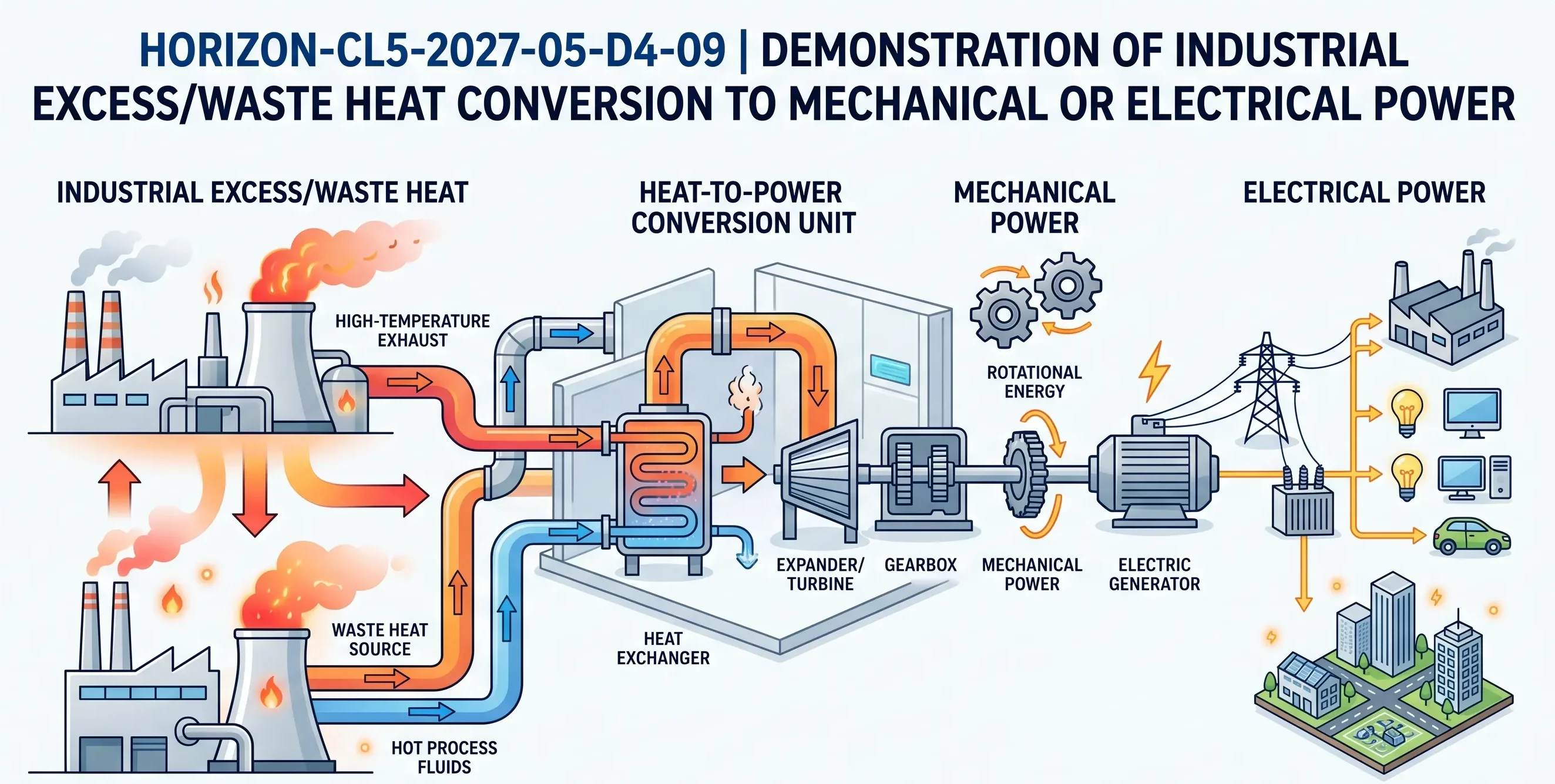
Industrial heat is currently going to waste on a huge scale – usually it simply goes straight up into the atmosphere. This call is for generating power from otherwise wasted industrial heat. This is not a lab-scale demonstration but one that takes place at a real industrial site and is requested by the Commission itself. It is this integration with SCADA and the possibility of cross-sectoral replication that marks this out as a grid contribution, rather than an energy-saving measure.
Download the MIC Horizon Europe 2026/2027 Calls Calendar:
Discover more!
Administrative facts: what do we know about the HORIZON-CL5-2027-05-D4-09 call?
Which call is it, and when is the opening and the deadline?
- Call name: BATTERIES and ENERGY
- Call identifier: HORIZON-CL5-2027-05
- Destination: D4 – Efficient, sustainable and inclusive energy use (Industry sub-section)
- Topic: HORIZON-CL5-2027-05-D4-09 – Demonstration of industrial excess/waste heat conversion to mechanical or electrical power
- Opening date: 05 May 2027
- Deadline: 15 September 2027 (17:00:00 Brussels local time)
- Type of action: Innovation Action (IA)
What about the budget and estimated size of the project?
- Total indicative topic budget: EUR 13.50 million
- Number of projects expected: 2
- Expected EU contribution per project: around EUR 6.75 million
- Eligible costs take the form of a lump sum contribution.
What are the key eligibility and evaluation conditions?
- Standard eligibility conditions per General Annex B apply.
- TRL target: activities are expected to achieve TRL 7 to 8 by the end of the project; they may start at any TRL
- If satellite-based earth observation, positioning, or navigation data are used, beneficiaries must use Copernicus and/or Galileo/EGNOS (additional data sources are allowed on top)
- IP transfer restriction: the granting authority may object to a transfer of ownership or exclusive licensing of results for up to 4 years after the end of the action
- No JRC or clustering conditions mentioned for this specific topic
- If the targeted industrial sector has been covered by LIFE-2024-CET-HEATPUMPS actions, the proposal must build on those results and cooperate where possible.
Scientific range: what does the Commission expect from the HORIZON-CL5-2027-05-D4-09 grant?
What are the expected outcomes?
By the end of the project, at least one industrial sector will have a clear pathway and business case for exploiting and converting waste heat into mechanical or electrical energy. Expected improvements will be across efficiency, flexibility, grid contribution, and profitability. Results would not need to be published by the Commission itself as part of the outcome.
What outcomes are expected?
- Novel systems for capturing waste heat and converting it to mechanical or electrical energy – it is important that integrated thermal or electrical energy storage is included if appropriate.
- A demonstration at a real industrial site in an EU Member State or an Associated Country.
- A technical and economic blueprint in an open format, capable of being integrated with SCADA and EMS systems.
- An in-depth need assessment of an EU-wide industrial sector before design takes place, and not as an afterthought.
- Standardization of specific components.
- Business cases for the valorization of waste heat to electricity – and this can include the flexible operating mode and grid stabilization aspects of the generating system.
- Dissemination of results within the Cluster 4 ecosystem.
What are the specifically proposed research directions?
The work program is extremely specific about the requirements of the Commission:
- That the waste heat should be converted to mechanical or electrical energy and not for further heating or upgrades, which is covered by D4-08.
- That the key operational capability of the system must be flexible generation linked with storage, which can surprise people when it is read out.
- Standardization of hardware across specific sectors at an EU level.
- Open tools to be provided for integration with SCADA and EMS.
- Sectoral approach strategies for implementation, which must include the detailed needs of EU factories.
Scientific strategy: how can you enhance your chances of being funded through HORIZON-CL5-2027-05-D4-09?
What scientific choices matter most?
- Look for a sector where there is abundant, characterized industrial waste heat, for instance the cement sector or chemical refining sector. The choice of sector is significant when the proposal is evaluated.
- Aim for TRL 7 by the end of the project: it is anticipated that a system will be in operation at an industrial site, and laboratory-based work or pilots will not suffice.
- Build a flexible generation concept directly into the system, rather than retrofitting it. The Commission places particular emphasis on its benefits to the grid. It has been observed that proposals where flexibility is explicitly cited as a fundamental component perform better than those in which it is mentioned as a peripheral or added feature.
- Include an energy storage component, either thermal or electrical. The work program itself states that storage is encouraged, but it is not compulsory, however you may well find yourself justifying why storage has been omitted, should it not be present in your system design.
- Think of replicability right from the start: assess the needs of as broad a sample of EU factories as possible in your chosen sector and use the results to inform the design and the contents of the deliverable on this topic.
- Identify components that lend themselves to standardization: that is, those that are common across numerous machines within the industry sector.
- For the SCADA and EMS integration, stick to open tools to satisfy the requirements and maximize the scope of the proposal.
Consortium & proposal-writing plan: what works best with this type of call?
- This call specifies a high budget for an Innovation Action, up to around €6.75 million for each project – tight cost control should therefore be a key requirement. This translates to between 8 and 12 partners, typically, perhaps more if multiple sites are to be used. You should aim for, or be within, the funding range stated.
- The owner of the industrial site at which the demonstration is to be conducted needs to be part of the consortium – associate partner status is not sufficient as the work program states it should be a demonstration at a real site using an operating system.
- One or more partners should have expertise in energy systems or grid integration, enabling accurate claims for flexible operation and grid stabilization.
- The technology owner or the developer of the converting system, such as a thermoelectric generator or an Organic Rankine Cycle, will have a central role.
- If the project is to target an industrial sector such as steel or cement, you should include a relevant industrial or technology cluster in the consortium as this will enhance the dissemination and relevance to that industry and also to the wider Cluster 4 community.
- Including an innovative SME specialized in open SCADA/EMS will enhance the proposal’s relevance and comprehensiveness concerning the integration and replication aspects of the system.
- It is suggested that you base your technical proposal on a replication strategy rather than on the demonstration itself, since the Commission will be looking at its potential for scalability and impact.
- Should your research activities overlap significantly with LIFE-2024-CET-HEATPUMPS, make sure that your proposal discusses how these projects relate to each other, to avoid falling foul of proposal overlap issues.
How would microfluidics contribute to this topic?
Conventional heat exchangers are neither ideal nor easily adapted for specific smaller scales of application or where a high degree of flow control is needed, nor are they always readily configurable to deal with variable waste heat streams. Microfluidics offers a unique solution:
- Component-level thermal mapping: One of the fundamental tasks at the initial stage of a conversion system design is detailed understanding of thermal distribution at component-level. Microfluidic sensor arrays could accurately map thermal profiles in an industrial apparatus, data that conventional measurement tools cannot extract and which is crucial for designing an optimized and efficient system.
- Dynamic optimization of conversion loops with fluctuating waste heat streams: Industries generating intermittently fluctuating heat (varying between 200°C and 350°C based on the operational schedules) can benefit from dynamic adjustment of ORC working fluid flow using microfluidic heat exchangers, maintaining peak efficiency.
- Miniaturized handling of fluid streams in ORC systems: Precise control over the flow rate of a working fluid is essential in an Organic Rankine Cycle. Microfluidic valves, regulators and micro-pumps would offer unparalleled control and responsiveness when replacing their conventionally larger counterparts.
- Real-time monitoring of working fluid degradation and contamination: Long industrial demonstrations might see working fluid degradation or contamination. Microfluidic sensors provide the capability for real-time on-chip detection of chemical processes that cause these problems, thus enabling the performance impact of such degradation to be quantified and addressed.
The core strength of MIC, which lies in lab-on-chip thermal sensing and microfluidic flow control, can deliver significant advancements in this systems’ measurement and control aspects. MIC’s team would be delighted to be part of a consortium and contribute components, with significant prior experience in Horizon Europe energy and industrial sector projects. Given that TRL 7 demonstration is required at industrial site, the contributions from microfluidic sensors and actuators would highly improve the attractiveness of both technical feasibility section of proposal and overall replicability of the developed system.
The MIC already brings its expertise in microfluidics to Horizon Europe:
H2020-NMBP-TR-IND-2020

Microfluidic platform to study the interaction of cancer cells with lymphatic tissue
H2020-LC-GD-2020-3
Toxicology assessment of pharmaceutical products on a placenta-on-chip model

FAQ – HORIZON-CL5-2027-05-D4-09
What types of industrial sectors are targeted by HORIZON-CL5-2027-05-D4-09?
The work program is not limited to a particular sector. Any industry with high volumes of waste heat can be considered. Candidates that are obvious include steel, cement, glass and chemical refining that are very thermal losers. The most important thing is that the proposal has to survey EU factories in that sector prior to the design phase starting, and the solution that is to be developed must meet the needs of the majority of factories.
What is the difference between HORIZON-CL5-2027-05-D4-09 and the adjacent topic D4-08?
Diversity is inherent. Specifically of interest to HORIZON-CL5-2027-05-D4-09 is the conversion of waste heat to either mechanical power, or electrical power. D4-08 touches upon the problem of waste heat upgrading and reuse as the process heat in industrial locations. The appropriate call to make in case your idea involves a heat pump that re-uses the heat in a production line is D4-08. The correct topic to be discussed in case it is an Organic Rankine Cycle or a thermoelectric generator.
What TRL must my project achieve by the end of the grant?
The activities will also be required to be at TRL 7-8 at the end of the project. This means that it is a prototype system which has been tested in a real world scenario and not in a laboratory. You can commence work at any TRL, although you could initiate work at TRL 4 or 5, but this has to finish with a complete demonstration. Make sure that the Gantt chart demonstrates a realistic plan of TRL progression. Check the Funding and Tenders Portal for more information.
Is energy storage mandatory in the conversion system?
No, there is no need to have energy storage (thermal or electrical) in place. The work program explains it as a possibility which can be used with the conversion system. That being said, the Commission evidently links storage to grid stabilization and flexible electricity generation two consequences that carry a huge weight with regard to evaluation. When there is no storage, then you need to explain the reasons as to why it has not been included and demonstrate how grid flexibility is achieved in other ways.
What does the work programme mean by replicability by design?
It implies that the replicability should be designed into the project at the very first stage, prior to making any technical design choices. The work program in particular provides that the needs of the EU and the Factories in the targeted sector in the countries should be surveyed and analyzed before starting with the design phase. This means that there should be a special needs assessment work package in the project schedule. The resulting design should be explicitly geared towards meeting most of those requirements and not just the requirements of the individual demonstration site.
Do I need to cooperate with LIFE-2024-CET-HEATPUMPS projects?
You do not already have a targeted industrial sector/process that is already covered by the LIFE-2024-CET-HEATPUMPS actions. In identifying the solution to demonstrate and plan channels of dissemination where there is an overlap you need to build up on those results and cooperate where you can in the work program. In case there is no overlap, then this is not applicable to your proposal.
What are SCADA and EMS, and why do open tools matter for this call?
The layers of operational control in industrial plants are SCADA (Supervisory Control and Data Acquisition) and EMS (Energy Management System). The Commission needs proposals to formulate open technical and economic principles and open tools to fit in the waste heat conversion system into these already existing plant infrastructures. Open is not proprietary, and can be used by other operators around the EU. This is also directly connected with the replicability objective: proprietary tools would not enable other factories to use the solution without additional costs on software.
Can the industrial demonstration be located outside the EU?
The demonstration should be done in an operating industrial facility within an EU Member State or an Associated Country. Associated Countries are the countries that have signed association agreements with Horizon Europe which comprise of Norway, Iceland and Israel. Should you have an industrial partner outside the EU, they can also become members of the consortium, although the demonstration must be physically in a qualifying territory.
What does flexible electricity generation mean in this call?
In the context of this call, flexible electricity generation means the ability of the waste heat conversion system to modulate its electrical output in response to grid signals or operator commands. The system may be implemented in combination with thermal or electrical energy storage to store heat during low electricity prices and provide power to the system during peak grid demand. This leads to the conversion system being a dispatchable resource, as opposed to a fixed-output plant, which is the particular grid advantage the Commission seeks.
How should I structure the consortium for a project of this size?
The typical case of an Innovation Action is to involve a consortium of 8 to 12 partners, the project is estimated to cost about EUR 6.75 million, and the duration of the project is estimated to be about three years. You will require at least: an operator of an industrial location (full partner), a developer of technology to the conversion system (ORC, thermoelectric or similar), an expert on energy system or grid integration, an open tools developer to SCADA/EMS integration – preferably innovative SME. The story of replicability and dissemination is supported by an industry association or cluster on the sectoral level. Maintain overhead lean: the amount of budget is to expect two projects.