
Tips & Tricks for a successful HORIZON-CL4-2027-04-DIGITAL-EMERGING-05 proposal
Opening
17 November 2026
Deadline
Keywords
AI-driven robotics
system integration
LoT
industrial adoption
SME robotics
digital twins
Made in Europe
Apply AI Strategy
Green AI
Your microfluidic SME partner for Horizon Europe
We take care of microfluidic engineering, work on valorization and optimize the proposal with you
HORIZON-CL4-2027-04-DIGITAL-EMERGING-05: Apply AI; AI-Driven Robotics for Industry; Enabling System Integration and Adoption (IA) (Partnership in AI, Data and Robotics)
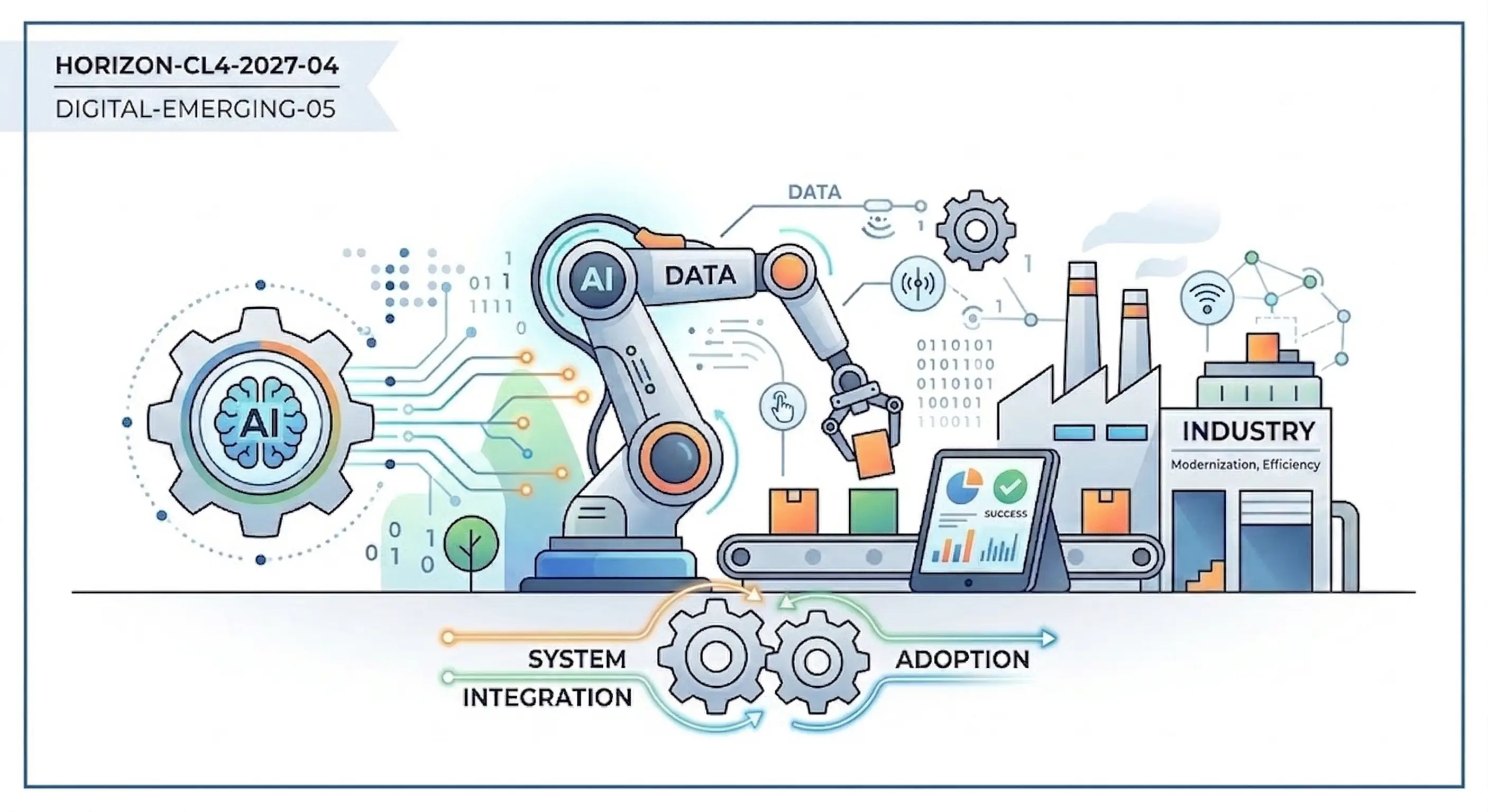
Europe is developing high-performance robots. The challenge is to get them quickly on the large-scale production lines, especially in companies that have limited engineering teams for integration management. This matter is not about inventing new robot technologies. It is about making reusable structures, adoption kits and open tools that system integrators and SMEs can use to implement what is already there. One project, a big budget, very clear results.
Download the MIC Horizon Europe 2026/2027 Calls Calendar:
Discover more!
Administrative facts: what do we know about the HORIZON-CL4-2027-04-DIGITAL-EMERGING-05 call?
Which call is it, and when are the opening and the deadline?
- Call name: DIGITAL
- Call identifier: HORIZON-CL4-2027-04
- Destination: Achieving open strategic autonomy in digital and emerging enabling technologies
- Topic: HORIZON-CL4-2027-04-DIGITAL-EMERGING-05
- Opening date: 17 November 2026
- Deadline: 18 March 2027
- Type of action: Innovation Action (IA)
What about the budget and estimated size of the project?
- Total topic budget: EUR 18.00 million
- Estimated number of projects to be funded: 1
What are the key eligibility and evaluation conditions?
- Participation restricted to legal entities established in EU Member States, Iceland, Norway, Canada, Israel, South Korea, New Zealand, Switzerland, and the United Kingdom
- Third countries newly associated to Horizon Europe during 2026-2027 may qualify, subject to conditions at time of submission
- Entities outside eligible countries must provide guarantees on IP control, data access, and personnel clearance
- Projects must allocate tasks for cohesion activities with the ADRA partnership (AI, Data and Robotics)
- Coordination with HORIZON-CL4-2025-04-DIGITAL-EMERGING-05 (focused on soft robotics) is encouraged
- No JRC involvement indicated; no clustering mechanism stated in the work programme text
Scientific range: what does the Commission expect from the HORIZON-CL4-2027-04-DIGITAL-EMERGING-05 grant?
What outcomes are expected?
The Commission expects a set of tools for easy adoption by SMEs without the need for a specialist team, an open dataset and benchmarks accessible to the wider European robotics community, and a validated, deployable integration framework tested in at least three different industrial environments at the end of the project. They are not looking at publication series here. They also want to make it very clear that this is an acceleration pipeline rather than a research initiative.
What is within scope?
- Interoperable and modular integration frameworks for robotic systems powered by artificial intelligence
- Standardized procedures for data sharing, validation, and safety testing in industrial settings
- Testbeds with high-fidelity digital twins for secure training and a seamless transition to actual deployment
- Carbon-conscious operating tactics and energy-efficient AI models (Green AI); shared benchmark challenges and reusable, IP-compliant datasets with the larger robotics community
- Adoption tools for SMEs: detailed instructions, useful checklists, and examples of budgeting and execution
- Specific contributions to certification pathway guidelines and open standards
What are the specifically proposed research directions?
- Giving system integrators knowledge of the newest robotic hardware and software components will improve their competencies
- Interoperability solutions that link IoT settings, robotics, AI tools, and outdated industrial systems
- The capacity of integration techniques to be expanded and used to various business sizes and industries
- At least three actual industrial demonstrations that reflect really distinct reference cases (different industries, various firm profiles)
- The system architecture incorporates environmentally friendly deployment and operations procedures
Scientific strategy: how can you enhance your chances of being funded through HORIZON-CL4-2027-04-DIGITAL-EMERGING-05?
What scientific choices matter most?
- Rather than showing just a technical point of view, show the real industrial motivation. Evaluators will be looking for evidence that the proposed framework is capable of working within real operational constraints. In the proposal, have your end-user partners tell about the integration problems.
- Make the three pilots quite different from each other. The scenarios should differ between sectors, business size, and level of current robotics infrastructure. It is not just a decoration; a SME pilot is expected.
- Green AI should not be considered as an extra; it is the design itself. There is a possibility of implementing energy-saving measures. Make it part of the plan from the start. Make the point about the EU’s previous grants more detailed.
- The Commission specifically expects the use of EuroCORE resources and the AI-on-Demand Platform. Failing to address this will most likely lower the proposal’s impact score.
- Among the deliverable items, there are standardization contributions. Early naming of partners involved in standards bodies is recommended and they should be assigned concrete work plan tasks.
Consortium & proposal-writing plan: what works best with this type of call?
- Targeting eight to twelve partners is a good idea; if the industry coverage truly warrants it, there may be a few more.
- On the one hand, the fundamental partners must be manufacturing firms (the work program particularly mentions the automobile industry) with actual workplan tasks rather than merely consultative functions.
- The consortium should include system integrators. Without them, the proposal will not meet the objectives of the call.
- Consider partnering with an innovative SME, ideally one facing the same integration problems the project aims to address. In this way, the proposal’s storyline will not only be more credible but also more convincing than a regular SME placeholder.
- Keep an IA-appropriate ratio between academic and industrial budgets. Research labs come in handy here.
- Provide a tangible ADR. Cohesion activities need to be physically placed in the beginning rather than just done at the end of the work plan as a formality.
- The work program is somewhat flexible as to what is meant by a reference scenario for the pilots. Use that flexibility to demonstrate cases in which your consortium has real access, information, and legitimacy.
How would microfluidics contribute to this topic?
Industrial robots and microfluidics are typically incompatible. However, tiny sensors are exactly what many robot integration scenarios require to function correctly in high-precision manufacturing environments, particularly in pharmaceutical production, diagnostics manufacturing, and food safety testing.
- Robotic end-effectors equipped with microfluidic sensors offer a unique ability to measure process parameters in real time that conventional equipment cannot. For example, on-chip analytics can be directly linked to the AI control loop and detect variances without stopping the line if your pilot process includes a robotic system that dispenses chemicals in a pharmaceutical SME. Actually, this is the kind of scenario this call is meant to help with.
- Calibration of digital twins. Microfluidic test platforms can generate high-quality process data quickly. These platforms allow you to assess your integration framework faster and more affordably than with traditional approaches, provided they include a digital twin testbed.
- Robots with small embedded diagnostics can provide continuous, real-time quality feedback, exactly what SME end users in the biotech and medical device manufacturing industries need from their robots.
- As part of the larger integration framework, your consortium might consider providing microfluidics as a specialized sensing layer. It should be the feature that, from a technological perspective, makes some high-value pilot scenarios incredibly believable rather than the primary technology. The Microfluidics Innovation Center can play that part in your proposal because of its background in both platforms and applications.
The MIC already brings its expertise in microfluidics to Horizon Europe:
H2020-NMBP-TR-IND-2020

Microfluidic platform to study the interaction of cancer cells with lymphatic tissue
H2020-LC-GD-2020-3

Toxicology assessment of pharmaceutical products on a placenta-on-chip model

FAQ – HORIZON-CL4-2027-04-DIGITAL-EMERGING-05
What is the main goal of HORIZON-CL4-2027-04-DIGITAL-EMERGING-05?
The primary aim is to fast-track the implementation of AI-based robotic systems in the European industry by creating reusable integration platforms, open tools, and adoption packages that can be implemented by system integrators and SMEs without huge teams of specialists.
What type of action is this call and how much funding is available?
This is an Innovation Action (IA). These are the total topic budget, EUR 18.00 million; one project should be funded at approximately EUR 18.00 million in EU contribution.
Who can apply to this call?
The participation is limited to legal entities that are based in EU Member States and other related countries such as Iceland, Norway, Canada, Israel, South Korea, New Zealand, Switzerland, and the United Kingdom. Other countries newly associated in 2026-2027 may also be eligible.
What TRL level is expected for this topic?
The text of the work program does not give any explicit TRL levels of entry or exit to this topic. This is a typical Innovation Action with a TRL entry of around 5-6 and an exit of around 7-8; it is worth checking on the Funding and Tenders Portal before entering.
What industrial sectors are targeted?
The automotive sector is a reference point that the work program makes particular reference to, but the call is intended to be broadly applicable to industry. There should be at least three different reference scenarios which should be based on various sectors and firm profiles.
What are the three pilot scenarios the Commission expects?
The Commission anticipates that there will be at least three industrial demonstrations that are truly different each other in terms of sector, business size, and level of robotics infrastructure at the moment. At least one SME pilot must be present.
How important is Green AI in this call?
Green AI is a design requirement, not an add-on. Energy-efficient AI models and carbon-conscious operating procedures should be embedded in the system architecture from the start. Proposals that treat this as a dissemination activity will likely score lower on impact.
What role do SMEs play?
SMEs are in the center of attention, as end-users who will be put to the test to show the integration challenge, as pilot environments. The innovative SME with actual integration issues enhances the plausibility of the proposal’s plot and is strongly recommended as one of the consortium’s main partners.
How should the consortium be structured?
Goal of eight to twelve partners. Manufacturing companies should have key positions with tangible work plans. Integrators are needed. The budget ratio should be based on the nature of the IA call, with industry as the most important among academic partners.
How can microfluidics contribute to an AI-driven robotics proposal?
Microfluidic sensing platforms can also be integrated as a dedicated layer of measurement in robotic end-effectors, which allows real-time monitoring of processes in pharmaceutical, diagnostic, and food safety manufacturing facilities. This greatly enhances the accuracy and authenticity of pilot scenarios.