Tips & Tricks for a successful HORIZON-CL4-2026-02-DIGITAL-EMERGING-53-two-stage proposal
Opening
16 December 2025
Deadline
Keywords
OT/IT plant infrastructure
OT/IT integration
robotics
generative AI
AI process industries
Processes4Planet
foundation models
Clean Industrial Deal
agentic AI
Your microfluidic SME partner for Horizon Europe
We take care of microfluidic engineering, work on valorization and optimize the proposal with you
HORIZON-CL4-2026-02-DIGITAL-EMERGING-53-two-stage: Innovative AI methods and technologies for the process industries (Processes4Planet and AI, Data and Robotics partnerships) -
Stage 2 preparation
Stage 1 closed on 17 March 2026. Supposing that your consortium has turned in, now the clock runs to 13 October 2026 – the Stage 2 deadline. What you turned in at Stage 1 was a short, anonymised concept note. Stage 2 is another form of submission. The blind assessment regulation is eliminated. The three criteria are applicable in their entirety. The Commission anticipates a full scientific plan, a credible process industry demonstration, and an implementation plan that can stand the test.
Download the MIC Horizon Europe 2026/2027 Calls Calendar:
Discover more!
Administrative facts: what do we know about the HORIZON-CL4-2026-02-DIGITAL-EMERGING-53-two-stage call? What changes at Stage 2?
Key Stage 2 dates and conditions
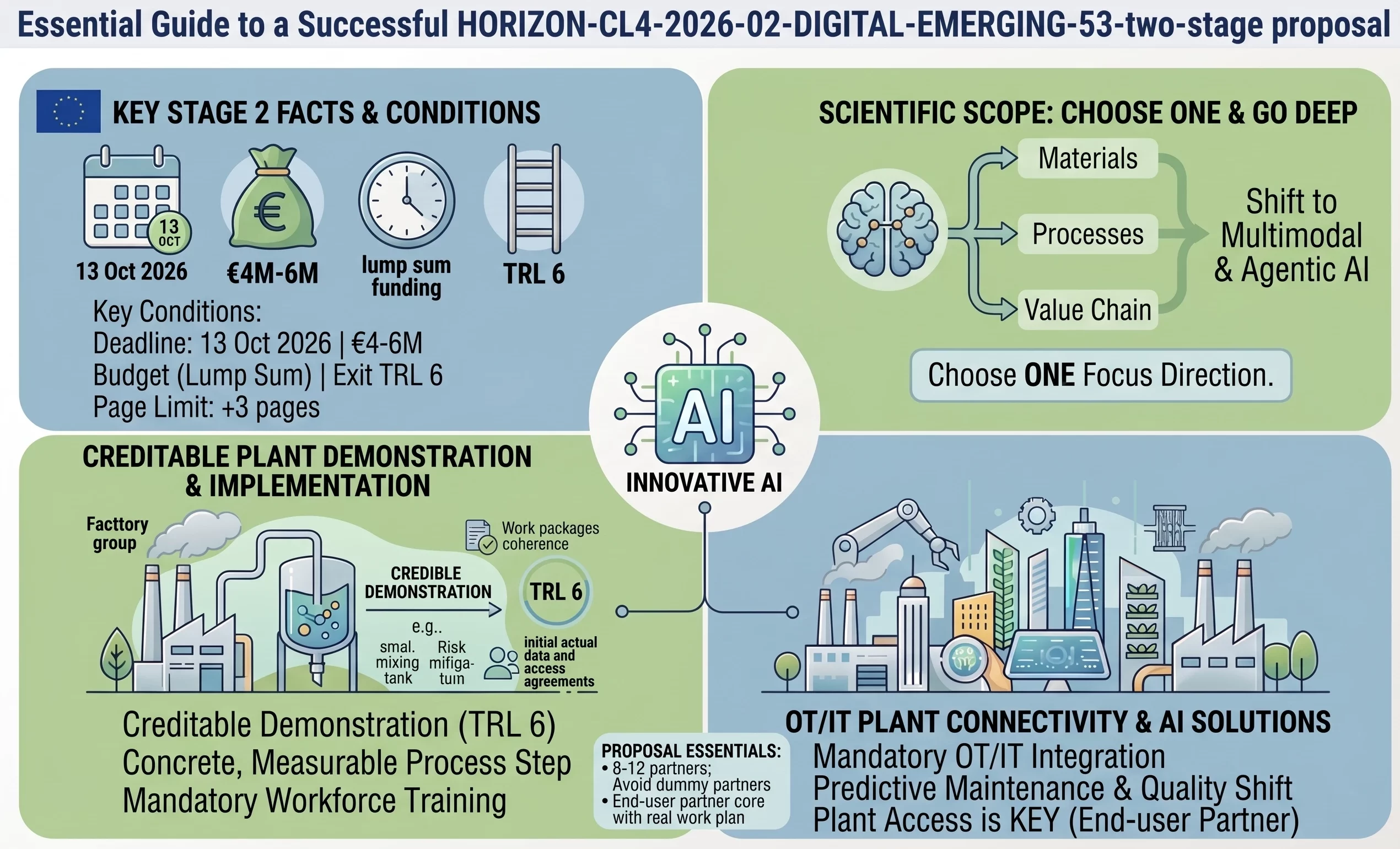
- Stage 2 deadline: 13 October 2026
- Budget per project: EUR 4.00 to 6.00 million
- Total available: EUR 30.00 million for approximately 6 projects
- Type of action: Research and Innovation Action (RIA)
- The blind evaluation rule no longer applies: organisation names, acronyms, logos, and personnel names can now appear throughout the proposal
- TRL target: entry at TRL 4-5, exit at TRL 6 by end of project
- Lump sum funding applies
- Page limit extended by 3 pages in Part B to accommodate the mandatory business case and exploitation strategy
- Transfer or exclusive licensing of results: granting authority may object up to 4 years after project end
- This topic co-implements the Processes4Planet and AI, Data and Robotics European Partnerships – links to both should be formalized in Stage 2
What the Stage 2 evaluation covers
- Three criteria: Excellence, Impact, Implementation – all three scored, all three thresholds must be met
- Implementation now carries full weight: work plan coherence, team track records, partner roles, and budget allocation are all scored
- Read your Stage 1 Evaluation Summary Report line by line before writing a single word of Stage 2
Scientific range: what does the Commission expect from the HORIZON-CL4-2026-02-DIGITAL-EMERGING-53-two-stage grant?
What outcomes are expected?
The Commission desires AI to be truly implemented within process industry plants – chemicals, steel, cement, pulp, and pharmaceuticals. At the completion of the project, AI-based solutions that will either enhance the creation of new materials and processes faster, decrease the environmental impact of production, or make the workplace in plants less dangerous and more appealing should be demonstrated. Both competitiveness and sustainability are not back-end aspirations.
What is within scope?
- Multimodal generative AI, foundation models, and agentic AI in process industry challenges – the work programme in particular indicates a shift towards predictive maintenance and conventional quality control
- AI process design and engineering solutions: speed up the creation of new materials, products, and process designs
- AI in plant operations: automation of processes, enhancement of the consistency of the results, adaptation to varying conditions, and autonomous operation
- AI in value chain management: identifying changing customer requirements at a faster rate, shortening time to market
- Artificial Intelligence to support the workforce and workplace safety: minimizing health risks, simplifying complicated tasks, and knowledge transfer
- User acceptance, operator training, and integration with existing OT/IT plant infrastructure – this is a mandatory, not an optional requirement
- Business case and exploitation strategy: required in Stage 2, extra page allowance
The proposals should concentrate on one of three scope directions. That one-subject need is not similar to topic -51. Select the direction your consortium can best illustrate at pilot or plant scale at TRL 6, and develop everything around it.
What specifically needs to be developed in Stage 2?
- Concrete process industry demonstration plan: what plant, what step in the process, what are the operational conditions, and what measurable improvement is to be expected
- The description of a particular AI architecture: the work programme mentions generative AI, foundation models, and agentic AI; Stage 2 reviewers would be interested to know what approaches you are taking, and why they align with your scope direction
- The OT/IT integration pathway: what is your AI solution integration with the current plant control infrastructure without disturbing operations?
- A clear TRL 4-5 to TRL 6 development, where milestones demonstrate validation in bench or simulation, and then to realistic plant conditions
- Workforce aspect: acceptance of user, training of operator and adapting to human needs are covered in the scope text – they must be covered in the work plan, not defined as a communication activity
Scientific strategy: how can you enhance your chances of being funded through HORIZON-CL4-2026-02-DIGITAL-EMERGING-53-two-stage?
What does Stage 2 demand that Stage 1 did not?
- Take action on your Stage 1 Evaluation Summary Report. Something will have been flagged by reviewers. Discuss each of them, at least briefly, in the appropriate Stage 2 sections. Disregard of feedback is observed.
- Choose a direction of the scope and go deep. This call requests one direction, not two, as opposed to topic -51. The urge to hedge in all three is real. Don’t. A proposal that attempts to address materials development, sustainability, and workforce safety in equal parts will appear to be unfocused. Select, and be selectable at the abstract.
- Take an idea to approach. Stage 1 was regarding the concept. Stage 2 requires a particular experimental procedure, access agreements with at least one process industry plant and initial data where you have it. The methodology of the Excellence criterion scores does not mean ambition, but plausibility.
- Bang the Implementation criterion. This is where good science is defunded. Work packages, milestones, risk mitigation, partner roles, budget allocation; all should stick together internally. We have been taken up more than one consortium, this trip.
- Connect to Processes4Planet. This alliance is referred in the title of the topic. A task or work package that is committed to Processes4Planet initiatives and coordinates with them is better than a paragraph in the impact section. The link on the Apply AI Strategy will also be anticipated.
- OT/IT integration requirement is not boilerplate. It is particular in the work programme. Proposals, which consider plant connectivity a background assumption, instead of a technical challenge, will be rated lower on Excellence.
- Right-size the budget. EUR 4-6 million per project. Construct bottom-up out of your real work plan and check the overall fits within the range.
- There is a reason why the business case section has three additional pages. The respondents to the reviewer questions are based on actual market uptake plans with named potential adopters within the process industries rather than a general statement about commercial potential.
Consortium & proposal-writing plan: what to consolidate for Stage 2?
- Stage 2 involves the use of paper where real names, CVs, and track records are written. In case one of the partners was a dummy in Stage 1, shut the consortium now not in September.
- 8 to 12 partners will probably be the best and possibly a few more in case the diversity of the process sector does indeed demand it. Only include partners when there is a true scientific or industrial gap; evaluators can tell when a consortium is expanding between phases unnecessarily.
- One of the process industry end-users should be a core partner with a real work plan activity, and not an affiliated organization. A plausible Stage 2 demonstration plan cannot compromise on plant access. There is no plant, no credibility.
- The OT/IT integration project requires a person who has performed it within a production facility. It is not the usual scholastic ability. When that knowledge is lacking in your consortium, seek it out.
- Include an innovative SME. An AI tooling company or industrial sensor integration or process analytics company within the target industry provides credence to the exploitation pathway and generally scores higher on Implementation.
- System coverage is important in a sense other than in topic -51. You only have one direction of scope, but you require the entire chain to be covered: the AI development experience, the knowledge of the process domain and the ability to integrate it on the plant level. Ensure that your partner mix in fact includes all three.
- Have somebody who has written an Implementation section write it. It is the component that distinguishes between funded and well-intended proposals.
- Provided Processes4Planet or AI, Data, and Robotics partnership was mentioned during Stage 1; formalize those relationships at this stage. A coordination job that was given much thought is much better than a reference in the intro.
How would microfluidics contribute to Stage 2?
Stage 2 reviewers desire technology options to be defined in a concrete, rather than a catalog, manner. Process industries work with liquids at all times, reaction mixtures, slurries, solvents, and liquids dissolved in gases. The traditional methods of plant instrumentation record bulk parameters. It is frequently unable to observe, at the molecular or compositional scale, what is occurring in real time. This is what microfluidics can bridge as a viable case to the Stage 2 work plan.
- Suppose your demonstration is of a chemical or pharmaceutical production process, in which the yield of a reaction can vary, and that the AI model is intended to identify the cause of the variation and rectify it dynamically. The composition of the process stream is monitored at the rate of an inline microfluidic analyser that can monitor the flow at rates that are incomparable to the standard plant sensor. That information is directly fed to the AI model. The process dynamics are viewed in the model, rather than the output parameters. It makes your argument to your Excellence all the more difficult to dispute.
- Microfluidic platforms can be used to carry out the same process chemistry in small scale under controlled conditions before investing in deploying AI on a large scale. That creates the initial information that your Stage 2 proposal actually requires, namely, actual data that your AI solution is viable in real-world conditions, not only in simulation.
- An interesting angle on this is the workforce safety scope direction. Real-time exposure to dangerous compounds can be checked via microfluidic wearable or near-process sensors. Entering that data into an AI health risk model is not an idea, but a tangible, demonstrable deliverable.
- One microfluidics partner would be designated by your consortium to provide the inline sensing and process measurement layer, and deliverables in the work plan. None of the generic technology descriptions in the partner table. It is that particularity the Stage 2 evaluators are interested in.
In the case of HORIZON-CL4-2026-02-DIGITAL-EMERGING-53-two-stage, microfluidics provides the process measurement accuracy which is missing in most AI-for-process-industry proposals. It renders your plant demonstration technically plausible, provides your AI model with superior input data, and argues that your solution is running on high-resolution process data rather than past plant logs. MIC has experience in platforms and industrial applications to contribute to your consortium.
The MIC already brings its expertise in microfluidics to Horizon Europe:
H2020-NMBP-TR-IND-2020

Microfluidic platform to study the interaction of cancer cells with lymphatic tissue
H2020-LC-GD-2020-3

Toxicology assessment of pharmaceutical products on a placenta-on-chip model

FAQ – HORIZON-CL4-2026-02-DIGITAL-EMERGING-53-two-stage
What is the deadline of HORIZON-CL4-2026-02-DIGITAL-EMERGH-53-two-stage, Stage 2?
Stage 2: 13 October 2026, 17:00 local time in Brussels. Consortia which submitted Stage 1 by 17 March 2026 will have around six months to develop their full proposal based on the concept note.
What is the difference between Stage 2 assessment and Stage 1?
The evaluation in Stage 1 was blind on Excellence and Impact only – no names of organisations or logos or staff names were allowed. Stage 2 uses all three requirements: Excellence, Impact, and Implementation. The identities of the organizations are completely displayed, and the entire work plan, budget justification, and team track records are assessed.
In what budget range should a Stage 2 proposal be?
The Commission approximates the EU contribution to be EUR 4.00 to 6.00 million per project. Expanding far beyond this range will tend to cause red flags on efficiency. Prepare your budget using your work plan as a bottom-up, and ensure that it fits within the range.
What is the number of scope directions that should be covered in the proposals?
In contrast to topic HORIZON-CL4-2026-02-DIGITAL-EMERGH-51-two-stage, in this call, proposals are requested to concentrate on one of three scope directions: more effective and faster development of new materials and processes, competitive and sustainable production with less environmental impact, or reduction of risks to the health of the workforce and workplace attractiveness. Make a choice, go in-depth, and ensure that the choice is apparent in the abstract.
What level of TRL should be at project end?
The activities will commence at TRL 4-5 and reach TRL 6 towards the project termination. The Stage 2 proposal should also contain clear milestones with the evidence of validation transitioning between a bench or simulation and a realistic plant-level. Check the Funding and Tenders Portal for more information.
How important is the OT/IT integration requirement?
The requirement of OT/IT integration is stated directly in the work programme – it is not boilerplate. Proposals which consider plant connectivity as a background assumption, and not as a technical challenge will achieve lower scores on Excellence. Your consortium requires a person who has experience in actually doing this within a production plant.
What is the best way to organize the consortium at Stage 2?
Target 8-12 partners. The end-user of at least one process industry must be a core partner with real work plan tasks – not an associated entity. The right to access plants is not on the agenda. Bring in a new SME in AI tooling, integration of industrial sensors, or process analytics. Cover the entire chain: AI development skills, knowledge in the field of processes and the ability to integrate on the plant level.
How important is the Implementation criterion in Stage 2?
What is the role of Processes4Planet partnership?
The topic title is Processes4Planet – this is not a background reference. Stage 2 proposals must have a specific task or work package demonstrating tangible coordination with Processes4Planet activities. It needs to be mentioned in the introduction. The partnership link between AI, Data, and Robotics should be formalized as well.
What does the microfluidics have to add to a Stage 2 AI-in-process-industry proposal?
The composition of process streams can be monitored with microfluidic inline analyzers at rates unattainable by any standard plant sensor, and can input high-resolution data directly to the AI model. Microfluidic platforms can also be used to run process chemistry under controlled conditions in small scale prior to full plant deployment to generate the initial data Stage 2 reviewers require. In the case of workforce safety, microfluidic wearable or near-process sensors would provide real-time data on hazardous compound exposure to AI health risk models. The specificity that Stage 2 evaluators seek is naming a particular microfluidics SME with particular deliverables, as opposed to an abstract technology line.