Tips & Tricks for a successful HORIZON-CL4-2026-02-DIGITAL-EMERGING-51-two-stage proposal
Opening
16 December 2025
Deadline
Keywords
Stage 2 Proposal
AI in manufacturing
Explainable AI
digital twins
factory automation
Made in Europe
Clean Industrial Deal
Deep learning
LLMs
Your microfluidic SME partner for Horizon Europe
We take care of microfluidic engineering, work on valorization and optimize the proposal with you
HORIZON-CL4-2026-02-DIGITAL-EMERGING-51-two-stage: AI-enhanced manufacturing and production processes in factories (Made in Europe and AI, Data and Robotics partnerships) -
Stage 2 preparation
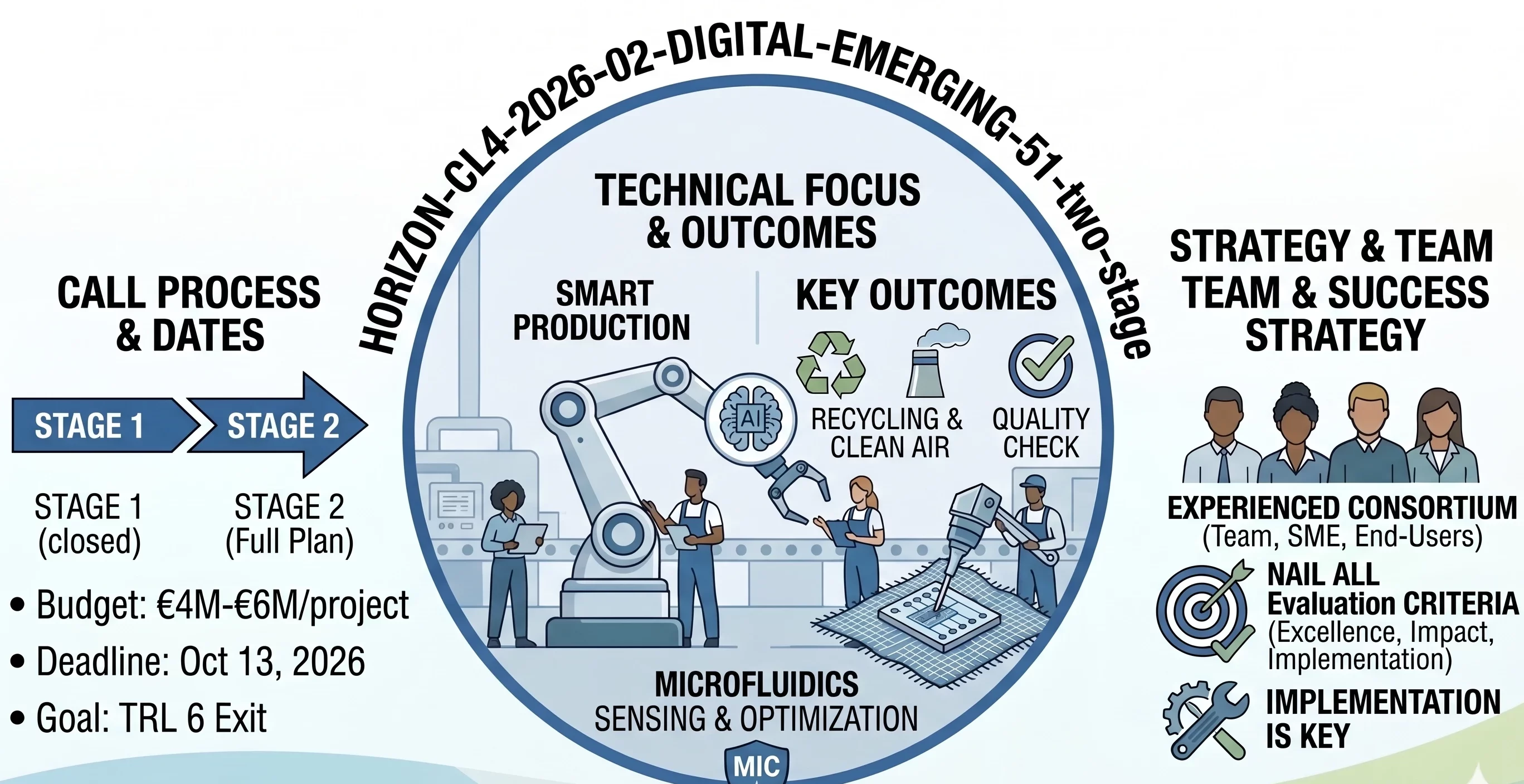
Stage 1 closed on 17 March 2026. Assuming that your consortium has turned in a submission, you now have up to 13 October 2026 to transform a brief, blind concept note into a full, revisable proposal. Stage 2 is another exercise. The blind assessment rule is eliminated. Each of the three criteria is fully weighted. The Commission anticipates a full scientific and implementation plan and not an outline. Six months is like a long time. It isn’t.
Download the MIC Horizon Europe 2026/2027 Calls Calendar:
Discover more!
Administrative facts: what do we know about the HORIZON-CL4-2026-02-DIGITAL-EMERGING-51-two-stage call? What changes at Stage 2?
Key Stage 2 dates and conditions
- Stage 2 deadline: 13 October 2026
- Budget per project: EUR 4.00 to 6.00 million
- Total available: EUR 30.00 million for approximately 5 projects
- Type of action: Research and Innovation Action (RIA)
- The blind evaluation rule no longer applies: organisation names, acronyms, logos, and personnel names can now appear throughout the proposal
- TRL target: entry at TRL 4-5, exit at TRL 6 by end of project
- Lump sum funding applies
- Page limit extended by 3 pages in Part B to accommodate the mandatory business case and exploitation strategy
- Portfolio balance rule: at least one grant will go to the highest-ranked proposal focused on complex functional and technical textiles, provided it meets all thresholds (worth checking twice if your application touches textiles)
- Transfer or exclusive licensing of results: granting authority may object up to 4 years after project end
What the Stage 2 evaluation covers
- Three criteria: Excellence, Impact, Implementation, all three scored, all three thresholds must be met
- Implementation now carries full weight: work plan coherence, team track records, partner roles, and budget allocation are all scored
- Read your Stage 1 Evaluation Summary Report line by line before writing a single word of Stage 2
Scientific range: what does the Commission expect from the HORIZON-CL4-2026-02-DIGITAL-EMERGING-51-two-stage grant?
What outcomes are expected?
The Commission would like working, explainable AI on real factory floor infrastructure. At the completion of the project, validated solutions should be in place that enhance the way of producing, identify defects before they spread or utilize recycled materials better. The reduction in emissions should be quantified, and compliance with the Clean Industrial Deal should be anticipated, not optional.
What is within scope?
- Real-time process monitoring and adaptive optimisation in manufacturing processes via AI
- Deep learning, large language models (LLMs), digital twins, and synthetic data generation to production systems
- Scrap and energy reduction, and carbon footprint reduction, via AI-controlled processes
- Quality enhancement through real-time monitoring and rectification of production abnormalities
- Optimisation of the flow of materials with special attention given to regenerated or recycled materials
- AI solutions that are explainable and have been created specifically with manufacturing in mind
At least two of the three scope directions identified in the work programme must be addressed by the proposals: process efficiency and reduction of environmental impact, real-time defect prevention, and maximisation of regenerated material use.
What specifically needs to be developed in Stage 2?
- A practical demonstration plan: where, what, and how will the results be measured at a realistic scale in a concrete, industrial demonstration?
- A clear experimental design concerning the two areas of scope that your consortium is pursuing – not generic assertions about AI in manufacturing
- The explainability architecture: how your AI models explain their reasoning to operators and process engineers, rather than simply generate outputs
- An explicit continuum between TRL 4-5 to TRL 6, including certain milestones in between the validation of AI models and factory-floor evidence
- Stakeholder integration was part of the work plan, not outlined as a dissemination task in the end
Scientific strategy: how can you enhance your chances of being funded through HORIZON-CL4-2026-02-DIGITAL-EMERGING-51-two-stage?
What does Stage 2 demand that Stage 1 did not?
- Take action on your Stage 1 Evaluation Summary Report: Reviewers flagged something. Discuss all the points (even briefly) in the corresponding Stage 2 parts. Disregard of feedback is observed.
- Translating concept to method: Stage 1 was regarding the idea, Stage 2 will need a certain experimental procedure, access rights with factory partners, and initial data in case you possess one. The methodology of excellence criterion scores is plausible, rather than ambition.
- Nail implementation criterion: It is at this point that good science becomes defunded. Work packages, milestones, risk mitigation, partner roles, budget allocation, all must stick together internally. We have taken this journey at least once over a consortium.
- Stage 2 requires explainability: A black box model that gives good results will not meet the reviewers. Develop the interpretability layer of the work plan as a core of the work plan and tangible deliverables.
- Relates directly to the Apply AI Strategy and the Clean Industrial Deal: These are not policy references to fall in the introduction. The Impact section must address the industrial competitiveness targets, emissions reduction milestones, not merely scientific goals.
- Right-size the budget: EUR 4-6 million / project. Far above attracts efficiency flags. Write your actual work plan upwards and see if it fits in the range.
- The business case section is more than you might imagine: Three extra pages are provided for it. Uptake plans are specific and are answered by reviewers.
Consortium & proposal-writing plan: what to consolidate for Stage 2?
- Stage 2 makes your team paper based: real names, CVs, track records. In case one of the partners was a place holder in Stage 1, shut down the consortium now and not in September.
- 8 or 12 partners is likely to be optimal, perhaps even more so in the event that coverage of the industrial sector truly necessitates it. Add partners only in case of a genuine scientific or technical gap – evaluators can tell when a consortium between stages increases without apparent cause.
- The manufacturing of end-users should be among the main collaborators with tangible work plans. Actual production processes with at least two or three companies should be running that the AI will be tested against. It won’t be cut by associates.
- When your consortium does not have an innovative SME, now is the time. A SME that creates AI tooling or senses to help manufacturing will add credibility to the Exploitation narrative and tend to boost the Implementation score.
- System coverage matters. When your proposal is in two directions of scope, ensure that the partner mix actually addresses both. A consortium of AI-for-quality, which does not have a partner working on material flows, will not be persuasive on that second direction.
- Get someone who has already written the Implementation section to write it. It is the component that distinguishes financed proposals and those that are well-intentioned.
- In case the Made in Europe or AI, Data, and Robotics partnership was mentioned during Stage 1, formalize those connections by now. A paragraph is not as strong as a dedicated task or work package that has coordination with those initiatives.
How would microfluidics contribute to Stage 2?
Stage 2 reviewers desire technology choices to be explained, rather than enumerated. Traditional factory sensors gauge results: temperature, pressure, and throughput. They seldom get to observe the process dynamics that lead to a defect or a deviation. That is the breach point of microfluidics, where the statement of capabilities cries out.
- Suppose you have a demonstration in your factory, a step in a production line that is a chemical treatment or some kind of coating. A microfluidic sensor array is connected in-line and provides high-resolution, continuous physicochemical measurements directly into the AI model. The model is more improved in terms of input. It identifies process drifts at earlier stages and rectifies on the fly. Your Stage 2 monitoring work package enriches itself with data in a manner that a typical industrial IoT data stream cannot achieve.
- Microfluidic platforms enable you to screen process variants quickly – same scientific question, much faster answer – before you commit to a full-scale AI remediation strategy. That is the initial information your Stage 2 Excellence section is in fact required to possess.
- The explainability criterion can be more readily illustrated when the AI model receives accurate, well-characterized sensor data. The microfluidic measurement provides cleaner inputs resulting in easier reasoning to surface the model to operators. This is a concrete argument for the Excellence criterion.
- Your consortium would name a particular microfluidics partner as having the sensing and measurement layer, rather than as a generic technology line in the partner table. This type of thing is what evaluators are particular about.
In the case of HORIZON-CL4-2026-02-DIGITAL-EMERGING-51-two-stage, microfluidics provides the sensing accuracy missing in most AI-for-manufacturing plans. It also lends credibility to your field demos, and directly supports the argument that your AI is operating on actual, quality process data, not historical logs. MIC has experience in platforms and industrial applications to contribute to your consortium.
The MIC already brings its expertise in microfluidics to Horizon Europe:
H2020-NMBP-TR-IND-2020

Microfluidic platform to study the interaction of cancer cells with lymphatic tissue
H2020-LC-GD-2020-3

Toxicology assessment of pharmaceutical products on a placenta-on-chip model

FAQ – HORIZON-CL4-2026-02-DIGITAL-EMERGING-51-two-stage
What is the Stage 2 submission date and how is the six months to be spent?
Stage 2 will be due 13 October 2026. That window is comfortable and not: between the transformation of a blind concept note into a full revisable proposal, locking the consortium, gaining access to the factory, and generating initial data, most teams are on the final two months. It is a good discipline to plan back to the first of September to be reviewed internally.
What is the per-project budget and the number of planned projects to be funded?
Projects would be funded between EUR 4.00 to 6.00 million of an envelope of EUR 30.00 million, and it is anticipated that there would be about 5 projects funded. The funding is provided in a lump sum, which alters the organization of cost justification and cost payment points in contrast with actual cost grants. The huge budgets will lead to efficiency flags on the evaluator side and the work plan should be sized then the budget verified against it.
What kind of action is this, and what partnerships?
It is a co-programmed Research and Innovation Action (RIA) within two Horizon Europe partnerships Made in Europe and AI, Data and Robotics. Provided these partnerships were referred to in Stage 1, Stage 2 is the stage to cement the relationship by creating a task or a work package with specific coordination activities, not a paragraph of well wishes.
What TRL trajectory is desired, and what does that concretely mean?
Entering: TRL 4-5 and leaving: TRL 6, at the end of the project. The proposal should demonstrate a clear transition between the two with the in-between milestones between model validation, lab integration and factory floor evidence. A leap between validated algorithm and industrial demonstration that does not have apparent intermediate steps is likely to cast doubt on the feasibility. Check the Funding and Tenders Portal for more information.
What has transformed in Stage 1 to Stage 2?
Three changes matter. There is no longer any need to be blind-tested: organisation names, acronyms, logos and personnel names may now be used everywhere. The Implementation criterion is fully weighted together with Excellence and Impact and all three thresholds are to be met. And a full scientific and implementation plan with experimental design, roles of partners, access rights, and initial data where possible are now anticipated by the Commission, rather than an outline.
What are the number of scope directions to be covered in the proposal and what are they?
The proposals should plausibly respond to two or three of the three scope directions, which may include process efficiency and simultaneously environmental impact reduction, real-time defect prevention, and maximization of regenerated material use. The mix of partners ought to be substantially encompassing both directions. A consortium with high scores on AI-for-quality, but without a person on material flows will be unconvincing on that second direction.
What do the evaluators really want?
The Commission desires working, explainable AI that operates on real factory floor infrastructure, and proven solutions that enhance production, identify defects before they propagate or use more recycled materials. The reductions of emissions should not be stated in words but in numbers and compliance with the Clean Industrial Deal and the Apply AI Strategy should be reflected in the Impact section with tangible competitiveness and emissions targets.
What is a competitive consortium?
The number of partners that works reasonably is 8 to 12, which may increase when industrial coverage truly requires it. The real work package should be a real responsibility of manufacturing end users, and two or three live production processes can be used to test AI, and associates who are not committed will be unconvincing. A creative SME developing AI equipment or sensing enhances the Exploitation story and the Implementation rating. The addition of partners between Stage 1 and Stage 2 with no obvious scientific or technical gap is evident to evaluators.
What is the value added by microfluidics in this particular call?
Four concrete contributions. To begin with, in line sensing: microfluidic arrays record continuous and high resolution physicochemical dynamics absent in conventional factory sensors, enabling the AI to detect process drifts sooner and correct in real-time. Second, one can quickly screen variants of the processes, generating the initial data which the Stage 2 Excellence section rewards more and more. Third, explainability was simpler with cleaner inputs, since well-characterized features are simpler to surface to operators. Fourth, an identifiable microfluidics partner with the sensing and measurement layer reads better in the partner table than an unidentified technology line.