Tips & Tricks for a successful HORIZON-CL3-2026-01-INFRA-03 proposal
Opening
06 May 2026
Deadline
Keywords
Critical Infrastructure Resilience
NaTech Scenarios
Compound Disasters
Cross-border Coordination
Port & Maritime Security
Emergency Response
Your microfluidic SME partner for Horizon Europe
We take care of microfluidic engineering, work on valorization and optimize the proposal with you
HORIZON-CL3-2026-01-INFRA-03: Targeted innovative capabilities for the resilience of critical entities to natural and human-induced disasters, including hybrid scenarios
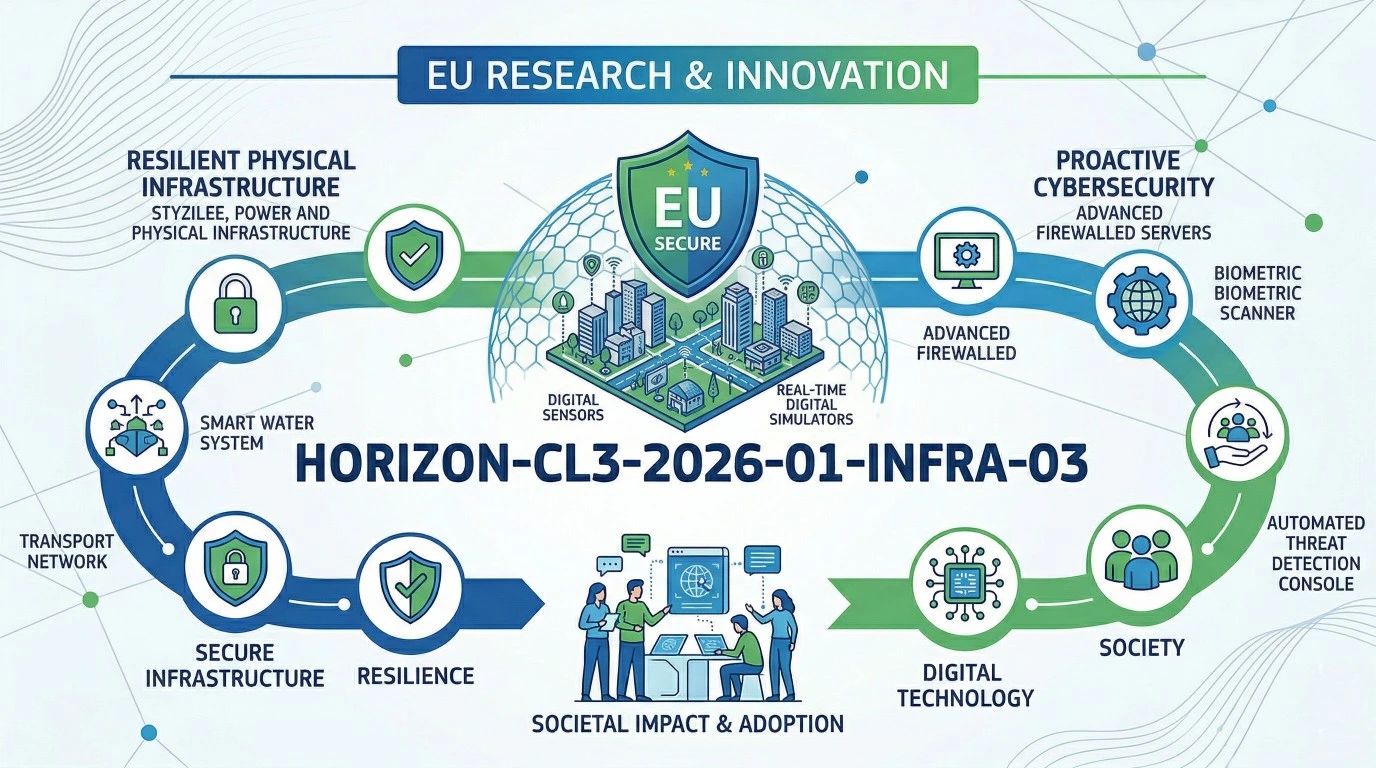
The European Commission is seeking effective on-the-ground tools, not another set of resilience frameworks that just gather dust. This is about showcasing solutions that address real needs in how critical entities plan for, react, and bounce back from complex calamities: floods causing chemical disasters, mixed crises, and chain reactions across infrastructures. The message could not be clearer: get real, leave the ivory tower thinking behind, and prove your solutions through field, or at least, by simulation of the reality-based operational environment.
Download the MIC Horizon Europe 2026/2027 Calls Calendar:
Discover more!
Administrative facts: what do we know about the HORIZON-CL3-2026-01-INFRA-03 call?
Which call is it, and when is the opening and the deadline?
- Call name: Civil Security for Society 2026
- Call identifier: HORIZON-CL3-2026-01
- Destination: Resilient Infrastructure
- Topic: HORIZON-CL3-2026-01-INFRA-03
- Opening date: 06 May 2026
- Deadline: 05 November 2026
- Type of action: Innovation Action (IA)
What about the budget and estimated size of the project?
- Overall topic budget: EUR 9.00 million
- Number of projects expected to be funded: 2
- Budget per project: around EUR 4.50 million
What are the key eligibility and evaluation conditions?
- Standard evaluation thresholds (General Annex D)
- Entities controlled directly or indirectly by China are not eligible (restriction on control for IAs in critical technology areas)
- At least 3 relevant practitioners from EU Member States or Associated Countries must be beneficiaries
- Projects using satellite earth observation must use Copernicus and/or Galileo/EGNOS
- Lump sum funding model
- Security sensitive topic (EUCI and SEN provisions apply)
- Granting authority may object to transfer of ownership or exclusive licensing up to 4 years after the project end
Scientific range: what does the Commission expect from the HORIZON-CL3-2026-01-INFRA-03 grant?
What outcomes are expected?
The Commission wants to identify proven tools and platforms that public authorities, first responders, and infrastructure operators would be able to implement in real compound crisis scenarios. Projects are expected to illustrate clear improvements in how critical entities identify their systemic vulnerabilities, cooperate internationally and guarantee the continuation of essential services during the occurrence of multiple different disruptions. Validating the already existing NaTech countermeasures is certainly in the scope as well.
What is within scope?
- Technological solutions tailored to specific sectors for the area of preparedness, response, and recovery in multi-hazard situations
- Governance and technology tools capable of being interoperable, modular, and usable in real-life operational situations
- Interfaces that serve as a risk assessment and decision-making platform, able to support situational awareness during quick changes of the crisis
- Multi-actor, cross-border response continuity planning and coordination mechanisms that can be changed accordingly
- Performance in testing and simulation of real-life operational contexts with public authorities, emergency services, and critical infrastructure operators
- Port security and maritime infrastructure (the work programme highlights the EU Maritime Security Strategy and European Port Strategy)
- Cross-border infrastructures which are also vulnerable, including international cooperation
- Early-stage research or generic framework is not the focus of the topic. Demonstration and validation matter here.
What exactly are the research directions being proposed?
- Capability gaps identification and prioritisation where cascading, cross-sectoral risks posing threats
- NaTech scenario building and response (natural disasters triggering technological failures), and hybrid scenarios layered on top of that
- Cross-border coordination mechanisms tested through multi-actor simulations or in representative environments where critical infrastructure is exposed to compound hazards
- Adaptive tools that maintain service continuity under rapidly changing conditions of crises (the Commission wants dynamic instead of static systems)
- Coordination with previous projects HORIZON-CL3-2025-01-INFRA-01, INFRA-02; and HORIZON-CL3-2024-DRS-01-04 to avoid duplication and build on prior results
Scientific strategy: how can you enhance your chances of being funded through HORIZON-CL3-2026-01-INFRA-03?
What scientific choices matter most?
- Set your proposal on the basis of real incidents. The working plan refers to “lessons from recent disruptive events.” Pick two or three cases of simultaneous disasters and, through your capability gaps analysis, use them to illustrate the point.
- Don’t spread yourself too thin. Identify one or two main critical entity sectors (energy, transport, ports, water) and, rather than trying to cover numerous sectors, do a thorough job on them. Reviewers won’t be tricked by the “we cover everything” approach.
- Show irrefutable evidence of significant advancement. The passage contains the word “measurable.” If you cannot express in numbers how your tools reduce response time or improve coordination under a NaTech scenario, it is better to give up that idea.
- Involve actual operational testing from the very start and not as a final work package. A call for a proposal clearly recognizes the use of simulations in representative environments.
- Use EU projects that are already in operation. The call refers to 3 mature projects you should take into consideration. Ignoring them will most likely result in a negative evaluation.
- Think about the maritime angle. Besides the port and coastal critical entities, this is also an area of much less competition than the energy or transport grids.
Consortium & proposal-writing plan: what works best with this type of call?
- Between 8 and 12 partners is about the right number, maybe a few more if cross-border testing necessitates it. Don’t exceed the 15-mark.
- You need at least 3 practitioners as the main beneficiaries. Examples of critical infrastructure operators, civil protection, police, etc. They are not advisory board members; they are full consortium partners.
- Ideal mix would be public research labs and infrastructure operators plus at least one highly innovative SME with a readily deployable technology. The evaluators of this destination want you to transition beyond the project’s lifetime. An SME with a real product roadmap signals that.
- For a maritime or port security project, invite a port authority and a coastal emergency management body to the discussions. Two countries minimum for cross-border dimension.
- Proposal writing: be the capability gap analysis lead rather than the technology. Explain what is wrong first and then show how your consortium is the solution. This is the mistake that teams that started with a tech pitch that we have seen more than once.
- Retention of the coordination plan with the three named predecessor projects visible in Part B is essential. A paragraph is not enough; evaluators will check.
How would microfluidics contribute to this topic?
Imagine that you are an operator of essential infrastructures and that you have to detect, at the very beginning, the presence of chemical substances in your environment during a technological disaster? Lab analyses would be of no use, they are slow and far away from the field. Suppose a flood alters a facility in which hazardous liquids are stored: you need to know within the hour if the flood water is polluted or if the water that supplies the population downstream is contaminated. It is here that portable sensors with a microfluidic chip should be used.
- Whether the sensor is installed at the inlet of the water supply or at the dock of the port, it immediately detects the presence of chemical pollutants in the water sample you have just taken. There is no need for sampling and transporting to a lab to wait your turn: the crisis is just beginning, the operational response team already has the results in hand and can react.
- These microfluidic platforms can be used to monitor different hazards across sectors (and compound groups, from minerals to foam): change only the cartridge, which contains the reagent. This is how the call is done.
- Environmental monitoring around the site of a technological crisis (for example, a forest fire that has just reached an industrial area) is often limited to fixed stations. Portable microfluidic devices allow you to drive along the contamination plume. Not to replace the fixed network, but to integrate it.
- If your project includes biological hazard identification, such as mixed or complex scenarios, on-chip organoids are able to provide fast toxicology screening without the need to use animals for testing. The microfluidic platform will host the tissue or organ exposed to the contaminant, it will observe the cells’ response to stress and provide a toxicity assessment in a few hours rather than weeks.
If your project’s theme is real-time emergency management and cross-border coordination, think of how evaluators here will appreciate the value of going beyond simulation to truly on-the-field sensor data collection. That’s the added value your consortium will bring to this destination, well beyond dashboards and simulation platforms.
The MIC already brings its expertise in microfluidics to Horizon Europe:
H2020-NMBP-TR-IND-2020

Microfluidic platform to study the interaction of cancer cells with lymphatic tissue
H2020-LC-GD-2020-3

Toxicology assessment of pharmaceutical products on a placenta-on-chip model

FAQ – HORIZON-CL3-2026-01-INFRA-03
So, what is NaTech with reference to this call?
NaTech is the abbreviation of Natural hazard triggering Technological disaster. Within the context of this call, it pertains to situations in which an occurrence of nature (flood, earthquake, wildfire) leads to a breakdown in industrial or critical infrastructure, resulting in a compound crisis that needs to be addressed through multi-sector response.
What are some of the predecessor projects that I need to mention in my proposal?
The call specifically mentions three predecessor projects: HORIZON-CL3-2025-01-INFRA-01, INFRA-02, and HORIZON-CL3-2024-DRS-01-04. The applicants should demonstrate how their proposal is an expansion or a non-duplication of the outcomes of these projects. When they are ignored, this is a warning to the evaluators.
What number of practitioners do you need in the consortium?
You must have at least 3 relevant practitioners as full beneficiaries (not as subcontractors or members of the advisory board) of EU Member States or Associated Countries. They may be critical infrastructure operators, civil protection agencies, police, or other operating entities.
Do they have any limitations on the participation of non-EU countries?
Yes. Entities controlled directly or indirectly by China are not eligible to participate in this topic, which falls under the restriction on control for Innovation Actions in critical technology areas. This is specified in the call conditions.
What is the level of TRL of this Innovation Action?
It is an Innovation Action (IA) and therefore the anticipated Technology Readiness Level is high. The Commission desires to see demonstration and validation in representative or operational settings, not preliminary research. Set Think TRL 6-8 as a target range, and the work plan should include real-world testing right at its inception.
Does it specifically address maritime and port security?
Yes. The work programme clearly brings out the EU Maritime Security Strategy and the European Port Strategy. Port authorities and coastal emergency management bodies are strong candidates for the practitioner requirement. Competition in the maritime situation is also a lesser challenge compared to either energy or transport proposals.
What is lump sum funding in respect to this call?
The topic is based on a lump sum funding model. This implies that you settle on agreed values of work packages during the proposal stage, as opposed to actual reporting. Under this model, budget planning and definition of clear milestones is even more important.
How much would the budgets be per project?
The topic budget amounts to EUR 9 million, and the 2 projects that are expected to be funded will be provided with approximately EUR 4.5 million per project. When doing an Innovation Action, like cross-border testing, and with more than two practitioners, size and ambition your consortium.
Does it have security clearance requirements?
Yes. It is a security sensitive subject. EUCI (EU Classified Information) and SEN (Sensitive) provisions are in effect. Members of the consortium might require security clearances, and some deliverables might have limited dissemination. Include this in your project management and choice of partners.
What can microfluidics do to bolster my suggestion to this topic?
For reaction crises, portable microfluidic sensors can provide rapid on-site chemical measurements in place of slow laboratory tests. Organ-on-chip models provide rapid toxicology screening of biological hazards. These technologies will provide actual field information, and your proposal will not be just demonstrations on simulation.