Tips & Tricks for a successful HORIZON-MISS-2027-07-CLIMA-CIT-NEB-01 proposal
Opening
09 February 2027
Deadline
Keywords
EU Missions
Urban nature restoration
transportation
Nature-based solutions
urban ecosystem
Tree canopy
Climate adaptation
NEB
community involvement
Your microfluidic SME partner for Horizon Europe
We take care of microfluidic engineering, work on valorization and optimize the proposal with you
HORIZON-MISS-2027-07-CLIMA-CIT-NEB-01: Urban nature: supporting restoration of urban ecosystems, along urban transport networks and in the built environment
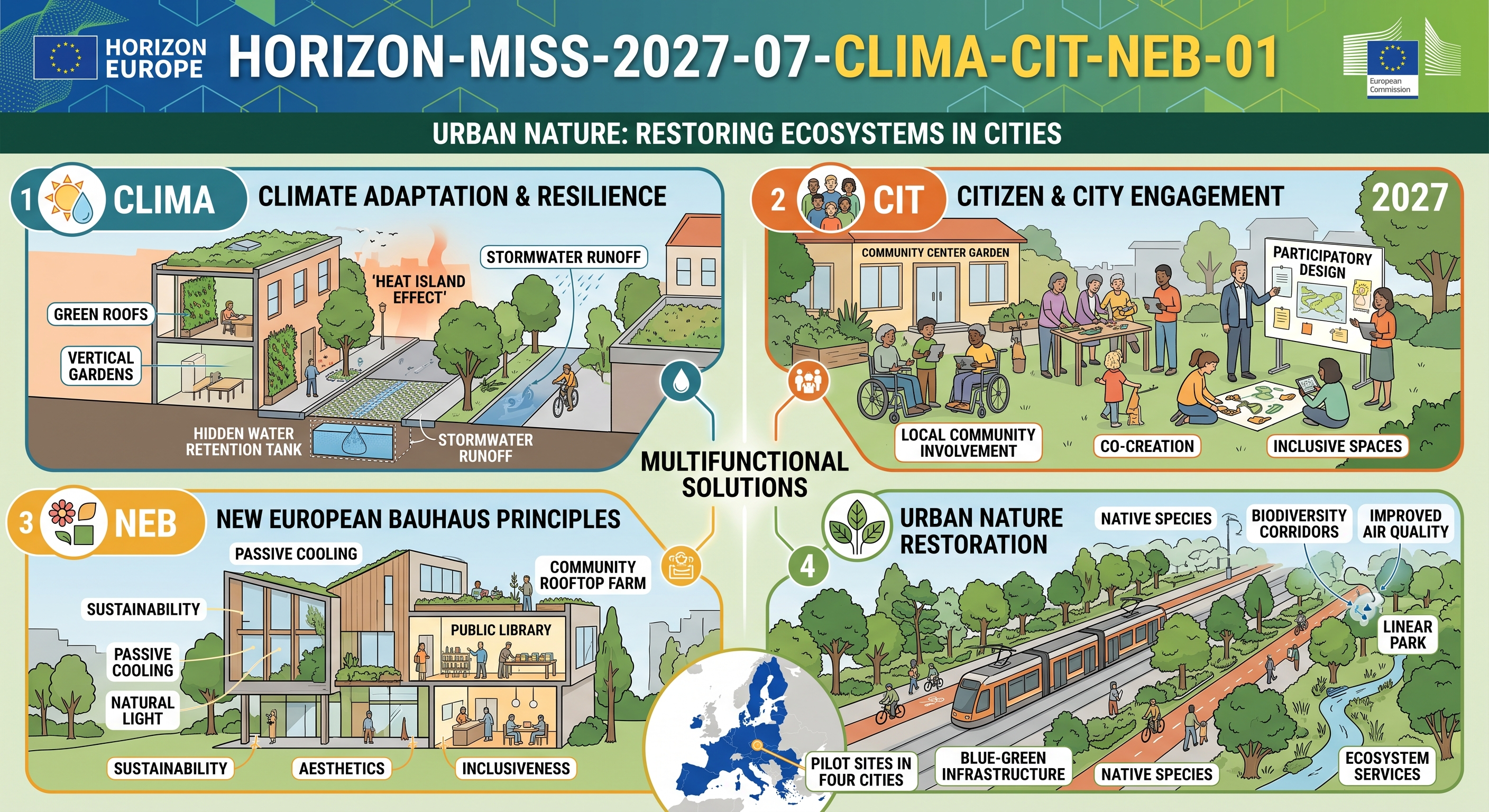
The Commission wants more green in cities, and it wants it where cities are hardest to green. Streets, car parks, tramlines, building facades. This is a joint Cities Mission and Climate Adaptation Mission call, with the New European Bauhaus in the mix, so real-neighbourhood demonstration matters far more than lab work. Under HORIZON-MISS-2027-07-CLIMA-CIT-NEB-01 you will plant, monitor and prove impact. Not publish.
Download the MIC Horizon Europe 2026/2027 Calls Calendar:
Discover more!
Administrative facts: what do we know about the HORIZON-MISS-2027-07-CLIMA-CIT-NEB-01 call?
Which call is it, and when is the opening and the deadline?
- Call name: Joint Call between the Climate-Neutral and Smart Cities Mission and the Adaptation to Climate Change Mission
- Identifier: HORIZON-MISS-2027-07
- Destination: EU Missions’ Joint Calls
- Topic: HORIZON-MISS-2027-07-CLIMA-CIT-NEB-01
- Opening date: 09 February 2027
- Deadline: 22 September 2027, 17.00 Brussels time
- Type of action: Innovation Actions
What about the budget and estimated size of the project?
- Overall topic budget: EUR 40 million, of which EUR 10 million comes from the New European Bauhaus Facility
- Number of projects expected: 4
- Budget per project: around EUR 10 million (40 divided by 4)
What are the key eligibility and evaluation conditions?
- Award criteria follow General Annex D, standard Innovation Action scoring
- Entities from at least four cities, each in a different Member State or Associated Country, must be beneficiaries
- At least one city must be among the 112 Climate-Neutral and Smart Cities Mission cities, and at least one must be a signatory to the Adaptation Mission Charter
- No JRC involvement in this topic
- Clustering with other Cities Mission, Adaptation Mission and NEB projects is required; a Memorandum of Understanding with the Mission Platform must be signed shortly after the start
- TRL 7 to 8 by project end
Scientific range: what does the Commission expect from the HORIZON-MISS-2027-07-CLIMA-CIT-NEB-01 grant?
What outcomes are expected?
By the end, the Commission wants green space and tree canopy actually restored and growing in real pilot sites, with the environmental, social and health impact measured. Publication series are not what they are after. They want methods other cities can copy, and results pushed out to follower cities.
What is within scope?
Projects must deploy in at least two pilot sites across two lead cities, and at least one pilot site has to sit along a transport network or in the built environment. Address at least three of these per pilot site.
- Tools and methods linking green space and canopy patterns to heat, biodiversity, stormwater, landslides and air quality
- Solutions to the barriers blocking urban greening, including the clash between roots and underground pipes, water scarcity and short supply of native seedlings
- Measures to increase canopy and green space, prioritising native species and connectivity so you do not end up with isolated green patches
- Multifunctional designs combining stormwater management, shade, recreation, noise reduction and fairer access to nature
What are the specifically proposed research directions?
- Greening the awkward places: streets, car parks, pavements, waterways, tramlines, building envelopes
- Root survival and tree health in compacted, pipe-heavy urban ground
- Monitoring across air, water, soil, temperature, biodiversity, noise, plus jobs and citizen perception
- Co-creation with residents, including disadvantaged groups and private property owners
The work programme is fairly explicit here, so less reading between the lines than usual. The built-environment angle is where fewer consortia will compete.
Scientific strategy: how can you enhance your chances of being funded through HORIZON-MISS-2027-07-CLIMA-CIT-NEB-01?
What scientific choices matter most?
- Pick your pilot sites early. Two lead cities, real sites, one tied to transport or buildings.
- Measure everything. The four impact categories are mandatory. Weak monitoring sinks the impact score.
- Prove the tech is nearly ready. TRL 7 to 8 means near-deployment, not early-stage research in a costume.
- Native species and connectivity. The Commission says it plainly, so say it back.
- Show the legacy. What happens to the green space once the money stops (this one catches people off guard).
Consortium & proposal-writing plan: what works best with this type of call?
- Line up your four cities, four countries, both special categories covered, before anything else.
- Somewhere between eight and twelve partners, maybe a couple more if monitoring coverage demands it.
- Mix city authorities, landscape and urban planners, ecologists, monitoring specialists, and an innovative SME or two for the tech and data side.
- If one city is both a Mission city and a Charter signatory, even better. Fewer boxes to tick.
- The multi-actor approach is required. Bring residents and land owners in at design stage, not as an afterthought.
- Budget the platform links early. The MoU and NEB clustering are not optional.
How would microfluidics contribute to this topic?
Monitoring urban ecosystems usually means bagging a sample and shipping it to a lab. Slow, and you miss the moment. Microfluidic sensors shrink that lab onto a chip you drop in the field, so water, runoff and air get read on site, near real time. MIC works exactly this kind of on-site water quality and pollutant detection.
- Say you want to know whether a new rain garden really cleans stormwater before it hits the drain. A small microfluidic water unit lets you sample the runoff on the spot and read nitrates, phosphates or heavy metals. No courier, no week’s wait.
- Soil moisture and nutrient chips near the roots. You catch water stress before the tree shows it, which counts when native seedlings are scarce.
- Air quality too. Compact lab-on-chip samplers track particulates street by street, so you know if a green corridor is doing its job or just looking pretty.
- One follower-city trap: they copy a solution, it fails, nobody knows why. Portable microfluidic monitoring gives the same measurement in every city, so you get consistent results and can tell cause from coincidence.
For your proposal, microfluidics is the piece that turns “we planted trees” into “we measured what the trees did.” That evidence base is exactly what an Innovation Action‘s impact section needs. And it travels. Same chip, lead city and follower city. MIC has already mapped this call for microfluidic relevance.
The MIC already brings its expertise in microfluidics to Horizon Europe:
H2020-NMBP-TR-IND-2020

Microfluidic platform to study the interaction of cancer cells with lymphatic tissue
H2020-LC-GD-2020-3

Toxicology assessment of pharmaceutical products on a placenta-on-chip model

About the author

Julia Sepulveda Diaz, PhD
Chief Executive Officer, Microfluidics Innovation Center
Julia holds a PhD in glycobiology and neurobiology from Université Paris-Est Créteil. Before moving into microfluidics, she spent several years as a postdoctoral researcher at the Paris Brain Institute, on Parkinson’s disease, neuroinflammation, and the role of heparan sulfate in protein aggregation. Today she leads the Microfluidics Innovation Center as CEO, steering its researchers and engineers and its collaborative research and innovation projects.
FAQ – HORIZON-MISS-2027-07-CLIMA-CIT-NEB-01
So what is this call really about?
It is an Innovation Action under HORIZON-MISS-2027-07-CLIMA-CIT-NEB-01, a joint call of the Cities Mission and the Adaptation Mission, with the New European Bauhaus on board. The aim is to restore urban green space and tree canopy, including along transport networks and in the built environment.
Who can apply, and how much money is on the table?
The topic budget is EUR 40 million, funding around four projects at roughly EUR 10 million each. Any legal entity can join, but the beneficiary mix must include the required cities.
When does the call open and close?
Opening is 09 February 2027. The deadline is 22 September 2027 at 17.00 Brussels time. The Director-General may shift these dates within the usual limits.
What counts as an eligible city consortium?
You need entities from at least four cities, each in a different Member State or Associated Country. At least one must be one of the 112 Climate-Neutral and Smart Cities cities, and at least one must be a signatory to the Adaptation Mission Charter.
Check the Funding and Tenders Portal for more information.
What outcomes does the Commission actually want?
Restored and maintained green space and tree canopy in real pilot sites. Solid measurement of environmental, economic, social and health impacts. And a clear path to spread results to follower cities.
What has to happen in the pilot sites?
Deploy greening measures in at least two pilot sites across two lead cities. At least one pilot site must sit along a transport network or in the built environment. Involve local communities, monitor impacts, and plan for the legacy after the grant.
What is in scope, and what is not?
In scope: increasing urban green space and canopy, tackling root-versus-pipe conflicts, native species, and multifunctional nature-based designs. Out of scope in practice: pure research with no field deployment, or single-city pilots that skip the follower-city dimension.
How ready does the technology need to be?
Activities should reach TRL 7 to 8 by project end. That means near-deployment solutions, tested in the field, not early prototypes.
Where does microfluidics add value here?
Field-ready microfluidic sensors give on-site, near real-time readings of water, soil and air. That turns claims about green infrastructure into measured evidence, and the same chip gives consistent results across every city in the consortium.
What usually sinks proposals on this kind of call?
Weak monitoring plans, vague pilot sites, and thin community engagement. Consortia also stumble on the mandatory platform links and clustering, so budget those from the start.