Tips & Tricks for a successful HORIZON-MISS-2027-03-OCEAN-04 proposal
Opening
09 February 2027
Deadline
Keywords
Mission Ocean
sustainable tourism
citizen science
coastal and freshwaters
water quality monitoring
community-driven business models
restore our oceans
Your microfluidic SME partner for Horizon Europe
We take care of microfluidic engineering, work on valorization and optimize the proposal with you
HORIZON-MISS-2027-03-OCEAN-04: Towards community-driven business models: coastal and freshwaters sustainable tourism
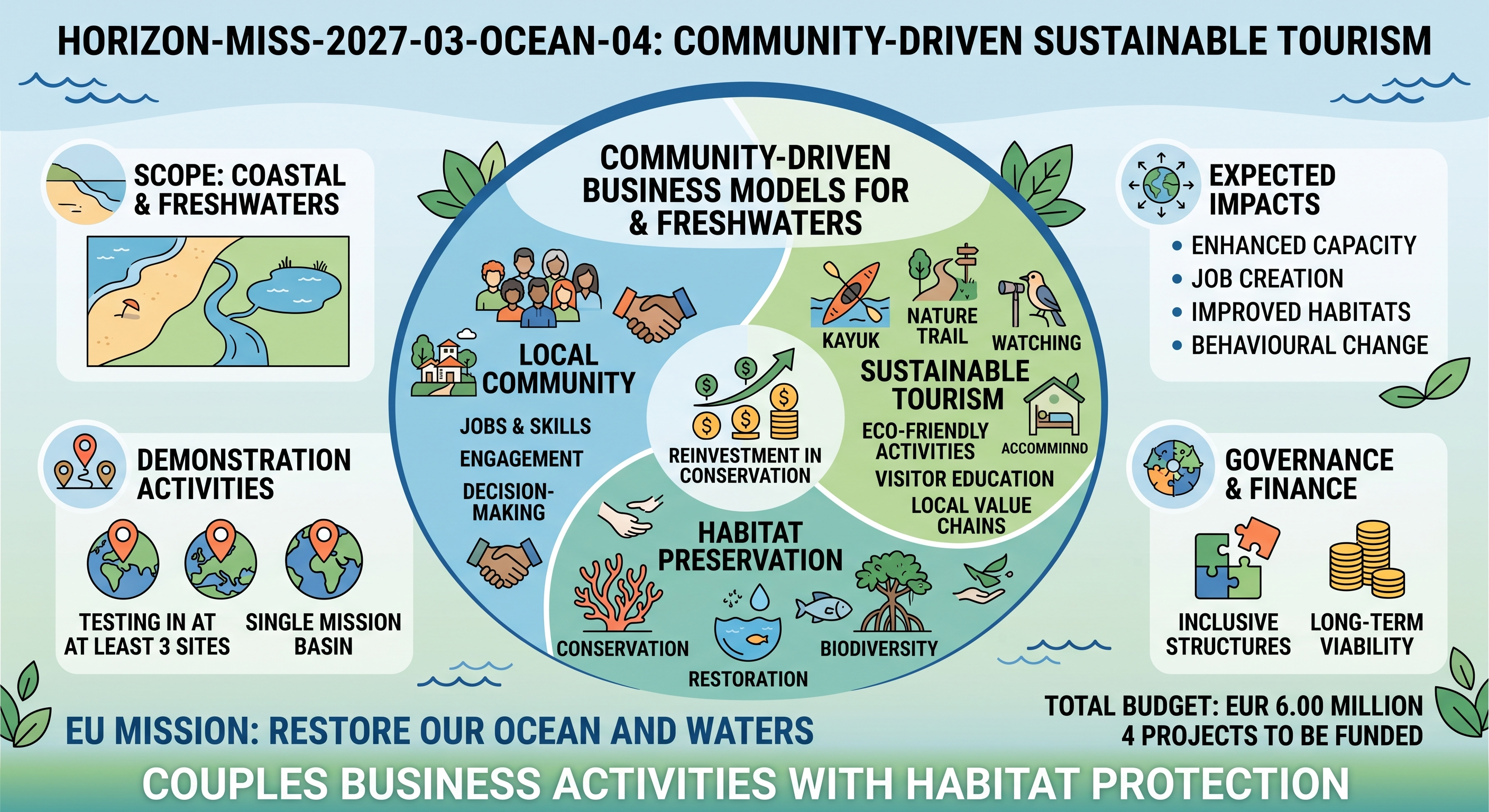
The Commission wants coastal and freshwater tourism to stop taking more than it gives back. This topic funds business models built with local communities, not for them. Initiatives have to pay for themselves while protecting habitats. Four projects, one basin each.
Download the MIC Horizon Europe 2026/2027 Calls Calendar:
Discover more!
Administrative facts: what do we know about the HORIZON-MISS-2027-03-OCEAN-04 call?
Which call is it, and when is the opening and the deadline?
- Call name: Supporting the implementation of the Restore our Ocean and Waters Mission
- Call identifier: HORIZON-MISS-2027-03
- Destination: none. Missions are organised by Mission, not by Destination
- Topic: HORIZON-MISS-2027-03-OCEAN-04
- Opening: 09 February 2027
- Deadline: 21 September 2027, 17:00:00 Brussels time
- Type of action: Innovation Action (IA)
What about the budget and estimated size of the project?
- Topic budget: EUR 6.00 million
- Indicative number of projects: 4
- Budget per project: EUR 1.50 million on average, with EUR 1.00 to 1.50 million indicated
- Overall 2027 call budget: EUR 100.40 million
What are the key eligibility and evaluation conditions?
- Award criteria: General Annex D applies, no exception declared
- Portfolio rule: not awarded by ranking alone. One top ranked proposal per basin is funded, thresholds permitting
- Basin rule: one proposal, one basin. Atlantic/Arctic, Mediterranean, Baltic/North Sea, or Danube with the Black Sea
- Open science: in situ data and marine observations go to EMODnet, FAIR principles
- No JRC involvement. Cooperation with Lighthouse CSAs and the Mission Implementation Platform is required
Scientific range: what does the Commission expect from the HORIZON-MISS-2027-03-OCEAN-04 grant?
What outcomes are expected?
Working businesses. Not feasibility studies. The Commission wants local ventures that earn money, employ people, and leave the habitat measurably better. Replication across basins is part of the deal, so one success in a single bay scores poorly.
What is within scope?
- Community driven tourism business models demonstrated in at least 3 coastal and freshwater areas, across different Member States or Associated Countries
- Engagement formats for tourists and sea users: citizen science, clean up initiatives, regenerative practices, co-management of protected areas
- Practices that cut the pressure tourism puts on water bodies: pollution, waste, product choices
- Inclusive capacity building and training, for residents and visitors alike
- Governance structures that survive the end of the grant
- Financial instruments for upscaling: reinvested profits, crowdfunding, philanthropy
- Synergies with the New European Bauhaus are encouraged
Outside your declared basin, out of scope.
What are the specifically proposed research directions?
- Testing whether a site specific initiative is really viable, socially and economically
- Coupling revenue generating activity with restoration so the two reinforce each other
- Vulnerable groups, gender equality, the overlap with poverty and exclusion
The work programme stays vague on tourist behavioural change, which gives you room to frame it your way.
Scientific strategy: how can you enhance your chances of being funded through HORIZON-MISS-2027-03-OCEAN-04?
What scientific choices matter most?
- Pick your basin on day one. Everything else follows from that choice.
- Show the money. An IA at 1.5 million covering three sites is thin, and budget discipline shows.
- Bring evidence, not intentions. If you claim habitats improve, say what you measure and how often. Too many proposals stop at “monitoring will be undertaken”.
- Treat the community as a partner, not a stakeholder consulted twice a year
- Plan the life of the governance structure after month 36. This one trips people up.
- Design replication in from the start
Consortium & proposal-writing plan: what works best with this type of call?
- Somewhere between eight and twelve partners, maybe a couple more if you cover several demonstration sites properly
- You need local anchors. Municipalities, port authorities, protected area managers, tourism operators, fishers associations
- At least one social science team for the behavioural and inclusion parts
- An innovative SME helps here, above all one able to supply the monitoring or digital tools the sites need. Small companies also make a business model credible
- If you have a partner already active in the basin Lighthouse CSA, use them
- Keep site descriptions concrete: names, surface, visitor numbers, current pressures
How would microfluidics contribute to this topic?
Water quality testing still goes through a lab most of the time. Samples travel, results come back days later, and the beach stayed open all week. Microfluidic devices run the analysis on the spot, with a few microlitres and no cold chain.
- Say your volunteers want to know whether the bay is recovering. A portable chip reading nutrients and faecal indicators lets them see it themselves, same afternoon.
- Screening for microplastics and chemicals in small samples. Useful when you have to prove the tourism pressure went down, not just claim it.
- eDNA capture and readout on chip, for biodiversity checks that don’t need a taxonomist on site
- Cheap enough to hand out. And that matters for citizen science, fifty devices in the field instead of two.
- Digital output from the start, which makes the EMODnet obligation much less painful
Microfluidics will not write your business model. What it gives your consortium is a measurement backbone that costs little, works in the field, and produces numbers a reviewer trusts. Claim versus result, that is the difference.
The MIC already brings its expertise in microfluidics to Horizon Europe:
H2020-NMBP-TR-IND-2020

Microfluidic platform to study the interaction of cancer cells with lymphatic tissue
H2020-LC-GD-2020-3

Toxicology assessment of pharmaceutical products on a placenta-on-chip model

About the author
Julia Sepulveda Diaz, PhD
Chief Executive Officer, Microfluidics Innovation Center
Julia holds a PhD in glycobiology and neurobiology from Université Paris-Est Créteil. Before moving into microfluidics, she spent several years as a postdoctoral researcher at the Paris Brain Institute, on Parkinson’s disease, neuroinflammation, and the role of heparan sulfate in protein aggregation. Today she leads the Microfluidics Innovation Center as CEO, steering its researchers and engineers and its collaborative research and innovation projects.
FAQ - HORIZON-MISS-2027-03-OCEAN-04
What is HORIZON-MISS-2027-03-OCEAN-04 actually funding?
Local tourism ventures that communities run themselves, along European coasts, rivers and lakes. The grant pays for building and testing the business model, not for writing a report about it. Each project has to show the model works in at least three areas, in different Member States or Associated Countries. And the habitat has to come out better, not just unharmed.
When does the call open and when is the deadline?
Opening is 09 February 2027. The deadline is 21 September 2027 at 17:00:00 Brussels time. Both dates can move: the Director-General may open the call up to one month either side, and may delay the deadline by up to two months. You can track the whole 2026-2027 sequence on our European calls calendar.
How much money is available per project?
The topic budget is EUR 6.00 million for four projects. The work programme expects a contribution of EUR 1.00 to 1.50 million per project. That is small for an Innovation Action with several demonstration sites, so the budget table gets read closely. Asking for a different amount is allowed, but you had better justify it.
Check the Funding and Tenders Portal for more information.
Do we really have to pick a single sea basin?
Yes, and you have to say so explicitly in the proposal. The four options are Atlantic and Arctic, Mediterranean, Baltic and North Sea, or Danube River basin including the Black Sea. River basins flowing into a sea basin count as part of it. Because the Commission awards at least one top ranked proposal per basin, the basin you choose changes who you are competing against.
How many demonstration sites do we need?
At least three, in different countries. The work programme sets a floor, not a target. With 1.5 million to spread around, more sites usually means thinner sites. Three well documented locations with named partners beat six vague ones. Give surface, visitor numbers, current pressures, and who owns what.
What does the EMODnet obligation mean in practice?
If your project collects in situ data or marine observations, those data go to EMODnet under FAIR principles. This is a grant agreement obligation, not a recommendation. Plan the data workflow early: formats, metadata, who curates, who uploads. Teams that treat this as an afterthought end up doing it badly in month 34.
Is this a research topic or a deployment topic?
Deployment, clearly. It sits in the second phase of the Mission, where solutions already piloted get replicated and scaled. Publication series are not what the Commission is after. What it wants is something running at the end of the grant, with a governance structure and a revenue stream that outlive the funding.
What kind of consortium works for this call?
Roughly eight to twelve partners. Local anchors matter more than famous names: municipalities, protected area managers, port authorities, tourism operators, fishers associations. Add a social science team for the behavioural and inclusion work. An innovative SME is worth including, especially one that can supply the monitoring or digital tools the sites will need. It also makes the business model sound like a business.
Where does microfluidics fit in a tourism topic?
In the measurement layer. You claim less pollution and better habitats, so somebody has to prove it. Portable microfluidic devices read nutrients, faecal indicators or eDNA on site, with a few microlitres and no cold chain. Cheap enough that volunteers can carry them, which turns citizen science from a communication activity into a data source. Our own Missions relevance ranking puts this topic in the niche category, and that is honest: microfluidics supports the claim, it does not carry the project.
What are the usual mistakes in this kind of proposal?
Four we see often. Communities described as beneficiaries rather than partners. Impact claims with no measurement plan behind them. A governance structure that quietly dies at month 36. And a replication section written in the last week before submission. If you want a second pair of eyes before you submit, talk to us or browse the other calls we follow.