
Tips & Tricks for a successful HORIZON-MISS-2027-03-OCEAN-01 proposal
Opening
09 February 2027
Deadline
Keywords
Mission Ocean & Waters
green space
resilience
EU missions
nature-based solutions
riparian areas
climate adaptation
water quality monitoring
islands
Your microfluidic SME partner for Horizon Europe
We take care of microfluidic engineering, work on valorization and optimize the proposal with you
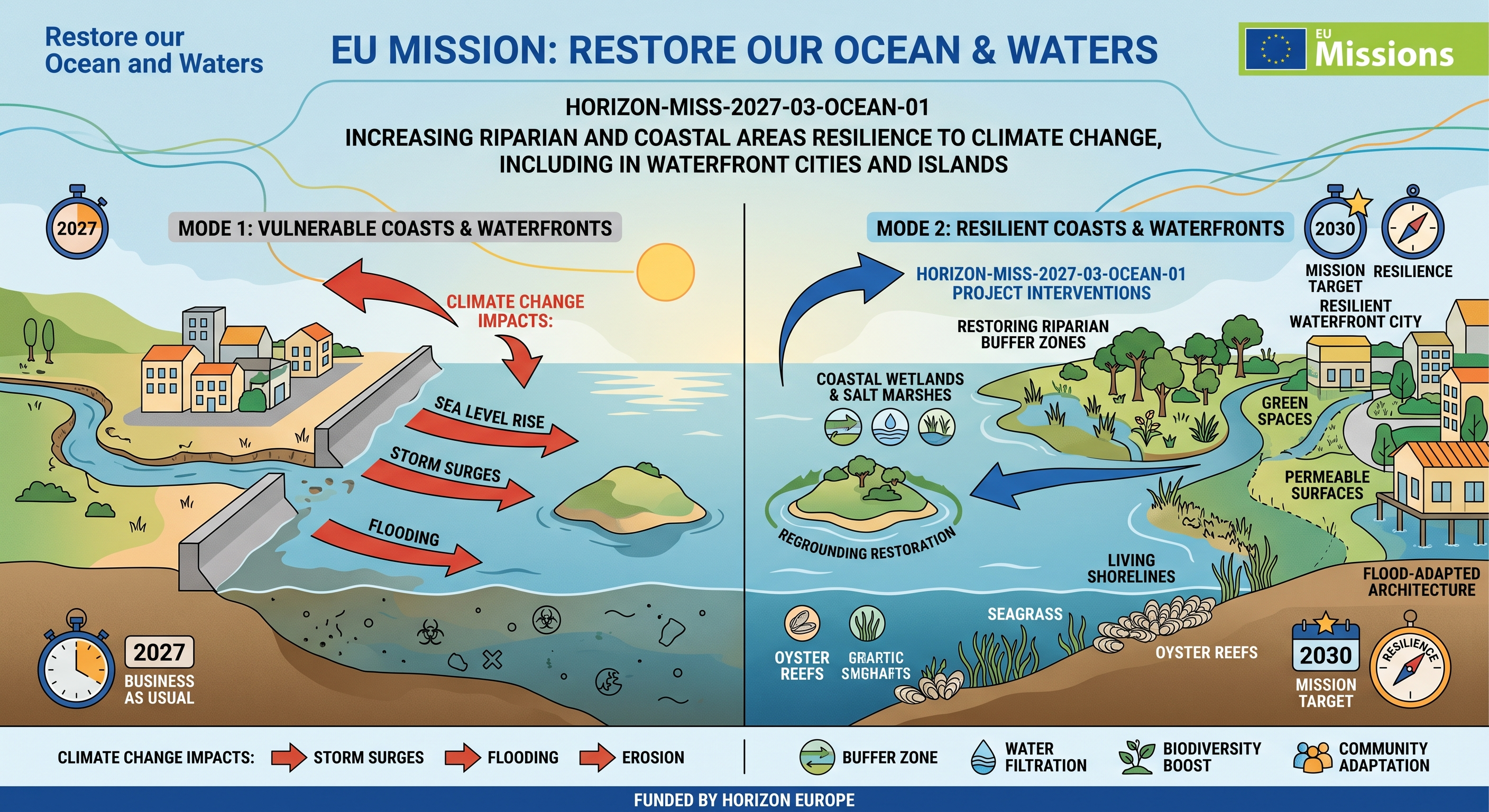
HORIZON-MISS-2027-03-OCEAN-01: Increasing riparian and coastal areas resilience to climate change, including in waterfront cities and islands
Coastlines and riverbanks are where climate change gets expensive. The Commission wants solutions that already work on one site proven in real places, with the public bodies who manage them on board. A demonstration call, not a research call. Four projects, one basin each. Full details of the Horizon Europe 2026-2027 calls are collected on our site.
Download the MIC Horizon Europe 2026/2027 Calls Calendar:
Discover more!
Administrative facts: what do we know about the HORIZON-MISS-2027-03-OCEAN-01 call?
Which call is it, and when is the opening and the deadline?
- Call name: Supporting the implementation of the Restore our Ocean and Waters Mission
- Call identifier: HORIZON-MISS-2027-03
- Destination: Restore our Ocean and Waters by 2030
- Topic: HORIZON-MISS-2027-03-OCEAN-01
- Opening: 09 February 2027
- Deadline: 21 September 2027, 17:00 Brussels time
- Type of action: Innovation Action
What about the budget and estimated size of the project?
- Total indicative budget: EUR 35.70 million
- Indicative number of projects: 4
- EU contribution per project: EUR 8.00 to 8.925 million (35.70 / 4 = 8.925)
What are the key eligibility and evaluation conditions?
- Award criteria: General Annex D, no exception
- TRL 6 to 8 by project end
- Copernicus or Galileo/EGNOS mandatory if satellite data used
- Portfolio rule: highest ranked proposal per Mission basin gets funded, thresholds permitting
- Financial support to third parties: max EUR 100,000 per regional or local authority, once each
- In-situ and marine observation data must go to EMODnet, FAIR principles apply
Scientific range: what does the Commission expect from the HORIZON-MISS-2027-03-OCEAN-01 grant?
What outcomes are expected?
Something has to work on the ground when the grant ends. Member States should walk away with affordable solutions they can copy: cleaner water, less erosion, lower flood risk, healthier shores. A publication series is not what the Commission is after.
What is within scope?
- Nature-based solutions, with a source-to-sea logic treating land and water as one system
- Erosion control, sediment transport, groundwater recharge, pollution remediation, carbon sequestration
- Sea level rise, extreme events, drought resilience, harmful algal blooms
- Socio-economic and tourism benefits from restored areas
- Living labs, citizen participation, capacity building for local authorities
One hard boundary (worth reading twice): one basin per proposal. Atlantic and Arctic, Mediterranean, Baltic and North Sea, or Danube including the Black Sea. State it on page one.
What are the specifically proposed research directions?
- At least 6 demonstrations in different area types, across 3 countries of your basin minimum
- Local-scale monitoring linked to the Digital Twin Ocean, feeding the Ocean and Water Knowledge System
- Societal acceptance tracked as a monitoring variable, not a communication afterthought
- A replication roadmap, with at least 5 associated regions engaged and supported
- Policy recommendations across water, navigation, fisheries and energy, building on Water4All, ERDF, INTERREG, LIFE and HORIZON-MISS-2025-01-CLIMA-03
Scientific strategy: how can you enhance your chances of being funded through HORIZON-MISS-2027-03-OCEAN-01?
What scientific choices matter most?
- Pick your basin first. Everything else follows.
- Make the demonstration sites real. Named locations, signed commitments from site owners, a monitoring plan for each. Vague sites sink scores.
- Design monitoring for decades, not four years. Alignment with long-term ecological observation programmes is requested, unusual in an Innovation Action.
- Show cost-effectiveness in numbers. Cost per hectare, per kilometre of bank, avoided flood damage.
- Budget the third-party support properly. Five associated regions at up to 100k each is real money and real admin (catches people off guard).
Consortium & proposal-writing plan: what works best with this type of call?
- Somewhere between twelve and eighteen partners, maybe a couple more if six sites in three countries stretch you.
- Local and regional authorities as full beneficiaries, not letters of support. Inland water bodies too, when your sites sit on rivers. The text says strongly encouraged. In practice, we read it as required.
- A workable mix: two or three research institutes, engineering and environmental SMEs, a modelling partner for the Digital Twin link, plus the site owners. An innovative SME with a sensing product gives the demonstration work packages real substance.
- Danube basin: widening-country partners are almost unavoidable, and they help.
- Write the replication section as if it were its own proposal. Much of the Impact weight sits there.
- One page per demonstration site, same template each time. Evaluators read fast.
How would microfluidics contribute to this topic?
Water quality monitoring along a coast or river still means grab samples, a cooler box, and a lab two hundred kilometres away. Results come back days later, sometimes weeks. Microfluidic sensors move the measurement to the riverbank, on a chip you hold in one hand.
- Nutrients and pollutants measured in the field: nitrate, phosphate, ammonium, heavy metals. A number in minutes instead of a number next Tuesday.
- Say you want to prove a restored wetland actually cuts nitrogen load. Put chip-based analysers upstream and downstream, run them across two seasons, and you have the before-and-after curve your Impact section needs. Cause and effect, measured.
- Harmful algal blooms. Microfluidic cytometry and molecular chips flag a bloom early, matters when the site is a tourist beach (and it often is).
- eDNA sampling with on-chip preparation for biodiversity monitoring. It scales across six sites, survey campaigns don’t.
- Low-power devices stream data continuously. The in-situ feed EMODnet wants.
Microfluidics won’t build your dykes or plant your seagrass. What it gives your consortium is hard evidence that each intervention worked, site by site, cheaply enough to instrument all six sites instead of two. Often the difference between a demonstration and a claim.
The MIC already brings its expertise in microfluidics to Horizon Europe:
H2020-NMBP-TR-IND-2020

Microfluidic platform to study the interaction of cancer cells with lymphatic tissue
H2020-LC-GD-2020-3

Toxicology assessment of pharmaceutical products on a placenta-on-chip model

FAQ - HORIZON-MISS-2027-03-OCEAN-01
What is HORIZON-MISS-2027-03-OCEAN-01 actually asking for?
Demonstrations, in real riparian and coastal areas, of solutions that make those areas more resilient to climate change. Waterfront cities and islands are named explicitly. The topic sits under the Restore our Ocean and Waters Mission and runs as an Innovation Action, so TRL 6 to 8 is the expected level.
When does the call open and when is the deadline?
Opening on 09 February 2027, deadline 21 September 2027 at 17:00 Brussels time. Keep in mind the Director-General may shift the opening by up to a month and delay the deadline by up to two months. Plan for the published date anyway.
How much funding is available, and for how many projects?
EUR 35.70 million for the topic, split across 4 projects. The Commission expects each grant to sit between EUR 8.00 and 8.925 million. Asking for a different amount is allowed, but you would need a good reason to do it.
Check the Funding and Tenders Portal for more information.
Which sea basins are covered, and can we address more than one?
Four: Atlantic and Arctic, Mediterranean, Baltic and North Sea, and Danube including the Black Sea. One basin per proposal, no exceptions. Because the portfolio rule funds the top-ranked proposal in each basin, the competition you face is inside your basin, not across Europe.
How many demonstration sites do we need?
At least 6, in different types of riparian and coastal areas, spread over at least 3 countries of your basin. Real sites with real owners. This is the part of the proposal evaluators check first, in our experience.
What are these 'associated regions' and the third party funding?
You have to work with at least 5 regions that are not project beneficiaries, share results with them, and help them replicate. To support that, you may pass on grants of up to EUR 100,000 to local or regional public authorities, once each. Budget the management effort, not just the money.
Do public authorities really have to be partners?
The work programme says their participation is strongly encouraged. Regional and local authorities, plus inland water management bodies. Read as required if you want a competitive proposal. Letters of support will not carry the same weight.
What data and satellite obligations apply?
If you use satellite earth observation or positioning data, Copernicus and Galileo/EGNOS are mandatory (other sources may be added). In-situ data and marine observations must be published openly through EMODnet, following FAIR principles. Set up the data pipeline early, not in the final year.
Where does microfluidics fit in a coastal resilience project?
Mostly in the monitoring work packages. Chip-based analysers give nutrient, pollutant and biodiversity readings on site, in minutes, at a cost per measurement that lets you instrument all six demonstration sites rather than a token two. That is what turns a claimed improvement into a measured one.
What usually weakens proposals on this kind of Mission call?
Sites described in general terms. Replication plans written as an afterthought. Monitoring that stops when the grant stops. And consortia where the public authorities appear only in the dissemination work package. Fix those four and you are already ahead of most of the field.