Tips & Tricks for a successful HORIZON-CL3-2026-01-DRS-02 proposal
Opening
06 May 2026
Deadline
Keywords
Cluster 3 Civil Security
multi-hazard risk assessment
cascading disaster impacts
digital twins for resilience
AI-driven forecasting
disaster risk management
Your microfluidic SME partner for Horizon Europe
We take care of microfluidic engineering, work on valorization and optimize the proposal with you
HORIZON-CL3-2026-01-DRS-02: Multi-hazard approach and cumulative / cascading impacts
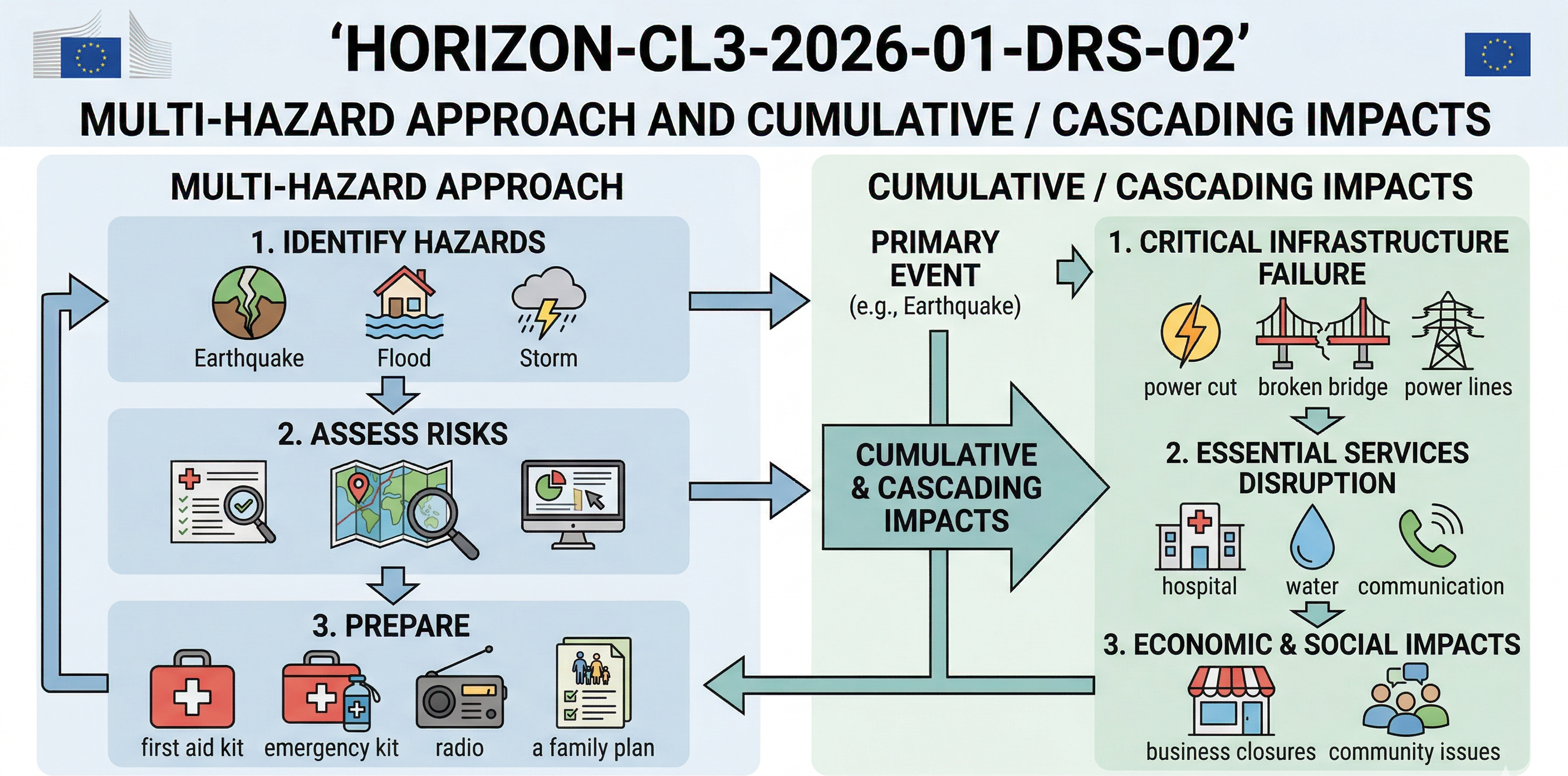
The Commission wants next-generation predictive tools capable of handling what single-hazard models can’t: domino effects like a heatwave leading to a landslide leading to infrastructure damage, etc. This call is about developing tools to predict these, how damage adds up, and how this information can be used in actual civil protection decisions. Models published in a repository aren’t what they’re funding here.
Download the MIC Horizon Europe 2026/2027 Calls Calendar:
Discover more!
Administrative facts: what do we know about the HORIZON-CL3-2026-01-DRS-02 call?
Which call is it, and when is the opening and the deadline?
- Call name: Civil Security for Society 2026
- Call identifier: HORIZON-CL3-2026-01
- Destination: Disaster-Resilient Society for Europe
- Topic: HORIZON-CL3-2026-01-DRS-02: Multi-hazard approach and cumulative / cascading impacts
- Opening date: 06 May 2026
- Deadline: 05 November 2026 (17:00:00 Brussels time)
- Type of action: Innovation Action (IA)
What about the budget and estimated size of the project?
- Overall budget for this topic: EUR 8.00 million
- Number of projects expected to be funded: 2
- Budget per project: around EUR 4.00 million
What are the key eligibility and evaluation conditions?
- Lump sum funding model applies
- TRL target: activities are expected to reach TRL 6 by end of project
- Mandatory consortium composition: at least 2 national authorities in charge of disaster risk or crisis communication, plus 2 local or regional authorities in charge of disaster response, from at least 3 different EU Member States or Associated Countries
- The practitioner’s table must be completed in the application form
- Subject to restrictions for the protection of European communication networks
- Relevant international organisations headquartered in a Member State or Associated Country are exceptionally eligible
- Use of Copernicus and/or Galileo/EGNOS is mandatory if satellite-based data is used
- Security sensitive: some activities may involve classified background or produce EUCI/SEN results
- IP transfer restriction: the granting authority may object to transfer of ownership or exclusive licensing up to 4 years after end of action
- Coordination expected with projects funded under HORIZON-CL3-2025-01-INFRA-01, INFRA-02, and HORIZON-CL3-2024-DRS-01-04
Scientific range: what does the Commission expect from the HORIZON-CL3-2026-01-DRS-02 grant?
What outcomes are expected?
The Commission is seeking integrated systems that bring together the single-hazard models into a multi-hazard predictive system, with validated predictive capabilities for cascading and cumulative effects for meteorological, geophysical, and technological hazards. They are also seeking a full range of risk and resilience measures that include physical, economic, and social dimensions. Finally, they are seeking improved interoperability of data, improved sharing of knowledge gained from previous emergencies, and improved tools to interpret all this into a decision-support tool for prevention and adaptation.
What is within scope?
- Use of AI-based analytics and remote sensing for real-time multi-hazard forecasting
- Platform interoperability and data sharing among local, national, and global hazard monitoring infrastructures
- Interoperability among regional and national hazard warning infrastructures (the Commission cites, for example, landslides caused by extreme weather conditions and cumulative earthquake aftershock damage)
- Development of loss estimation models, including cascading long-term effects on infrastructure, built environment, and communities
- Use of digital twins for risk modeling and risk modeling-based stress testing of lifeline infrastructures (such as energy, water, transportation, and telecommunication networks)
- Use of AI-based decision support tools, including consideration of existing biases
- Use of citizen-generated content from social media and other decentralized platforms for early warning and situational awareness
- Leveraging existing infrastructures, such as: Copernicus Emergency Management Service, Destination Earth Platform, Risk Data Hub
- FAIR data management principles are applicable, and alignment with European Research Infrastructures and relevant Data Spaces is encouraged
The “out of scope” section does not clearly define what is and what isn’t in scope, except by implication, suggesting that any answer without a degree of operational testing and/or inability to interface with existing infrastructures will not score well.
What are the specifically proposed research directions?
- Integrating single-hazard models into the next generation of predictive models that can perform compound scenario analysis
- Enhancing the understanding of the interaction and compounding effects of meteorological, geophysical, and technological hazards
- Developing holistic risk and resilience metrics that move beyond physical damage to include economic and social consequences
- Advancing loss estimation techniques for cascading effects on infrastructure interdependencies
- Creating early-to-action pipelines from warnings to action, with international knowledge and data sharing
- Incorporating the effects of climate change, environmental degradation, and social factors (gender, age, and disability) into all levels of the risk assessment
Scientific strategy: how can you enhance your chances of being funded through HORIZON-CL3-2026-01-DRS-02?
What scientific choices matter most?
- Integration, not a laundry list of hazard models working side by side. The Commission wants to see a platform where the results are integrated into each other, not separate work streams that happen to share a logo.
- Demonstrate operational validation. This is an Innovation Action, TRL 6. You need to show proof of concept, not just write a paper about it.
- Use Copernicus, Destination Earth, or the Risk Data Hub as a starting point, rather than starting from scratch. The evaluators will be checking for awareness of what is already available.
- The social aspects. We see a lot of applications for this area that only go as far as the engineering level. Gender, age, disability, and community vulnerability are all included in the work program and probably in the evaluation criteria, too.
- AI and digital twins need to be for decision-making. Avoid tech for tech’s sake. The work program includes biases in AI systems, and that means you need to address that too.
- Scope: Cross-border. The mandatory practitioner requirement from at least 3 Member States is already pushing you this way. Go for it, especially for shared infrastructure corridors.
Consortium & proposal-writing plan: what works best with this type of call?
- Somewhere between eight and twelve partners feels just right for a EUR 4 million IA, maybe a couple more if the practitioner needs to justify it.
- The mandatory composition cannot be negotiated: 2 national disaster risk/crisis communication authorities, 2 local/regional disaster response authorities, from 3+ countries. First, build around this skeleton.
- Research organizations with multi-hazard modeling capabilities form the technical backbone. At least two will be required, with overlapping expertise in different domains of hazards.
- An innovative SME with expertise in AI analytics, digital twin technologies, or sensors will benefit both the innovation part and the exploitation plan (check this one out early in your consortium building process)
- If satellite data is involved, then Copernicus/Galileo has to be used. A partner with experience in these technologies should be part of your consortium.
- The plan for practitioner involvement should be developed early. The table required in the application form under this part is quite detailed and catches unaware consortia.
- With the lump sum model, keep your work package structure clean and cost allocation per partner transparent from the beginning. Lump sum applications are rejected more often than one would think, mainly because of budget clarity issues.
How would microfluidics contribute to this topic?
In traditional environmental monitoring for multi-hazard scenarios, monitoring is done using stationary monitoring equipment and laboratory analysis of samples. These are good for monitoring but are limited when quick on-site monitoring of multiple types of contaminants is needed in cascading events. Microfluidic sensor platforms, on the other hand, have a different strategy. They integrate sample analysis, detection, and signal processing into one small chip.
- Suppose, for example, that a flood event triggers an industrial spill upstream of the water supply. You need to know quickly if heavy metals or organics are entering the water supply. A microfluidic sensor for water quality will provide an answer on-site without sending samples to a laboratory. This is important when emergency management officials are deciding whether to activate the shutdown of the supply.
- Your proposal involves using digital twins and real-time data feeds. Microfluidic sensor arrays are useful in this regard. These sensor arrays can connect to digital twins and provide continuous readings of chemicals and biologicals from distributed nodes. Same chip, different location, same result.
- In terms of soil and sediment monitoring following a NaTech event, a microfluidic device can perform a parallel screening of multiple contaminants, a capability not currently possible with traditional field kits, which perform one analyte at a time. The parallel screening approach directly maps onto the multi-hazard approach to risk assessment, which your call asks us to do.
- In terms of air quality monitoring during compound hazards such as a combination of wildfire smoke and industrial emissions, a microfluidic gas sensor, which can perform a combined detection of particles and volatile organic compounds, would be valuable.
While microfluidics does not replace the large-scale modeling infrastructure your proposal outlines, we believe it does provide your consortium with a deployable sensing layer, providing validated field data to your models, and this is what your evaluators, in a TRL 6 Innovation Action, want to see.
The MIC already brings its expertise in microfluidics to Horizon Europe:
H2020-NMBP-TR-IND-2020

Microfluidic platform to study the interaction of cancer cells with lymphatic tissue
H2020-LC-GD-2020-3
Toxicology assessment of pharmaceutical products on a placenta-on-chip model

FAQ – HORIZON-CL3-2026-01-DRS-02
Who is the target audience of the HORIZON-CL3-2026-01-DRS-02 call?
The intended target of this call are civil protection agencies, emergency responders, infrastructure operator, local, national, and cross-border policy makers engaged in disaster risk management. The call identifies the need of the involvement of the national authorities in charge of the disaster risk or crisis communication and the local or regional authorities in charge of disaster response.
What type of consortium is best suited for HORIZON-CL3-2026-01-DRS-02?
The most robust consortia will be those involving a combination of research organisations and multi-hazard modeling knowledge, national civil protection bodies, and local/regional disaster response bodies, and at least one innovative SME with AI analytics, digital twins, or sensor technology capabilities. Experience in Copernicus or Destination Earth systems is a plus. Target a number of eight to twelve partners representing at least 3 EU Member States or Associated Countries. Check the Funding and Tenders Portal for more information.
What hazard types should be covered in the proposal?
The call directly deals with meteorological, geophysical and technological hazards and their interactions. Examples are heatwaves, floods, droughts, landslides, heavy rainfall, and earthquake aftershocks. It is concerned with compound and cascading situations, rather than single-hazard situations. The proposals need to consider the trends of climate change and environmental degradation as factors of changing risk as well.
What are the key technological deliverables expected?
The Commission anticipates the existence of integrated forecasts models whereby single-hazard systems are integrated into multi-hazard prediction platforms. These must include real-time information, artificial intelligence (AI)-based analytics, and remote sensing. Other deliverables are digital twins to support risk modelling, stress testing of lifeline services using scenarios, holistic risk and resilience measures, and enhanced interoperability of hazard warning systems on regional and national levels.
How should social vulnerability be addressed in the proposal?
This is not a call that is social vulnerability optional. The work programme clearly requests a holistic approach, which takes into consideration gender, age, disabilities and other social factors. These dimensions should be incorporated into the risk assessment methodology, rather than being considered as a work package or an after-thought. The indicators of economic and social impacts should be placed next to the indicators of physical damages in the resilience framework.
How can microfluidics contribute to a multi-hazard proposal?
Microfluidic sensor platforms are capable of giving real-time, on-site contaminant detection during cascading events, feeding proven field data into the digital twins and real-time forecasting systems that the call needs. Its use is in water quality following industrial spills that occur due to floods, screening of soil contaminants simultaneously in parallel with NaTech events, and air quality during compound disasters. This sensing feature enhances the validity aspect of operations that TRL 6 assessors consider.
What role do practitioners play in this call?
This call involves practitioners. The consortium should consist of 2 national authorities responsible in disaster risk or crisis communication and 2 local or regional authorities responsible in disaster response, in at least 3 different countries. The application form should be filled with information on the practitioner table. They must not just be involved in the process of validation and testing of the tools developed as advisors.
What is in scope and what is not?
In scope: Multi-hazard prediction through AI, platform interoperability, digital twins, loss estimation models, citizen-generated early warning data, stress testing critical infrastructure, and overall risk metrics. The excluded items are not explicitly mentioned in the call, but the wording very much implies that the scope will not be high by proposing purely theoretical modelling with no operational validation, the tools that do not support the integration with the existing systems such as Copernicus or the Risk Data Hub, and the proposals that lack cross-border dimensions.
What common mistakes should be avoided in the proposal?
Typical traps are: constructing a system of parallel, but not actually integrated, hazard models; omitting consideration of the social vulnerability aspects explicitly mandated by the work programme; under-budgeting the lump sum budget planning requirement; and not planning early enough the detailed practitioner table needed in the application form.
How should work packages be structured for a lump sum IA?
Budget clarity is all there is, in the case of a lump sum Innovation Action. Every work package must be with a well-defined scope, deliverables, and the cost per partner. Do not have overlapping activities within work packages. The cost justification should be made open-ended initially, as lump sum proposals are analysed on the basis of consistency and plausibility of the budget. Maintain structure: management WP, requirements and stakeholder WP, functional-based technical development WPs, a validation WP with real practitioners, and dissemination and exploitation WP.