Tips & Tricks for a successful HORIZON-CID-2027-01-02 proposal
Opening
12 January 2027
Deadline
Keywords
Horizontal Activities
TRL 6-8
renewable energy
Clean Industrial Deal
market readiness
Climate action
clean tech demonstrator
energy storage and CCU
Your microfluidic SME partner for Horizon Europe
We take care of microfluidic engineering, work on valorization and optimize the proposal with you
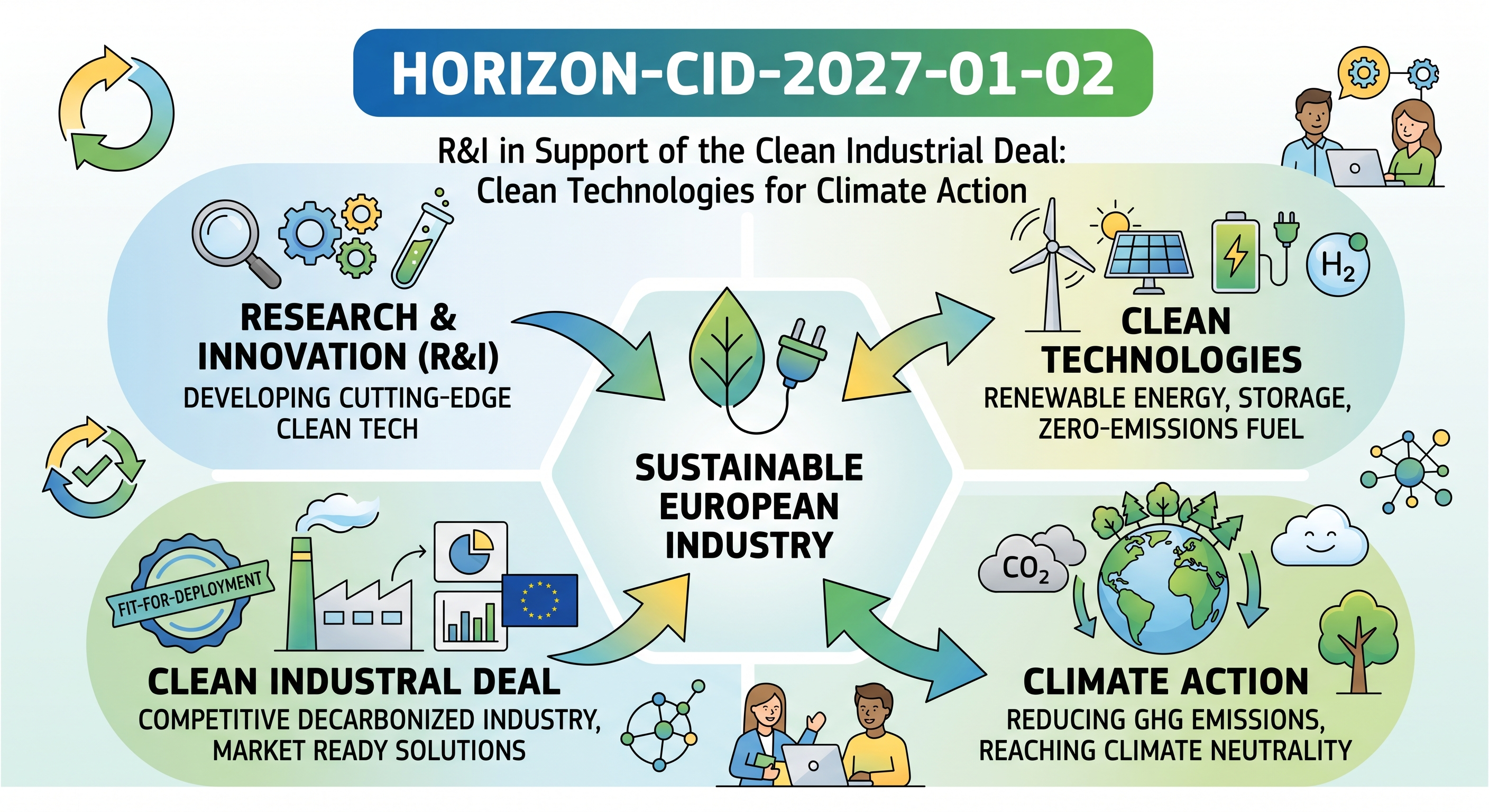
HORIZON-CID-2027-01-02: R&I in Support of the Clean Industrial Deal: Clean Technologies for Climate Action
One of two open topics in the Clean Industrial Deal flagship call. The Commission wants clean tech demonstrators finishing at TRL 8 with permits and a deployment partner secured. Think Innovation Fund feeder, not research grant. A nice pilot with no buyer is not what they are after.
Download the MIC Horizon Europe 2026/2027 Calls Calendar:
Discover more!
Administrative facts: what do we know about the HORIZON-CID-2027-01-02 call?
Which call is it, and when is the opening and the deadline?
- Call name: R&I in Support of the Clean Industrial Deal
- Call identifier: HORIZON-CID-2027-01
- Destination: horizontal call, Work Programme part 14
- Topic: HORIZON-CID-2027-01-02, Clean Technologies for Climate Action
- Opening date: 12 January 2027
- Deadline: 15 September 2027
- Type of action: Innovation Action (IA)
What about the budget and estimated size of the project?
- Overall topic budget: EUR 140 million
- Number of projects: 8 indicative
- Budget per project: EUR 17.5 million on average (15 to 25 expected)
- TRL: from 6 to 8
What are the key eligibility and evaluation conditions?
- Thresholds: General Annex D, no topic-specific exception
- Page limit: 60 pages, business plan and market-readiness strategy included
- Portfolio rule: top proposal per technology area funded if above thresholds
- Consortium: industry driven, indicatively ten participants maximum
- Satellite data, if used: Copernicus and/or Galileo/EGNOS
- NZIA sourcing clause for components with over 50% third-country dependency
- Commission may object to ownership transfer or exclusive licensing, up to 4 years post-project
- No JRC or clustering requirement; coordination with the 2026 twin topic encouraged
Scientific range: what does the Commission expect from the HORIZON-CID-2027-01-02 grant?
What outcomes are expected?
Two outcomes, both mandatory. First, a clean tech solution that measurably raises its circular material use rate and cuts the levelised cost of energy for end users. Baseline documented, Net-Zero Industry Act manufacturing goals served. Second, the same solution at TRL 8, ready to plug into a factory or a fleet.
What is within scope?
One main area, combinations allowed:
- Integrated net-zero emissions energy systems, grids included
- Enhanced zero-emission power technologies, renewable electricity and heat
- Storage and fuels: batteries, renewable hydrogen, advanced biofuels, synthetic fuels, plus CCU
- Network step-changes (electricity, heat, gas, hydrogen, CO2), advanced materials and recycling if tied to your value chain
Out of scope in practice: anything harming biodiversity, or hydrogen work the Clean Hydrogen JU covers.
What are the specifically proposed research directions?
The wording is deliberately open and industry led. Our reading:
- Electrification of end-use sectors, direct or via intermediate technologies. The one explicit priority.
- Direct or indirect integration, straight to an industrial user or via the grid. Both count once GHG and competitiveness effects are quantified.
- A full value chain, not a component. Reusing earlier EU project results earns cheap points (often forgotten).
Scientific strategy: how can you enhance your chances of being funded through HORIZON-CID-2027-01-02?
What scientific choices matter most?
- Pick one main area and say so on page one. The portfolio rule funds the top proposal per area, so leading a quiet area beats third in a crowded one.
- Build the plan around the go/no-go moment. Engineering, techno-economic assessment, permits and final business plan all come before demonstration (permits are where we see timelines slip).
- Quantify LCOE and circularity baselines. Vague “significant improvement” claims won’t survive the impact criterion.
- Show the NZIA sourcing plan component by component.
- Don’t oversell TRL 6. Really at TRL 5? Say so, explain how year one closes the gap.
Consortium & proposal-writing plan: what works best with this type of call?
- Small and justified. Ten participants maximum (and the work programme means it). Six to nine is probably comfortable, a couple more if the value chain is long.
- Industry in the driving seat. Coordinator, or at least technical lead, from a supplier or energy user. Universities and RTOs bring validation, not the steering wheel.
- Cover the chain: supplier, end user, integrator or utility, and the deployment leader. Name that last one.
- An innovative SME often brings the component nobody else delivers fast.
- Five listed impacts. Pick two, make them measurable. Ticking all five reads as noise.
- Business plan as core content, yearly update deliverable included. The extra pages exist for this.
How would microfluidics contribute to this topic?
Big demonstrators run on big equipment, and fine-grained measurement gets lost along the way. A pilot electrolyser tells you it works, rarely why it drifts. Microfluidic tools work at the scale where electrolytes and catalysts actually behave. That detail arrives before the go/no-go decision.
- Say your hydrogen or CCU chain hinges on a new catalyst. Droplet microfluidics makes and tests hundreds of formulations in a week, same conditions every time, before any tonne-scale batch. You learn early which one deserves the demonstrator.
- Microchannel engineering for battery cooling or electrolyser flow fields. Better heat removal, better bubble removal, lower pressure drop (not glamorous, but it shows in your LCOE figure).
- In-line sensing during demonstration. Electrolyte health, feed-water purity, CO2 conversion yield, gas purity. Chip-based sensors run continuously and give the techno-economic assessment real numbers, not lab averages.
Let us be clear. Microfluidics won’t be the headline of a EUR 20 million demonstrator. It de-risks the engineering phase and puts real numbers in your techno-economic assessment. An SME bringing that capability also fills the SME slot the work programme keeps mentioning. Electrochemistry or thermal management in your chain? Worth a conversation.
The MIC already brings its expertise in microfluidics to Horizon Europe:
H2020-NMBP-TR-IND-2020

Microfluidic platform to study the interaction of cancer cells with lymphatic tissue
H2020-LC-GD-2020-3
Toxicology assessment of pharmaceutical products on a placenta-on-chip model

FAQ – HORIZON-CID-2027-01-02
What is HORIZON-CID-2027-01-02 about, in one sentence?
It funds industry-led Innovation Actions that take a clean tech solution from TRL 6 to TRL 8 and leave it ready for deployment, business plan and market-readiness strategy attached. The topic sits in the Clean Industrial Deal flagship call of the Horizontal Activities work programme, not in a thematic cluster.
When does the call open and close?
Opening on 12 January 2027, deadline on 15 September 2027 at 17:00 Brussels time. The Director-General may move the opening by up to one month and the deadline by up to two months, so check the Funding and Tenders portal before you plan your writing calendar.
How much funding is available per project?
The topic carries EUR 140 million, with around 8 projects expected. The Commission estimates an EU contribution of EUR 15 to 25 million per project. Asking for a different amount is allowed, but you will need to explain why.
What are the three technology areas, and do I have to pick one?
Integrated net-zero emissions energy systems. Enhanced zero-emission power technologies. Storage technologies plus renewable fuels and CCU. You must name one main area in the proposal, and you may combine areas in an integrated way. That main area is what the portfolio rule uses.
Check the Funding and Tenders Portal for more information.
What does the go/no-go moment mean in practice?
Before contracting and demonstration start, the project must deliver detailed engineering plans, a techno-economic assessment, all permits for the demonstrator and a complete business plan, and it must name the industrial partner leading deployment. If those are missing, the demonstration phase does not proceed. Build your Gantt chart around this point.
How large should the consortium be?
The work programme says indicatively not more than ten participants, industry driven, with a size justified by the value chain covered. You need clean tech suppliers, energy users and whichever other stakeholders make the business case hold. SME participation is explicitly encouraged.
Is there a special page limit for this topic?
Yes. Part B may run to 60 pages instead of the standard limit, because the business plan and market-readiness strategy are part of the proposal. Use the extra space for market figures and financial projections, not for longer prose.
What is the NZIA sourcing clause?
For each main component where more than 50% of the Union’s supply comes from a single third country, at least 50% of that component should be sourced in the EU or in Horizon Europe Associated Countries. A lower share is possible with justification, if a strong dependency would otherwise compromise the project.
How does the Commission select projects across the three areas?
Ranking comes first, then a portfolio adjustment. At least the highest ranked proposal in each of the three areas is funded, provided it passes all thresholds. Choosing your main area is therefore a strategic decision, not a formality.
Where does microfluidics fit in a clean tech demonstrator?
Not as the headline. As a support capability: fast catalyst and electrolyte screening before the go/no-go moment, microchannel cooling or flow-field design, in-line chip-based sensors during demonstration, and the documentation those parts need in the market-readiness strategy. An SME like MIC can carry those tasks in a compact work package.