Research and Innovation Actions under Horizon Europe
Author
Christa Ivanova, PhD
Publication Date
September 14, 2021
Keywords
Horizon Europe Pillar 2 RIA
Prototype development
Health, Environment, Energy, Food & Bioeconomy calls
Early‑stage R&D
collaborative research consortia
Your microfluidic SME partner for Horizon Europe
We take care of microfluidic engineering, work on valorization and optimize the proposal with you
Horizon Europe in brief
- The EU’s key funding program until 2027
- Supports Research and Innovation with a budget of €95.5 billion
- Implementation:
- Marie Skłodowska-Curie actions and research infrastructures under pillar 1
- All clusters under pillar 2
- European innovation ecosystems under pillar 3
Pillar 2: Health, Environment, Energy and Food
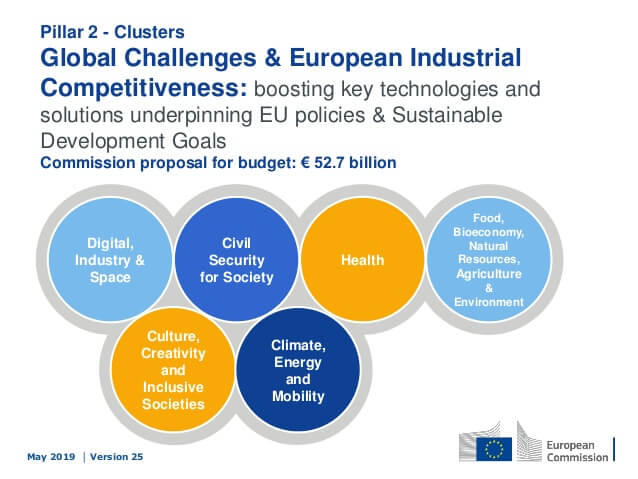
The Horizon Europe Work program is divided into 3 main pillars, where pillar 2 focuses on Research and Innovation actions similar to the RIA and IA actions known under H2020. Pillar 2 is divided into 6 clusters:
- Health
- Culture, creativity, and inclusive society
- Civil Security for society
- Digital, industry, and space
- Climate, Energy, and mobility
- Food, bioeconomy, natural resources, agriculture, and environment
Each cluster focuses on a specific global challenge and offers several calls to which researchers can submit project proposals for funding. The general submission rules are similar to the Horizon 2020 program.
Focus on Health and Sustainability
As mentioned above, pillar 2 will be implemented through several clusters that tackle global challenges identified by the European Union and intends to strenghten the European Industrial Competitiveness. We identified 2 clusters as specifically interesting for researchers working in biomedecine, biotechnology, innovation and green chemistry: Cluster 1 focused on Health and Cluster 6, focused on Food, Bioeconomy, Natural Ressources, Agriculture and Environment.
The main deadlines to keep in mind are: Cluster 1 – September 21 and Cluster 6 – October 6.
Why the MIC is the ideal partner for your Research and Innovation project under Horizon Europe
The Microfluidics Innovation Center participates in collaborative research projects by offering expertise in microfluidics – an innovative technology that is currently more and more in demand since it facilitates and accelerates experiments that require precise flow control.
Classical experiments can be scaled up, and novel concepts and models can be developed, including organ-on-chip assays, nanoparticle fabrication and application, high-speed drug testing, automated cell culture, and many more. You can have a look at our different project collaborations if you want to learn more about our activity.
In addition, having extensive experience with submitting research proposals, we are prepared for all administrative steps and procedures.
Specific objectives
- Knowledge transfer and innovation
- Support research to produce European innovations
- Disease prevention
- Viable food production
- Sustainable management of natural ressources and climate action
Where the MIC can help
- Novel in-vitro models based on cell culture
- Vaccines and diagnostics for animal disease
- Identification of biomarkers
- Modeling host-pathogen interactions
- Personalized medicine
- Next-generation advanced therapies
- Green pharmaceuticals
- Environmental sampling and analyses
Want more? Visit our page summarizing the novelties in Horizon Europe implementation (grant management, proposal writing and evaluation, dissemination strategy…).
Interested in MSCA (ITN, IF, RISE…)? Check out the differences between H2020 and Horizon Europe!
Check the Horizon Europe tips and tricks
FAQ – Research and Innovation Actions under Horizon Europe
1) What does Research and Innovation Actions under Horizon Europe actually entail?
In Horizon Europe, collaborative research in areas such as health, environment, energy, or food falls in Pillar 2, which is designed around Research and Innovation Actions (RIAs) and Innovation Actions (IAs). Pillar 2 is divided into six “clusters” Health; Culture, Creativity and Inclusive Society; Civil Security; Digital, Industry and Space; Climate, Energy and Mobility; and Food, Bioeconomy, Natural Resources, Agriculture and Environment. Each cluster addresses a global issue with specific calls in which consortia may submit RIA or IA proposals.
2) What in the practice of my lab work do these Pillar 2 clusters relate to?
You can drop nearly anywhere in either Cluster 1 (Health) or Cluster 6 (Food, Bioeconomy, Natural Resources, Agriculture, and Environment) as long as you work in biomedicine, biotechnology, microfluidics, or green chemistry. Such clusters contain calls on subjects like advanced diagnostics, personalised medicine, sustainable food systems, bio-based processes, environmental monitoring and climate-resilient agriculture, which is precisely the type of area where microfluidic technologies can help expedite experiments, cut down on reagent consumption and allow new in-vitro models.
3) How does a research action differ in terms of Horizon Europe (an innovation action)?
-A Research and Innovation Action (RIA) is an activity aimed at creating new knowledge, demonstrations of concept and initial prototypes, typically between TRL 2 -3 and TRL 4-5.
-An Innovation Action (IA) is more deployed and more scaled, typically TRL 5-6 or more to TRL 7-8, with experiments in operational settings and a path to market.
They both share being Research and Innovation Actions in the broad meaning of the term that is used on the MIC page, except that RIAs are more science-oriented and IAs more market-oriented. It is natural in most areas to plan a path in which one or more IAs succeed a successful RIA.
4) What is the reason why the MIC pays so much attention to Cluster 1 (Health) and Cluster 6 (Food & Environment)?
Due to the fact that these two clusters lie at the very intersection of health, sustainability and industrial competitiveness, and microfluidics is a enabling technology that has significant power. Cluster 1 includes such topics as novel in-vitro models of disease, biomarker discovery, next-generation therapies and diagnostics; Cluster 6 includes viable food production, sustainable management of natural resources, environmental monitoring and climate action. They are together in the majority of applications in which you may require organ-on-chip systems, high-throughput droplet platforms, microfluidic environmental samplers or lab-on-chip diagnostics.
5) What is the actual way microfluidics can be used to reinforce a Horizon Europe RIA or IA proposal?
-Scaling classical experiments, parallelising assays, and automating flow control.
-Empower new ideas and designs, including organ-on-chip, nanoparticle production, ultra-rapid testing of drugs, or sophisticated cell-based tests.
-Minimize the sample and reagent usage and maximize control over gradients, shear and residence times.
In Horizon Europe proposal, this would translate into more ambitious goals (e.g. realistic human-relevant models and not oversimplified in-vitro tests) and more Implementation (credible and automated experimental pipelines versus hand-waving).
6) What is it specifically that the Microfluidics Innovation Center offers to a RIA/IA consortium?
MIC enters as a specialist in microfluidic engineering. Concretely, that means:
-Bringing into being chips and flow systems custom-designed to your biology or chemistry.
-Combining pumps, sensors, valves, and automation to transform protocols into strong tools, not sketches.
-Aiding knowledge exchange and innovation, from prototyping to pre-industrial demonstrators.
MIC also has extensive experience in submission and management of EU proposals and therefore it can manage the administrative aspect as you concentrate on the science.
7) What kind of Horizon Europe goals do you think MIC has the most expertise in?
The article singles out a list of these recurring goals in which microfluidics fits well:
-Sharing knowledge and innovation, particularly in biotechnology and diagnostics.
-Preventive disease and improved health surveillance using in-vitro models, biomarker tests, and lab-on-chip systems.
-Food growth and profitable processing through enhanced microreactors and controlled emulsions.
-Ecological balance of the natural resources and climate change, such as environmental sampling and analysis.
MIC can, in all these ways, serve as the driver that brings the complex experimental ideas into technological reality.
8) How can MIC be practically used in the scope of a Health/Food/Environment project?
The MIC page enumerates some areas where it can expeditiously incorporate its current know-how:
-In-vitro models (on a cell culture basis), novel, organ-on-chip (or disease-on-chip).
-Animal disease vaccines and diagnostics based on microfluidic microassays and sample-to-answer systems.
-Identification of the biomarkers and high-throughput microfluidic screening.
-The interactions between hosts and pathogens can be modeled under microenvironment conditions.
-Individualised medicine processes using patient-specific chips and outputs.
-Next-generation innovative therapies, e.g., microfluidic cell processing or nanoparticle formulation.
-Flow syntheses, green pharmaceuticals, and environmentally benign syntheses.
-Environmental samples and analyses, miniaturised samplers and sensors.
9) I am creating my first Horizon Europe consortium. So why should an SME, such as MIC, be included?
Evaluators believe it is important to reflect that a project is not only scientifically interesting, but also implementable and scalable. Specialised SME like MIC means that:
-People who do this daily will design and construct microfluidic rigs and prototypes.
-The idea of technology transfer and valorisation is no longer pushed into the distant future among the vague partners.
-The consortium already has one of the industrial actors that may assist in commercializing the results into goods or services or subsequent innovation activities.
In numerous Horizon calls, consortia, such as MIC, have noticed that a combination of excellent science and excellent microfluidic engineering yields proposal success rates well above the average EU figures.
10) What do I do to determine whether my idea is RIA-material and whether MIC is the appropriate partner to be approached?
You consider yourself in the RIA territory when you want to:
-Prove a new concept in health, environment, food, or bioeconomy,
-Design an in-vitro model, diagnostic, microreactor, sensing system, never tried before.
-And you want to have flow control customised, miniaturised, or automated to get the idea realistic.
When your work may call on a finer level of micro-scale control of fluids, cells, reagents or environmental samples, then chances are high that you are in the comfort zone of MIC. In that regard, preliminary discussions can serve to narrow the objectives, select the appropriate cluster and design work packages that meet the expectations of Horizon Europe regarding Research and Innovation Actions.