
Lump sum funding for beginners
Author
Marlene Kopf, PhD
Publication Date
May 30, 2024
Keywords
Lump sum grants EU
Budget planning
Subcontracting
Deliverables-based funding
Redistribution of funds
Budget autonomy
Reduced administrative burden
grant simplification
No audits
No cost reporting
Your microfluidic SME partner for Horizon Europe
We take care of microfluidic engineering, work on valorization and optimize the proposal with you
Lump sum funding – a buzzword that is cropping up more and more frequently in Horizon Europe. Wondering what it’s all about?
Here are the most important facts.

Which costs are eligible for lump sum funding in Horizon Europe?

Actual cost accounting, the most frequently used method in Horizon Europe to date, has several prerequisites:
- Basic principle: profitability and project necessity have occurred and are verifiable (proof: accounting or project result)
- The costs incurred during the project term
- The expenses were planned in the application and necessary for the project implementation
- The costs are in accordance with national law
No differences to the "actual cost-based" model regarding these important aspects:

- The rules on the composition of the consortium remain the same as before.
- The funding rate (depends on the measure and type of institution).
- Continued application of general funding principles: Transparency, co-financing, no profit-making, no cumulation ban.
- Presentation of objectives, methods, and expected results is required as in all applications.
- Evaluation: The procedure and requirements are the same.
Lump sum funding application: How does it work?

- The cost reimbursement model is specified in the call for applications and cannot be freely chosen by the applicants.
- A standard form for applications has to be used (more space: 50 instead of 45 pages).
- New: For Horizon Europe lump sum funding, a dedicated Excel spreadsheet for detailed budget planning should be filled in for each project partner.
Download the MIC Horizon Europe 2026/2027 Calls Calendar:
What are the general funding principles in Horizon Europe?

- Transparency: the amount of the costs must be comprehensible.
- Co-financing requirement: the institution’s own contribution (e.g. for equipment, indirect costs).
- Prohibition of profit-making.
- No cumulation ban: Resources from Horizon Europe can/should be combined with other EU funding, such as structural funds and general funding principles.
- These principles are valid for lump sum funding as well.
Why is the EU Commission increasingly using lump sum for funding?

- Flat-rate subsidies reduce the risk of incorrect billing; this is a great opportunity for newcomers to apply for Horizon Europe funding.
- More financial planning security for beneficiaries.
- There is great potential for simplification in project management, e.g., by eliminating financial reports.
- Most importantly, with lump sum funding in Horizon Europe, the focus shifts from financial management to project content.
The type of tender determines the grant model
- Actual costs funding scheme:
- Reimbursement is based on actual costs incurred.
- The exact amount of costs must be documented.
- The amount of costs must be verifiable.
- Horizon Europe Lump sum funding:
- Reimbursement is made when the planned activities have been carried out.
- The cost amount must be planned plausibly and convincingly beforehand in the application.
- Proof of the amount of the costs is not necessary.

Horizon Europe lump sum projects can choose between two options

Option 1 | Option 2 |
Preset amount | Lump sum is specified by the applicant |
The budget must correspond to the specified amount | The amount required for the implementation of the project can be freely determined |
The resources used for the project must be described | The chosen lump sum must be justified by the funds made available |
What requirements must be met for the lump sum funding to be paid out?
- The requirements for the total budget are specified in Annex 2, Art. 6.1 of the Grant Agreement (lump sum).
- Work packages have been completed.
- The results (according to Annex 1) have been achieved within the project duration.
- Exception: the final report can be submitted after the project ends.
- Additional special regulations can be added if appropriate.

Lump sum funding - budget planning

- Budget planning is very detailed.
- The dedicated Excel spreadsheet must be downloaded from the application area of the Funding and Tenders portal and attached as an annex to the B part of the application.
- Costs correspond to actual necessary project costs and must convince the reviewers. High costs should be justified (especially personnel costs)!
Detailed cost planning as a basis for lump sum funding in Horizon Europe
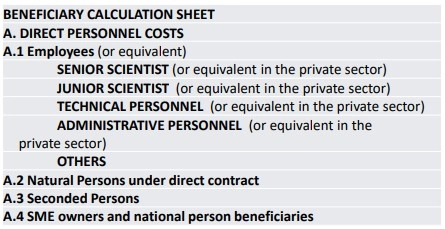
The Excel table for budget planning is broken down into individual work packages and partners.
Eligible costs include
- Personnel costs
- Costs for subcontracts
- Acquisition costs (e.g. travel expenses, equipment, consumables)
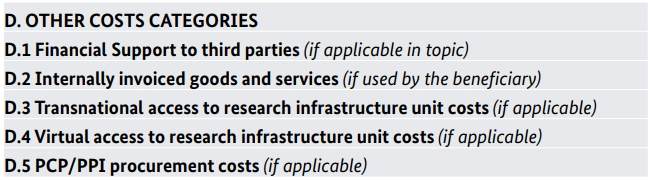
- Other direct costs (e.g. internal cost allocation)
- Flat rate for indirect costs: 25% on A. + C.
Budget table cost categories
- Units and cost per unit are filled in –> these refer to the costs per PM.
- PM is not defined.
- Take cost increases over the term into account!
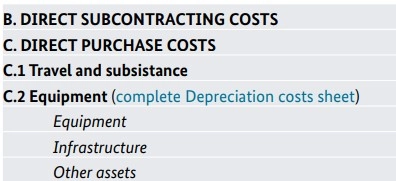
- C1: Units and cost per unit (= cost per trip) are filled in
- C2: The depreciation list requires detailed information on the time of acquisition, proportion of use in the project, etc.
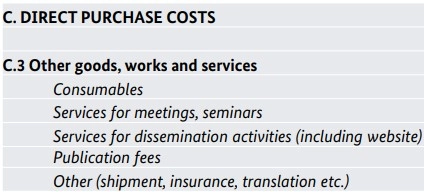
- Units and costs per unit are filled in –> these refer to the number of consumables/services and planned costs.
Dashboard for personnel costs
- The reviewer briefing contains a link to the Personnel Cost Dashboard, which assesses the level of personnel costs (based on actual reported costs in HEU projects since 2021).
- Initial experience indicates that the dashboard is consulted during the review process.
–> Tip: If a partner’s personnel costs are significantly higher than indicated in the dashboard for the respective type of organization, they must be explained.
Work package planning for lump sum projects
- Payment is made according to completed work packages (WP); therefore, it is important to structure the project carefully. At the end of each review period, only completed WPs are paid.
- Plan as many WPs as necessary, but no more than manageable.
- Work packages with longer duration (e.g., management, dissemination, and Exploitation) can be split, e.g., one WP Management per reporting period.
- Each partner’s share in individual WPs must be recognizable from the project application.
- Deliverables should be suitable for checking the project’s progress. They serve as proof of work and results provided and justify the funding.
- The partners’ responsibility for individual deliverables should be recognizable

The goal for WPs:
- As many as necessary and reasonable (many WPs = many deliverables).
- Work packages serve as meaningful subdivisions of a project.
- Work packages with a long duration may be divided.
Keep in mind:
- An activity is not a work package.
- A single task is not a work package. Every WP has to consist of at least two tasks.
- Progress (e.g. half of the attempts) is not a work package.
- A period of time is not a work package.
Evaluation of lump sum projects

- The evaluation is based on the Horizon Europe standard criteria of excellence, impact, and implementation.
- You can find out more about how to organize the individual sections here:
- Budget planning is taken into account during the project implementation.
- Assessment of appropriateness: Is the cost estimate reasonable/not excessive? The planned resources should be sufficient to carry out the project.
- If the lump sum is excessive, the European Commission will make a specific budget proposal and adjust the project funding amount in the GA.
- If the lump sum is too high/low, a lower score for implementation is possible.
Grant Agreement preparation
- The GA preparation follows a standard process, without contract negotiations, only necessary changes
- Correction of errors and inconsistencies
- If necessary, clarification of ambiguities
- If necessary, adjustment of the lump sum if the value is slightly overstated
- A special Model Grant Agreement for Horizon Europe lump sum projects is used.
Recognition of work packages in lump sum projects

- Recognition is granted when the planned work has been completed (not linked to the project’s success).
- (Scientifically necessary) adjustments to the project are possible; either via contract amendments or through justifications in reports.
- In the final payment, work on incompletely concluded WPs is paid pro rata.
Lump sum - budget shifts

- The consortium has budget autonomy: after signing the GA, shifts within its own budget and between partners are always possible.
- Contract amendments are required if changes in work packages or in the distribution of tasks are to be mapped.
- Recommendation: If the responsibility changes, amend the contract!
Lump sum - documentation
Required:
- Technical documents
- Publication, prototypes, deliverables
- Documents of good scientific practice, as in all projects
Not required:
- Timesheets, payslips
- Depreciation calculations
- Invoices, cost statements, CFS
Lump sum - practical experience

- Some projects require more deliverables than usual.
- It is impossible to omit deliverables, but changes to the deliverables are possible.
- Milestones can be postponed.
- Amendments to the GA have a similar time horizon as usual.
- 99% of work packages in ongoing lump sum projects have been accepted and fully paid –> cuts in 1% of projects
Lump sum - further information
- Info portal on Horizon Europe lump sum funding of the European Commission
- If your question is not answered in this summary, try the FAQ of the European Commission or
- Ask your National Contact Point (NCP) for help!
Check the Horizon Europe tips and tricks
FAQ – Lump Sum Funding for Beginners
What is lump sum funding as it relates to Horizon Europe?
Under the lump sum model, EU is not covering your real costs retrospectively. Rather, you and your partners have an agreed amount of work package budget. Providing that the intended work in a work package is done and the outcomes are presented as provided in the Annex 1 are delivered on time, the respective lump sum is paid in full- despite the actual internal cost.
Does lump sum have absolutely different rules of eligibility and funding principles?
No. The shocking aspect is the extent to which things remain the same. Depending on a lump sum grant you must continue to respect the principle core eligibility principles of Horizon Europe:
- The project must have costs that it needs,
- They should conform to the national law,
- Typical principles are used: transparency, cofinance, no profit, no duplication of funds.
The difference only lies in how these costs are verified: as opposed to auditing each cost line by line at the conclusion, they are verified at the proposal stage (through the detailed Excel budget).
What does it mean that a call is lump sum and what does the application change?
The model is not selected by yourself: the text of the call contains clear statements on whether it is an actual cost or lump sum.
In case it is lump sum, 3 realistic implications are involved:
- You have to take a slightly longer Part B template.
- Both partners will be required to complete an Excel spreadsheet of their budget dedicated to work packages and categories.
- The Excel file will be an appendix to the proposal, and it is what evaluators will base their judgment of whether the lump sum requested is reasonable.
What is the lump sum project budget development? What cost categories exist?
They are simply summed up in the lump sums per WP:
- Personnel costs
- Subcontracting
- Travel, equipment, consumable direct costs.
- Other direct costs (e.g. internal allocations)
- An indirect cost of 25% on the entitled basic direct costs.
You specify units and unit cost (e.g. personmonths or number of trips) instead of specifying invoices. The cumulative attribute of each partner’s work package is then frozen to the lump sum.
Another twist: the Commission’s Personnel Cost Dashboard can be checked by evaluators to determine whether your mentioned daily rates are realistic compared to those of similar organisations. In the event that your personnel expenses are much more than the benchmark, you ought to justify this.
What is the time of actual payment under the lump sum model?
The work packages are paid based on the work done, not based on individual cost items:
- The Commission verifies the completion of the appropriate WPs at the end of every reporting period based on the Annex 1.
- The equivalent lump sum amounts are then paid up in advance.
- In case a WP has been partially finalized at the time when the project is finalized, a pro-rata payment is still possible during the final payment.
What are the work package and deliverables that we need to design in a lump sum project?
Due to the fact that payments are WPbased, the structure of projects becomes of great concern abruptly. According to the article, there are some ground rules:
- Have as many WPs as you have time to take care of.
- WPs that span over time (management, dissemination, exploitation) can be divided on a periodbyperiod basis, such that a portion of the funding is released during the project.
- At least two tasks must be contained in every WP; neither an isolated exercise nor a time interval is a WP.
- Deliverables should be tangible products of work, and these should have a partner allocated to them clearly.
Consider WPs as funding milestones: in case you would not be happy to be paid or not paid on the basis of that block of work, then they are likely to be specified at an inappropriate level.
What is the level of flexibility after the grant is signed? Can we move budget around?
Lump sum does not imply that your budget is in stone. To a certain extent, consortia have budgetary independence:
- Transfers between and among the partners of the partner are permissible without alteration of the Grant Agreement, provided that the work packages and their substance remain the same.
- When you shift the responsibility of a WP or have significant transfers in the work, you ought to design an amendment in writing so that Annex 1 is consistent with reality. The practical suggestion of the article: in case of the change of responsibility, modify the contract.
In this way, you can be more flexible than classic cost reporting, but you still need to maintain the structure and the use of responsibilities of the structure in a logical manner.
Have we to continue with invoices, timesheets and payslips?
This is where one will find the wellknown aspect of simplicity: in the case of lump sum projects, the Commission does not ask you to submit or undergo audits:
- Timesheets and personal time cards.
- Payslips
- Depreciation tables
- Invoices and elaborate cost statements.
What you have to retain is the standard technical and scientific documentation: deliverables, publications, prototypes, lab books, where applicable, and evidence that the intended activities were performed in good scientific practice. When you have good science and your WPs are done, then you are safe in funding.
What does experience in early experience in lump sum projects tell us? Is it “dangerous”?
The data are so far quite encouraging. Commission statistics are given in the MIC guide that indicate approximately 99 percent of work packages in current lump sum grants have been completely accepted and paid with reduction being made in only approximately 1% of projects.
So far, there were practical lessons that include:
- Certain projects have had a greater number of deliverables compared to a normal actual-cost grant.
- You cannot just drop the deliverables but you are allowed to amend it by making amendments or rather coming up with justifiable modifications.
- Milestones may be delayed scientifically where they are required.
What can the Microfluidics Innovation Center (MIC) contribute to lump sum projects, particularly when our work has to do with microfluidics or lab-on-chip?
- MIC assists partners in creating work packages based on microfluidic engineering, prototyping and automation that are realistic in that, each of the work packages should have deliverables that can be effectively produced.
- MIC will input into manmonths, equipment, consumables, and justification of the increased personnel costs when advanced engineering is required, which will be included in the detailed budget building in the Excel sheets.
- Being an SME with a strong interest and participation in EU projects, MIC has a good record of actualizing microfluidic ideas into workable instruments and demonstrators. Consortia that include the MIC have seen their proposal success probability approximately double.