Tips & Tricks for a successful HORIZON-NEB-2026-01-BUSINESS-01 proposal
Opening
05 May 2026
Deadline
Keywords
New European Bauhaus
homelessness
lump sum
social infrastructure
neighbourhoods
healthcare
Innovative business models
integrated services
Your microfluidic SME partner for Horizon Europe
We take care of microfluidic engineering, work on valorization and optimize the proposal with you
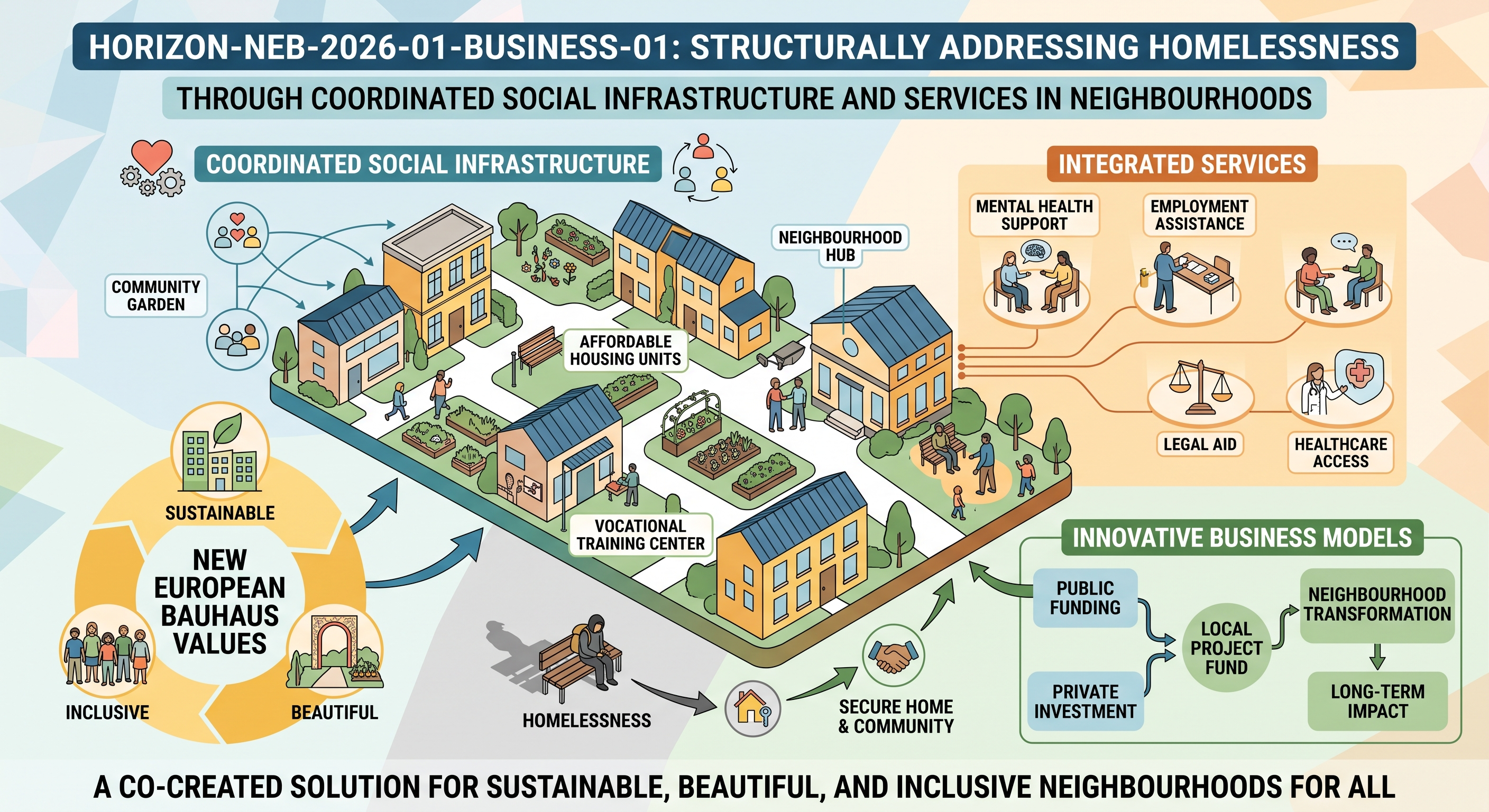
HORIZON-NEB-2026-01-BUSINESS-01: Structurally addressing homelessness through coordinated social infrastructure and services in neighbourhoods
Over 1.2 million people experience homelessness in Europe, and almost half of them have been in that situation for more than two years. The Commission wants to move past emergency shelters. This topic asks how healthcare, employment, education and community services can be coordinated at neighbourhood scale. Housing alone won’t fix it, and the call says so plainly.
Download the MIC Horizon Europe 2026/2027 Calls Calendar:
Discover more!
Administrative facts: what do we know about the HORIZON-NEB-2026-01-BUSINESS-01 call?
Which call is it, and when is the opening and the deadline?
- Call name: Beautiful, inclusive and sustainable neighbourhoods for communities
- Call identifier: HORIZON-NEB-2026-01
- Destination: Innovative funding and new business models for the transformation of neighbourhoods
- Topic: HORIZON-NEB-2026-01-BUSINESS-01
- Opening: 05 May 2026
- Deadline: 01 December 2026, 17:00:00 Brussels time
- Type of action: Innovation Action, lump sum funding
What about the budget and estimated size of the project?
- Topic indicative budget: EUR 10.50 million
- Indicative number of projects funded: 3
- Expected EU contribution per project: around EUR 3.50 million
- Overall call budget: EUR 101.10 million
What are the key eligibility and evaluation conditions?
- General Annexes A to G apply, with no topic-specific derogation other than the lump sum
- Award criteria and thresholds: General Annex D, standard Horizon Europe thresholds
- Mandatory contribution of social sciences and humanities disciplines and experts
- Validation required in at least five neighbourhoods in different Member States or Associated Countries
- At least 0.8% of budget allocated to the New European Bauhaus hub for results and impact
- Synergies encouraged with HORIZON-NEB-2026-01-PARTICIPATION-01
Scientific range: what does the Commission expect from the HORIZON-NEB-2026-01-BUSINESS-01 grant?
What outcomes are expected?
Stakeholders working on homelessness should end up with usable evidence on which social infrastructure actually shifts outcomes. Access to those services must have measurably improved in the neighbourhoods you worked in. A publication series is not what the Commission is after here.
What is within scope?
- Neighbourhood-level analysis of the existing built environment and of equitable access to social services
- Coordination across healthcare, education, employment, community integration and other social services
- Strategies to overcome data fragmentation, siloed service systems and funding barriers to scaling
- Socioeconomic impact assessment based on measurable indicators of service accessibility and use
- Transferability guidance for other neighbourhoods
Housing-led approaches belong to PARTICIPATION-01. Don’t rebuild that proposal here.
What are the specifically proposed research directions?
- The correlation between how infrastructure and services are designed in the built environment and the degree of homelessness locally
- Views, willingness and ability of chronically homeless people to actually use what is offered (this one gets underplayed a lot)
- Impacts on community reintegration, well-being, social cohesion and sense of belonging, for the broader neighbourhood too
- Unequal geographical distribution of services, with gender, age, sexual orientation and physical or psychological functional variations factored in
Scientific strategy: how can you enhance your chances of being funded through HORIZON-NEB-2026-01-BUSINESS-01?
What scientific choices matter most?
- Build the coordination mechanism, not a map. Evaluators want a system that runs, not an inventory of what exists.
- Put SSH partners in charge of work packages. The topic requires their effective contribution, and token involvement is visible from the first page.
- Pick your five neighbourhoods for contrast. Convenience selection weakens transferability.
- Define indicators before the pilots start.
- Plan properly for the lump sum. Work packages must be tightly bounded, because payment follows completion, not effort. We see this trip up first-time coordinators.
- Get municipalities in as beneficiaries. Letters of support are not enough.
- The call wording on data limitations is vague, which gives you room to frame the data problem your way.
Consortium & proposal-writing plan: what works best with this type of call?
- Somewhere between ten and fourteen partners, maybe a couple more if the five sites need local anchors
- A municipality or public housing agency in each pilot site. Non-negotiable.
- At least two SSH institutions: sociology, social policy, urban studies
- NGOs already working with homeless populations, ideally connected to European networks
- If you can, bring in a health or social care provider
- One or two innovative SMEs on the data and service-coordination side. Good for the exploitation plan, and usually good for the impact score.
- Writing tip: your impact section should read like an implementation plan, not a promise
How would microfluidics contribute to this topic?
Health services for homeless people usually mean a van, a drop-in centre, or a shelter clinic. Sending a sample to a hospital lab means the person is gone before the result comes back. Microfluidic point-of-care devices run the test where the person is, in minutes.
- Cartridge-based screening for tuberculosis, hepatitis C or HIV. One visit, one result, treatment can start the same day.
- Say your mobile team wants to know whether a new drop-in clinic improves detection. Portable tests give you comparable numbers across all five neighbourhoods. Same device, same protocol, you get the same answer twice.
- Water and air quality checks in temporary accommodation, using compact polymer devices with integrated sensors. Small sensors, no lab.
- Results come out digital, so they feed straight into your indicator framework.
For your proposal, this is what turns “improved access to healthcare” into a number you can put in a table.
The MIC already brings its expertise in microfluidics to Horizon Europe:
H2020-NMBP-TR-IND-2020

Microfluidic platform to study the interaction of cancer cells with lymphatic tissue
H2020-LC-GD-2020-3

Toxicology assessment of pharmaceutical products on a placenta-on-chip model

About the author

Céleste Chidiac, PhD
Scientific writer and digital marketing specialist
Céleste Chidiac holds a doctorate in neuroscience and molecular biology from the University of Strasbourg. Since joining the Microfluidics Innovation Center in 2023, she has combined scientific writing with website management. For MIC’s Horizon Europe topic pages, she draws on her research background to explain scientific challenges and clarify funding priorities. Her writing helps prospective applicants understand each topic’s scope, expected outcomes and research directions.
FAQ - HORIZON-NEB-2026-01-BUSINESS-01
What is HORIZON-NEB-2026-01-BUSINESS-01 about?
It funds projects that tackle homelessness at neighbourhood level by coordinating social infrastructure and services: healthcare, education, employment, community integration. The idea is to attack the root causes rather than manage the emergency.
How much funding is available and how many projects will be selected?
The topic budget is EUR 10.50 million. Three projects are expected, at around EUR 3.50 million each. The overall call budget is EUR 101.10 million.
When does the call open and close?
Opening on 05 May 2026, deadline on 01 December 2026 at 17:00:00 Brussels time. Single stage. The Director-General may shift the opening by one month and the deadline by up to two.
What type of action is it?
Innovation Action, with eligible costs taking the form of a lump sum. That changes how you build your work packages, so read General Annex G before you draft the budget.
Is social sciences and humanities participation mandatory?
Yes. The topic explicitly requires the effective contribution of SSH disciplines and the involvement of SSH experts and institutions. Adding one sociologist at 3 person-months will not convince anyone.
Check the Funding and Tenders Portal for more information.
How many pilot neighbourhoods do we need?
At least five, located in different Member States and/or Associated Countries. Pick them for contrast in housing markets, service density and local governance, not because the partners are already there.
What is the difference with PARTICIPATION-01?
PARTICIPATION-01 covers housing-led approaches. BUSINESS-01 covers the social infrastructure and services around housing. The work programme encourages synergies between the two, but duplication will be penalised.
Is there a mandatory budget allocation for the NEB hub?
Yes. At least 0.8% of your budget must be reserved for engaging with the Horizon Europe funded New European Bauhaus hub for results and impact. Put it in the plan from the start.
What kind of consortium works best?
Roughly ten to fourteen partners. Municipalities or public housing agencies in each pilot site, at least two SSH institutions, NGOs working with homeless populations, and one or two innovative SMEs on the data and service-coordination side.
Where does microfluidics fit in a call like this?
Only through the healthcare access strand. Point-of-care testing lets mobile health teams deliver a result in one visit, and it produces comparable figures across all pilot sites. It is a supporting component, not the backbone of the proposal.