Horizon Europe: Novelties of the new research and innovation programme
Author
Christa Ivanova, PhD
Publication Date
September 14, 2021
Keywords
R&I programme 2021-2027
five missions
3 pillars
European Innovation Council
open science
International collaboration
Simplified partnerships
Your microfluidic SME partner for Horizon Europe
We take care of microfluidic engineering, work on valorization and optimize the proposal with you
The 5 Horizon Europe novelties
- Launch of the European Innovation Council
- Five missions to fulfill
- More international collaboration
- Open science
- New forms of partnerships
Horizon Europe novelty #1: European Innovation Council
One says the ERC is the Nobel prizes factory of the European Union. But what about innovation? Europe is as good as the USA in research, but very few companies arise from this research and scale enough to reach the market.
Many public funds are available for fundamental research and proofs of concept at the national and international levels. Private investors bet on promising start-ups that have already proven their worth. One of the challenges of Horizon Europe and, more specifically, of the European Innovation Council (EIC) is to fill the funding gap around creating and upscaling new companies, helping research go to market, and having a genuine impact on society.
The EIC will propose two funding schemes to reach this objective: EIC Pathfinder and EIC Accelerator.
EIC Pathfinder
- ex FET
- to explore radically new/breakthrough technologies
- Low TRLs
- 2 types of calls: bottom-up (only collaborative projects, TRL 1-3) & top-down (collaborative and individual projects, TRL 2-4)
EIC Accelerator
- Ex SME Instruments
- To develop radically new/breakthrough technologies so that they become attractive for private investors
- High TRLs: 5-6 at the beginning of the project, 8 at the end
- Mostly individual funding
- Transition: funding of successfull ERC or EIC pathfinder facilitated
In addition, the participants will have an access to mentoring, networking opportunities, etc… to increase their chance to succeed.
Horizon Europe novelty #2: Five missions
Europe needs more sustainable ways to grow, eat, and consume. Healthier ways of living, healthier soils, and healthier oceans are essential for the planet’s future. This certainly requires excellent research and daily citizen engagement to change behaviors. Everybody needs to be on board to reach our societal challenges!
The commission has set up five missions to raise awareness of the European citizens and engage them alongside researchers. They will orient the research to reach ambitious and measurable objectives by 2030:
- Cancer: By 2030, more than 3 million lives will be saved.
- Adaptation to climate change, including societal transformation (climate): by 2030, prepare Europe to deal with climate disruptions, accelerate the transition to a healthy and prosperous future within safe planetary boundaries, and scale up solutions for resilience that will trigger societal transformations.
- Healthy oceans, seas, coastal and inland waters (oceans): by 2030, clean marine and fresh waters, restore degraded ecosystems and habitats, and decarbonize the blue economy to harness the essential goods and services they provide sustainably.
- Climate-neutral and intelligent cities (cities): by 2030, support, promote, and showcase 100 European cities in their systemic transformation towards climate neutrality.
- Soil health and food (soil): by 2030, at least 75% of all soils in the EU will be healthy for nutrition, people, nature, and climate.
Source: European Commission website
For each open call, the commission will indicate to which mission it can contribute. The missions will be achieved thanks to different projects from different calls/clusters.
Everybody is invited to bring their contribution to the definition of the missions’ objectives through the collaborative platform “Get Involved in Missions.”
Horizon Europe novelty #3: Extended association possibilities
International collaboration will be further encouraged in Horizon Europe to improve our efficiency in tackling societal challenges. In particular:
- The number of associated countries will be increased
- More actions and calls involving third countries will be set up
Horizon Europe novelty #4: Open science
Open science was already much encouraged in H2020. Horizon Europe’s goal is to reinforce openness (open innovation, open science, and open data) to allow better exploitation of research results and more efficient diffusion of knowledge and practices.
The main concrete actions are:
- Open-access publications will be mandatory. The commission has funded the development of an open-access publishing platform to host beneficiaries’ publications.
- Attention will be paid to generating FAIR (Findable, Accessible, Interoperable, Re-usable) and open data. Data sharing will become the standard unless you have a good reason, like IP protection (the motto is to be as available as possible, as close as necessary).
- The European Open Science Cloud (EOSC) will be created to share research results.
- New indicators will promote open science to evaluate researchers.
- Reciprocity of the openness will be strongly encouraged for the collaboration with third countries.
Horizon Europe novelty #5: Simplification of the partnerships
The partnerships in Horizon Europe are associations between some EU members and other actors from different sectors. They aim to develop and manage a research and innovation program and propose funding.
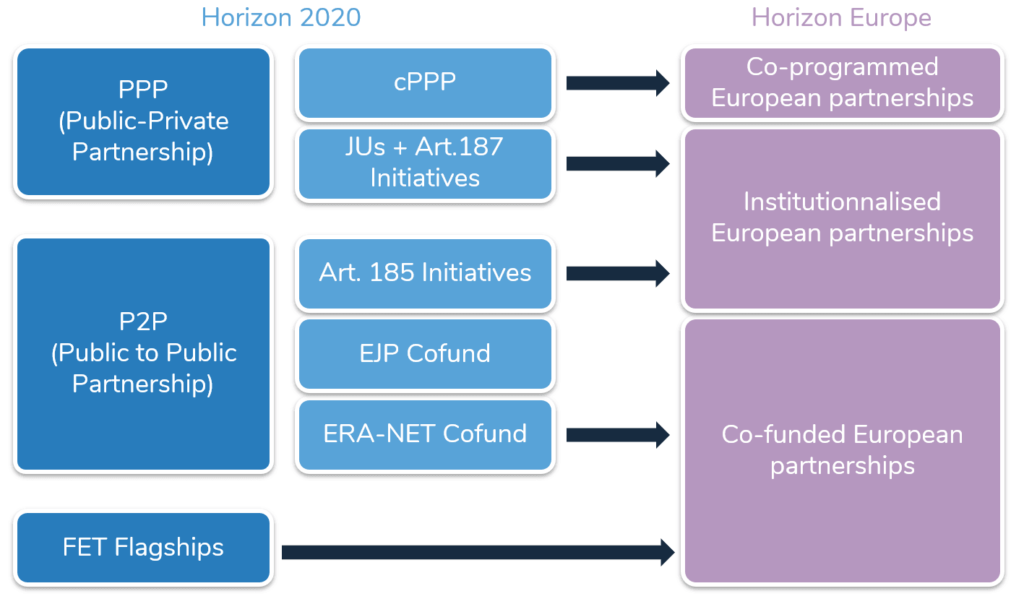
In H2020, several types of partnerships coexisted, and finding your way around them was difficult. In Horizon Europe, only three types of partnerships will be proposed:
- Co-programmed European partnerships: between the European Commission and private and public partners. They will be at the origin of the typical Horizon Europe calls (RIA/IA/CSA, etc).
- Co-funded European partnerships: between EU countries, with research funders and other public authorities at the consortium’s core. The EU and the national agencies of the involved EU countries fund the calls proposed by this kind of partnership.
- Institutionalized European partnerships: partnerships where the EU participates in research and innovation funding programs by EU countries.
Comparison of partnerships in H2020 and Horizon Europe
Want more? Visit our page summarizing the novelties in Horizon Europe implementation (grant management, proposal writing and evaluation, dissemination strategy…).
Are you interested in MSCA (ITN, IF, RISE…)? Check out the differences between H2020 and Horizon Europe!
The MIC and Horizon Europe
Find out more about our expertise for the Horizon Europe R&I program!
Our last news
We will be glad to participate in your project. Visit our dedicated webpage to learn more about our expertise as H2020 and Horizon Europe partner!
Curious about the calls currently open?
We are particularly interested in the following calls but remain open to any collaboration!
- EIC WORK PROGRAMME that supports all stages from R&D to industry for game-changing innovations
- HORIZON EUROPE RIA CALLS, specifically focusing on health and food, bioeconomy, natural resources, agriculture, and environment
Download the MIC Horizon Europe 2026/2027 Calls Calendar:
Some of our funded projects
ACDC
Artificial cells with distributed cores to decipher protein function

FIDA
Complex and automated fluid handling in a disruptive antibody analytical platform
Active Matter
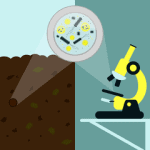
Microfluidic soil-on-chip devices in the study of microbial communities
Check the Horizon Europe tips and tricks
FAQ - Horizon Europe: Novelties of the new research and innovation programme
What are the five “Missions” and why should they be considered?
Consider missions as problem-based portfolios that have 2030 objectives; cancer; climate adaptation; ocean and water restoration; climate-neutral and smart cities; and soil health. Although you need not be submitting to a mission-specific call, making your use-cases, datasets, or demonstrators mission KPIs helps to bolster your exploitation story and enables your project to become more policy-relevant.
What now is the structure of the Horizon Europe?
There are three pillars and a horizontal strand of widening participation:
Pillar I: Excellence science (ERC, MSCA, research infrastructures).
Pillar II: Collaborative R&I that is driven by challenges within six clusters (Health; Digital/Industry/Space; Climate/Energy/Mobility, etc.).
Pillar III: Going big on innovation (EIC Pathfinder/Transition/Accelerator, EIT KICs).
Widening & ERA: Making Europe stronger to enhance capacity, reform and mobility.
What is different with evaluation and reporting?
The traditional Excellence-Impact-Implementation lens has not disappeared, but panels have higher demands of crisper “activities – outputs – outcomes” chains and open-science plans (called repositories, metadata and data access). The dissemination and exploitation are followed beyond the grant using key exploitable outcomes. Reduced number of generic assurances, more pronounced milestones and adoption, direction.
Lump-sum grants: easier or more difficult?
Both. Instead of reporting real costs, a work package is completed which results in payment. There is disappearance of timesheets, and increase in delivery risk. The remedy: chop large risky WPs into smaller pieces, establish internal done criteria, and phase prototypes/data sets, such that you can say results are done in a piecemeal fashion, as opposed to at the conclusion.
What about budgets?
Horizon Europe will consist of a 2021-2027 envelope of approximately EUR95.5B. Funding rates: Research and Innovation Actions are normally fully funded (100%), Innovation Actions (100% to non-profits). MSCA and schemes still have unit-cost logics. Joint projects are planned on work-package and task budget, which suits the lump-sum mentality.
The partnerships were redesigned – what should coordinators observe?
Less, more strategic partnerships (co-programmed, co-funded, institutionalised). Each has got its SRIA, KPIs and regulatory/standardisation workstreams. When one of the topics makes mention of a partnership, read its SRIA first – it is usually the hidden evaluation lens.
Open science and open data: What is now a requirement?
Real-time access to peer-reviewed journals.
Plan Living Data Management (FAIR-compliant) having repositories, access regulations and metadata.
More and more reproducibility resources: software, laboratory protocols, negative outcomes. In the case of sensitive data, controlled-access repositories have to be pre-defined. Slogans are not expected, but tangible, citable results by the reviewers.
Equality between the genders, broadening participation, and morality – mere check-box?
Not anymore. Gender Equality Plan is usually formal. Actions that are widened finance mobility, teaming, twinning, and ERA chairs; adding credibility to widening partners. Ethics addresses information control, dual use, and do not harm, will cause significant harm – mitigate the plan going as granular as the technical risk.
Recommendable heuristics in writing that would work with Horizon Europe?
Restrict the pages with a maximum of 2-3 promises on each page with a metric.
Name instruments, datasets, protocols – no imprecision such as platforms.
Measurability: planned releases, TRL advancements, benchmarks, standardisation contributions, number of users onboarded. Offers that can be put into effect on Day 1 are better than wordy, hopeful accounts.
Why would a specialized SME such as MIC be a value addition?
Two levers: uptake and feasibility. MIC creates end-to-end (chips, flow control, sensors, automation), fabricates custom devices, and creates demonstrators – work packages conceived to bench without drifting. When we are here, the success rate is usually doubled as the reviewers will witness actual prototypes, realistic Gantt charts, and plausible adoption pathways.
Microfluidics tip: impressing Horizon Europe panels.
Be precise in numbers: rates of droplet generation, percentages of the fabrication, stacks of fabrication, limit of detections, benchmarking strategies. Bind secondments and pilots onto actual instruments and datasets. MIC has the option to co-design chips, construct control electronics and provide first-month prototypes – de-risking lump-sum claims and enhancing the credibility of exploitation.