
Tips & Tricks for a successful HORIZON-CL5-2026-11-D3-15 proposal
Opening
04 August 2026
Deadline
Keywords
Cluster 5 Energy
agriPV
offshore PV
IA
EUPI-PV Partnership
nearshore PV
Innovative design
PV system design
lump sum grant
photovoltaics
Your microfluidic SME partner for Horizon Europe
We take care of microfluidic engineering, work on valorization and optimize the proposal with you
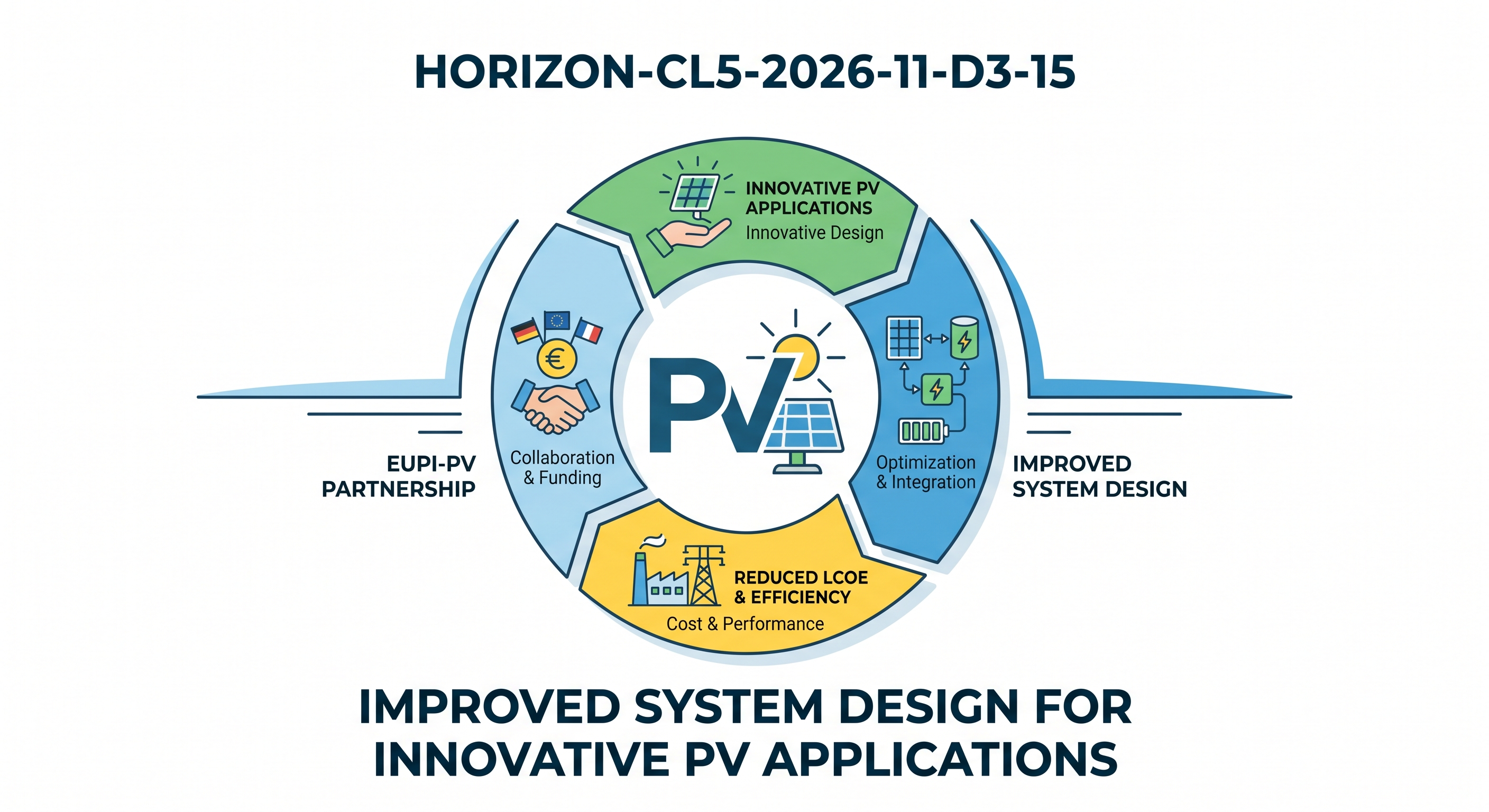
HORIZON-CL5-2026-11-D3-15: Improved system design for innovative PV applications (EUPI-PV Partnership)
Solar is not only about panels in an empty field anymore. This topic asks photovoltaics to share space with something else: crops, or water. The Commission wants demonstrators of real size, plus the modelling, permitting and business work around them. Pick one area and commit.
Download the MIC Horizon Europe 2026/2027 Calls Calendar:
Discover more!
Administrative facts: what do we know about the HORIZON-CL5-2026-11-D3-14 call?
Which call is it, and when is the opening and the deadline?
- Call name: ENERGY
- Call identifier: HORIZON-CL5-2026-11
- Destination: Sustainable, secure and competitive energy supply
- Topic: HORIZON-CL5-2026-11-D3-15
- Opening date: 04 August 2026
- Deadline: 01 December 2026, 17:00:00 Brussels time
- Type of action: Innovation Action, lump sum funding
What about the budget and estimated size of the project?
- Total indicative topic budget: EUR 30.00 million
- Indicative number of projects funded: 4
- EU contribution per project: around EUR 7.50 million (30.00 divided by 4)
What are the key eligibility and evaluation conditions?
- General Annex B conditions apply
- Copernicus and/or Galileo/EGNOS mandatory if satellite EO or positioning data are used
- TRL 7 to 8 by project end, any starting TRL accepted
- Proposals must address only one of the two areas
- Portfolio rule: at least two highest ranked agriPV and two highest ranked offshore/nearshore proposals get funded, if thresholds are met
- SSH disciplines and experts must be effectively involved
- The granting authority may object to transfer of ownership or exclusive licensing of results for 4 years after the action
Scientific range: what does the Commission expect from the HORIZON-CL5-2026-11-D3-15 grant?
What outcomes are expected?
Something has to be standing and producing when the grant closes. The Commission is after bankable agri or offshore PV systems that cut CAPEX and OPEX, push LCoE down, and leave land and sea better off than a conventional plant. Design studies alone are not what they pay for.
What is within scope?
One area per proposal, not both.
- Full system modelling for reliable energy yield, plus plant yield, crop quality and biodiversity for agriPV, comparable across sites
- Advanced components and architectures at adequate scale, minimising impact on land or sea while maximising output and grid connection
- Resilience to climate change: extreme events, shifting agricultural practices, new crop choices
- Standardisation of module and structure design
- Permitting process definition
- Demonstrators totalling at least 5 MW, across different EU climate or sea zones
- Exploitation planning with a business case, pointing at follow-up funding like the Innovation Fund
What are the specifically proposed research directions?
- AgriPV designs where the crop and the electricity both win, with agronomic risk mitigation and energy justice treated seriously
- Offshore and nearshore systems that survive the sea states actually found around Europe, plus co-location and system integration with offshore wind
- Conflicts of use over water areas: shipping, fishing, sand extraction, military zones, sailing. The call names them, so answer them
Scientific strategy: how can you enhance your chances of being funded through HORIZON-CL5-2026-11-D3-15?
What scientific choices matter most?
- Pick your area on day one. Do not hedge.
- Bring the 5 MW. Evaluators will add up your sites.
- Make the modelling comparable. Several climate zones only pay off if one methodology travels between them. Plenty of proposals let every site run its own protocol.
- Treat permitting as a work package, not an annex.
- The call asks for acceptance to be handled holistically. What scores is a named SSH partner with a real budget line.
- Show the cost model. CAPEX, OPEX and LCoE, before and after, assumptions visible.
Consortium and proposal writing plan: what works best with this type of call?
- Somewhere between ten and fifteen partners, a few more if you need several sea or climate zones covered.
- You need whoever owns the site. Farmers, cooperatives, port authorities, offshore operators. Without them the demonstrator is a promise.
- Module and structure makers, a grid integrator, an agronomy or marine ecology lab, at least one SSH team.
- An innovative SME usually helps here (they carry the component work and the exploitation story better than a large integrator).
- Never coordinated a lump sum grant? Bring someone who has. The work package split is the budget.
- Write the impact section against the five expected outcomes, in that order. Evaluators tick them off.
How would microfluidics contribute to this topic?
Field trials under agriPV panels need a full growing season before they tell you anything. Offshore ageing tests are slow and expensive. Microfluidics shrinks those questions onto chips the size of a microscope slide. Controlled conditions, tiny volumes, answers in days.
- Root-on-chip work. Say you want to know whether a crop under thirty percent shade is water stressed or just growing slower. Grow the roots in a chip, change light and watering, watch it live. Two weeks instead of a season.
- Lab-on-chip sensors for nitrate, phosphate and salinity in soil water under the panels. Cheap enough to deploy plenty.
- eDNA sampling and on-chip prep around floating arrays. Tells you what lives down there, no nets involved.
- Microchannel cooling. Panels over water run hotter than people expect. And a cooler cell is a more efficient one.
- Anti-soiling coatings tested as droplet behaviour on chip. Dust, pollen, salt spray. Same coating, different climate, different result.
None of this replaces your demonstrator. It feeds it. Microfluidics answers the biology and materials questions that would otherwise eat a whole field season, and it shows a reviewer you can get the same result twice.
The MIC already brings its expertise in microfluidics to Horizon Europe:
H2020-NMBP-TR-IND-2020

Microfluidic platform to study the interaction of cancer cells with lymphatic tissue
H2020-LC-GD-2020-3

Toxicology assessment of pharmaceutical products on a placenta-on-chip model

FAQ - HORIZON-CL5-2026-11-D3-15
What is HORIZON-CL5-2026-11-D3-15 actually funding?
It funds Innovation Actions that improve system design for two specific photovoltaic applications. First, agriPV, where panels and agricultural production share the same land. Second, offshore or nearshore PV, where the array sits on water. The Commission is paying for working systems at demonstrator scale, along with the modelling, standardisation and permitting work that makes them replicable.
When does the call open and when is the deadline?
The call is ENERGY, identifier HORIZON-CL5-2026-11. It opens on 04 August 2026 and closes on 01 December 2026 at 17:00:00 Brussels time. Keep in mind that the Director-General may open the call up to one month earlier or later, and may delay the deadline by up to two months.
How much money is on the table per project?
The indicative topic budget is EUR 30.00 million and around four projects are expected. That works out at roughly EUR 7.50 million of EU contribution per project. Requesting a different amount is allowed, it just has to be justified. Funding is a lump sum, so the work package split effectively is the budget.
Can one proposal cover both agriPV and offshore PV?
No. The work programme is explicit: proposals must address only one of the two areas. Trying to straddle both usually reads as a lack of focus, and it also puts you in an awkward spot with the portfolio rule described below. Choose the area where your demonstrator sites and your partners are strongest.
What TRL do we have to reach?
Activities are expected to reach TRL 7 to 8 by the end of the project. You may start at any TRL, but the endpoint is a system validated and demonstrated in an operational environment. In practice this means real sites, real weather or sea conditions, and measured performance rather than simulated performance.
Check the Funding and Tenders Portal for more information.
What does the 5 MW demonstrator requirement mean in practice?
Your demonstrators must total at least 5 MW altogether, and they have to be spread across different EU climate or sea zones. It does not have to be a single installation. Several sites can be added together. What evaluators will check is that the total adds up and that the zones are genuinely different, not three sites in the same conditions.
What is the portfolio rule and how does it change our odds?
To keep a balanced portfolio, grants are not awarded on ranking alone. At least the two highest ranked agriPV proposals and at least the two highest ranked offshore/nearshore PV proposals will be funded, provided they attain all thresholds. So you are competing mainly inside your own area. Picking the less crowded of the two is a legitimate strategic consideration.
Do we really need social sciences and humanities partners?
Yes. The topic requires the effective contribution of SSH disciplines and the involvement of SSH experts and institutions. Acceptance, energy justice, permitting and conflicts of use over land and water are named in the text. A paragraph promising stakeholder engagement is not enough. Name the partner, give them work packages and a visible budget line.
What does a credible consortium look like for this topic?
Somewhere between ten and fifteen partners is a reasonable target, more if you need extra climate or sea zones. You need the site owner, whether that is a farming cooperative, a port authority or an offshore operator. Add module and structure manufacturers, a grid integrator, an agronomy or marine ecology group, an innovative SME for the component and exploitation side, and at least one SSH team.
Where does microfluidics fit into a PV system design project?
In the supporting measurements, not in the array itself. Lab-on-chip sensors track nutrients and salinity in soil water under the panels. Root-on-chip setups answer crop stress questions in weeks rather than seasons. eDNA workflows document biodiversity around floating arrays. Microchannel cooling and coating tests feed the module design work. You can see how MIC ranks the wider Cluster 5 calls by microfluidic relevance, and the full Horizon Europe work programme overview is on the same site.