
Automated flow control in a disruptive antibody analytical platform: FIDA
Author
Christa Ivanova, PhD
Publication Date
December 14, 2019
Status
Keywords
micro-capillary system
complex fluid handling
flow-induced dispersion analysis
detection automation
vaccine development
antibody binding characterization
Your microfluidic SME partner for Horizon Europe
We take care of microfluidic engineering, work on valorization and optimize the proposal with you
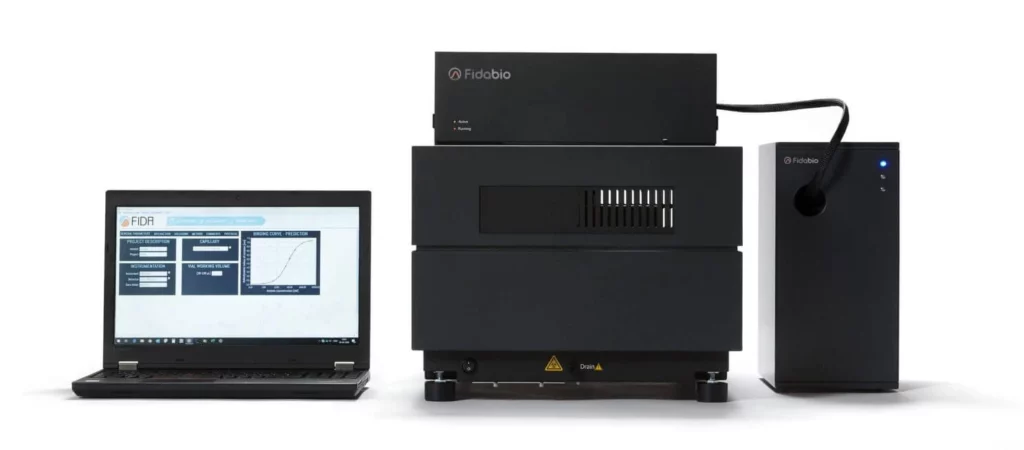
To develop new vaccines, an efficient tool characterizing antibody binding is needed. The platform FIDA, integrating complex fluid handling, will take up this challenge.

Antibodies are a significant component of modern medicine, whether for treating diseases or the R&D of new vaccines.
However, antibody testing is currently done with artificial assays based on non-native sample materials, failing to accurately predict the actual biological events in human patients.
In addition, the present methods to evaluate antibodies are tedious and time-consuming and can lead to false results due to the sample dilution required and the low analytical sensitivity.
All these drawbacks lead to considerable costs to develop new therapeutic antibodies or vaccines, limiting the R&D in this field and the possibility for small companies to build a new product.
In this context, finding a better way to characterize antibodies and antibody binding is urgent: this is the purpose of FIDA.
FIDA is a patented platform that allows one to perform immunological measurements under native conditions in less than 20 min and with up to 10 times higher sensitivity than current tools.
This project aims to bring the FIDA prototype to the market with the support of pharmaceutical companies and Denmark’s leading public health and infectious diseases vigilance body.
Antibody analytical platform: our role
We will bring our expertise in flow control to FIDA to achieve complex and precise fluid handling in the analysis platform.
Thanks to an upgraded version of the OEM flow controller, uniform pressure will be applied to 8 capillaries simultaneously, allowing parallelized detection.
FIDA software will be coupled with Elveflow ESI software to control sample injection and analysis. Great care will be taken to develop a product compatible with large-scale production.
Finally, the new platform will be tested to assess performance in antibody characterization and identify any potential deficiencies, particularly regarding flow control.
Download the MIC Horizon Europe 2026/2027 Calls Calendar:


Funding and Support
This project has received funding from the European Union’s Horizon 2020 EIC-FTI under grant agreement No 878727 (FIDA).
Check our Projects
FAQ – Automated flow control in a disruptive antibody analytical platform: FIDA
What’s the expected throughput for a typical lab day?
Eight channels run simultaneously, with cycles under 20 minutes as standard to make measurements. Practical throughput with screening-grade experiments can reach dozens of samples per hour, depending on protocol length and QC steps. The first multiplier is parallelization.
What does the tool do to minimize false returns?
FIDA does not enable the use of immobilization and dilution to reduce the true stoichiometry and affinity landscape. Greater sensitivity eliminates the need for violent amplification procedures (which can introduce bias), and synchronized channels eliminate run-to-run drift that would otherwise creep in during longer serial operations.
Is it possible to integrate this platform into other biomolecular assays?
Yes. This parallel, pressure-driven backbone may be used to carry out binding, competition, or stability cycles with proteins, peptides, and complex biologics. In practice, adapting a new assay involves adjusting channel geometry, pressure profiles, and injection timing, while the synchronized control logic remains in place.
What is the rationale of engaging a specialized SME in an EU research consortium in such work?
Two reasons: time-to-prototype and funding success. Such SMEs as MIC introduce the past experiences in microfluidic toolchains (design – fabrication – integration) and have a history of commercializing laboratory ideas into viable instruments. When presented in Horizon Europe proposals, an implementation-oriented SME is likely to increase the project’s execution credibility; in our case, MIC’s involvement has approximately doubled the success rate of proposals submitted to published calls.
What is the role played by the Microfluidics Innovation Center (MIC)?
MIC designs the fluidic system, which feeds the cells under control, imposes controlled flow and shear forces, and injects well-characterized nanoparticle formulations. Consider it the chip’s circulation system: strong perfusion, accurate dosing, and controls that make experiments reproducible. MIC also assists in setting the test conditions and throughput with the consortium.
I am developing a Horizon Europe consortium- where should MIC be placed outside this project?
MIC is a microfluidics SME specializing in regularly participating in EU consortia to provide hardware, automation, and measurement components for complex bioassays. We prepare offers together, model work packages based on prototype deliverables, and risk-proof manufacturable designs. Consortia incorporating MIC prototype-first model usually claim success rates that are twice the official baseline at similar calls- a trend we put down to obvious technical way, believable milestones, and early demonstrators.