Tips & Tricks for a successful HORIZON-CL3-2027-01-FCT-05 proposal
Opening
05 May 2027
Deadline
Keywords
synthetic drugs
stimulants
harm reduction
drug trafficking
law enforcement
EUDA
Innovation Actions
Your microfluidic SME partner for Horizon Europe
We take care of microfluidic engineering, work on valorization and optimize the proposal with you
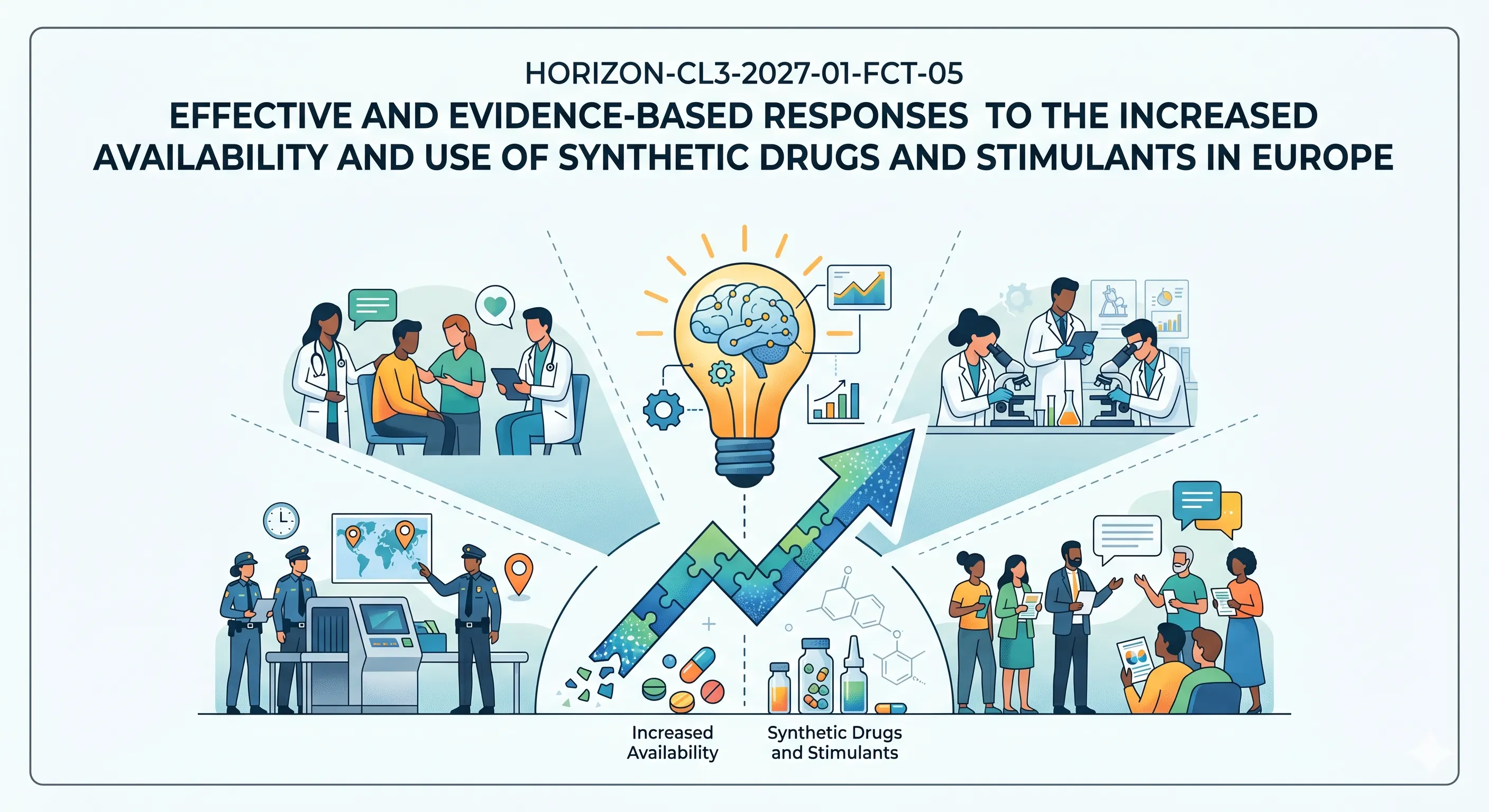
HORIZON-CL3-2027-01-FCT-05: Effective and evidence-based responses to the increased availability and use of synthetic drugs and stimulants in Europe
Synthetic drugs are no longer a niche concern in Europe. Cocaine, crack cocaine, and a growing range of novel stimulants are reshaping drug markets across the EU, and the evidence base for responding to them is still catching up. The Commission wants proposals that bridge that gap: building better knowledge for prevention, treatment, and harm reduction while also giving law enforcement practical tools to counter trafficking and drug-related violence. This is a call that sits squarely at the intersection of public health and security. Both dimensions need to be addressed. Proposals that treat it as purely one or the other will struggle.
Download the MIC Horizon Europe 2026/2027 Calls Calendar:
Discover more!
Administrative facts: what do we know about the HORIZON-CL3-2027-01-FCT-05 call?
Which call is it, and when is the opening and the deadline?
- Call name: Civil Security for Society 2027
- Call identifier: HORIZON-CL3-2027-01
- Destination: Better protect the EU and its citizens against Crime and Terrorism
- Topic: HORIZON-CL3-2027-01-FCT-05
- Opening date: 05 May 2027
- Deadline: 04 November 2027 (17:00 Brussels time)
- Type of action: Innovation Actions (IA)
What about the budget and estimated size of the project?
- Total indicative topic budget: EUR 8.00 million
- Expected number of projects funded: 2
- Expected EU contribution per project: around EUR 4.00 million
What are the key eligibility and evaluation conditions?
- Minimum 3 Police Authorities must be active beneficiaries (not associated partners)
- At least 2 Civil Society Organizations or NGOs must be active beneficiaries.
- Proposals expected to engage with the Europol Innovation Lab throughout the project
- Engagement with the EU Drugs Agency (EUDA) is mandatory, including outcome validation.
- Cooperation with CEPOL is required for training-related activities (if CEPOL does not apply for funding itself)
- Mid-term deliverable required: a practitioner-led assessment of project outcomes at the halfway point
- TRL range: not explicitly stated in the work program for this IA topic (worth verifying on the Funding and Tenders Portal)
- Standard admissibility, eligibility, financial capacity, and award criteria apply per General Annexes A through G.
Scientific range: what does the Commission expect from the HORIZON-CL3-2027-01-FCT-05 grant?
What outcomes are expected?
The Commission wants usable outputs: stronger evidence on prevention, treatment, and harm reduction for synthetic drugs; new tools for law enforcement to address violence and trafficking; and better understanding of how external factors (geopolitical, legal, and societal) drive drug market changes in Europe. At the end of the project, security practitioners and policymakers should have genuinely better resources than they had before. A collection of academic publications is not what the Commission is after here.
What is within scope?
- Evidence-based prevention strategies, treatment modalities and harm reduction practices for synthetic drugs including cocaine, crack cocaine and novel stimulants
- Pharmacological data generation for emerging drugs to support risk assessment and intervention design
- Strategies to reduce violence and criminal behaviour linked to drug use and marketing
- Socioeconomic and cultural analysis of drug use patterns, including gender, age and other social factors
- Technologies and tools addressing drug trafficking across the full supply chain
- Analysis of geopolitical, legal and societal drivers of drug market evolution in Europe
What are the specifically proposed research directions?
- Evaluation of existing intervention efficacy and identification of best practices across EU member states
- Understanding how international crises affect local drug dynamics and designing adaptive responses
- Development of skills, tools and technology for Police Authorities and civil society to reduce drug-related offending
- Collaboration frameworks linking researchers, policymakers and security practitioners — the work programme is explicit that this integration is a requirement, not an option
- Increased understanding of how external change drivers shape synthetic drug markets over time
Scientific strategy: how can you enhance your chances of being funded through HORIZON-CL3-2027-01-FCT-05?
What scientific choices matter most?
- Frame around deployment barriers, not technology novelty: Evaluators here are not looking for innovation for its own sake. They want to know what will actually change in how practitioners respond to synthetic drug challenges.
- Address the pharmacological gap directly: There is limited data on many emerging synthetic drugs. Proposals that include a credible plan for generating and sharing pharmacological data will stand out.
- Balance both dimensions. The work program is explicit: proposals must address technological and societal aspects in a balanced way. Leaning too far in either direction is a risk.
- Plan for the EUDA and Europol validation requirements from day one: These aren’t optional add-ons. Build them into the project timeline and budget.
- Include sex and gender analysis in the socioeconomic components: The work program names gender and age as relevant social factors.
- Build national and EU-level upscaling into the plan: The Commission wants a roadmap for what happens after the grant ends.
Consortium & proposal-writing plan: what works best with this type of call?
- The minimum eligibility conditions force a specific structure: at least 3 police authorities and 2 CSOs or NGOs as beneficiaries. That’s your starting point. Everything else builds around it.
- Aim for somewhere between 10 and 14 partners, maybe slightly more if you need clinical or public health coverage from multiple member states.
- Academic partners should bring criminology, public health, pharmacology, and behavioral science. Don’t rely on a single faculty or department.
- An innovative SME specialized in data analytics, detection technologies, or digital tools for practitioners would strengthen both the technical and impact dimensions.
- Include at least one partner with direct access to EUDA networks. The mandatory agency engagement is easier when someone in the consortium already has the relationship.
- On writing: the proposal’s impact section needs to be specific. Generic statements about improving security won’t cut it. Name the practitioner communities, the scale of the problem, and the concrete change your project produces.
- Cross-border coverage across at least four or five member states signals genuine European relevance.
How would microfluidics contribute to this topic?
Traditional drug analysis relies on centralized lab infrastructure: slow, expensive, and often disconnected from the field. Microfluidic platforms change that equation. They bring analytical capability closer to where it’s actually needed, whether that’s a law enforcement checkpoint, a harm reduction service, or a clinical setting.
- Portable microfluidic detection systems can identify synthetic drugs and novel psychoactive substances in field conditions. Your consortium could include a detection tool that police authorities can actually use, not one that requires a lab.
- Say you’re trying to understand how a new stimulant behaves in the body. Organ-on-chip models let you study that directly, without waiting for clinical case accumulation. You get pharmacological data faster, which is exactly what this call says is missing.
- Microfluidic biosensors offer consistent, repeatable results for drug screening in harm reduction contexts. That matters when you’re trying to build an evidence base that policymakers will trust.
- Blood or saliva analysis for drug exposure mapping across populations—microfluidics makes this feasible at a scale that supports the epidemiological work the call is asking for.
For a consortium working on this topic, MIC’s capabilities in portable diagnostics and lab-on-chip biosensor development are directly applicable. Microfluidics won’t define the whole proposal, but it could be the difference between a detection or pharmacological component that evaluators find credible and one that stays theoretical.
The MIC already brings its expertise in microfluidics to Horizon Europe:
H2020-NMBP-TR-IND-2020

Microfluidic platform to study the interaction of cancer cells with lymphatic tissue
H2020-LC-GD-2020-3

Toxicology assessment of pharmaceutical products on a placenta-on-chip model

FAQ – HORIZON-CL3-2027-01-FCT-05
What is the HORIZON-CL3-2027-01-FCT-05 call about?
HORIZON-CL3-2027-01-FCT-05 will address the increased supply and consumption of synthetic drugs and stimulants in Europe. It invests in Innovation Actions (IA) that would help to develop more effective evidence on prevention, treatment, and harm reduction, as well as provide law enforcement with the means to fight drug-related violence and trafficking.
Who are the mandatory consortium members for this topic?
This subject is difficult to pass the eligibility criteria. At least 3 police authorities should be active beneficiaries (not merely associated partners) and at least 2 civil society organizations (CSOs) or NGOs. Cooperation with the Europol Innovation Lab and the EU Drugs Agency (EUDA) is also obligatory throughout the project.
What is the total budget and how many projects will be funded?
The overall indicative budget on this topic is of EUR 8.00 million, divided into 2 projects. The Commission anticipates approximately EUR 4.00 million per project as an EU contribution. The proposals that demand varying sums can also be made and chosen.
What is the role of EUDA in this call?
EU Drugs Agency (EUDA) is at the centre of validation. Suggestions should include interaction with EUDA within the project, and their outcomes should be verified by the agency. Properly it is a mandatory component of a project lifecycle and not an advisory arrangement, and must be scheduled in the timeline and budget at the outset.
What does evidence-based mean specifically for this topic?
In this call, “evidence-based” implies more than a literature review. We expect the proposals to identify best practices in current interventions, assess their practical effectiveness, and provide pharmacological data on new drugs where data are currently limited. The Commission is categorical that the evidence base in the area of synthetic drugs is in its inception and that there is a need to enhance it.
How should proposals address both technological and societal dimensions?
The work program is straightforward: both dimensions have to be covered in a balanced manner. Proposals that are strictly technological and do not consider socioeconomic or cultural aspects will have low marks. It is the same with proposals which are solely sociological with no technological input. Frame at the beginning of the proposal.
What is the deadline and opening date for this call?
This call opens on 05 May 2027 and closes on 04 November 2027 at 17:00 Brussels time. It is a part of the HORIZON-CL3-2027-01 call Civil Security for Society 2027. Dates can be moved within a one month by the discretion of the Director-General.
How can microfluidics contribute to drug detection under this call?
The major contribution in the field of microfluidics is the portable detection and quick pharmacological profiling. In field conditions, microfluidic biosensors can detect synthetic and emerging psychoactive drugs without requiring centralized laboratory analysis. The data gap in this call can be filled in with organ-on-chip platforms that can generate pharmacological data on new stimulants faster than clinical cases can build up.
What type of action is HORIZON-CL3-2027-01-FCT-05 and what TRL is expected?
This is not a Research and Innovation Action, but an Innovation Action (IA). It focuses on implementation and verification of solutions with actual practitioners, rather than on basic research. The anticipated TRL at the end of the project is not clearly mentioned in the work program. It is advisable to check the Funding and Tenders Portal and then submit.
What previous EU-funded research should proposals build on?
The work programme specifically references prior projects under HORIZON-CL3-2024-FCT-01-04 and HORIZON-CL2-2025-01-DEMOCRACY-05 as work to build on and not duplicate. Review those outcomes before writing your scope section. Coordination among proposals funded from the same topic is also expected once results are announced.