
Tips & Tricks for a successful HORIZON-CL4-2027-01-MAT-PROD-02 proposal
Opening
22 September 2026
Deadline
Keywords
Advanced Manufacturing
Critical Raw Materials
Innovation Action
Made in Europe
Digital Twins
Safe & Sustainable by Design
Material Circularity
Your microfluidic SME partner for Horizon Europe
We take care of microfluidic engineering, work on valorization and optimize the proposal with you
HORIZON-CL4-2027-01-MAT-PROD-02 - Advanced manufacturing for key products (IA) (Made in Europe partnership)
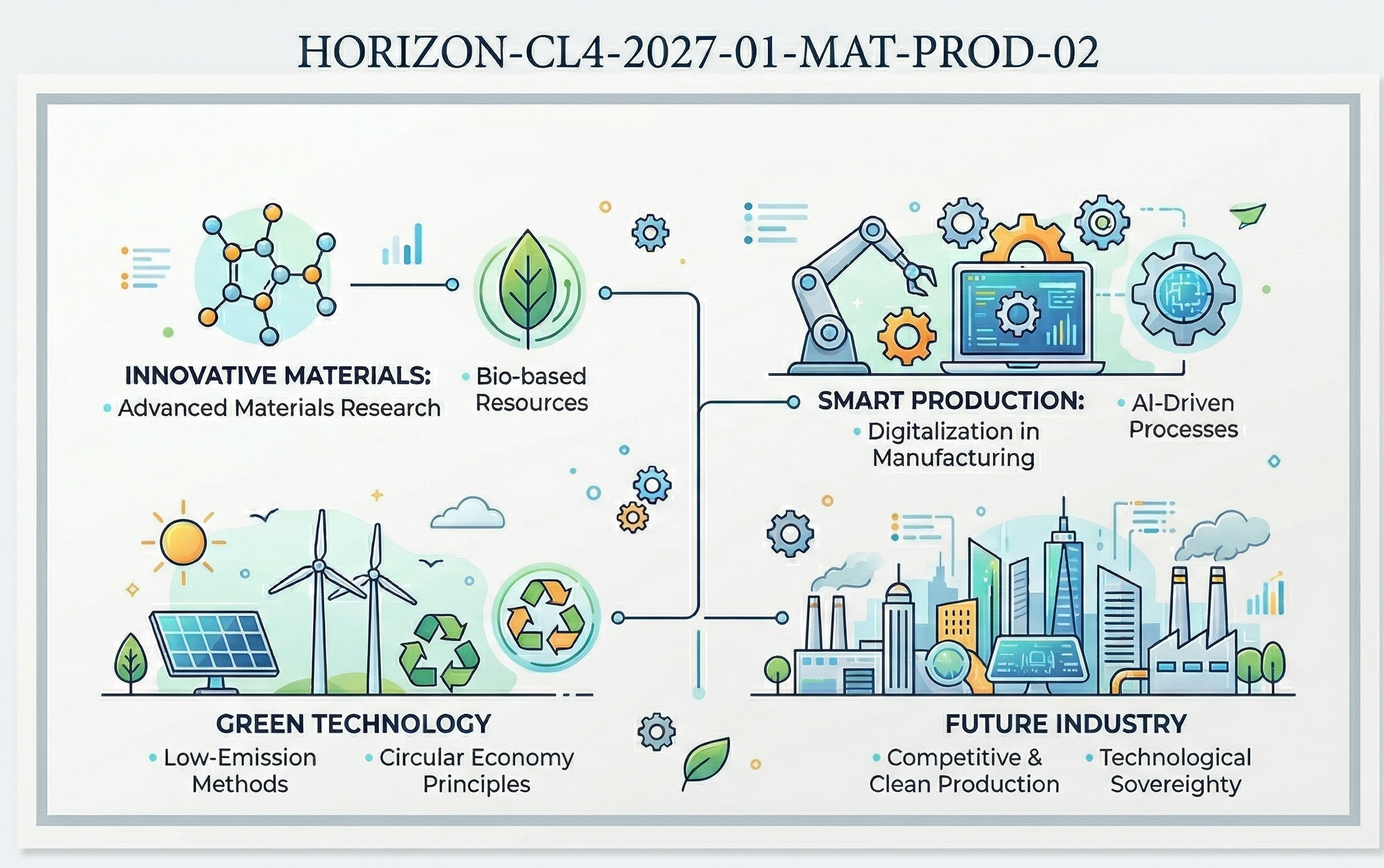
This topic is the Commission’s response to a real industrial anxiety: Europe is losing ground in the manufacturing of high-performance components. Not because the know-how isn’t there, but because the production technologies are ageing, supply chains run through non-European suppliers, and critical raw materials are imported at scale. The Commission wants projects that actually put new manufacturing capacity on the ground, reduce dependency on outside inputs, and do it in a way that closes material loops. It’s an Innovation Action, so the expectation is working technology, not papers.
Worth double-checking on the Funding & Tenders Portal once the call opens.
Download the MIC Horizon Europe 2026/2027 Calls Calendar:
Discover more!
Administrative facts: what do we know about the HORIZON-CL4-2027-01-MAT-PROD-02 call?
Which call is it, and when is the opening and the deadline?
- Call name: INDUSTRY
- Call identifier: HORIZON-CL4-2027-01
- Destination: Leadership in materials and production for Europe
- Topic: HORIZON-CL4-2027-01-MAT-PROD-02 – Advanced manufacturing for key products
- Type of action: Innovation Action (IA)
- Opening date: 22 September 2026
- Deadline: 02 February 2027
- Partnership: Made in Europe
What about the budget and estimated size of the project?
- Total indicative budget: EUR 36.00 million
- Number of projects expected: 6
- Budget per project: EUR 6.00 to 8.00 million (calculated average: EUR 6.00 million per project)
What are the key eligibility and evaluation conditions?
- Standard eligibility per General Annex B
- Chinese universities linked to MIIT: participation restricted (check General Annex B carefully)
- Portfolio approach applies: at least one funded project must focus on the automotive industry
- Battery production is explicitly out of scope (addressed separately under HORIZON-CL5-2026-05-D2-03)
- TRL: start at TRL 5, reach TRL 7 by project end
- Business case and exploitation strategy required; page limit extended by 3 pages for this purpose
- FAIR data principles apply where data exchange is involved
- International cooperation is encouraged, particularly with Japan or Taiwan
Scientific range: what does the Commission expect from the HORIZON-CL4-2027-01-MAT-PROD-02 grant?
What outcomes are expected?
By the project’s conclusion, a workable and proven manufacturing method and machinery at TRL 7 must be available and demonstrated for parts and products that Europe does not currently produce on its own. The Commission anticipates significant gains in material circularity and resource efficiency, as well as an increase in industrial competitiveness. A proposal with only a technical outcome and no obvious industrial application viability will not receive a high score.
What is within scope?
- High-performance component machinery and advanced production methods
- Replacing essential or imported resources with secondary raw materials, bio-based inputs, or revalued components
- Novel materials (lightweight, functionalized, self-healing) used in manufacturing applications; materials development is not the primary focus
- Where applicable, digital twins for materials and Safe and Sustainable by Design (SSbD) procedures
- Specific technologies: innovative additive manufacturing, hybrid manufacturing (additive and subtractive), photonics, advanced joining, polymer composite manufacturing, improved surface treatment and structuring, lightweight component production, and in-line testing
- Applications for automobiles are accepted
- Production of batteries, whether automotive or not, is outside the purview
What are the specifically proposed research directions?
- Redesigning the manufacturing processes to reduce reliance on essential raw resources
- Including bio-based secondary flows into current processes to produce high-performance parts
- Showcasing production techniques that use less foreign materials while maintaining the same level of quality
- Using digital twins or SSbD techniques to develop adaptable advanced materials to fit industrial processes
- In-line monitoring and quality control: although “in-line testing” is mentioned in the work programme, it should be emphasized because it is frequently overlooked in proposals
- Industrial uses with a strong business justification, particularly when Europe’s ability to produce these materials is at risk
- The Commission seems to be guiding toward industries where supply chain resilience is a current political concern, such as precision mechanics, medical devices, aerospace, and mobility (though not necessarily on batteries)
Scientific strategy: how can you enhance your chances of being funded through HORIZON-CL4-2027-01-MAT-PROD-02?
What scientific choices matter most?
- Choose a genuine product or component that is in danger of being lost to Europe; provide a clear product or component name in your proposal. The specification of the dependence problem is essential for review.
- Don’t make material development your main goal. The Commission advises against doing this. If additional content is needed, present it as an adaptation exercise with a clear objective – for example, following the completion of the SSbD validation task, the digital twin, etc.
- Aim for a believable TRL 7. It is feasible to get from TRL 5 to TRL 7 in a single project, but the strategy must be believable. Overly optimistic ventures that promise a TRL 7 demo beginning from a TRL 5 will be flagged by evaluators.
- The automotive argument. One automotive investment will be funded thanks to a portfolio structure. Make it obvious from the outset if this is pertinent to your technology.
- Begin constructing the business case right away. Evaluators will read the three additional pages given to this call. Think about who purchases the technology after the project and how much it costs.
- Display data pertaining to resource efficiency gains. Quantified improvement in reduced critical raw material use scores better than generic circularity claims.
- Mention cooperation with Taiwan or Japan specifically if it is feasible and appropriate (the Commission has specifically requested this).
Consortium & proposal-writing plan: what works best with this type of call?
- This is an IA, so the weight shifts toward industry. You’ll want manufacturers or technology providers as lead partners, not research labs. Academia plays a supporting role here, materials characterization, modeling, and SSbD assessment.
- Somewhere between eight and twelve partners is probably right, maybe a couple more if you’re covering multiple industrial sectors or regional value chains. Don’t pad the consortium to look broad.
- If you’re going for the automotive slot, make sure an automotive OEM or Tier 1 supplier is in the consortium. Reviewers will check.
- Include an innovative SME: SMEs can provide specialised equipment or surface-treating expertise that a larger partner lacks internally, and evaluators expect this.
- The three-page business case extension is a good opportunity; instead of using it to compile a list of general exploitation objectives, use it to produce an actual market study.
- Bring in early letters of intent if you intend to work with Taiwan or Japan; these bolster your claim regarding international cooperation.
- A writing tip: since evaluators use the scope of the work programme as a checklist, make sure the scope of your proposal precisely matches the content in that document.
How would microfluidics contribute to this topic?
Advanced manufacturing is essentially what takes place on the factory floor. However, characterising the behaviour of materials such as how a new secondary feedstock reacts to a polymer composite matrix or how a surface treatment endures cyclic load is necessary before it can take place on an industrial scale. These initial characterisation stages can be quickly studied in microfluidics. Microfluidic systems provide quick exploration of material combinations and process parameters using very small sample sizes, whereas conventional bulk testing methods are labour-intensive and material-intensive.
- Say you wish to qualify a bio-based resin for usage in a composite production line instead of a petrochemical binder. A chip-based flow cell can repeatedly demonstrate how that resin cures under different temperature and shear conditions on numerous formulations before you commit to a pilot run.
- Microfluidic sensors can provide real-time information on fluid and material properties at the process interface – the explicit goal of the work programme. Not one more step in the lab. On the line.
- Being able to provide microfluidic characterisation as part of a digital twin validation loop or as part of the SSbD design phases would be very beneficial. Microfluidic devices provide well-controlled, repeatable data points, and the quality of the input data is key.
- For lightweight material manufacturing involving adhesive bonding or composite lay-up techniques, interface behaviour is everything. Microfluidic tools let you study wetting, adhesion and delamination phenomena without damaging the sample.
The MIC already brings its expertise in microfluidics to Horizon Europe:
H2020-NMBP-TR-IND-2020

Microfluidic platform to study the interaction of cancer cells with lymphatic tissue
H2020-LC-GD-2020-3

Toxicology assessment of pharmaceutical products on a placenta-on-chip model

FAQ – HORIZON-CL4-2027-01-MAT-PROD-02
What is HORIZON-CL4-2027-01-MAT-PROD-02 really about?
This is a call for substituting or reducing the use of essential raw materials in European industrial production. The Commission finances initiatives that create new innovations on advanced materials (IAMs) or a redesign of production processes to minimize reliance on foreign or limited supplies in key industries.
Who should apply and how much funding is available?
Consortia of industrial and academic partners are welcome to apply. The overall budget is EUR 36 million, allocated to 6 projects with an allocation of EUR 6 to 8 million per project. The type of action is an Innovation Action (IA) that implies that industry has to play a leading role.
Which sectors and products are in scope?
Target industries are energy, mobility, construction, electronics, medical devices, and chemical industries. The production of batteries is excluded. The portfolio approach will guarantee that at least one of the automotive projects will be funded in case a qualifying proposal is presented.
What does TRL 5 to TRL 7 mean in practice for this call?
A TRL of 5 or above indicates that you have a technology that has been tested in a pertinent environment. At TRL 7, you should have a system prototype that has been shown to operate in a real environment. This is a serious leap within 3-4 years, thus, your proposal should demonstrate a plausible route – with industrial partners that can serve as hosts of demonstrations.
What makes a winning scientific strategy?
The point is to tie the proposal to a certain product or element at stake of being lost in terms of European production. Do not make material development the centre of attention. Develop the business case early, measure resource efficiency benefits, and incorporate SSbD across work packages as opposed to an individual task.
How should the consortium be structured?
Eight to twelve partners, industry-led. Add manufacturers or technology providers as leads, academia to do characterization and modeling, and at least one innovative SME to provide process or equipment knowledge. In case of the automotive slot, an OEM or Tier 1 supplier is necessary.
Is battery production in scope for this topic?
No. Battery manufacturing is a specific topic that is out of scope. It is dealt with separately under HORIZON-CL5-2026-05-D2-03. Any proposals that touch on battery chemistry or manufacturing would be out of scope, despite the wider context.
What role does SSbD play and why does it matter to evaluators?
The Safe and Sustainable by Design (SSbD) framework needs to be used throughout the innovation process, not just stated in the introduction. Evaluators hope it will be part of the decision-making, recorded in a transparent and traceable manner, and connected to the Common Data Platform where Chemicals are produced.
How can microfluidics strengthen a HORIZON-CL4-2027-01-MAT-PROD-02 proposal?
Microfluidics helps in screening of materials and characterization of processes on a small scale, before investing in costly pilot production. It aids digital twin validation, gives data by design compliant with FAIR, and allows real-time in-line monitoring of material behavior – all priorities in the HORIZON‑CL4‑2027‑01‑MAT‑PROD‑02 scope.
What are the most common proposal mistakes in this type of call?
- Viewing the proposal as a research project instead of an innovation action;
- Making the development of the material the center of attention;
- Not recognizing a particular European dependency; underestimating the business case section;
- Using SSbD as a formality instead of integrating it into work packages.