
EIC 2027 AIC 02: Advancing NAMs from Research to Biomedical Practice
Opening
Date not yet specified
Deadline
Keywords
EIC 2027 AIC 02
Organ-on-chip
validated prototypes
Human-relevant testing
External validation
NAM
animal use
Controlled exposure
Regulatory uptake
Your microfluidic SME partner for Horizon Europe
We take care of microfluidic engineering, work on valorization and optimize the proposal with you
HORIZON-EIC-2027-AIC-01: Translating Disruptive New Approach Methodologies (NAMs) into Practice
What should a NAM predict when animal and human evidence disagree?
A New Approach Methodology (NAM) should predict the human response relevant to its intended use. Agreement with an animal experiment is therefore insufficient when that experiment misses a known human effect. In a blinded study, Ewart and colleagues tested a human Liver-Chip against drugs with established clinical liver-toxicity profiles, including toxicities missed by animal studies. The findings concern that model and compound set, rather than every NAM. [1]
For EIC 2027 AIC 02, this makes the choice of reference evidence central to translation. The challenge seeks methods that users can apply to preclinical research or to testing the safety, efficacy or quality of medicinal products and medical technologies.
Microfluidics Innovation Center (MIC) could contribute the fluidic engineering needed for organ-on-chip NAMs. Within the completed Horizon 2020 LIFESAVER project, MIC developed a two-circuit perfusion system with controlled compound injection and sample collection for placental-barrier experiments. This provides an engineering basis for controlling exposure; biological predictive performance requires its own validation.
Download the MIC Horizon Europe 2026/2027 Calls Calendar:
Discover more!
Call facts and the restricted Stage 2 route
Which call is it, and when is the opening and the deadline?
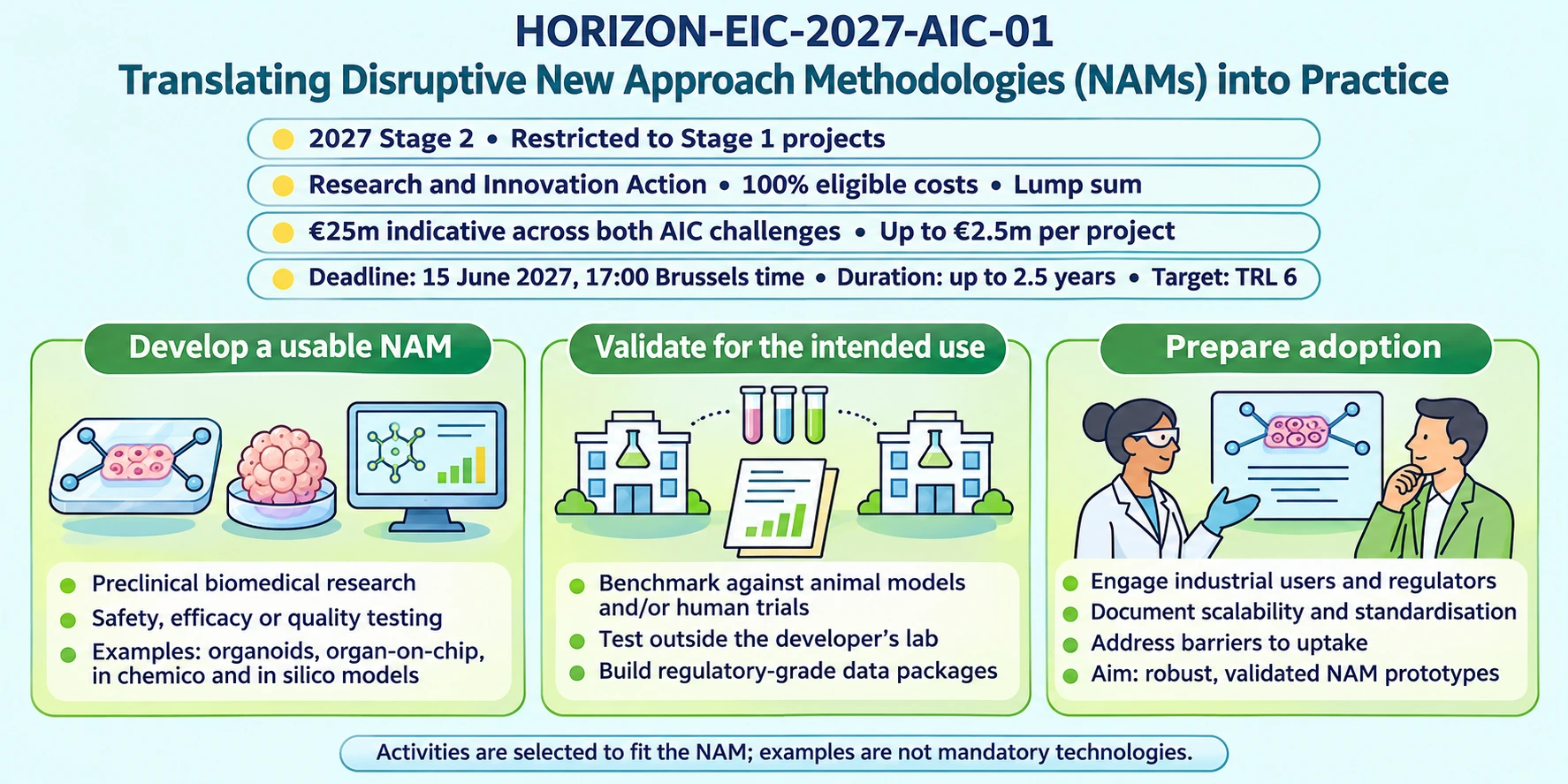
Call identifier: HORIZON-EIC-2027-AIC-01. Challenge IV.2: Translating Disruptive New Approach Methodologies (NAMs) into Practice. The 2027 call funds Stage 2 development and user testing. Only proposals selected for Stage 1 funding can progress through this restricted route.
- Deadline: 15 June 2027 at 17:00 Brussels local time. The work programme does not specify a Stage 2 opening date.
- Action and funding: Research and Innovation Action, funded through a lump sum at 100% of eligible costs.
- Indicative call budget: €25 million across both AIC challenges; this is not a NAMs-only allocation.
- EU contribution and duration: up to €2.5 million per project, for a maximum of 2.5 years.
- Technology readiness: the challenge starts from laboratory or in silico viability at Technology Readiness Level (TRL) 4 and targets TRL 6 after Stage 2.
Who can participate?
Eligible applicants include a single start-up, small or medium-sized enterprise (SME), or research-performing organisation in an EU Member State or Associated Country. Larger companies cannot apply alone. Two-entity consortia require independent entities in two different eligible countries. Three-entity consortia require one entity in a Member State and two others in different Member States or Associated Countries. More than three eligible entities is not permitted.
Small consortia must include the Stage 1 entity. The programme also addresses successor applicants with rights to the Stage 1 technology and results; any such arrangement must satisfy section IV and its associated eligibility conditions. Access to appropriate infrastructure and stakeholder interest are part of the challenge’s entry conditions.
Submit both the proposal and pitch presentation. Part B sections 1–3 plus the cover page have a 22-page limit; the pitch lasts 15 minutes. Evaluation addresses technical progress, user interest, deployment, scale-up and implementation. The applicable conditions are in the EIC Work Programme 2027, section IV and Annex 2.
What the NAM must deliver for users
EIC 2027 AIC 02 scope covers preclinical biomedical research and testing medicinal products or medical technologies for safety, efficacy or quality. Eligible technological approaches include human organoids, organ-on-chip and disease-on-chip systems, in chemico methods, digital twins, virtual patients, artificial-intelligence-enhanced predictive models, mechanistic in silico platforms and advanced three-dimensional human tissue models.
The intended Stage 2 outcome is a functional, scalable and validated NAM prototype suitable for regulatory, industrial or clinical uptake. The work programme requires activities to cover a number of the following elements, according to the proposed method:
- Benchmarking against state-of-the-art animal models and/or human trials, and demonstration in a relevant application.
- Consultation with industrial users, regulators, contract research organisations (CROs), standard-setting bodies or other relevant stakeholders.
- Testing and data collection outside the developer’s laboratory through suitable infrastructure.
- Regulatory-grade data packages and documentation of scalability, standardisation and barriers to uptake.
These activities should form a connected route from experimental evidence to a user’s decision. For example, a drug-safety method needs an explicit endpoint and an interpretation rule. A disease model needs a defined biological process and a demonstration that it can answer the selected research question. These are design recommendations, not additional technology requirements.
The expected impact includes stronger biomedical NAM validation, evidence to inform assessment practices and more harmonised tools for industry. Beneficiaries are encouraged to consider the EU Reference Laboratory for alternatives to animal testing (EURL ECVAM) for relevant standardisation, automation and validation support. This encouragement does not establish a compulsory facility or guarantee regulatory acceptance.
Design validation around exposure and the intended decision
For EIC 2027 AIC 02, start the validation plan with the proposed use: the test article, human endpoint, decision threshold and conditions under which a result will be interpreted. Choose reference cases that challenge the method, including negative controls and mechanisms likely to reveal its limits. Agree acceptance criteria before analysing the validation set.
For a perfused NAM, establish the exposure delivered through the whole wetted circuit. Winkler and Herland tested 15 neuropsychopharmaceutical compounds in recirculating barrier-chip systems. Under their experimental conditions, tubing sorption could dominate losses from the chip itself. Changing the chip material alone therefore did not resolve exposure uncertainty. [2]
A useful engineering plan separates three questions: does the instrument deliver the intended conditions, does the biological model retain its relevant function, and does the complete method support the intended prediction? Assign a measurable acceptance criterion to each. The criteria should reflect the application; the call does not prescribe universal flow tolerances or accuracy thresholds.
For external testing, provide a fixed protocol, reference materials, instrument settings and a method for recording deviations. Compare results across operators or laboratories before changing the interpretation rule. Treat a failed transfer as information about the procedure, consumables or model, and investigate the cause before expanding the claim.
Connect the developer with users and independent testing
For EIC 2027 AIC 02, build the work plan around complementary responsibilities: NAM development, biological or computational validation, independent testing and the intended user’s decision process. With a small consortium, each beneficiary needs a clear interface and access to the required expertise. Where organ-on-chip engineering is required, MIC could participate as a technical partner; consortium leadership remains with the coordinator.
The challenge requires a letter of intent from an interested industrial end user or regulatory body. For Stage 2, new or updated letters reflecting Stage 1 results and planned activities are encouraged. Use the AIC template. An endorsing external party must receive no incentive for the endorsement and cannot subsequently act as a subcontractor or service provider funded by the action.
As a planning recommendation, make user involvement operational: specify which test cases, data or facilities the user will provide and which result would support adoption. Allocate responsibility for data provenance, access permissions and review of the validation package. Record the software and protocol versions used for each result.
Prepare an initial business plan around the actual workflow: consumables, operator effort, failed runs, maintenance, throughput and transfer support. Use measured project evidence for these assumptions. The Stage 2 pitch should connect Stage 1 results with user engagement and credible milestones for scaling the solution.
Where MIC could strengthen an organ-on-chip NAM
For a NAM that depends on controlled perfusion, MIC could design and integrate the fluidic circuits, injection sequence, environmental monitoring and sample collection. The proposed output would be an instrumented exposure workflow with operating procedures and qualification results that the biological team can use in its validation study.
MIC’s molecular transport platform independently controls the two sides of a barrier and combines recirculation, temperature control, oxygen monitoring and automated sampling. Its architecture is relevant when the experimental question requires separate donor and receiver compartments.
Fournier and colleagues, including MIC researchers, demonstrated automated transport measurements with acellular biomimetic membranes. That 2026 study establishes physical transport and instrument capabilities; it does not establish clinical prediction or a validated living placental model. [3]
In an EIC 2027 AIC 02 consortium, a proposed MIC task could deliver the fluidic design, time-stamped exposure and sampling records, a method for checking compound recovery, and transfer support for an external laboratory. Biological partners would define the cells or tissues, culture acceptance criteria and functional endpoints. The validation team would assess prediction against relevant reference evidence.
This division follows MIC’s consortium-partner role: develop the engineering needed for the assay and help partners integrate and test it. It keeps the instrument contribution connected to a usable NAM without attributing the consortium’s biological or regulatory conclusions to MIC.
The MIC already brings its expertise in microfluidics to Horizon Europe:
H2020-NMBP-TR-IND-2020

Microfluidic platform to study the interaction of cancer cells with lymphatic tissue
H2020-LC-GD-2020-3

Toxicology assessment of pharmaceutical products on a placenta-on-chip model

About the author

Céleste Chidiac, PhD
Scientific writer and digital marketing specialist
Céleste Chidiac holds a doctorate in neuroscience and molecular biology from the University of Strasbourg. Since joining the Microfluidics Innovation Center in 2023, she has combined scientific writing with website management. For MIC’s Horizon Europe topic pages, she draws on her research background to explain scientific challenges and clarify funding priorities. Her writing helps prospective applicants understand each topic’s scope, expected outcomes and research directions.
FAQ — EIC 2027 AIC 02: Interpreting and transferring NAM results
These questions address experimental controls, model limitations and data interpretation that matter when a NAM moves into a user’s workflow.
Can a human-cell NAM still contain animal-derived materials?
Yes. Human cells do not by themselves make the entire method animal-free. For example, the Liver-Chip study used fetal bovine serum during endothelial-cell expansion. Review media, matrices and reagents separately when describing replacement of animal use. [1]
Does a more complex model always give a better prediction?
No. For development planning, add a cell type, organ compartment or algorithm only when it addresses a defined limitation and can be evaluated. Compare the added complexity with a simpler baseline using the same intended endpoint. Complexity is a design choice, not an acceptance criterion.
What do sensitivity and specificity mean for a safety assay?
Sensitivity measures the fraction of known positives detected; specificity measures the fraction of known negatives correctly classified. Interpret both with the reference set, threshold and exposure conditions. A high value on one compound panel does not establish performance on untested substances. [1]
Does changing the chip polymer solve compound loss?
Not necessarily. Tubing, reservoirs and connectors also contact the test compound. Winkler and Herland found substantial tubing-related losses in their recirculating system. Include tubing-only and cell-free circuit controls, then measure recovery for the actual compound, medium and exposure period. [2]
What can an acellular barrier experiment establish?
It can characterise physical transport and instrument behaviour without cellular variability. Fournier and colleagues used this approach to study transport through biomimetic membranes. Demonstrating those functions does not demonstrate active cellular transport or a tissue’s biological response. [3]
Why does recirculation change the interpretation of exposure?
Recirculation returns liquid, so earlier dosing and sampling alter later concentrations. Track volumes and compound amounts in each compartment. Synchronized sampling helped interpret non-equilibrium transport in the acellular platform study. [3]
Can a transport simulation replace concentration measurements?
A simulation needs experimentally supported parameters and validation. Grant and colleagues combined measured partitioning and diffusion with a finite-element model to estimate amodiaquine concentrations in a PDMS lung-chip system. The computed concentration field remained a model prediction tied to that experimental characterisation. [4]
How should an apparently inactive compound be investigated?
Check delivery and assay function before interpreting inactivity as a biological result. Confirm compound recovery, include an appropriate positive control, and examine the exposure time. The material-loss experiments of Winkler and Herland show why nominal reservoir concentration alone can be misleading. [2]
What should accompany a dataset transferred to another laboratory?
As a practical transfer package, include the protocol version, sample identities, instrument configuration, calibration records, units, timestamps, processing steps and deviations. Keep raw measurements alongside processed outputs. Define how failed runs are labelled so that the receiving laboratory can reproduce the analysis and understand exclusions.
What would biological partners need to supply for a MIC engineering task?
They would define the model, medium, exposure schedule, allowable mechanical conditions and biological readouts. MIC could translate those requirements into fluid delivery and sampling specifications, then support integration and testing. The biological team would remain responsible for demonstrating that the model answers the intended biological question.
References
[1] Ewart, L., Apostolou, A., Briggs, S. A., et al. Performance assessment and economic analysis of a human Liver-Chip for predictive toxicology. Communications Medicine. 2022;2:154. doi:10.1038/s43856-022-00209-1
[2] Winkler, T. E. and Herland, A. Sorption of Neuropsychopharmaca in Microfluidic Materials for In Vitro Studies. ACS Applied Materials & Interfaces. 2021;13(38):45161–45174. doi:10.1021/acsami.1c07639
[3] Fournier, O., Neves, M. A. D., Gavoille, T., Morin, A., Pais, B., Brenta, I., Lereculey-Beaumanoir, J., Cruz, A., Santos, D., Oliveira, H., Gasik, M., Muiznieks, L. D. and Mendes Pinto, I. Automated Microfluidic Platform for Molecular Transport Analysis across Biomimetic Interfaces. Advanced Sensor Research. 2026;5(1):e00166. doi:10.1002/adsr.202500166
[4] Grant, J., Özkan, A., Oh, C., Mahajan, G., Prantil-Baun, R. and Ingber, D. E. Simulating drug concentrations in PDMS microfluidic organ chips. Lab on a Chip. 2021;21(18):3509–3519. doi:10.1039/D1LC00348H