
EIC 2027 AIC 01: Physical AI systems for autonomous deployment and user testing
Opening
Date not yet specified
Deadline
Keywords
EIC 2027 AIC 01
Physical AI
Embodied intelligence
Autonomous laboratories
Robot assistant
AI robotics
Human-AI interaction
Deployment loops
User testing
Your microfluidic SME partner for Horizon Europe
We take care of microfluidic engineering, work on valorization and optimize the proposal with you
HORIZON-EIC-2027-AIC-01: Accelerating Physical AI: Embodied Intelligence for the Next Frontier of AI-Powered Robotics
Why should an autonomous experiment sometimes test a less promising condition?
An experiment can be useful for the uncertainty it reduces, even when it is not expected to give the best immediate result. A self-directed laboratory must balance improving a known solution with exploring conditions it understands less well. Li and colleagues implemented this balance in PoLARIS, a microfluidic laboratory that combined automated synthesis and optical measurements with machine-learning selection of experiments on double perovskite nanoplatelets. [1]
This connects artificial intelligence (AI) to physical experimentation: the system acts, measures what happened and uses that evidence to choose its next action. EIC 2027 AIC 01 applies this ambition to autonomous laboratories, disaster-response systems and robot assistants, with an emphasis on integrated solutions tested with users.
For the autonomous-laboratory application, Microfluidics Innovation Center (MIC) could contribute controlled liquid handling and instrument feedback. Its automatic droplet size regulator measures droplets optically and feeds the measurements back to pressure control. This is a concrete basis for the experimental hardware layer of a self-directed workflow.
Download the MIC Horizon Europe 2026/2027 Calls Calendar:
Discover more!
Call conditions for the restricted Stage 2
Which call is it, and when is the deadline?
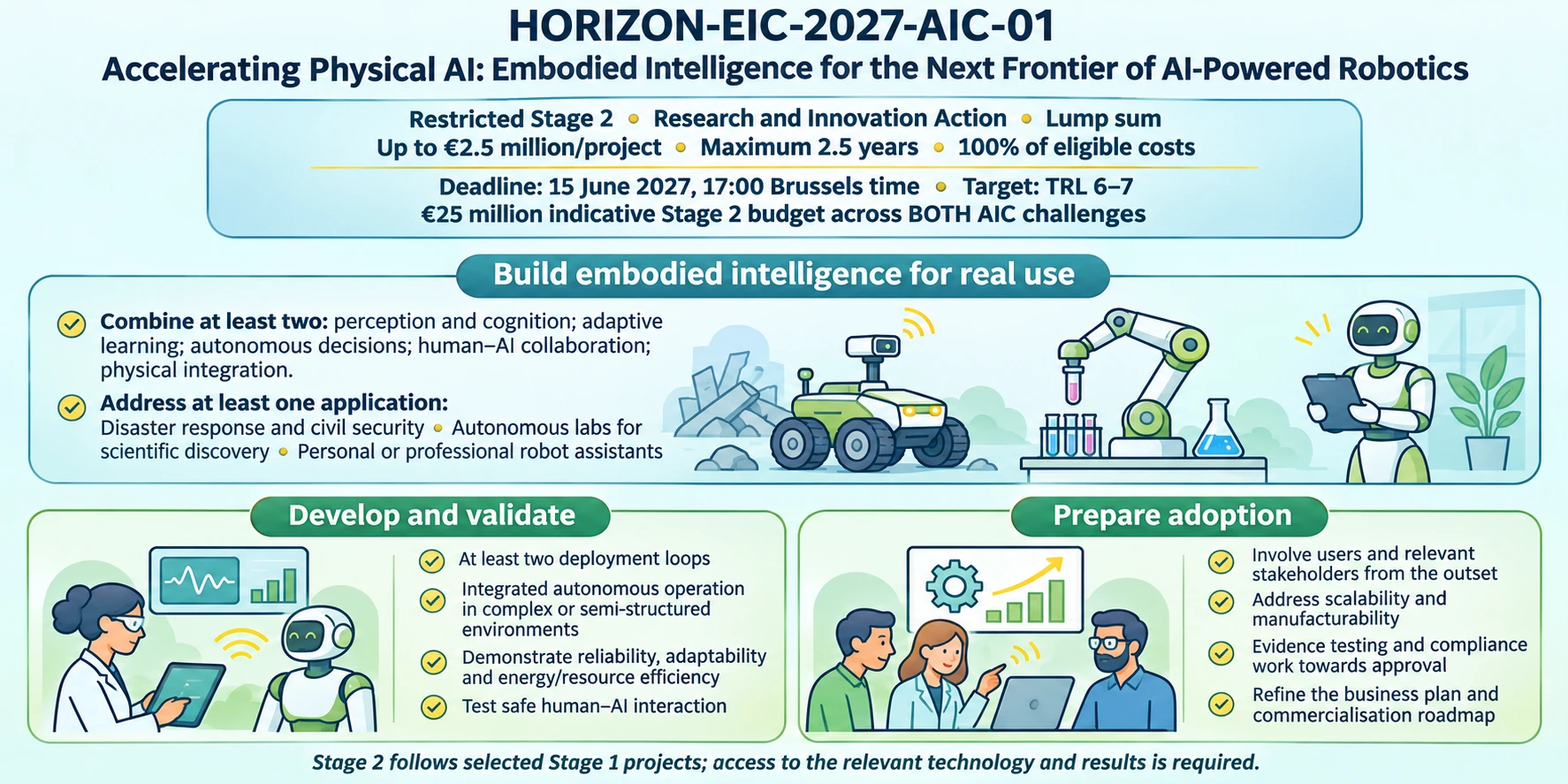
HORIZON-EIC-2027-AIC-01 is the 2027 Advanced Innovation Challenges call reference (official call page). This page covers its Accelerating Physical AI challenge. The deadline is 15 June 2027 at 17:00 Brussels local time.
- Action: Research and Innovation Action, with lump-sum funding covering 100% of eligible costs.
- Project support: EU contribution up to €2.5 million, for a maximum of 2.5 years, plus Business Acceleration Services.
- Budget: €25 million indicative funding for the Stage 2 call across both AIC challenges. This is not a dedicated €25 million Physical AI allocation.
Who can enter?
Stage 2 follows proposals selected for Stage 1 funding. The Stage 1 entity must participate, or the applicant must demonstrate the necessary rights to use its technology and results. The official AIC eligibility guidance allows new partners to join where they add complementary expertise. An unrelated new project cannot enter directly.
Eligible configurations are a single start-up, small or medium-sized enterprise (SME), or research-performing organisation in an EU Member State or Associated Country; two independent entities from two different Member States or Associated Countries; or three independent entities in three such countries, with at least one in a Member State. Larger companies cannot apply alone. Consortia exceeding three eligible entities are ineligible; the applicable EIC annex conditions also apply.
Submission and assessment: submit the proposal and pitch presentation as PDFs through the Funding & Tenders Portal. Part B sections 1–3 and its cover page are limited to 22 A4 pages. A 15-minute pitch should connect Stage 1 results, user engagement, Stage 2 milestones and an initial business plan. Evaluation thresholds are 4/5 for excellence, 4/5 for impact and 3/5 for implementation. Passing thresholds does not guarantee selection.
What the Physical AI solution must demonstrate
The EIC 2027 AIC 01 concerns AI that perceives and acts through a physical system. Proposals must demonstrate at least two of five characteristics:
- Perception and cognition: sensing, understanding and reasoning in real time.
- Adaptive learning and optimisation: improvement, adaptation to a domain or intelligent resource management.
- Autonomous decisions and collective intelligence: problem-solving, action or swarm coordination in changing environments.
- Human–AI collaboration: intuitive interaction and collaborative robotics.
- Physical integration: novel sensors, actuators or materials enabling embodied intelligence.
At least one application must address disaster response and civil security, autonomous laboratories for scientific discovery, or personal or professional robot assistants. These are alternative application areas; a proposal need not cover all three. The research must retain a civil focus.
Stage 2 expects a robust integrated solution, at least two deployment loops and progress to technology readiness level (TRL) 6–7. The endpoint is autonomous operation in complex or semi-structured environments, with evidence of reliability, adaptability, energy/resource efficiency and safe human–AI interaction.
Development must address scalability and manufacturability, stakeholder consultation, and the testing and documentation needed towards certification or regulatory approval. Responsible AI, security, transparency, accountability, privacy and human-centred design belong in the system requirements. For autonomous or semi-autonomous wet-lab work, the challenge’s additional safeguards include applicable biosafety and containment rules, automated screening of AI-generated or selected biological sequences, agents and protocols against recognised dual-use and controlled-agent lists, and mandatory human authorisation checkpoints for the activities specified in footnote 108.
Design deployment loops that produce decision-ready evidence
A useful EIC 2027 AIC 01 proposal turns each deployment loop into a testable engineering question. In the first loop, deploy the integrated system in the intended setting, record where it succeeds or fails, and collect user feedback. In the next, test whether the resulting changes resolve those problems. This is a suggested implementation of the required loops, rather than a prescribed allocation of work packages.
Agree acceptance criteria with users before testing. Depending on the application, these could include task completion, intervention frequency, recovery time, sensing errors, material consumption or energy per completed task. Report the operating conditions and failures alongside successful runs. Set numerical targets from Stage 1 evidence and user needs, rather than borrowing them from another robot.
For autonomous laboratories, validate the measurement used to choose the next experiment. PoLARIS compared its online optical proxy with independent photoluminescence measurements and identified limits if particle morphology changed substantially. Its result concerns that synthesis space, not every laboratory process. [1]
Keep a record connecting observations, decisions, actuator commands and outcomes. This helps distinguish a planning error from an execution or measurement problem. Reserve time to test the full assembly after hardware, software or workflow changes; component performance alone cannot establish the integrated deployment result.
Connect the team to users, deployment sites and uptake
For EIC 2027 AIC 01 proposal, organise responsibilities around the system’s interfaces: AI and control, physical hardware, application expertise, deployment and exploitation. One organisation may cover several responsibilities. A small consortium needs clear ownership of integration, test decisions and access to facilities, data and relevant intellectual property.
Demand-side involvement should begin from the outset. Users can help define the task, assess its operational value and identify obstacles to adoption. Their involvement need not take the form of consortium membership. Make any proposed access to a site, equipment or staff concrete and support it with the corresponding commitment.
The 2027 programme encourages new or updated letters of intent reflecting Stage 1 results and Stage 2 plans. An external letter should use the AIC template and come from an interested user or customer. It must confirm that no incentive was exchanged for endorsement. Its signatory cannot act as a subcontractor or service provider, or receive money or other support from the action; the detailed letter conditions are in the Stage 2 application provisions.
The commercialisation roadmap should connect the proposed product to a user’s purchasing decision. Explain how production, integration, maintenance and the required compliance work affect adoption. Use consultation meetings to refine those assumptions. The business plan and scaling strategy are expected project work, alongside technical development and user testing.
Where MIC could support autonomous laboratory integration
For EIC 2027 AIC 01, an autonomous laboratory needs a physical execution layer that can deliver the experiment selected by its AI and return usable observations. For workflows based on liquids, MIC could contribute as a consortium partner through fluid handling, sensing and feedback integration.
MIC’s sequential injection device uses a distribution valve linked to pressure control to select connected reservoirs. Its inline flow sensor measures liquid flow and detects internal clogging and measurement drift. Together with its droplet-regulation work, these functions support a defined task: connecting commanded fluid conditions to measured experimental conditions.
A proposed contribution could deliver an instrument-control interface, a fluidic execution module and a validation report covering repeatability, carryover and recovery after interrupted runs. AI specialists would define experiment selection and decision logic; application researchers would establish the scientific readout and its interpretation. The intended user would assess the combined workflow in the deployment setting.
The fluidic work should test the relevant liquids, materials, operating range and cleaning procedure. Reservoir switching and a stable sensor signal do not by themselves establish biological validity or autonomous scientific reasoning. MIC’s development and laboratory-transfer work could support the instrument integration and user trials within that defined scope.
The MIC already brings its expertise in microfluidics to Horizon Europe:
H2020-NMBP-TR-IND-2020

Microfluidic platform to study the interaction of cancer cells with lymphatic tissue
H2020-LC-GD-2020-3

Toxicology assessment of pharmaceutical products on a placenta-on-chip model

About the author

Céleste Chidiac, PhD
Scientific writer and digital marketing specialist
Céleste Chidiac holds a doctorate in neuroscience and molecular biology from the University of Strasbourg. Since joining the Microfluidics Innovation Center in 2023, she has combined scientific writing with website management. For MIC’s Horizon Europe topic pages, she draws on her research background to explain scientific challenges and clarify funding priorities. Her writing helps prospective applicants understand each topic’s scope, expected outcomes and research directions.
FAQ — Scientific choices in embodied AI and autonomous laboratories
These questions address experimental decisions, physical interfaces and the interpretation of evidence in autonomous systems.
Does physical AI require a humanoid robot?
No. Embodiment means that the AI senses and acts through a physical system. A mobile civil-security agent, a laboratory instrument or a robot assistant can satisfy that description. The relevant architecture follows the task and the challenge’s capability and application requirements; a human-like shape is not a requirement.
Is a fixed feedback controller already an autonomous scientist?
No. A controller can maintain a set point without selecting a scientific question or deciding what to investigate next. MIC’s automatic droplet size regulator illustrates feedback between optical sensing and pressure actuation. Experiment selection and scientific interpretation are separate functions that require their own design and evaluation.
Should an optimiser be allowed to choose physically infeasible experiments?
No. Define allowable conditions before selecting experiments, including actuator ranges, fluid compatibility and any applicable safety restrictions. PoLARIS used operating constraints when defining its search space. [1] Teams should review those constraints when the apparatus or process changes.
How should a team choose its baseline?
Use the workflow the intended user would otherwise adopt, with comparable inputs and operating conditions. Depending on the task, that may be a manual process, a scripted automation sequence or an existing controller. Report which parts of the comparison share hardware and data so that improvements can be attributed to the changed component.
Can a robot’s task-success score hide excessive supervision?
Yes, if the score counts completion without recording human assistance. A useful test report separates autonomous completion, completion after intervention and aborted attempts. It should also record the intervention’s duration and purpose. This is a recommended reporting choice, not a universal metric prescribed by the call.
Should a laboratory keep the same optimisation signal after changing its instrument?
Only after checking that the signal still represents the intended scientific property. PoLARIS tied its optical proxy to a specific validated measurement relationship. [1] After an instrument or protocol change, compare the new readout with an independent reference before reusing earlier calibration or performance claims.
What information should survive an interrupted experiment?
Retain the sample identity, last confirmed physical state, executed commands, measurement timestamps and interruption reason. The restart procedure should specify whether the run can resume or needs to be discarded. Keeping commanded and observed states separate helps prevent a partially completed operation from being recorded as a valid experiment.
How should resource efficiency be compared between systems?
Define the same useful output and count the resources needed to obtain it. For a laboratory workflow, include preparation, cleaning and failed runs as well as successful measurements. For a robot task, state whether sensing, computation and standby energy are included. This makes the comparison interpretable across different architectures.
What can a liquid-flow alert establish in an autonomous laboratory?
It can identify a fault within the measurement scope of the sensor. MIC’s inline flow sensor detects internal clogging and measurement drift. Such an alert does not establish the condition of every component or the validity of the assay; the application needs additional checks for its relevant failure modes.
How can teams distinguish adaptation from a new operating task?
State the conditions and task boundaries covered by the validation. Adjusting behaviour within those boundaries is different from moving to a new environment, sample type or purpose. Record what changed and decide which tests need repeating. The resulting evidence should identify the supported use, rather than imply general autonomy.
References
[1] Li, J., Delgado-Licona, F., Liu, Z., Perry, H., Xu, J., Mukhin, N., Sadeghi, S., Chen, O. and Abolhasani, M. Autonomous microfluidic experimentation for exploring reaction inference and synthesizing double perovskite nanoplatelets. Nature Communications. 2026;17:4514. doi:10.1038/s41467-026-72765-2