
Tips & Tricks for a successful HORIZON-MISS-2027-01-CLIMA-02 proposal
Opening
09 February 2027
Deadline
Keywords
Mission Adaptation
coastal flooding
data accessibility
regional authorities
AI optimization
climate resilience
machine learning
resource management
EU mission
Your microfluidic SME partner for Horizon Europe
We take care of microfluidic engineering, work on valorization and optimize the proposal with you
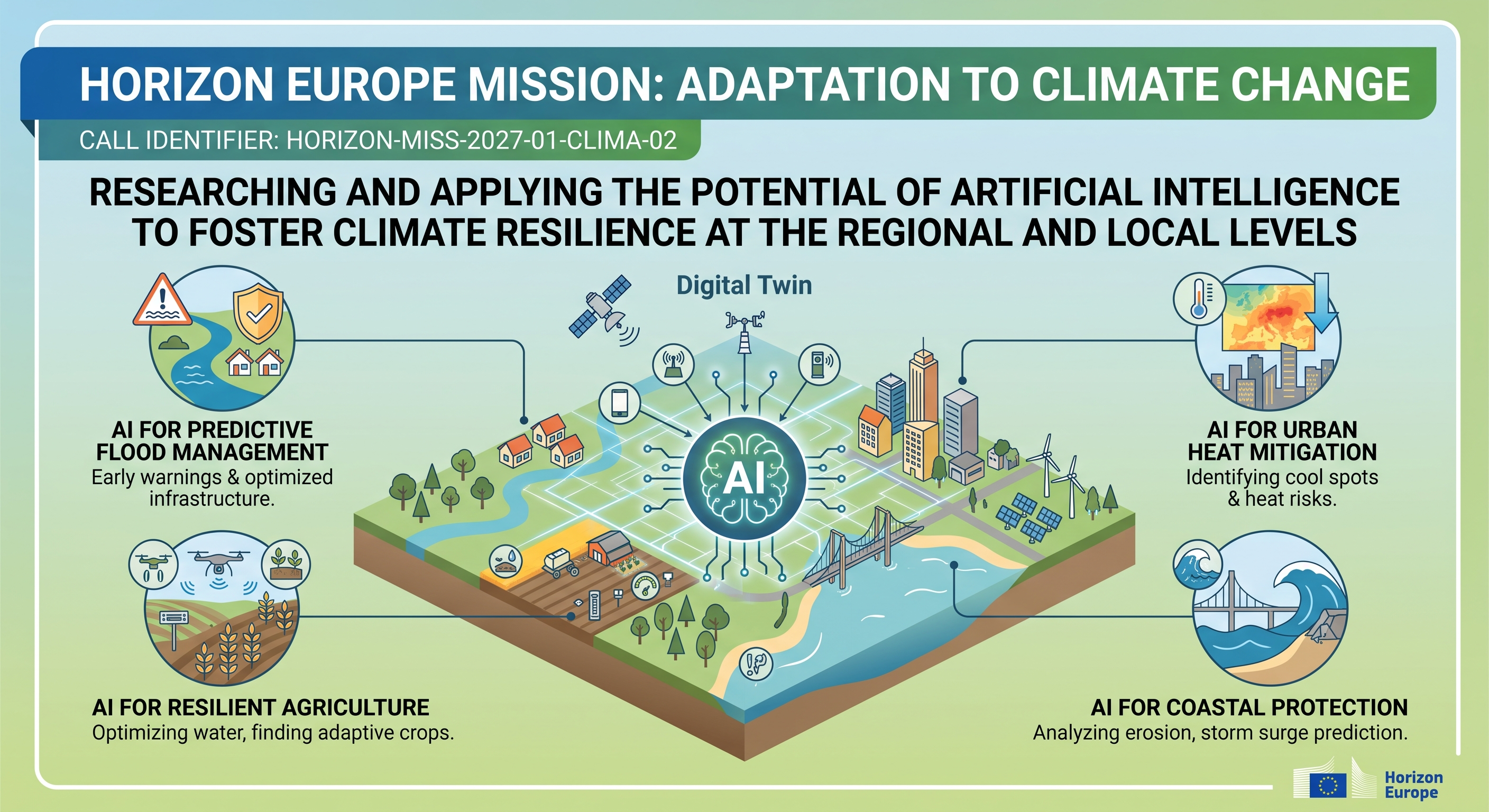
HORIZON-MISS-2027-01-CLIMA-02: Researching and applying the potential of Artificial Intelligence to foster climate resilience at the regional and local levels
It is a topic for funding Research and Innovation Actions (RIA) under the EU Mission on Adaptation to Climate Change, putting Artificial Intelligence to work for climate resilience at the regional and local levels. The Commission wants usable tools for regions and local authorities, not lab prototypes. It also feeds the AI Continent Action Plan.
Download the MIC Horizon Europe 2026/2027 Calls Calendar:
Discover more!
Administrative facts: what do we know about the HORIZON-MISS-2027-01-CLIMA-02 call?
Which call is it, and when is the opening and the deadline?
- Call name: Supporting the implementation of the Adaptation to Climate Change Mission
- Call identifier: HORIZON-MISS-2027-01
- Destination: Adaptation to Climate Change
- Topic: HORIZON-MISS-2027-01-CLIMA-02
- Opening date: 09 February 2027
- Deadline: 21 September 2027, 17.00 Brussels local time
- Type of action: Research and Innovation Action (RIA)
What about the budget and estimated size of the project?
- Topic budget: EUR 12.00 million
- Number of projects expected: 4
- Budget per project: EUR 3.00 million (12.00 divided by 4), the Commission estimate
- Funding form: lump sum
What are the key eligibility and evaluation conditions?
- Standard eligibility (General Annex B): at least three independent legal entities from three different Member States or Associated Countries
- Award thresholds (General Annex D): the usual RIA minimums, each criterion out of 5, overall pass mark of 10 out of 15
- Balanced portfolio rule: the top ranked proposal within each of the two objectives gets funded, provided all thresholds are met
- You must state the objective, objective 1 or objective 2, in the free keywords field
- Mission Implementation Platform and Community of Practice collaboration expected, and budgeted for
- No JRC, single stage
Scientific range: what does the Commission expect from the HORIZON-MISS-2027-01-CLIMA-02 grant?
What outcomes are expected?
By the end of the grant, an AI tool should exist that a real region or local authority is using. Either it makes climate data usable for decision-making, or it makes a specific sector measurably more resilient while pushing its digital transformation. Publication series are not what the Commission is after.
What is within scope?
- Objective 1, AI for more accessible data: AI, including deep learning, to turn complex climate datasets into something decision-makers can read and act on. Tested with at least three regional or local authorities.
- Objective 2, AI for sectoral adaptation: machine learning and AI to optimise resource management and adaptation technologies in a chosen sector. Developed and tested across at least five authorities, with private sector actors involved.
- Named sectors include smart agriculture, buildings and construction, water management, waste, transport, energy system resilience.
- Every project must deliver training and dissemination material so authorities can actually use the tool.
Incremental tweaks to existing models will not fly. Show a specific gap and go beyond the state of the art.
What are the specifically proposed research directions?
- Integrating climate data into decision-making at regional and local level
- Using or enhancing Destination Earth (DestinE) data, tools and services under Objective 1
- Sector-specific tools built for scalability and uptake, not one-off demos
- Bias control and representative data, plus handling the limits and misinformation risks of generative AI
- Linking monitoring to the UNDERPIN framework and using CLIMAAX for climate risk assessment
Scientific strategy: how can you enhance your chances of being funded through HORIZON-MISS-2027-01-CLIMA-02?
What scientific choices matter most?
- Pick your objective and commit. The balanced portfolio rule funds the top proposal in each objective. Being clearly the best in objective 2 can beat being fourth in a crowded objective 1.
- Name your regions early. Objective 1 needs three authorities, objective 2 needs five. Letters of support from named regions beat vague promises.
- Show the gap current tools cannot close.
- Bring the end-users in as partners, not as a testing afterthought.
- Plan for the Mission from day one. Budget the Community of Practice and platform links.
Consortium & proposal-writing plan: what works best with this type of call?
- For a EUR 3 million RIA, somewhere between six and ten partners usually works, maybe a couple more if you need wide regional coverage.
- You need real regional and local authorities inside the consortium, or firmly committed as third parties. This is the heart of the call.
- Mix AI and data science groups with climate and sector experts. Objective 2 especially needs a private partner.
- If you can bring an innovative SME that builds deployable tools, do it. It signals uptake.
- Interdisciplinary and intersectoral balance is scored, so do not stack five AI labs and call it a consortium.
- Writing tip: keep your impact section tied to the two expected outcomes, almost word for word.
How would microfluidics contribute to this topic?
Let us be honest. Microfluidics is not the centre of gravity here. This is an AI and data call. But data has to come from somewhere, and that is where microfluidic sensing can earn a seat, mostly under water management or smart agriculture.
- Say your Objective 2 tool manages water under drought or flood stress. Microfluidic sensors can feed it live readings on quality and contaminants. Your AI is only as good as the ground truth under it.
- Cheap, portable lab-on-chip devices let a region collect its own environmental data instead of leaning on sparse public datasets. That serves Objective 1 directly.
- You get the same answer twice across sites, which matters when your tool must behave the same in five territories.
Point is, microfluidics here is a data source, not the headline. If your proposal already leans on environmental monitoring, a sensing partner reinforces the data layer everything else sits on. If it does not, do not force it.
The MIC already brings its expertise in microfluidics to Horizon Europe:
H2020-NMBP-TR-IND-2020

Microfluidic platform to study the interaction of cancer cells with lymphatic tissue
H2020-LC-GD-2020-3

Toxicology assessment of pharmaceutical products on a placenta-on-chip model

FAQ - HORIZON-MISS-2027-01-CLIMA-02
So what is this AI call actually about?
It is about using Artificial Intelligence to help European regions and local authorities adapt to climate change. Either AI makes climate data usable for decision-making, or it makes a specific sector more resilient while advancing its digital transformation.
Who can apply and how much money is on the table?
Standard eligibility applies, so at least three independent entities from three different Member States or Associated Countries. The topic budget is EUR 12.00 million, with around EUR 3.00 million per project, four projects expected, funded as a lump sum.
What are the two objectives, and do I have to pick one?
Yes, you pick one. Objective 1 is AI for more accessible data. Objective 2 is AI for sectoral adaptation. You must flag the objective in the free keywords field, for example objective 1 or objective 2.
Check the Funding and Tenders Portal for more information.
How many regions do I need to involve?
It depends on your objective. Objective 1 needs testing with at least three regional or local authorities. Objective 2 needs at least five. Name them early and get letters of support.
What does the balanced portfolio rule mean for me?
Grants go to the top ranked proposal within each objective, not only in overall order of ranking, provided all thresholds are met. So being clearly the best in objective 2 can beat sitting fourth in a crowded objective 1.
Where does microfluidics fit in an AI call?
As a data source. This is an AI call, but the AI needs ground truth. Microfluidic sensors can feed live environmental readings, mostly under water management or smart agriculture. Do not force it if your proposal has no monitoring layer.
What kind of consortium works best for this topic?
Somewhere between six and ten partners usually fits a EUR 3 million RIA. You need real regional and local authorities inside, AI and data teams alongside climate and sector experts, and ideally an innovative SME to carry uptake.
What is in scope and what is out of scope?
In scope: AI tools developed and tested with real authorities, with a clear gap beyond the state of the art. Out of scope in practice: incremental tweaks to existing models, or tools that are never tested in the field with regions.
What usually sinks these proposals?
Vague regions with no firm commitment. No specific gap that current tools cannot close. No budget for Mission collaboration. And no plan for training, dissemination or uptake, which the call asks for explicitly.
How do I handle the links to the Mission and other projects?
Budget collaboration with the Mission Implementation Platform and the Community of Practice. Link your monitoring to the UNDERPIN framework, and use CLIMAAX for climate risk assessment where relevant.