
Tips & Tricks for a successful HORIZON-CL5-2027-03-D5-03 proposal
Opening
15 December 2026
Deadline
Keywords
battery passports
circular economy
lifecycle data
reuse, recycle
e-mobility
digital product passport
2ZERO Partnership
smart charging
ecodesign
Your microfluidic SME partner for Horizon Europe
We take care of microfluidic engineering, work on valorization and optimize the proposal with you
HORIZON-CL5-2027-03-D5-03: Data-driven circular economy for e-mobility ecosystem (2ZERO Partnership)
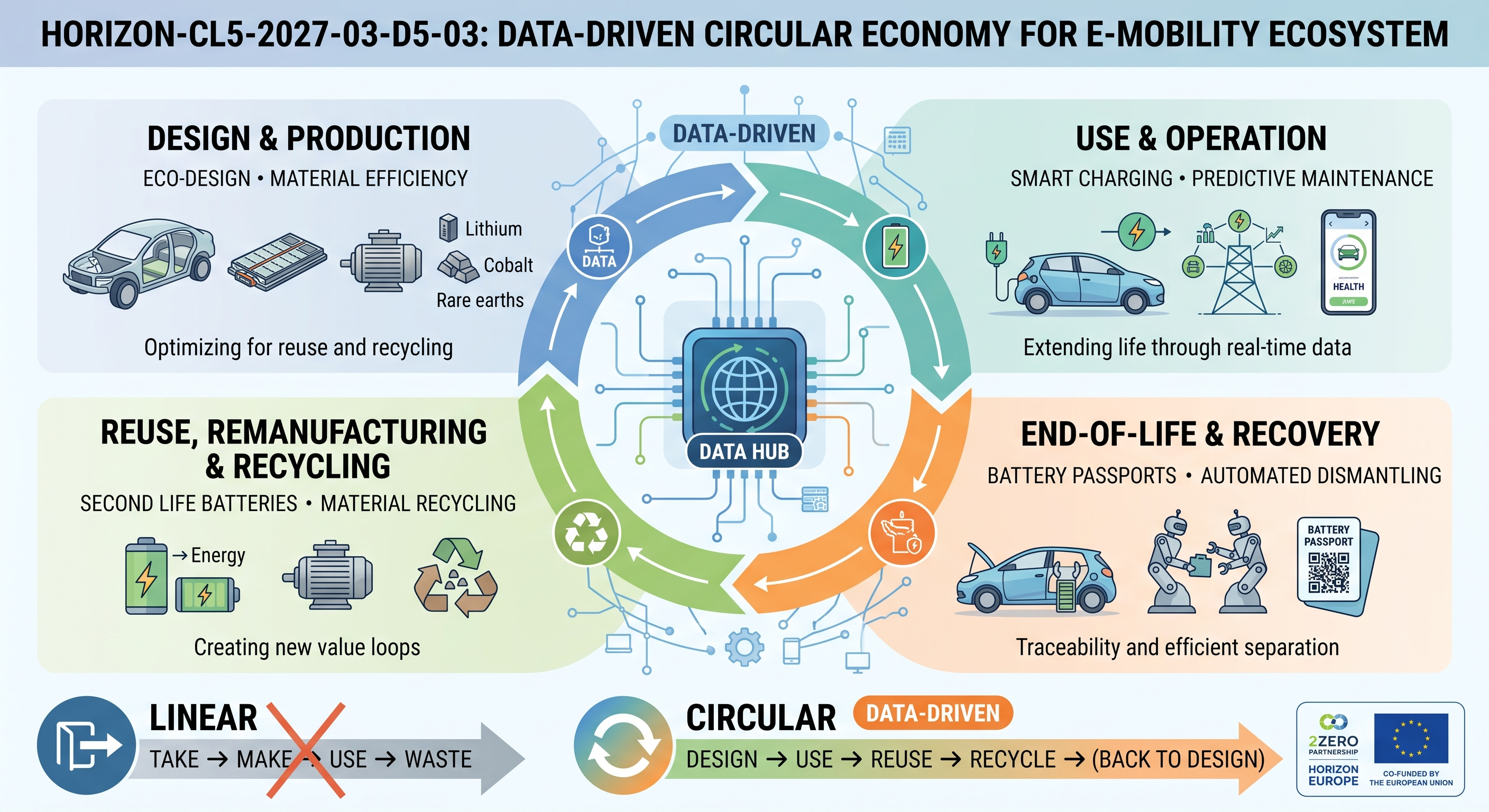
Electric vehicles are clean to run and still messy to retire. This topic asks what happens to drivetrains, power electronics and charging hardware after the first life. Circular design on one side, usable lifecycle data on the other. Two areas, one portfolio rule keeping both fundable.
Download the MIC Horizon Europe 2026/2027 Calls Calendar:
Discover more!
Administrative facts: what do we know about the HORIZON-CL5-2027-03-D5-03 call?
Which call is it, and when is the opening and the deadline?
- Call name: MOBILITY
- Call identifier: HORIZON-CL5-2027-03
- Destination 5: Clean and competitive solutions for all transport modes, zero-emission road transport
- Topic: HORIZON-CL5-2027-03-D5-03, Data-driven circular economy for e-mobility ecosystem
- Opening date: 15 December 2026
- Deadline: 14 April 2027, 17.00 Brussels time
- Type of action: Innovation Action (IA)
What about the budget and estimated size of the project?
- Topic indicative budget: EUR 24.00 million
- Projects expected: 4
- Budget per project: EUR 6.00 million on average, quoted as EUR 5.00 to 7.00 million
- Note: the scope text quotes EUR 7 million for Area A and EUR 5 million for Area B
What are the key eligibility and evaluation conditions?
- Eligibility per General Annex B
- Copernicus and/or Galileo/EGNOS required if satellite observation, positioning or timing data are used
- TRL 6 to 7 expected at the end, any starting TRL
- Portfolio rule: the two highest ranked proposals in each Area get funded, if thresholds are met
- Lump sum funding
- Transfer of ownership or exclusive licensing can be blocked up to 4 years after the action
- Thresholds per General Annex D, 3 out of 5 per criterion, 10 out of 15 overall
Scientific range: what does the Commission expect from the HORIZON-CL5-2027-03-D5-03 grant?
What outcomes are expected?
Area A should end with drivetrain and charging hardware whose footprint is measurably lower across the whole life, plus a credible read on remaining useful life. Area B should deliver a vehicle level passport on digital twins, with track and trace that survives a real supply chain. Studies are not what the Commission is after.
What is within scope?
Battery cells are out. Nearly everything around them is in.
- Power electronic converters, motor rotors and stators, gear assemblies
- Thermal management of the battery system
- Electric Vehicle Charging Infrastructure
- Design for longer life, lower critical raw material content, automated dismantling
- Digital twins and passports interoperable with the battery passport and the ESPR
- API based data management, FAIR data, GDPR compliant sharing
- Light duty and heavy duty vehicles both qualify
What are the specifically proposed research directions?
- Component health monitoring and remaining useful life, covering wear, fatigue and thermal stress
- Design concepts cutting dependency on critical raw materials, or enabling alternatives
- Standardised assessment methods and interfaces, so refurbishment becomes commercially real
- Real world mechanical, electrical and thermal loads measured in the use phase
- Passport concepts connected to IDIS, IMDS and Catena-X
- Cost and benefit of tracing each data point. Easy to skip. Evaluators notice.
Scientific strategy: how can you enhance your chances of being funded through HORIZON-CL5-2027-03-D5-03?
What scientific choices matter most?
- Pick one Area and commit. A proposal straddling A and B usually weakens both.
- Build on the named predecessors. HORIZON-CL5-2021-D5-01-04, HORIZON-CL5-2022-D5-01-09 and HORIZON-CL5-2025-04-D5-04 are cited explicitly. Area A must match the 2022 motor performance under real conditions.
- Show the demonstration environment early.
- Treat data governance as engineering, not a legal annex. Ownership, access and consent need a named owner.
- Quantify circularity. Not in adjectives.
- Keep the LCA honest. We see proposals where it lands in month 40 and confirms what the consortium already believed.
Consortium & proposal-writing plan: what works best with this type of call?
- Somewhere between ten and fourteen partners, a couple more if you need several vehicle platforms
- An OEM or Tier 1 supplier is near mandatory for Area A. Without one, dismantling claims stay theoretical.
- Area B needs a recycler or dismantler from month one, not on an advisory board
- Touching passports? Bring someone already inside a data space or a standardisation body
- Add an innovative SME with an instrumentation speciality. Lump sum rewards partners who deliver a defined thing.
- Write the impact section against 2ZERO KPIs. You report to them anyway.
- Work packages must read as deliverable objects. Under lump sum, vague tasks cost money.
How would microfluidics contribute to this topic?
Bench testing of coolant loops and recovery chemistry eats weeks and litres of solvent. Microfluidics runs the same chemistry in channels roughly the width of a hair. Smaller samples, faster screening. To be clear: this is not a microfluidics call.
- Thermal management of the battery system is named in the topic text. Microchannel cooling plates are microfluidics under another name. Channel design cuts coolant volume and pump load, feeding your LCA.
- Say you want to know whether a coolant is degrading before the pump gives up. A small inline fluidic sensor samples continuously and flags chemistry changes. Condition monitoring data, feeding remaining useful life.
- Rare earth recovery from rotor magnets means liquid liquid extraction. On chip, you get cause and effect on solvent choice in days, not months.
- Small test volumes mean you get the same answer twice. Matters when numbers feed a passport.
So where does it sit? Not in the headline. Microfluidics belongs in a work package on component health sensing or materials recovery, where it makes one claim testable. If your Area A story rests on remaining useful life, a fluidic block gives evaluators something concrete.
The MIC already brings its expertise in microfluidics to Horizon Europe:
H2020-NMBP-TR-IND-2020

Microfluidic platform to study the interaction of cancer cells with lymphatic tissue
H2020-LC-GD-2020-3

Toxicology assessment of pharmaceutical products on a placenta-on-chip model

FAQ - HORIZON-CL5-2027-03-D5-03
What is HORIZON-CL5-2027-03-D5-03 actually funding?
Two things under one roof. Area A funds circular design of Electric Vehicle drivetrains and charging infrastructure. Area B funds data driven life cycle management, meaning digital passports and track and trace on vehicle components. Battery cells sit outside the topic.
Who should apply, and how much money is on the table?
The topic carries EUR 24.00 million, with 4 projects expected and EUR 5.00 to 7.00 million per project. It is an Innovation Action under lump sum funding, so industrial partners with real demonstration assets carry most of the weight. Research groups fit best around monitoring, modelling and assessment methods.
When does the call open and close?
Opening is 15 December 2026 and the deadline is 14 April 2027, at 17.00 Brussels time. The call is HORIZON-CL5-2027-03, named MOBILITY.
You can find deadlines of all Horizon Europe 2026-2027 calls in our call calendar.
What does the portfolio rule change for my chances?
Quite a lot. Grants are not awarded on ranking alone. At least the two highest ranked proposals in Area A and the two highest in Area B get funded, provided they pass all thresholds. So a strong Area B proposal is not competing against the whole topic. Choose your Area deliberately.
Check the Funding and Tenders Portal for more information.
Which components are in scope, and which are not?
In: power electronic converters, rotors and stators of electric motors, gear assemblies, thermal management of the battery system, and charging infrastructure. Out: battery cells themselves. Both light duty and heavy duty vehicles qualify.
What TRL is expected at the end of the project?
TRL 6 to 7. Activities may start at any TRL, but the exit point is a validated demonstration in a relevant or operational environment. Concept studies will not clear the bar.
How should we handle data governance in Area B?
As engineering work, not as a legal annex written at the end. Ownership, access rights and consent need a named owner in the workplan, plus a concrete link to the common European Green Deal data space. FAIR data and GDPR compliance are both stated expectations.
Do we have to build on earlier EU projects?
The work programme names HORIZON-CL5-2021-D5-01-04, HORIZON-CL5-2022-D5-01-09 and HORIZON-CL5-2025-04-D5-04. Area A proposals are expected to target at least the same electric motor performance as the 2022 project, under real working conditions. Ignoring that lineage is an easy way to lose points on excellence.
Where does microfluidics genuinely fit here?
In narrow but real places. Thermal management of the battery pack is named in the topic, and microchannel cooling belongs to the same family. Fluid condition sensing feeds remaining useful life models. And solvent screening for rare earth recovery runs faster on chip. It is a supporting work package, not a headline.
Can the MIC join our consortium for this topic?
Yes, as an innovative SME covering microfluidic instrumentation, sensing and prototype delivery. We have contributed to more than 50 European grants and we write the technical and exploitation parts alongside coordinators. If the fit is unclear, talk to us before you lock the workplan.