Tips & Tricks for a successful HORIZON-NEB-2026-01-BUSINESS-02 proposal
Opening
05 May 2026
Deadline
Keywords
place-based impact investing
RIA
NEB Facility
capital market dynamics
investment solution
quality monitoring
neighbourhood transformation
Your microfluidic SME partner for Horizon Europe
We take care of microfluidic engineering, work on valorization and optimize the proposal with you
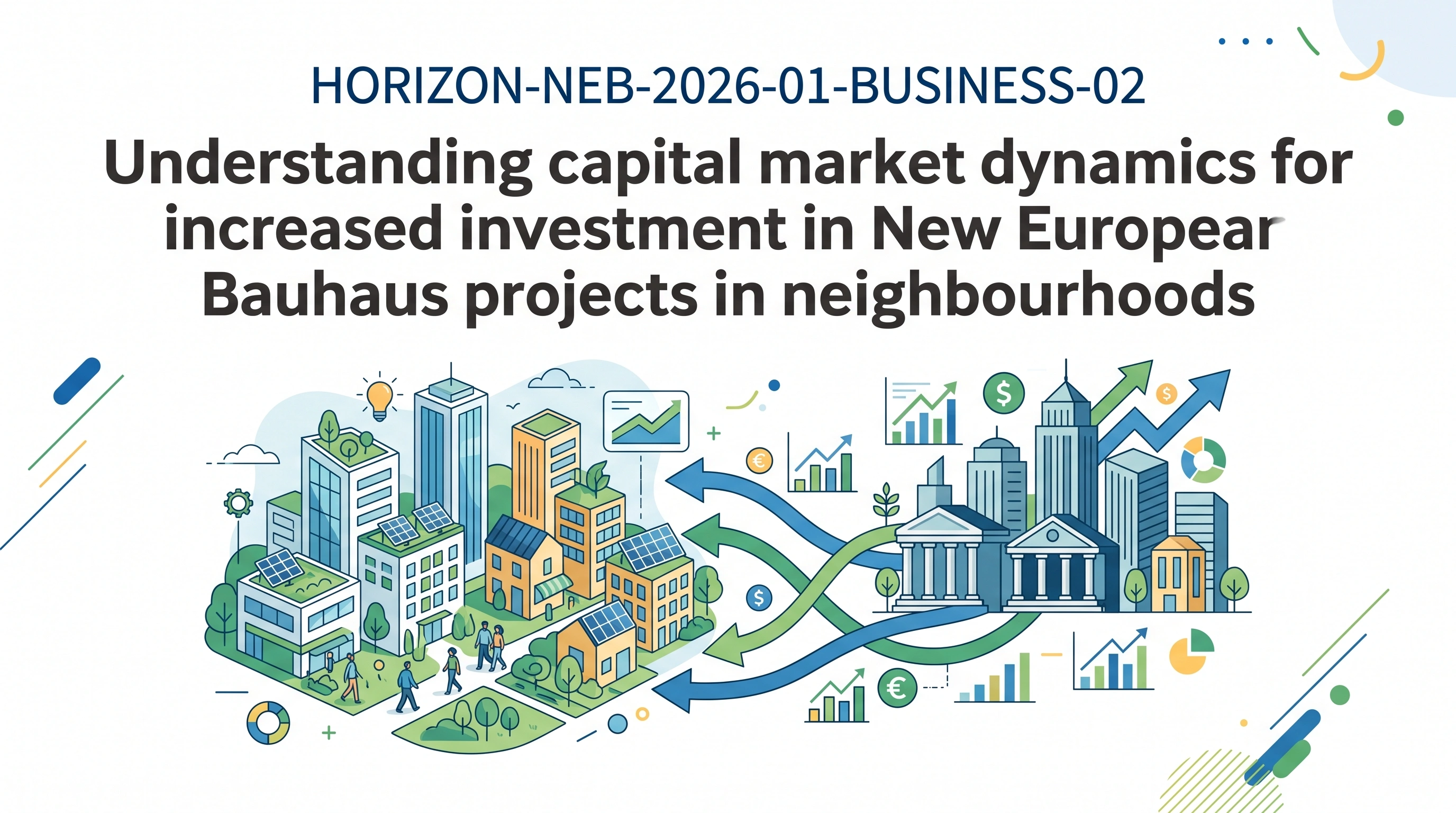
HORIZON-NEB-2026-01-BUSINESS-02: Understanding capital market dynamics for increased investment in New European Bauhaus projects in neighbourhoods
NEB-aligned neighbourhood projects are small. The funds that could finance them are large, risk-averse and short-term. The Commission wants research explaining that mismatch, then turning it into a working investment solution. Money moving, not a report on why it does not.
Download the MIC Horizon Europe 2026/2027 Calls Calendar:
Discover more!
Administrative facts: what do we know about the HORIZON-NEB-2026-01-BUSINESS-02 call?
Which call is it, and when is the opening and the deadline?
- Call name: Beautiful, inclusive and sustainable neighbourhoods for communities
- Call identifier: HORIZON-NEB-2026-01
- Destination: Innovative funding and new business models for the transformation of neighbourhoods
- Topic: HORIZON-NEB-2026-01-BUSINESS-02
- Opening: 05 May 2026
- Deadline: 01 December 2026, 17:00:00 Brussels time
- Type of action: Research and Innovation Action (RIA)
What about the budget and estimated size of the project?
- Overall call budget: EUR 101.10 million
- Topic budget: EUR 7.00 million
- Number of projects expected: 2
- Budget per project: EUR 3.50 million (7.00 divided by 2)
What are the key eligibility and evaluation conditions?
- Admissibility, eligibility, award criteria and procedure follow General Annexes A to G.
- Eligible costs take the form of a lump sum.
- Analysis and validation must cover at least three Member States and/or Associated Countries.
- At least 0.8% of the budget goes to the NEB hub for results and impact.
- Projects must build upon the New European Bauhaus Investment Guidelines.
Scientific range: what does the Commission expect from the HORIZON-NEB-2026-01-BUSINESS-02 grant?
What outcomes are expected?
Two things. Promoters, public authorities and investors should understand the demand and supply dynamics behind NEB investment far better than today. And investment into NEB-aligned neighbourhoods should rise. A well-argued study that shifts no capital is not what the Commission is after.
What is within scope?
- Size, scale and diversity of capital demand and supply, plus the barriers, risks and drivers
- The political, financial, economic, regulatory and cultural context of these investments
- Place-based impact investing, combined with other frameworks or funding schemes
- Digital financial instruments, platforms for community co-investment, blockchain-enabled transparency
- Capital to mobilise: impact funds, real estate investors, family and pension funds, philanthropists, insurers
This is a finance and governance topic. Construction and material innovation sits in the REGEN topics.
What are the specifically proposed research directions?
- Explain why small NEB projects and large funds keep missing each other. Present legislation shapes that mismatch. The work programme points at the EU Taxonomy, Fit for 55, ESF+.
- Develop one innovative investment solution. Not a catalogue of options.
- Validate how each type of capital can be mobilised, rather than assuming it can.
- Help investors assess returns across economic, social, cultural, aesthetic and environmental value.
- Deliver recommendations usable for future funding and financing decisions.
Scientific strategy: how can you enhance your chances of being funded through HORIZON-NEB-2026-01-BUSINESS-02?
What scientific choices matter most?
- Design the solution first, then build the research around it. The scope is one chain: analyse, develop, validate. Stopping at analysis costs two thirds.
- Choose your three countries for contrast, not convenience. Different property markets, different regulators, different investor cultures.
- Bring real capital into the consortium. A letter from an actual impact fund beats an advisory board.
- Aesthetic value is the hard one to measure. Say how you will do it.
- The call says “innovative investment solution” without defining it. Loose wording gives you room to frame the deliverable your way. Commit early.
- Lump sum funding means your work package structure is your payment structure. Split deliverables so partial delivery stays payable.
Consortium & proposal-writing plan: what works best with this type of call?
- Somewhere between six and ten partners, maybe a couple more if country coverage demands it. Two projects get funded. Bloated consortia read as risk.
- Core profile: finance researchers, urban economists, an investment practitioner, one city or housing agency with a live pipeline.
- Add a social scientist working on community well-being. Transdisciplinary is a requirement, not a bonus.
- An innovative SME is worth including. Fintech, impact measurement, a platform developer.
- If you already sit in a NEB-funded project, say so.
- Write the impact section against the two expected outcomes, almost word for word.
- Keep the participatory approach concrete. Who participates, when, and what changes.
How would microfluidics contribute to this topic?
Straight answer first. This call is about capital markets, not laboratory technology. Conventional research infrastructure has no natural seat here. One narrow way in exists, and it holds only if your investment solution needs real assets to test itself against.
- Small deep-tech services, say water quality monitoring built on microfluidic sensors, have the profile the call describes. Small ticket, slow payback, hard to value. The asset large funds walk away from.
- Your solution has to be validated on something. A concrete micro-asset gives your economists a real balance sheet.
- Suppose you want to show community co-investment works beyond housing stock. Local environmental monitoring is one of the few NEB-aligned services a neighbourhood can co-own.
For BUSINESS-02, microfluidics is peripheral. We would rather say that than dress it up. If your consortium wants MIC involved, the honest role is as an innovative SME bringing a small, real asset to test the investment model against.
The MIC already brings its expertise in microfluidics to Horizon Europe:
H2020-NMBP-TR-IND-2020

Microfluidic platform to study the interaction of cancer cells with lymphatic tissue
H2020-LC-GD-2020-3

Toxicology assessment of pharmaceutical products on a placenta-on-chip model

FAQ - HORIZON-NEB-2026-01-BUSINESS-02
What is HORIZON-NEB-2026-01-BUSINESS-02 actually about?
The topic funds research into why capital does not flow into small New European Bauhaus neighbourhood projects, and what would make it flow. Projects analyse capital market demand and supply, then build one innovative investment solution on top of that analysis. The end point is more investment, not a better description of the problem.
When does the call open and when is the deadline?
The call HORIZON-NEB-2026-01 opens on 05 May 2026. The deadline is 01 December 2026 at 17:00:00 Brussels local time. The work programme notes that the Director-General may open the call up to one month earlier or later, and may delay the deadline by up to two months.
How much money is on the table per project?
The topic budget is EUR 7.00 million and the Commission expects to fund 2 projects. That gives around EUR 3.50 million per project. Requesting a different amount is allowed, but the work programme frames 3.50 million as the size that addresses the outcomes appropriately.
What type of action is this topic, and what does that change?
It is a Research and Innovation Action (RIA). Funding rate and general conditions follow the Horizon Europe General Annexes A to G. In practice, an RIA here means the emphasis sits on analysis and validated solution development rather than on deploying a finished product at scale.
What does place-based impact investing mean in this call?
Place-based impact investing is the anchor approach named in the scope. It aims at risk-adjusted financial returns while producing local social, cultural, aesthetic and environmental value. The work programme encourages combining it with other frameworks, including digital financial instruments, community co-investment platforms and blockchain-based transparency mechanisms.
How many countries does the project have to cover?
At least three. Both the analysis and the validation of the developed investment solution must be carried out in at least three different Member States and/or Associated Countries. Picking contrasting property markets and regulatory environments usually strengthens the case.
Check the Funding and Tenders Portal for more information.
Is social sciences and humanities expertise mandatory for this topic?
The work programme does not attach the explicit SSH clause to this specific topic, unlike some neighbouring NEB topics. It does require a participatory and transdisciplinary approach through the integration of different actors and disciplines. Social science expertise is therefore expected in substance, even without a formal SSH requirement.
What does the lump sum funding model change for applicants?
Eligible costs take the form of a lump sum. Payment follows completion of work packages rather than reported actual costs. Build your work breakdown so that each package is self-contained and demonstrably complete, because a partially delivered package can block its whole payment.
What kind of consortium fits this topic best?
Finance researchers and urban economists at the core, an investment or real estate practitioner, and at least one city or housing agency with a real project pipeline. Add social science expertise on community well-being. An innovative SME covering fintech, impact measurement or platform development rounds out the profile.
Is microfluidics relevant to HORIZON-NEB-2026-01-BUSINESS-02?
Only marginally. This is a capital markets and governance topic, and microfluidics is peripheral to it. The one plausible route is using a small deep-tech neighbourhood service, such as microfluidic water quality monitoring, as a concrete micro-asset against which the investment solution can be validated.