
Testing soil-health solutions through regional living labs
Opening
04 February 2027
Deadline
Keywords
Mission Soil
Living labs
Soil health
Soil monitoring
Biogeographical regions
Multi-actor approach
Your microfluidic SME partner for Horizon Europe
We take care of microfluidic engineering, work on valorization and optimize the proposal with you
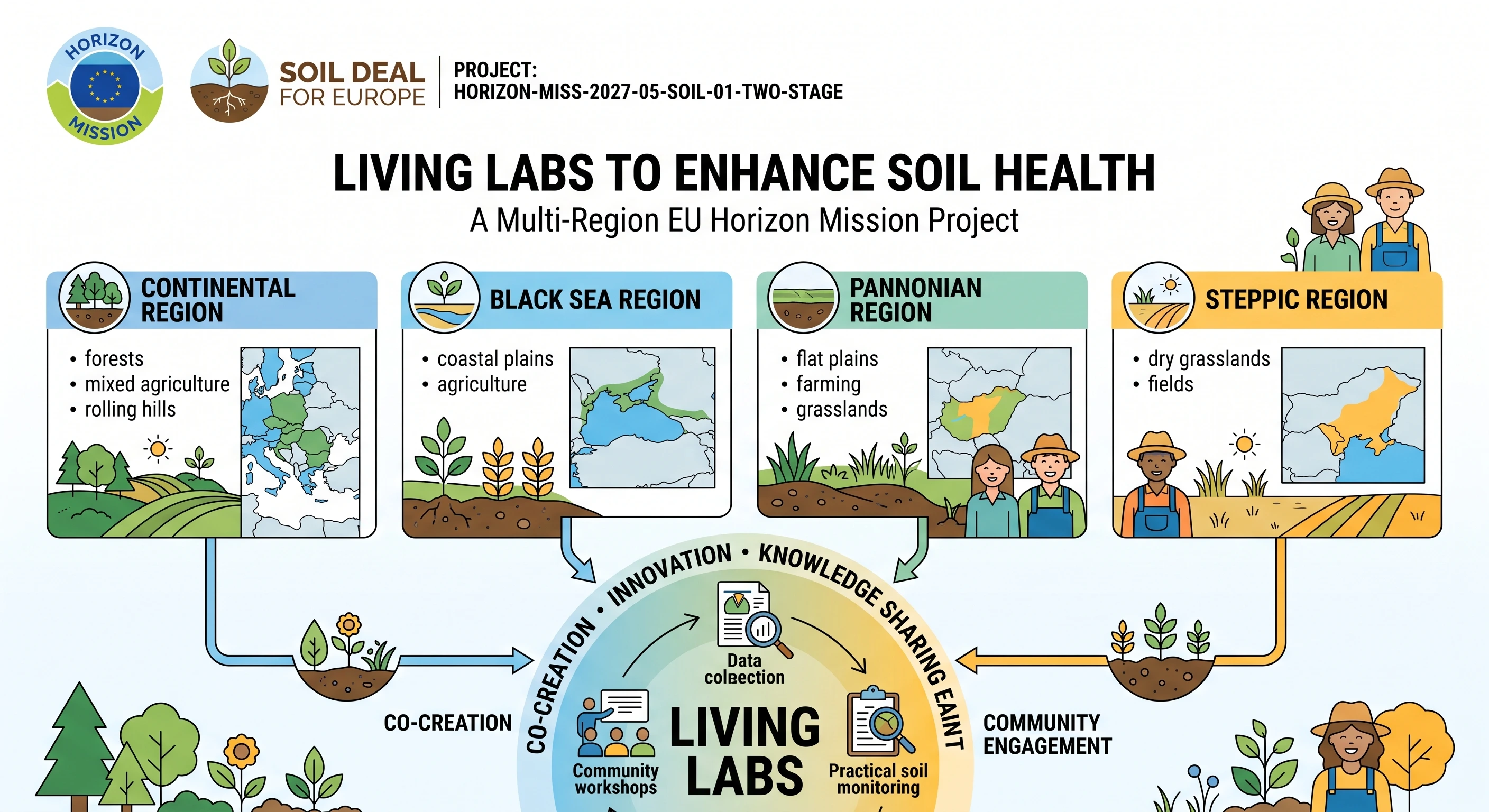
HORIZON-MISS-2027-05-SOIL-01-two-stage: Living labs to enhance soil health in Continental, Black Sea, Pannonian and Steppic biogeographical regions
Why can soil toxicity change before remediation starts?
Pollutants can change chemical form or become less accessible to organisms as they interact with soil over time. In six agricultural soils spiked with hexavalent chromium, Ao and colleagues found lower toxicity to the nematode Caenorhabditis elegans after 60 days of aging than after seven days. The soils were aged at 25 °C and 70% water-holding capacity; this was a controlled laboratory study, not a field remediation trial. [1]
For HORIZON-MISS-2027-05-SOIL-01-two-stage, this illustrates why a living lab needs both a baseline and a suitable comparison over time. Its research must connect locally tested practices to measured soil-health changes and knowledge that land managers can use.
Within the ongoing Horizon Europe project EDAPHOS, Microfluidics Innovation Center (MIC) is developing microfluidic systems with ecotoxicology partners. Their work includes a microfluidic setup for continuous exposure of C. elegans to soil leachates. For living labs addressing soil pollution, MIC could contribute the fluidic engineering for controlled laboratory bioassays, integrated with field sampling and chemical and ecological assessment.
Download the MIC Horizon Europe 2026/2027 Calls Calendar:
Discover more!
HORIZON-MISS-2027-05-SOIL-01-two-stage: Call facts, funding and evaluation
Which call is it, and when are the deadlines?
- Topic: HORIZON-MISS-2027-05-SOIL-01-two-stage — Living labs to enhance soil health in Continental, Black Sea, Pannonian and Steppic biogeographical regions. (Official page)
- Call: HORIZON-MISS-2027-05-two-stage, Supporting the implementation of the Soil Deal for Europe Mission.
- Opening: 4 February 2027.
- First stage: 8 April 2027. Second stage: 14 September 2027. Both deadlines are at 17:00 Brussels local time.
- Action: Research and Innovation Action (RIA), with an EU funding rate of up to 100% of eligible costs under the applicable rules.
The indicative topic budget is EUR 24 million. The Commission expects an EU contribution of around EUR 12 million per project, with two projects indicated. Proposals requesting different amounts remain possible.
Eligibility and evaluation
The multi-actor approach is mandatory. The general consortium minimum is three independent entities in three different EU Member States or Associated Countries, including at least one established in an EU Member State.
At the first stage, Excellence and Impact each have a 4/5 threshold; the overall threshold follows the General Annexes. At the second stage, this topic requires 12/15 overall and at least 4/5 for Excellence; the other individual thresholds remain 3/5.
The portfolio rule aims to fund at least one qualifying proposal in each of the two regional focus areas described below, subject to all thresholds. It does not establish a higher success probability for either focus.
Financial support to third parties is permitted to involve smaller actors. Support must take the form of grants of no more than EUR 60,000 per third party, through calls or, where duly justified, without a call.
A connected network of living labs with a clear regional focus
Choose and clearly state one focus: Continental, or one or more of Black Sea, Pannonian and Steppic. The majority of the proposal’s living labs must be within the chosen focus. These are biogeographical regions, not whole-country labels.
The scope calls for four to five living labs across at least three Member States and/or Associated Countries. Each normally comprises 10–20 real-life sites; fewer sites may exceptionally be proposed where the operating scale and context justify them. A living lab is a long-term collaboration among actors, rather than a single experimental plot.
Living labs should address shared soil-health challenges and complement the existing Mission Soil network. Relevant land uses include agricultural, urban, peri-urban, post-industrial, forest and semi-natural areas. Projects should contribute to all four expected outcomes:
- Stronger participatory and interdisciplinary capacity to create and implement economically viable solutions.
- Better monitoring and more high-quality, standardised local and regional soil data.
- Practice-oriented knowledge that improves adoption by land managers and users.
- Better-informed policies that reflect local needs and the economic sustainability of solutions.
Proposals in which all living labs address soil-management practices to reduce eutrophication within a specific river catchment are excluded: that configuration belongs under SOIL-02-two-stage.
Build evidence of change and a route to lasting use
Establish a soil-condition baseline for each living lab and monitor changes across its sites, including associated ecosystem services. Use the soil-health indicator framework identified in the Missions work programme, with additional indicators tailored to the challenge, land use and local conditions.
The work programme refers to the proposed Soil Monitoring and Resilience Directive. The Soil Monitoring Law has since entered into force; distinguish the topic’s monitoring expectations from legal implementation requirements.
For the research design, agree sampling depth, timing, spatial coverage, handling and analytical protocols before comparing sites. Use appropriate reference conditions and replication to distinguish an intervention from background changes. In pollution studies, Ao and colleagues’ findings on aging illustrate why elapsed time and soil properties belong in that comparison. [1]
Assess technical, social, economic, cultural and environmental viability, alongside scalability and transferability. Explain what counts as a useful improvement for land managers, who bears implementation costs and which conditions limit adoption.
Identify high-performing sites that could become lighthouses for demonstration, training and communication, working with SOILL on their development and possible labelling. A lighthouse can be within or outside a living lab.
Match project duration to the time needed for participation and soil processes. Plan how the living labs will continue through governance arrangements, business models and a credible mix of public or private funding beyond the grant.
Organise co-creation, shared data and collaboration
For HORIZON-MISS-2027-05-SOIL-01-two-stage, bring together the actors needed for the selected challenge: soil scientists, land managers and owners, advisers, relevant businesses, public authorities and civil society. Describe their capabilities, responsibilities and resources. The multi-actor approach requires active involvement from problem definition through implementation and use of results.
An effective contribution from social sciences, humanities and the arts is expected to support social innovation, knowledge transfer and behavioural and cultural change. Choose participation routes suited to each actor, including beneficiaries, associated partners, in-kind contributors or recipients of third-party support where appropriate.
Allocate dedicated tasks and appropriate resources for collaboration with SOILL, the support structure for soil-health living labs and lighthouses, and with relevant projects and Mission Soil clustering activities. Build on existing monitoring data and research rather than duplicating previous work.
Work with the European Union Soil Observatory (EUSO) and SoilWise on the accessibility, longevity and interoperability of outputs. Relevant data, maps and information should be capable of public availability through EUSO. Make data FAIR: Findable, Accessible, Interoperable and Reusable.
Turn results into practical materials for the channels land users consult. Results within the common agricultural policy remit must be summarised in practice abstracts using the common European Innovation Partnership for Agricultural Productivity and Sustainability format. Seek equivalent European-level dissemination for other areas.
Microfluidic engineering for pollution-focused living labs
For living labs evaluating soil-pollution solutions, a defined biological-effects assay can complement chemical measurements and field observations. The useful engineering task is to control sample delivery and exposure conditions so that ecotoxicologists can compare responses to relevant site samples.
In EDAPHOS, MIC is developing a lab-on-a-chip approach with partners who provide ecotoxicological methods. The team constructed a microfluidic setup and established a protocol to assess growth inhibition in C. elegans continuously exposed to soil leachates. MIC is also developing the Caterpillar pressure pump within the EDAPHOS microfluidic system to support parallel exposure experiments.
For this topic, MIC could tailor fluid delivery, routing and exposure conditions to the partners’ selected assay. Proposed outputs could include a fluidic module, an operating procedure and characterisation data on flow stability, liquid exchange and reproducibility. Ecotoxicology partners would define the biological endpoint and controls; soil teams would supply representative samples and connect results to the practices tested in the living labs.
Validate the complete workflow: sample preparation, material compatibility, exposure, biological readout and comparison with an appropriate laboratory method. A leachate assay addresses the fraction transferred into the test liquid; it does not reproduce every exposure route in intact soil or measure overall soil health. Field monitoring remains necessary to establish the effect of the intervention at site scale.
The MIC already brings its expertise in microfluidics to Horizon Europe:
H2020-NMBP-TR-IND-2020

Microfluidic platform to study the interaction of cancer cells with lymphatic tissue
H2020-LC-GD-2020-3

Toxicology assessment of pharmaceutical products on a placenta-on-chip model

About the author

Céleste Chidiac, PhD
Scientific writer and digital marketing specialist
Céleste Chidiac holds a doctorate in neuroscience and molecular biology from the University of Strasbourg. Since joining the Microfluidics Innovation Center in 2023, she has combined scientific writing with website management. For MIC’s Horizon Europe topic pages, she draws on her research background to explain scientific challenges and clarify funding priorities. Her writing helps prospective applicants understand each topic’s scope, expected outcomes and research directions.
FAQ - HORIZON-MISS-2027-05-SOIL-01-two-stage: Soil bioassays and evidence from living labs
Practical questions about interpreting biological responses, comparing samples and turning experimental results into usable knowledge.
Is a soil leachate assay equivalent to testing intact soil?
No. A leachate assay examines the material transferred into a liquid by a defined preparation procedure. An intact-soil test also involves contact with the soil matrix. Choose the exposure route that answers the research question and report the extraction and handling conditions.
Does a biological response identify the pollutant responsible?
No. Reduced growth or reproduction indicates an effect under the test conditions. Identifying its cause requires chemical measurements and suitable controls. For mixed contamination, avoid assigning the response to one substance solely because that substance was detected.
Why can growth and reproduction give different conclusions?
They measure different biological functions and can differ in sensitivity. In Ao and colleagues’ chromium-spiked soils, reproduction was generally more sensitive than growth after seven days of aging. That result concerns their organism, soils and exposure protocol, rather than a universal ranking. [1]
Can one nematode assay represent all soil biodiversity?
No. A response in one test species is one line of evidence. Select additional organisms, community measurements or ecological observations according to the soil-health question. Define what each endpoint can establish before combining the results.
Does miniaturisation guarantee a faster or cheaper test?
No. Compare the complete workflow, including extraction, organism preparation, exposure, imaging, quality checks and interpretation. A smaller test volume does not by itself shorten the biological response time or establish a lower cost per valid result.
What does MIC contribute to an ecotoxicological experiment?
MIC contributes microfluidic engineering: fluid delivery, routing and the conditions around the assay. Its work in EDAPHOS connects that engineering with partners’ ecotoxicological methods. Assay selection and biological interpretation need the appropriate scientific expertise.
What should be checked when a leachate changes the control response?
Check preparation and matrix effects before attributing the change to pollution. Include suitable controls for the extraction liquid, pH, food supply and handling. Investigate whether the fluidic setup changes the exposure delivered to the organisms.
How can two laboratories check that their results are comparable?
Use shared samples or reference materials, aligned protocols, common controls and agreed reporting criteria. Compare variability and systematic differences before pooling results. Record instrument settings and protocol versions so differences can be investigated.
What should accompany a soil-bioassay result in a shared dataset?
Include the sample identifier, location at an appropriate reporting resolution, land use, sampling date and depth, preparation method, organism and endpoint, exposure conditions, controls and quality flags. Preserve the connection to the intervention and the comparison sample.
How should an inconclusive result be shared with land managers?
Explain what was tested, what remains uncertain and which decision the evidence can support. Describe a justified next step, such as further sampling or a complementary measurement. Do not turn an absence of a clear response into proof that the soil is healthy.
References
[1] Ao, Xiang; Dang, Xiuli; Zhao, Long; Mai, Caiting; Bao, Mengmeng; Geng, Fengzhuo; Bol, Roland; Lynch, Iseult. Soil Properties and Aging Processes Regulate Cr(VI) Toxicity to Caenorhabditis elegans. Agriculture. 2026;16(2):275. https://doi.org/10.3390/agriculture16020275