Tips & Tricks for a successful HORIZON-HLTH-2027-02-DISEASE-01-two-stage proposal
Opening
10 February 2027
Deadline
Keywords
early detection
NCDs
prevention
clinical trials
organ-on-chip
digital health
sex and gender
Your microfluidic SME partner for Horizon Europe
We take care of microfluidic engineering, work on valorization and optimize the proposal with you
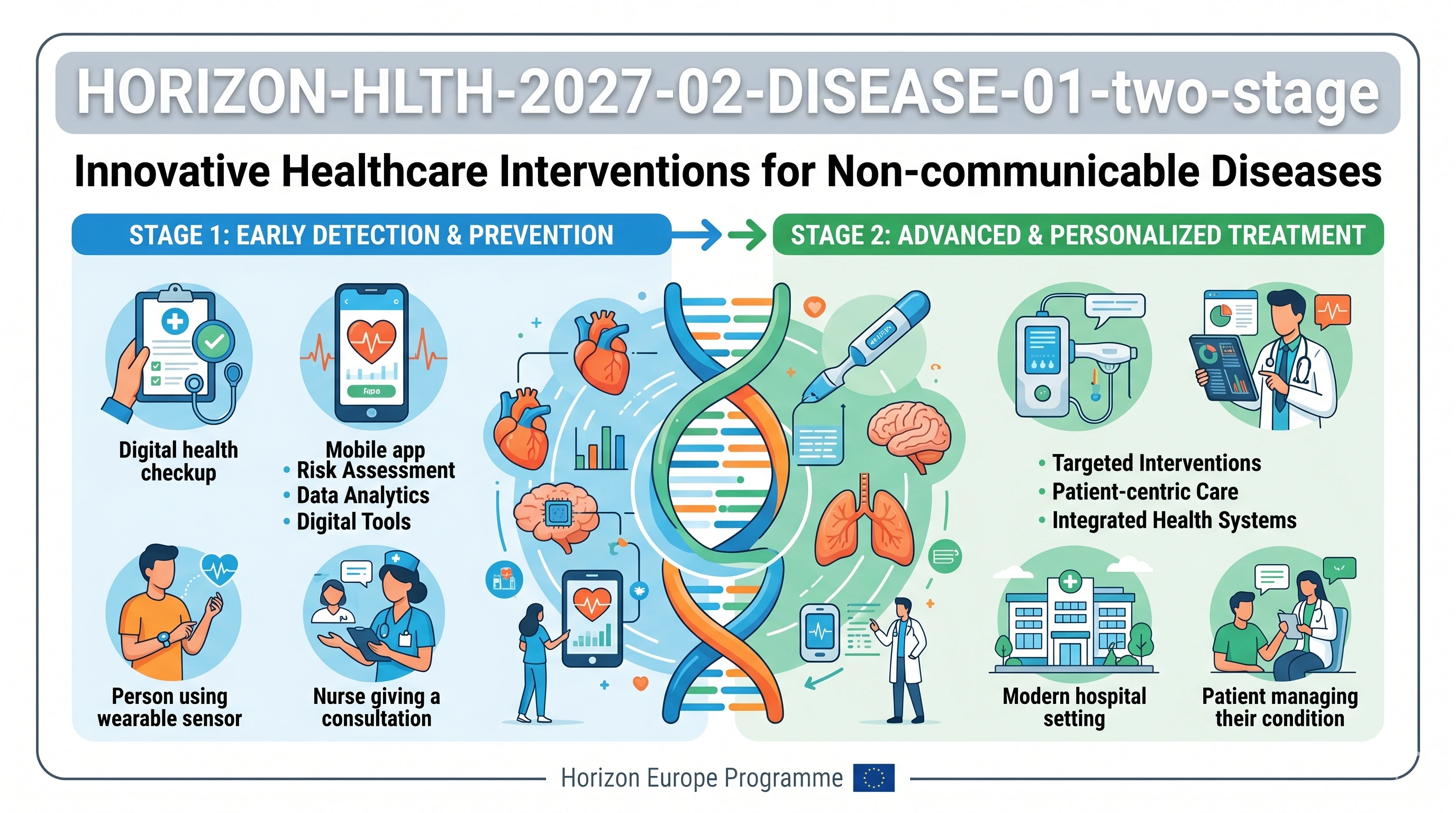
HORIZON-HLTH-2027-02-DISEASE-01-two-stage: Innovative healthcare interventions for non-communicable diseases
Non-communicable diseases account for over 80% of the disease burden in Europe. The Commission is not after basic research here. What it wants is clinical-stage validation of interventions that are ready to move forward, specifically for cardiovascular disease, diabetes, chronic respiratory disease, or chronic kidney disease. The two-stage format signals that the Commission expects a serious level of readiness before you even submit the first stage. This is a well-funded call, and competition will reflect that.
Download the MIC Horizon Europe 2026/2027 Calls Calendar:
Discover more!
Administrative facts: what do we know about the HORIZON-HLTH-2027-02-DISEASE-01-two-stage call?
Which call is it, and when are the opening and the deadline?
- Call name: Cluster 1 – Health (Two-stage – 2027)
- Call identifier: HORIZON-HLTH-2027-02-two-stage
- Destination: Tackling diseases and reducing disease burden
- Topic: HORIZON-HLTH-2027-02-DISEASE-01-two-stage
- Opening date: 10 February 2027
- First stage deadline: 13 April 2027 (proposals evaluated blindly)
- Second stage deadline: 22 September 2027
- Type of action: RIA (Research and Innovation Action)
What about the budget and estimated size of the project?
- Total indicative topic budget: EUR 63.80 million
- Expected EU contribution per project: EUR 7.00 to 8.00 million
- Indicative number of funded projects: 8
- Eligible costs take the form of a lump sum contribution.
What are the key eligibility and evaluation conditions?
- Standard admissibility and eligibility conditions apply (General Annexes A and B)
- Legal entities established in China are not eligible to participate.
- Both preclinical research and the draft clinical trial protocol must be completed at the time of submission.
- Evidence of preliminary consultations with ethics and regulatory authorities is required at submission
- Clinical studies template required at the second stage (strongly encouraged)
- The granting authority may object to the transfer of ownership or exclusive licensing of results up to 4 years after the end of the action.
- No JRC or clustering conditions specified for this topic
Scientific range: what does the Commission expect from the HORIZON-HLTH-2027-02-DISEASE-01-two-stage grant?
What outcomes are expected?
The Commission wants projects that arrive at clinical validation of genuinely new or refined healthcare interventions for a specific NCD. This is not about generating knowledge for its own sake. By the time the grant ends, you should have a validated trial, real-world data supporting scalability, and a clear pathway for widespread implementation. Clinicians, policymakers, and patient organizations are all listed as recipients of the results.
What is within scope?
The topic is deliberately narrow in disease areas. Only these four qualify:
- Cardiovascular diseases
- Diabetes
- Chronic respiratory diseases
- Chronic kidney diseases
Co- and multimorbidities should be addressed in the trial design where relevant. Digital technologies, including AI and wearables, are within scope, as are virtual human twins. Basic research, prevention studies, and work on other NCD categories are not what the Commission is after here.
- Sex and gender differences must be integrated throughout, not added as an afterthought.
- FAIR data principles apply to all databases and data-sharing activities
- Social sciences and humanities expertise must be meaningfully involved.
What are the specifically proposed research directions?
The work program is quite specific. These are the directions it points toward:
- Rigorous early-stage clinical trial(s) validating novel or refined healthcare interventions for one or more of the four eligible NCD areas.
- Use of digital tools (generative AI, wearables, unobtrusive home monitoring technologies) to implement and track long-term efficacy
- Integration of sex, gender, age, disability, racial and ethnic origin, and socioeconomic factors into trial design and stratification.
- Health-economic assessment and real-world data analysis to demonstrate scalability and sustainability beyond the grant period.
- Active engagement with national regulators and public health authorities throughout the project.
- Patient and caregiver involvement from the start, not as a dissemination afterthought.
Scientific strategy: how can you enhance your chances of being funded through HORIZON-HLTH-2027-02-DISEASE-01-two-stage?
What scientific choices matter most?
- Come trial-ready. The work program states that preclinical research and a draft clinical trial protocol must be available at submission. This one catches people off guard: if you are planning to run preclinical work during the project, you are already too early for this call.
- Choose your NCD disease area carefully. Four options, and you need a compelling case for why your intervention represents a meaningful advance in clinical practice for that specific disease. A generic “chronic disease” framing won’t work.
- Build the digital monitoring layer from the start. AI-assisted patient monitoring, wearable integration, home-based follow-up: the Commission sees these as part of the intervention design, not add-ons. Proposals that treat digital tools as optional will look outdated.
- Integrate sex and gender genuinely. Stratification by biological sex is a hard requirement, not a checkbox. We’d argue that reviewers can tell the difference between a gender analysis planned from the beginning and one retrofitted into an otherwise neutral design.
- Engage regulators early and visibly. The call explicitly asks for preliminary regulatory consultations at submission. This is not common in basic research calls, so it distinguishes serious proposals from speculative ones.
- Frame everything around clinical impact and disease burden reduction. The call is innovative and effective. In practice, what evaluators respond to is: will this reach patients and reduce the burden on healthcare systems? That framing should run through every section of your proposal.
Consortium & proposal-writing plan: what works best with this type of call?
- A consortium of 8 to 12 partners probably makes sense here, maybe a couple more if your trial spans multiple countries or requires specific clinical sites.
- Clinical partners are non-negotiable. You need hospital networks, clinical research centers, or university hospitals with active trial capacity. A proposal without a credible clinical execution infrastructure won’t pass the feasibility check.
- Include a regulatory science specialist or at least a partner with demonstrated experience in regulatory interactions in the relevant NCD area. The call asks for evidence of preliminary regulatory consultations.
- Patient organizations should be consortium members, not just stakeholders mentioned in the dissemination plan. The work program is specific about the need for constructive patient and caregiver engagement throughout.
- An innovative SME can deliver real value here, especially if they offer digital health technologies, monitoring devices, or data management solutions. SME participation is explicitly encouraged.
- SSH partners with expertise in health economics, behavioral science, or implementation science are required. Don’t treat this as a formality.
- If you go to the second stage, your clinical studies template must be complete. Plan the workload for that early.
- Regarding proposal writing, the blind first-stage evaluation is worth considering. The Commission evaluates first-stage proposals without knowing who you are. Your science and your intervention must stand on their own. Don’t rely on your consortium’s reputation to carry a weak scientific case.
How would microfluidics contribute to this topic?
Conventional clinical trial tools don’t always give you the resolution you need. When you’re tracking disease progression in cardiovascular disease or diabetes across dozens of patients over years, you need monitoring that is precise, frequent, and ideally unobtrusive. Standard lab assays are slow. Animal models don’t translate well to the clinical setting. That’s where organ-on-chip and microfluidic platforms come in.
- Say you want to test whether your intervention actually changes what’s happening at the vessel wall in diabetic nephropathy. A kidney-on-a-chip lets you run that experiment with human cells under controlled conditions before you commit to a full clinical arm. That’s preliminary efficacy data your proposal can use.
- Microfluidic biosensors can be embedded in wearable or point-of-care devices for real-time biomarker monitoring. Blood pressure is not enough for chronic respiratory disease. You want inflammatory markers, metabolic indicators, maybe exhaled breath analysis. Miniaturized sensors built on microfluidic principles get you there without repeated hospital visits.
- Your consortium would benefit from a microfluidics partner who can develop patient-specific in vitro models of your target NCD. Cardiovascular-on-chip, lung-on-chip, and gut-on-chip models can support mechanistic work alongside your clinical trial without requiring additional animal studies.
- And because sex-specific biology matters enormously in all four eligible disease areas, microfluidic models can be set up with male and female cell lines to test differential responses to your intervention directly. You get cause and effect, not just correlation.
For coordinators building a proposal under this call, the Microfluidics Innovation Center has experience designing organ-on-chip and biosensor platforms for chronic disease applications. Bringing that capacity into a consortium strengthens both the proposal’s preclinical readiness and the digital monitoring component the Commission specifically requests.
The MIC already brings its expertise in microfluidics to Horizon Europe:
H2020-NMBP-TR-IND-2020

Microfluidic platform to study the interaction of cancer cells with lymphatic tissue
H2020-LC-GD-2020-3
Toxicology assessment of pharmaceutical products on a placenta-on-chip model

FAQ – HORIZON-HLTH-2027-02-DISEASE-01-two-stage
What is HORIZON-HLTH-2027-02-DISEASE-01-two-stage actually about?
The HORIZON-HLTH-2027-02-DISEASE-01-two-stage topic seeks clinical validation of new or improved health care interventions for one of four non-communicable diseases (NCDs): cardiovascular disease, diabetes, chronic respiratory disease or chronic kidney disease. The Commission isn’t looking for basic research. It wants proposals with the preclinical research already done and a draft clinical trial protocol ready to go at the time of submission.
Which diseases are eligible under this call?
The call is for cardiovascular diseases, diabetes, chronic respiratory diseases or chronic kidney diseases. The trial design can account for comorbidities and multimorbidities. Anything other than these four NCDs is off the table. An overarching “chronic disease” approach will not work. Check the Funding and Tenders Portal for more information.
How much funding is available and how many projects will be funded?
The indicative budget is EUR 63.80 million with roughly 8 projects funded. The size of the projects should be around EUR 7.00 to 8.00 million. Projects are funded with a lump-sum contribution, which makes it easier to track expenses but requires careful cost prediction during the proposal.
What does the two-stage format mean in practice?
The first stage closes on 13 April 2027, and is reviewed anonymously (your consortium name is blinded). The science needs to be good. The second stage closes on 22 September 2027, and includes a full clinical studies template. Expect to work hard at the second stage.
Why does the Commission insist on preclinical work being complete at submission?
It’s a clinical-stage call. The work program requires preclinical work and a draft clinical trial protocol at submission. If you intend to do preclinical work during the project, it’s too soon. The Commission is looking for interventions that are ready for the trial, not ideas to be fleshed out.
How seriously should we take the sex and gender requirement?
Very seriously. Biological sex-based stratification is a must, not an option. The consideration must be reflected in the design, recruitment and analysis. You can see when the gender analysis is planned before the trial starts, and when it is shoe-horned into a gender-neutral trial.
What role can microfluidics play in an NCD clinical trial proposal?
Microfluidics delivers preliminary efficacy results, patient-specific in vitro models (kidney-on-chip, lung-on-chip, cardiovascular-on-chip), and biosensors for unobtrusive, real-time biomarker monitoring. It allows sex-specific biology testing (male and female cell lines). All this boosts the reading, especially for preclinical trials and the digital monitoring layer requested by the Commission.
Who needs to be in the consortium for this call?
8-12 partners is a good number, include more if your trial is multi-site. You definitely need clinical partners with trial capacity. Include a regulatory science expert, full partner patient organizations, an innovative SME on the digital health front, and SSH partners for health economics or implementation science. A microfluidics partner is optional for the preclinical and biosensor aspects.
What is the role of patient organizations and SSH partners?
Patient organizations need to be partners, not “trailing partners” in the dissemination plan. The work program includes specific engagement throughout the project. SSH partners with experience in health economics, behavioral science, or implementation science. Don’t treat either of these as a “box-ticking” exercise.
What pitfalls usually sink RIA proposals at this clinical stage?
A few recurring ones. Researchers are being too far upstream (preclinical, not complete). Too much disease agnosticism (non-specific of the four NCDs). Viewing digital monitoring as a “nice-to-have”. Adding sex and gender analysis at the end. Failure to start early with regulators. And misestimating the extent to which the science alone is weighed in the blind first-stage.